

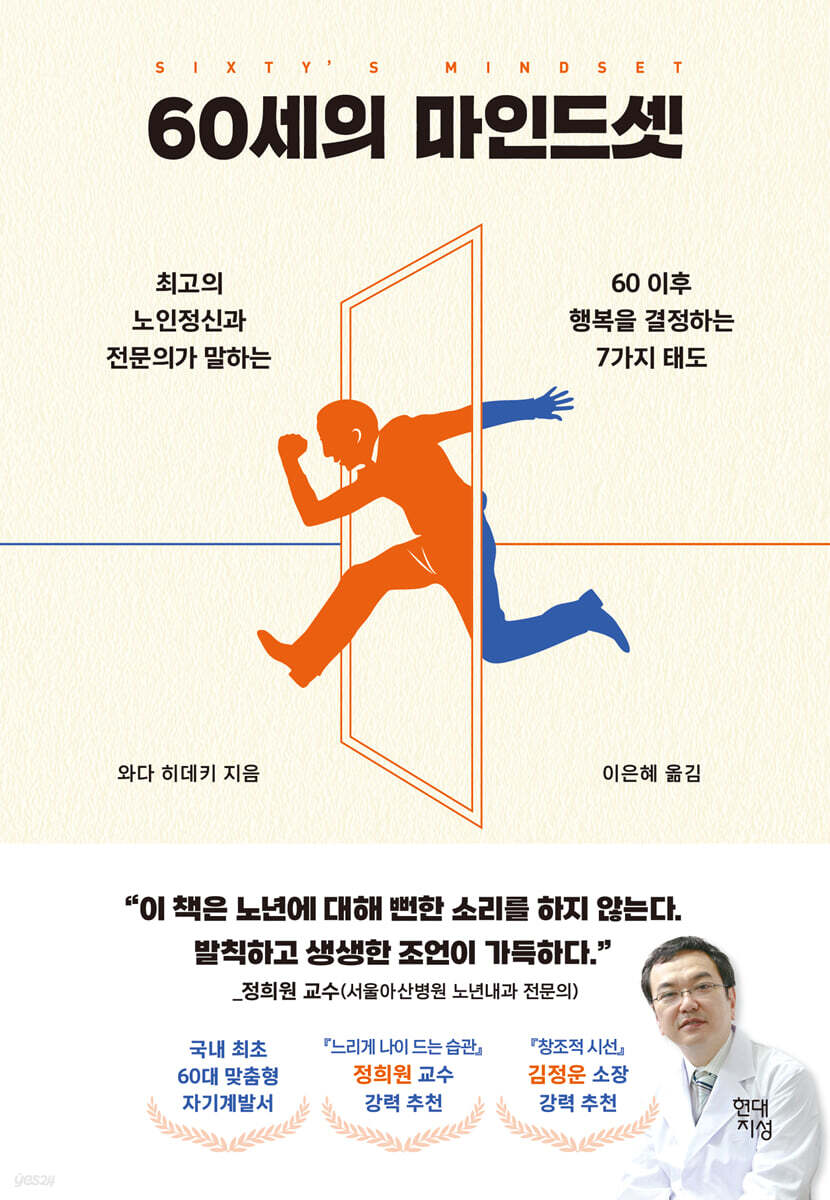
60-year-old mindset
 |
Description
Book Introduction
People who are happier as they age have a different mindset.
“A truly successful life is one in which you enjoy your old age!”
“This book doesn’t talk about old age and aging in abstract and cliche terms.
“It’s full of bold and vivid advice!”
Jeong Hee-won | Author of "Slow Aging Habits," Geriatrics Specialist, Seoul Asan Medical Center
-Korea's first self-development book tailored to people in their 60s!
- Highly recommended by Professor Jeong Hee-won of the Department of Geriatrics at Seoul Asan Medical Center and Director Kim Jeong-un, a cultural psychologist!
- A new work by bestselling author Hideki Wada, with cumulative sales exceeding 700,000 copies!
60 years old, in the past, was an age when people retired from the front lines of society, celebrated their 60th birthday, and were called "elderly people," but now, no one in their 60s thinks of themselves as elderly.
Thanks to advances in medical technology, average life expectancy has increased dramatically, and the era of longevity is approaching.
As life expectancy increases, people in their 60s today are at an age where they feel both the liberation that comes with retirement and the anxiety about the rest of their lives.
Hideki Wada, Japan's leading geriatric psychiatrist, has spent the past 30 years caring for elderly patients, observing what they most regret after turning 60 and how to live well for the next 40 years.
He realized that simply changing one's mindset can significantly change one's life in old age, and he summarized the '7 Commandments of Mindset' that one should prepare for at age 60 and introduced them in this book.
Hideki Wada strongly argues that, above all, we should enjoy life by breaking free from the habit of being tied down by and concerned about the opinions of others.
Because if you just suppress it, the rest of your life will not be happy.
He offers some counterintuitive and vivid advice on how to enjoy life, such as going out and spending money on things you want to do, not leaving your children an inheritance, and skipping health checkups.
While these tips may sound contradictory at first, they are proven tips that can help you stay healthy longer by slowing the aging of your frontal lobe, maintaining your daily vitality, avoiding the burden of worrying about your children, and avoiding unnecessary dieting or polypharmacy.
This book also contains a wealth of knowledge and know-how on welfare and pension systems in our neighboring country, Japan, which experienced an aging population earlier than ours.
This book will not only provide practical and clear answers to those in their 60s who are past the middle of their lives and wondering how to live their lives from now on, but also to those in their late 40s and 50s who are starting to think about their senior life, and will also instill hope and courage in them to live their remaining time more enjoyably.
As you approach your 60s, a completely different life will unfold if you change your mindset.
The best moments of your life are yet to come!
“A truly successful life is one in which you enjoy your old age!”
“This book doesn’t talk about old age and aging in abstract and cliche terms.
“It’s full of bold and vivid advice!”
Jeong Hee-won | Author of "Slow Aging Habits," Geriatrics Specialist, Seoul Asan Medical Center
-Korea's first self-development book tailored to people in their 60s!
- Highly recommended by Professor Jeong Hee-won of the Department of Geriatrics at Seoul Asan Medical Center and Director Kim Jeong-un, a cultural psychologist!
- A new work by bestselling author Hideki Wada, with cumulative sales exceeding 700,000 copies!
60 years old, in the past, was an age when people retired from the front lines of society, celebrated their 60th birthday, and were called "elderly people," but now, no one in their 60s thinks of themselves as elderly.
Thanks to advances in medical technology, average life expectancy has increased dramatically, and the era of longevity is approaching.
As life expectancy increases, people in their 60s today are at an age where they feel both the liberation that comes with retirement and the anxiety about the rest of their lives.
Hideki Wada, Japan's leading geriatric psychiatrist, has spent the past 30 years caring for elderly patients, observing what they most regret after turning 60 and how to live well for the next 40 years.
He realized that simply changing one's mindset can significantly change one's life in old age, and he summarized the '7 Commandments of Mindset' that one should prepare for at age 60 and introduced them in this book.
Hideki Wada strongly argues that, above all, we should enjoy life by breaking free from the habit of being tied down by and concerned about the opinions of others.
Because if you just suppress it, the rest of your life will not be happy.
He offers some counterintuitive and vivid advice on how to enjoy life, such as going out and spending money on things you want to do, not leaving your children an inheritance, and skipping health checkups.
While these tips may sound contradictory at first, they are proven tips that can help you stay healthy longer by slowing the aging of your frontal lobe, maintaining your daily vitality, avoiding the burden of worrying about your children, and avoiding unnecessary dieting or polypharmacy.
This book also contains a wealth of knowledge and know-how on welfare and pension systems in our neighboring country, Japan, which experienced an aging population earlier than ours.
This book will not only provide practical and clear answers to those in their 60s who are past the middle of their lives and wondering how to live their lives from now on, but also to those in their late 40s and 50s who are starting to think about their senior life, and will also instill hope and courage in them to live their remaining time more enjoyably.
As you approach your 60s, a completely different life will unfold if you change your mindset.
The best moments of your life are yet to come!
- You can preview some of the book's contents.
Preview
index
Recommendation
Entering your 60s? Reset your mindset!
Chapter 1: Happiness and Health Follow When You Spend Generously
If you don't want to have regrets at the end of your life
Money shines brighter in your wallet than in your bank account.
If you're anxious, prepare in advance.
Spend money and play to get healthy
Would it really be good to go to a luxury nursing home?
The Dankai Generation, a Key Player in the Consumer Market
Social roles and rights have no age limit.
People in their 60s are the hope of the domestic economy.
The ever-growing wealth of seniors
Saving money that you can't even spend
Work to spend your money freely
Lunch outside
A solitary gourmet is not lonely
They say that even ghosts that have eaten and died are pretty.
Preparing for old age is through social insurance and pension.
Spend all your money before you turn 80.
A home and housing pension that will support you throughout your life
Chapter 2: How to Become Independent from Your Spouse and Children
Parents' hearts, children's hearts
You can't take responsibility for your child's life.
Is it really necessary to pass down property?
The problems that legacy brings
Get care from a caregiver, not your child.
Sometimes it's okay to expect things from your children.
Let's put down the burden on our hearts
Twilight Divorce vs. Cohabitation-Based Divorce
Marital compatibility becomes more important after 60
Wives going out and husbands retiring
Play separately from your spouse until you're eighty.
Even couples need rules
Hobbies and passions have no age or gender.
A hundred-year marriage or second marriage
Chapter 3: Health Checkups Don't Take Responsibility for Your Health
Observe changes in your body and condition
As we age, we live with illness.
Doctors and patients are not in a superior-subordinate relationship.
How to avoid appearing like an easy or easy patient
Let's know my condition accurately and convey it.
Correcting health common sense
Cancer, what is the best treatment?
How to Be Positive About Cancer
Why You Shouldn't Get a Cancer Screening
There's no need to obsess over health checkups.
To avoid going to the wrong hospital
If you lack energy, stop taking your medication first.
The best way to stay healthy is to be comfortable and happy.
When you feel unmotivated, try hormone therapy.
Why You Should Eat More Meat
People who are slightly chubby live longer.
I'm at an age where I don't even need to quit smoking
GI Index and Healthy Drinking
Chapter 4: A Time to Find What You Love and Enjoy Life to the Fullest
He who does not work shall not eat?
There is nothing that must be done
Let's start with small and trivial things
Express your thoughts confidently
The joy of learning lasts a lifetime.
Say goodbye to a life of just enduring
6 Things You'll Regret Later in Life
In my 70s, I finally became the protagonist of my own life.
Habits that protect you from aging
Finding fun things to do after retirement
An age where I can live as I please
Coming out and the 7 commandments of a 60-year-old's mindset
Author's Note
Entering your 60s? Reset your mindset!
Chapter 1: Happiness and Health Follow When You Spend Generously
If you don't want to have regrets at the end of your life
Money shines brighter in your wallet than in your bank account.
If you're anxious, prepare in advance.
Spend money and play to get healthy
Would it really be good to go to a luxury nursing home?
The Dankai Generation, a Key Player in the Consumer Market
Social roles and rights have no age limit.
People in their 60s are the hope of the domestic economy.
The ever-growing wealth of seniors
Saving money that you can't even spend
Work to spend your money freely
Lunch outside
A solitary gourmet is not lonely
They say that even ghosts that have eaten and died are pretty.
Preparing for old age is through social insurance and pension.
Spend all your money before you turn 80.
A home and housing pension that will support you throughout your life
Chapter 2: How to Become Independent from Your Spouse and Children
Parents' hearts, children's hearts
You can't take responsibility for your child's life.
Is it really necessary to pass down property?
The problems that legacy brings
Get care from a caregiver, not your child.
Sometimes it's okay to expect things from your children.
Let's put down the burden on our hearts
Twilight Divorce vs. Cohabitation-Based Divorce
Marital compatibility becomes more important after 60
Wives going out and husbands retiring
Play separately from your spouse until you're eighty.
Even couples need rules
Hobbies and passions have no age or gender.
A hundred-year marriage or second marriage
Chapter 3: Health Checkups Don't Take Responsibility for Your Health
Observe changes in your body and condition
As we age, we live with illness.
Doctors and patients are not in a superior-subordinate relationship.
How to avoid appearing like an easy or easy patient
Let's know my condition accurately and convey it.
Correcting health common sense
Cancer, what is the best treatment?
How to Be Positive About Cancer
Why You Shouldn't Get a Cancer Screening
There's no need to obsess over health checkups.
To avoid going to the wrong hospital
If you lack energy, stop taking your medication first.
The best way to stay healthy is to be comfortable and happy.
When you feel unmotivated, try hormone therapy.
Why You Should Eat More Meat
People who are slightly chubby live longer.
I'm at an age where I don't even need to quit smoking
GI Index and Healthy Drinking
Chapter 4: A Time to Find What You Love and Enjoy Life to the Fullest
He who does not work shall not eat?
There is nothing that must be done
Let's start with small and trivial things
Express your thoughts confidently
The joy of learning lasts a lifetime.
Say goodbye to a life of just enduring
6 Things You'll Regret Later in Life
In my 70s, I finally became the protagonist of my own life.
Habits that protect you from aging
Finding fun things to do after retirement
An age where I can live as I please
Coming out and the 7 commandments of a 60-year-old's mindset
Author's Note
Detailed image
.jpg)
Into the book
A turning point in life doesn't come suddenly one day if you wait for it.
The turning point is right now, when I turn 60.
Changing your mindset at age 60 will allow you to live a free and energetic life in your 70s, and only then will you be able to maintain your curiosity and activity level and build relationships with diverse people in your 80s.
In other words, how you spend your 60s after retirement will determine the rest of your life.
--- p.17, from "Introduction: Are You in Your 60s? Reset Your Mind!"
As time passes, all that remains are memories.
Before you die, don't have regrets like, "I should have eaten a lot of delicious food," "I wanted to travel around the world," or "I should have bought a sports car with my retirement money." If there's something you want to do, don't hesitate and do it right now.
We need to let go of the frugal mindset we have maintained so far and live with a new mindset.
Money is not meant to be kept in a bank account, but rather in a wallet to be spent freely.
I become happy when I write.
There is no point in diligently saving up money that you will never use, and if the act of saving itself becomes the goal, it will only lead to obsession and become the seed of unhappiness.
--- p.
35, from “Chapter 1: Happiness and Health Follow When You Spend Without Sparing”
If people in their 60s actively spend money and enjoy leisure activities, and voice their opinions, saying, "It would be so convenient if there were a service like this," or "If a product like that were available, I would definitely buy it," wouldn't this lead to the development of relevant products and services, and a surge in businesses targeting older generations, previously difficult to find? The emergence of a new consumer base will also revitalize the domestic economy, which is a welcome development in terms of revitalizing the stagnant economy.
--- p.
51, from “Chapter 1: Happiness and Health Follow When You Spend Without Sparing”
Heinz Kohut, an American psychologist who advocated 'Self Psychology', argued that humans are fundamentally dependent creatures and that the human tendency to rely on others is a natural result of evolution.
Japanese psychoanalyst Takeo Doi also made a similar argument, citing the Japanese characteristic emotion of "amae" (甘え), which involves relying on and relying on one another.
He believed that the structure of "Amae" was deeply rooted in Japanese society, allowing people to live healthy and comfortable lives.
--- p.91, from “Chapter 2: How to Become Independent from Your Spouse and Children”
In some ways, marital compatibility is more important after 60 than in younger years.
In the marriageable age of 20s and 30s, economic conditions such as finding a home, making a living, and having and raising children become the top priorities.
How well your personalities match each other takes a back seat.
However, for an elderly couple living alone after retirement, the most important thing is how well their personalities and tendencies match.
--- p.99~100, from “Chapter 2: How to Become Independent from Your Spouse and Children”
As we age, it is natural for everyone to live with one or two illnesses or symptoms.
So, unless you have a serious illness, there is no need to try to cure it by taking pills in handfuls.
Rather than being overly excited or depressed by the test results, it is wise to first consider whether your current physical condition is okay and whether it is causing any major inconvenience in your daily life.
You can take the medicine when the pain is severe and you are suffering.
If you take a lot of different medications in advance to maintain your health and abuse them, you may end up taking polypharmacy, which can worsen your physical condition and even lower your cognitive function.
--- p.121, from “Chapter 3: Health Checkups Are Not Responsible for Your Health”
Like sex hormones, serotonin production also decreases with age.
So as we get older, we naturally lose motivation and become depressed.
Fortunately, serotonin decline can be somewhat overcome by improving lifestyle habits.
The most effective way at this time is to eat meat.
An amino acid called 'tryptophan' is needed to produce serotonin.
A representative food that contains a lot of tryptophan is meat.
Eating plenty of meat can help prevent a decline in motivation by promoting serotonin production.
--- p.159, from “Chapter 3: Health Checkups Are Not Responsible for Your Health”
Some people love studying so much that they take college classes or enter graduate school in their 70s to study their fields of interest.
What they have in common is a simple thirst for knowledge and a desire to know more.
Rather than a single correct answer, I want to know various thoughts and opinions, and I want to have a broader perspective than I have now.
The passion for learning never fades, no matter how old you get.
--- p.187, from “Chapter 4: A Time to Find What You Love and Enjoy Life to the Fullest”
Growing old isn't all sad.
Growing older year by year is also a process of creating my own world and finding what suits me best.
There are people who only become the true protagonists of their lives as they get older.
It's about becoming my true self, not about success and fame.
Once you realize this, you too will become a wonderful 70-year-old who is admired by others.
--- p.195, from “Chapter 4: A Time to Find What You Love and Enjoy Life to the Fullest”
Life should be lived like an experiment.
Let's say you want to eat ramen for lunch today.
If you go to your regular restaurant, you will definitely get delicious ramen.
But there is another ramen restaurant next to my regular restaurant.
I've never been there, but judging by the lines of people waiting, it must be a famous restaurant.
On days when you're feeling down and need a change of pace, why not visit that ramen place? You might just find yourself in a different, unexpected life.
--- p.207, from “Going Out: 7 Commandments for a 60-Year-Old’s Mindset”
As we age, our bodies age and become less responsive to our minds, so it can be difficult to know how to live the rest of our lives.
At this time, rather than lamenting a situation that cannot be changed, I wanted to suggest that we reset our minds, change our perspective on the situation, and change our way of life.
In that sense, this book is the first self-help book for people in their 60s.
The turning point is right now, when I turn 60.
Changing your mindset at age 60 will allow you to live a free and energetic life in your 70s, and only then will you be able to maintain your curiosity and activity level and build relationships with diverse people in your 80s.
In other words, how you spend your 60s after retirement will determine the rest of your life.
--- p.17, from "Introduction: Are You in Your 60s? Reset Your Mind!"
As time passes, all that remains are memories.
Before you die, don't have regrets like, "I should have eaten a lot of delicious food," "I wanted to travel around the world," or "I should have bought a sports car with my retirement money." If there's something you want to do, don't hesitate and do it right now.
We need to let go of the frugal mindset we have maintained so far and live with a new mindset.
Money is not meant to be kept in a bank account, but rather in a wallet to be spent freely.
I become happy when I write.
There is no point in diligently saving up money that you will never use, and if the act of saving itself becomes the goal, it will only lead to obsession and become the seed of unhappiness.
--- p.
35, from “Chapter 1: Happiness and Health Follow When You Spend Without Sparing”
If people in their 60s actively spend money and enjoy leisure activities, and voice their opinions, saying, "It would be so convenient if there were a service like this," or "If a product like that were available, I would definitely buy it," wouldn't this lead to the development of relevant products and services, and a surge in businesses targeting older generations, previously difficult to find? The emergence of a new consumer base will also revitalize the domestic economy, which is a welcome development in terms of revitalizing the stagnant economy.
--- p.
51, from “Chapter 1: Happiness and Health Follow When You Spend Without Sparing”
Heinz Kohut, an American psychologist who advocated 'Self Psychology', argued that humans are fundamentally dependent creatures and that the human tendency to rely on others is a natural result of evolution.
Japanese psychoanalyst Takeo Doi also made a similar argument, citing the Japanese characteristic emotion of "amae" (甘え), which involves relying on and relying on one another.
He believed that the structure of "Amae" was deeply rooted in Japanese society, allowing people to live healthy and comfortable lives.
--- p.91, from “Chapter 2: How to Become Independent from Your Spouse and Children”
In some ways, marital compatibility is more important after 60 than in younger years.
In the marriageable age of 20s and 30s, economic conditions such as finding a home, making a living, and having and raising children become the top priorities.
How well your personalities match each other takes a back seat.
However, for an elderly couple living alone after retirement, the most important thing is how well their personalities and tendencies match.
--- p.99~100, from “Chapter 2: How to Become Independent from Your Spouse and Children”
As we age, it is natural for everyone to live with one or two illnesses or symptoms.
So, unless you have a serious illness, there is no need to try to cure it by taking pills in handfuls.
Rather than being overly excited or depressed by the test results, it is wise to first consider whether your current physical condition is okay and whether it is causing any major inconvenience in your daily life.
You can take the medicine when the pain is severe and you are suffering.
If you take a lot of different medications in advance to maintain your health and abuse them, you may end up taking polypharmacy, which can worsen your physical condition and even lower your cognitive function.
--- p.121, from “Chapter 3: Health Checkups Are Not Responsible for Your Health”
Like sex hormones, serotonin production also decreases with age.
So as we get older, we naturally lose motivation and become depressed.
Fortunately, serotonin decline can be somewhat overcome by improving lifestyle habits.
The most effective way at this time is to eat meat.
An amino acid called 'tryptophan' is needed to produce serotonin.
A representative food that contains a lot of tryptophan is meat.
Eating plenty of meat can help prevent a decline in motivation by promoting serotonin production.
--- p.159, from “Chapter 3: Health Checkups Are Not Responsible for Your Health”
Some people love studying so much that they take college classes or enter graduate school in their 70s to study their fields of interest.
What they have in common is a simple thirst for knowledge and a desire to know more.
Rather than a single correct answer, I want to know various thoughts and opinions, and I want to have a broader perspective than I have now.
The passion for learning never fades, no matter how old you get.
--- p.187, from “Chapter 4: A Time to Find What You Love and Enjoy Life to the Fullest”
Growing old isn't all sad.
Growing older year by year is also a process of creating my own world and finding what suits me best.
There are people who only become the true protagonists of their lives as they get older.
It's about becoming my true self, not about success and fame.
Once you realize this, you too will become a wonderful 70-year-old who is admired by others.
--- p.195, from “Chapter 4: A Time to Find What You Love and Enjoy Life to the Fullest”
Life should be lived like an experiment.
Let's say you want to eat ramen for lunch today.
If you go to your regular restaurant, you will definitely get delicious ramen.
But there is another ramen restaurant next to my regular restaurant.
I've never been there, but judging by the lines of people waiting, it must be a famous restaurant.
On days when you're feeling down and need a change of pace, why not visit that ramen place? You might just find yourself in a different, unexpected life.
--- p.207, from “Going Out: 7 Commandments for a 60-Year-Old’s Mindset”
As we age, our bodies age and become less responsive to our minds, so it can be difficult to know how to live the rest of our lives.
At this time, rather than lamenting a situation that cannot be changed, I wanted to suggest that we reset our minds, change our perspective on the situation, and change our way of life.
In that sense, this book is the first self-help book for people in their 60s.
--- p.221, from the author's note
Publisher's Review
More important than extending the retirement age is a change in mindset.
A New Proposal from a 700,000-Copyright Author and Geriatric Psychiatrist
Hideki Wada, Japan's leading geriatric psychiatrist who has treated elderly patients for over 30 years, has published "The Mindset of a 60-Year-Old."
Having won the sympathy of 700,000 readers with his healthy common sense and lifestyle tips for those in their 70s and 80s, he has now released a self-help book for those in their 50s and 60s who are preparing for life after retirement.
As the population ages and the average age rises, Japan is raising the retirement age to 65 and implementing a system to re-employ retirees.
There is active discussion about extending the retirement age in our country as well.
We're changing laws and social systems to keep pace with the age of centenarians, but is that really the only solution? In fact, more important than retirement and retirement age is the mindset of each individual as they navigate life in old age.
Hideki Wada argues that as you approach your 60s, you need to reshape your mindset to live the rest of your life happily.
He presents seven specific mindset commandments for becoming happy.
The point is, don't be too concerned with what other people think and live the life you want.
I feel like I'm wasting the rest of my life just watching what others think and spending every day the same way.
As we get older, we need to break stereotypes and keep trying new things to enjoy a happy old age.
Your 60s are a turning point in your life, a time when you can let go of the obligation to work hard to build a family and achieve success at work and find freedom.
I'm retired and have a lot of time on my hands, but I'm still healthy, so it's the perfect age to enjoy life.
From now on, you must live 'without hesitation'.
The first thing you need to do to do that is to change your mindset.
“Sixty, choose a sports car over a party!”
Clear and practical counter-intuitive advice
So, let's look at some specific living guidelines and practices for people in their 60s.
Hideki Wada suggests that when you turn 60, you should first look back and re-establish your long-held economic views, family relationships, health management methods, and life values.
If you change your mindset, you can move beyond a life of unconditional saving, patience, and perseverance to a life of consumption, challenge, and enjoyment.
As you get older, you need to go out and spend money actively and have fun.
Rather than tying up your retirement funds in a bank account, it is much better for your mental health, hormonal balance, and physical health to buy a sports car and enjoy driving it freely (this means doing something you have always wanted to do).
It is also a luxury that suits old age well.
If you were thinking of saving money and leaving a large inheritance for your children, change your mind.
It is enough to pass on to children the ideal image of parents and the wisdom of life.
There is no need to get a health checkup.
Hideki Wada, a geriatrician for 30 years, presents research findings and real-life examples to emphasize that getting checkups, losing weight, and taking unnecessary medications can actually have a negative impact on your health and shorten your life.
Instead, we recommend that you enjoy eating out with your favorite menu, and we list in detail the reasons why you should do so.
It's to maintain healthy eating habits until I get older and my spouse passes away and I'm left alone.
It is natural that as we grow older, we live with the care of others.
When you're in your 60s, it's okay to let go of the strict values and mottos of your youth.
Hideki Wada emphasizes that true happiness in old age is to live each day energetically, enjoying hobbies and pastimes you enjoy, with the thought that you will receive back what you have given.
“A truly successful life is one that is enjoyable in old age. This book gives you courage!”
Kim Jeong-un (cultural psychologist)
It would be great if everyone could change their mindset and live happily, but many people still worry about old age and the future and cannot live differently than before.
This is because it is not easy to overturn a lifestyle and habits that have been maintained for a long time in an instant.
The author, who has been watching such elderly people with pity, honestly shares his own condition in his 60s and his clinical experience as a doctor.
Hideki Wada candidly shares his experience of developing adult diseases such as high blood pressure and heart failure as he gets older, but he manages his condition day by day with a sense of coexistence.
For those stressed about health care, it teaches them how to accept their illness and deal with it wisely.
Also, the story of how he used to be embarrassed to go to a restaurant alone when he was younger, but now he boldly goes into a restaurant he likes while walking down the street and enjoys 'eating alone' makes readers think, 'Should I try that too?'
Changing your lifestyle requires courage above all else.
Professor Jeong Hee-won of Seoul Asan Medical Center, author of “Slow Aging Habits” and the person who recently sparked the “decelerated aging” craze, said in his recommendation, “This book changes the negative and defeatist view of old age that we have unconsciously harbored.”
Kim Jeong-un, a cultural psychologist and author of “Creative Perspective” and a leading figure in the free-spirited and uninhibited 60s, said, “A truly successful life is one in which you are happy when you are old.
“This book gives you the courage to live an independent life right now,” he said.
"The 60-Year-Old Mindset" offers readers practical, clear answers and advice for preparing for retirement, while also encouraging them to start living the life they truly want, starting today.
I'm still in my 50s, but reading this book changed my thoughts about old age.
It is full of useful information to help you understand and accept old age more easily.
_From Amazon Reader Reviews
A New Proposal from a 700,000-Copyright Author and Geriatric Psychiatrist
Hideki Wada, Japan's leading geriatric psychiatrist who has treated elderly patients for over 30 years, has published "The Mindset of a 60-Year-Old."
Having won the sympathy of 700,000 readers with his healthy common sense and lifestyle tips for those in their 70s and 80s, he has now released a self-help book for those in their 50s and 60s who are preparing for life after retirement.
As the population ages and the average age rises, Japan is raising the retirement age to 65 and implementing a system to re-employ retirees.
There is active discussion about extending the retirement age in our country as well.
We're changing laws and social systems to keep pace with the age of centenarians, but is that really the only solution? In fact, more important than retirement and retirement age is the mindset of each individual as they navigate life in old age.
Hideki Wada argues that as you approach your 60s, you need to reshape your mindset to live the rest of your life happily.
He presents seven specific mindset commandments for becoming happy.
The point is, don't be too concerned with what other people think and live the life you want.
I feel like I'm wasting the rest of my life just watching what others think and spending every day the same way.
As we get older, we need to break stereotypes and keep trying new things to enjoy a happy old age.
Your 60s are a turning point in your life, a time when you can let go of the obligation to work hard to build a family and achieve success at work and find freedom.
I'm retired and have a lot of time on my hands, but I'm still healthy, so it's the perfect age to enjoy life.
From now on, you must live 'without hesitation'.
The first thing you need to do to do that is to change your mindset.
“Sixty, choose a sports car over a party!”
Clear and practical counter-intuitive advice
So, let's look at some specific living guidelines and practices for people in their 60s.
Hideki Wada suggests that when you turn 60, you should first look back and re-establish your long-held economic views, family relationships, health management methods, and life values.
If you change your mindset, you can move beyond a life of unconditional saving, patience, and perseverance to a life of consumption, challenge, and enjoyment.
As you get older, you need to go out and spend money actively and have fun.
Rather than tying up your retirement funds in a bank account, it is much better for your mental health, hormonal balance, and physical health to buy a sports car and enjoy driving it freely (this means doing something you have always wanted to do).
It is also a luxury that suits old age well.
If you were thinking of saving money and leaving a large inheritance for your children, change your mind.
It is enough to pass on to children the ideal image of parents and the wisdom of life.
There is no need to get a health checkup.
Hideki Wada, a geriatrician for 30 years, presents research findings and real-life examples to emphasize that getting checkups, losing weight, and taking unnecessary medications can actually have a negative impact on your health and shorten your life.
Instead, we recommend that you enjoy eating out with your favorite menu, and we list in detail the reasons why you should do so.
It's to maintain healthy eating habits until I get older and my spouse passes away and I'm left alone.
It is natural that as we grow older, we live with the care of others.
When you're in your 60s, it's okay to let go of the strict values and mottos of your youth.
Hideki Wada emphasizes that true happiness in old age is to live each day energetically, enjoying hobbies and pastimes you enjoy, with the thought that you will receive back what you have given.
“A truly successful life is one that is enjoyable in old age. This book gives you courage!”
Kim Jeong-un (cultural psychologist)
It would be great if everyone could change their mindset and live happily, but many people still worry about old age and the future and cannot live differently than before.
This is because it is not easy to overturn a lifestyle and habits that have been maintained for a long time in an instant.
The author, who has been watching such elderly people with pity, honestly shares his own condition in his 60s and his clinical experience as a doctor.
Hideki Wada candidly shares his experience of developing adult diseases such as high blood pressure and heart failure as he gets older, but he manages his condition day by day with a sense of coexistence.
For those stressed about health care, it teaches them how to accept their illness and deal with it wisely.
Also, the story of how he used to be embarrassed to go to a restaurant alone when he was younger, but now he boldly goes into a restaurant he likes while walking down the street and enjoys 'eating alone' makes readers think, 'Should I try that too?'
Changing your lifestyle requires courage above all else.
Professor Jeong Hee-won of Seoul Asan Medical Center, author of “Slow Aging Habits” and the person who recently sparked the “decelerated aging” craze, said in his recommendation, “This book changes the negative and defeatist view of old age that we have unconsciously harbored.”
Kim Jeong-un, a cultural psychologist and author of “Creative Perspective” and a leading figure in the free-spirited and uninhibited 60s, said, “A truly successful life is one in which you are happy when you are old.
“This book gives you the courage to live an independent life right now,” he said.
"The 60-Year-Old Mindset" offers readers practical, clear answers and advice for preparing for retirement, while also encouraging them to start living the life they truly want, starting today.
I'm still in my 50s, but reading this book changed my thoughts about old age.
It is full of useful information to help you understand and accept old age more easily.
_From Amazon Reader Reviews
GOODS SPECIFICS
- Date of issue: May 10, 2024
- Page count, weight, size: 224 pages | 135*195*20mm
- ISBN13: 9791139716092
- ISBN10: 1139716093
You may also like
카테고리
korean


korean

![GQ KOREA Mark (Monthly): December [2025]](http://librairie.coreenne.fr/cdn/shop/files/8ef265dbbfbf186523ed75ba7319009d.jpg?v=1765340328&width=3840)


