

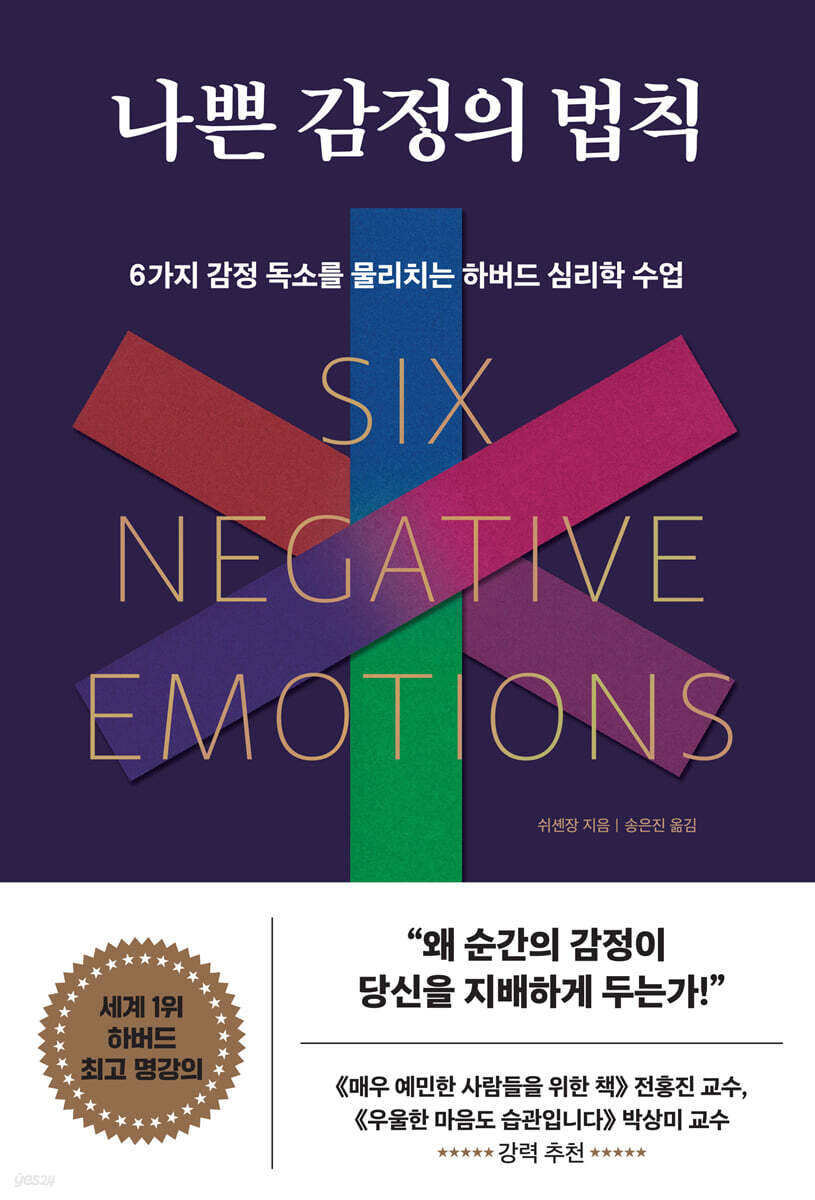
The Law of Bad Emotions
 |
Description
Book Introduction
“Why let the emotions of the moment rule you!”
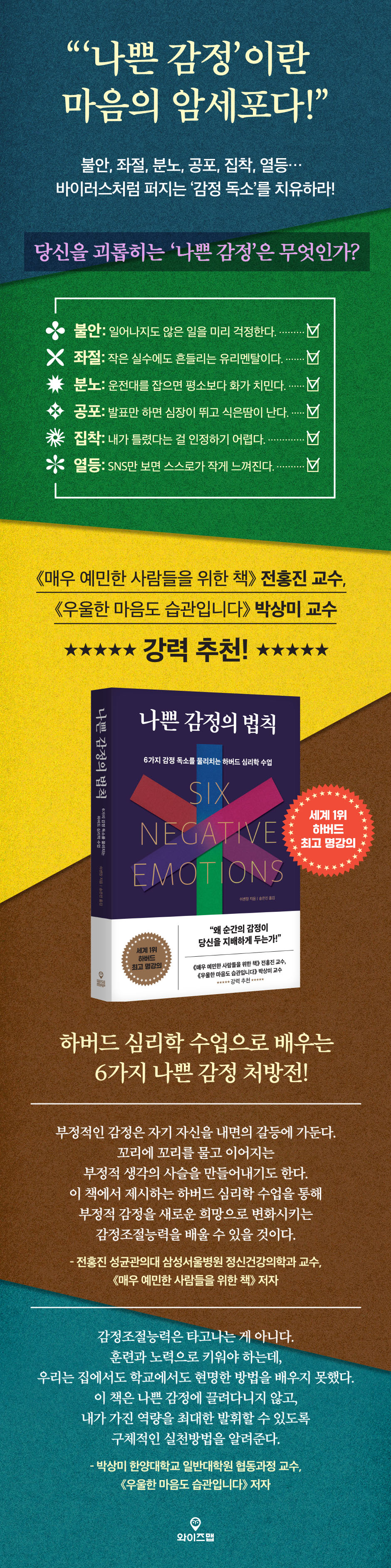
Anxiety, frustration, anger, fear, obsession, inferiority…
Conquer the 6 negative emotions that shake your heart!
Professor Jeon Hong-jin, "A Book for Highly Sensitive People"
"Depression is also a habit" Highly recommended by Professor Sangmi Park!
According to a Harvard psychology study, 80 percent of the factors that create achievement, fame, and wealth are related to emotions, while knowledge and skills account for only 15 percent.
- From the prologue
What are the 'bad feelings' that are bothering you?
Have you ever ruined a relationship by blurting out irrelevant words in a fit of anger? Have you ever been so depressed that you spent days staring at your phone? Have you ever given up on work or studying before even starting because of unnecessary anxiety? All of these are because you were held back by "emotional toxins."
According to psychologist Sylvan Tompkins, human emotions are broadly divided into nine types.
Unfortunately, six of them are 'bad emotions' that shake the heart.
A weak-minded person is easily swept away by even small waves of emotion.
'Bad feelings' rear their heads unexpectedly in every corner of our daily lives.
Today, I am 'angry' because the road is blocked, and I am 'frustrated' because I am not getting results at work.
I feel anxious because a large investment went wrong, and I feel inferior to a friend who is doing better than me.
Every time you get swayed by emotions, you end up facing bigger problems.
"The Law of Bad Emotions" is a book filled with Harvard's wisdom on cultivating and refining "emotional control skills" and "mature self."
'For the weak, misfortune is a cliff that leads to failure, but for the strong, it is a staircase that leads to success.'
Only those who control their emotions and become true masters of their minds can climb the ladder of success.
Anxiety, frustration, anger, fear, obsession, inferiority…
Conquer the 6 negative emotions that shake your heart!
Professor Jeon Hong-jin, "A Book for Highly Sensitive People"
"Depression is also a habit" Highly recommended by Professor Sangmi Park!
According to a Harvard psychology study, 80 percent of the factors that create achievement, fame, and wealth are related to emotions, while knowledge and skills account for only 15 percent.
- From the prologue
What are the 'bad feelings' that are bothering you?
Have you ever ruined a relationship by blurting out irrelevant words in a fit of anger? Have you ever been so depressed that you spent days staring at your phone? Have you ever given up on work or studying before even starting because of unnecessary anxiety? All of these are because you were held back by "emotional toxins."
According to psychologist Sylvan Tompkins, human emotions are broadly divided into nine types.
Unfortunately, six of them are 'bad emotions' that shake the heart.
A weak-minded person is easily swept away by even small waves of emotion.
'Bad feelings' rear their heads unexpectedly in every corner of our daily lives.
Today, I am 'angry' because the road is blocked, and I am 'frustrated' because I am not getting results at work.
I feel anxious because a large investment went wrong, and I feel inferior to a friend who is doing better than me.
Every time you get swayed by emotions, you end up facing bigger problems.
"The Law of Bad Emotions" is a book filled with Harvard's wisdom on cultivating and refining "emotional control skills" and "mature self."
'For the weak, misfortune is a cliff that leads to failure, but for the strong, it is a staircase that leads to success.'
Only those who control their emotions and become true masters of their minds can climb the ladder of success.
- You can preview some of the book's contents.
Preview
index
Prologue Why Harvard Researches and Teaches Emotions
Chapter 1: OT - Harvard's Eight Principles of Emotion
Rule 1: Emotions govern our actions.
Rule 2: Emotional outbursts can be prevented.
Rule 3: Excessive Emotions Lead to Extreme Situations
Rule 4: Control your emotions with positive thinking.
Rule 5: Good feelings are contagious.
Rule 6: Emotional Changes Have Cycles
Principle 7: Knowing Yourself Can Help You Overcome Misfortune
Principle 8: Emotional regulation skills can be trained.
Chapter 2: Inferiority, the Toxin That Eats Away the Ego
5 Ways to Overcome Inferiority Complex
How Flaws Become Weapons
There is no such thing as a perfect life.
The honest voice inside me
Embrace failure with all your might
There's no rule that says you can't dream just because you're ordinary.
Find your own individuality
Awaken the giant sleeping within me
Chapter 3: Obsession, the Toxin That Blocks Progress
Between conviction and obsession
Resolving emotional bottlenecks
If you want to go far, walk together.
Life is about direction, not speed.
Think backwards
Flexibility is a skill
Breaking the mold of authority
How to Turn Small Ideas into Gold
Chapter 4: Frustration, the Toxin That Destroys Hope
I write the ending of my life
How is 'confidence' created?
attitude toward difficulties
Don't extinguish the lamp of your heart
The world is unfair to everyone.
Befriend failure
There is no life without praise.
To you who are afraid of rejection
Chapter 5: Fear, the Toxin That Grabs Your Ankles
There is no paradise where you run away
Fear always preys on the weak.
4 Ways to Enjoy Adventure
The moment when knowledge becomes a limitation
Block the escape hole
A 'Trust' Class to Overcome Fear
To you who are afraid of change
Life is a game of choice.
Chapter 6: Anger, the Toxin That Burns Reason
Before anger consumes you
What is my anger type?
There is no such thing as a perfect relationship.
Try to walk in someone else's shoes
The flames of revenge return like a boomerang
Pouring water on an angry heart
Controlling the impulses that lead to conflict
Don't be swayed by rumors
Chapter 7: Anxiety, the Toxin That Breaks the Heart
When your heart hurts, your body hurts too.
There is no life without scars.
How to conquer the anxiety within me
The power of 'determination' that brings success
If you are suffering from an appearance complex
When you feel impatient because you want to succeed
99% of worries are useless
Grow more in the time you have to regret
Chapter 8: The End, Become the True Master of Your Heart
Do you really dream of a perfect life?
Don't waste your life being dragged around by money.
I decide my own mood
Embrace the passion that brings victory
Happiness comes to those who smile
Rule yourself
Who am I
The power of perseverance that surpasses talent
Chapter 1: OT - Harvard's Eight Principles of Emotion
Rule 1: Emotions govern our actions.
Rule 2: Emotional outbursts can be prevented.
Rule 3: Excessive Emotions Lead to Extreme Situations
Rule 4: Control your emotions with positive thinking.
Rule 5: Good feelings are contagious.
Rule 6: Emotional Changes Have Cycles
Principle 7: Knowing Yourself Can Help You Overcome Misfortune
Principle 8: Emotional regulation skills can be trained.
Chapter 2: Inferiority, the Toxin That Eats Away the Ego
5 Ways to Overcome Inferiority Complex
How Flaws Become Weapons
There is no such thing as a perfect life.
The honest voice inside me
Embrace failure with all your might
There's no rule that says you can't dream just because you're ordinary.
Find your own individuality
Awaken the giant sleeping within me
Chapter 3: Obsession, the Toxin That Blocks Progress
Between conviction and obsession
Resolving emotional bottlenecks
If you want to go far, walk together.
Life is about direction, not speed.
Think backwards
Flexibility is a skill
Breaking the mold of authority
How to Turn Small Ideas into Gold
Chapter 4: Frustration, the Toxin That Destroys Hope
I write the ending of my life
How is 'confidence' created?
attitude toward difficulties
Don't extinguish the lamp of your heart
The world is unfair to everyone.
Befriend failure
There is no life without praise.
To you who are afraid of rejection
Chapter 5: Fear, the Toxin That Grabs Your Ankles
There is no paradise where you run away
Fear always preys on the weak.
4 Ways to Enjoy Adventure
The moment when knowledge becomes a limitation
Block the escape hole
A 'Trust' Class to Overcome Fear
To you who are afraid of change
Life is a game of choice.
Chapter 6: Anger, the Toxin That Burns Reason
Before anger consumes you
What is my anger type?
There is no such thing as a perfect relationship.
Try to walk in someone else's shoes
The flames of revenge return like a boomerang
Pouring water on an angry heart
Controlling the impulses that lead to conflict
Don't be swayed by rumors
Chapter 7: Anxiety, the Toxin That Breaks the Heart
When your heart hurts, your body hurts too.
There is no life without scars.
How to conquer the anxiety within me
The power of 'determination' that brings success
If you are suffering from an appearance complex
When you feel impatient because you want to succeed
99% of worries are useless
Grow more in the time you have to regret
Chapter 8: The End, Become the True Master of Your Heart
Do you really dream of a perfect life?
Don't waste your life being dragged around by money.
I decide my own mood
Embrace the passion that brings victory
Happiness comes to those who smile
Rule yourself
Who am I
The power of perseverance that surpasses talent
Detailed image
Into the book
According to a Harvard psychology study, 80 percent of the factors that create achievement, fame, and wealth are related to emotions, while knowledge and skills account for only 15 percent.
This means that the ability to regulate emotions has a great impact not only on our minds, but also on work, success, daily life, and even interpersonal relationships.
---From the "Prologue"
According to research by Harvard University psychologists, the average emotional cycle lasts five weeks.
It means that it takes 5 weeks to go from happy to sad to happy again.
Of course, the cycle varies from person to person, so some people have a longer cycle and some have a shorter cycle.
The first half is a period of emotional highs and the second half is a period of emotional lows.
There is a two to three day critical period between when emotions go from high to low and from low to high.
At this time, emotions become particularly unstable and subtle imbalances occur in the body, making it easy for various problems to arise.
---From "Chapter 1: OT - Harvard's Eight Principles of Emotion"
After the broadcast, she was fired.
The broadcasting station judged that her personality of easily getting emotional and expressing it fully during broadcasts was a major flaw as an announcer.
After a while, she heard that another broadcasting station was planning a new program and immediately applied.
The manager, who was impressed by her confident and confident appearance, gave her the job of hosting a morning talk show.
…she captivated the performers and audiences with her natural talent.
In front of her, who strongly sympathized with their stories, the guests honestly cleared up various rumors, shared unfortunate experiences from their childhood, and boldly revealed their affection for their lovers.
The protagonist of this story is Oprah Winfrey, the highest-rated talk show host in the history of world television.
Her dazzling success was the result of the very flaw that had previously gotten her fired.
---From "Chapter 2: Inferiority, the Toxin that Eats Away the Ego"
On September 21, 1938, a massive hurricane struck the east coast of the United States.
… several meteorologists predicted the hurricane's size and arrival time, but the National Weather Service did not issue a warning for several minor reasons.
Residents of coastal villages also looked at wind vanes and barometers to predict that there would be unusual weather changes.
But since the 'authoritative' weather bureau didn't say anything, they didn't care.
…the vast majority of local residents made that judgment.
…blind faith in authority often leads to tragedy.
---From "Chapter 3: Obsession, the Toxin That Blocks Progress"
The truth is that misfortune is a cliff that leads to failure for the weak, but a stairway to success for the strong.
Whether it's misfortune or happiness, once it's happened, it can't be undone.
Instead, we can decide our attitude toward the event.
‘What attitude should I have toward life?’ means the same thing as ‘what kind of life should I live?’
---From "Chapter 4: Frustration, the Toxin That Destroys Hope"
You may walk a path of thorns while others walk with roses and applause.
A person who understands the essence of life and accepts the unfairness of the world does not ask for roses and applause.
Instead, he tries to turn the thorns around him into roses.
---From "Chapter 4: Frustration, the Toxin That Destroys Hope"
According to the basic principles of fluid dynamics, bumblebees could never fly.
He shook his head, looking puzzled at the bumblebee that overturned the foundations of physics.
The zoologists next turned to social behaviorists for help.
Before the zoologists could finish their explanation, the social behaviorist burst out laughing and asked back.
“What kind of research is needed here?” His interpretation was very simple.
The reason why bumblebees can fly is because they 'want to fly on their own.'
Because if you can't fly, you die, considering your survival ability and the environment.
After finishing his explanation, the sociologist added in a teasing tone.
“It’s a good thing that pumpkin bees don’t know anything about biology or fluid dynamics.
If I had known, I would never have flown.
No, I guess I never even thought about flying.”
---From "Chapter 5: Fear, the Toxin That Holds You Back"
In Harvard psychology classes, the adage, "The weak control their emotions with their actions, the strong control their actions with their emotions," often appears.
In an unpleasant situation, the weak get angry like fire, but the strong deal with it calmly.
Anger usually arises from our perception, interpretation and evaluation of external objects.
It is related to the individual's personality, but the most important factor is the ability to control emotions.
The reason why different people react differently to the same thing is because each person has a different ability to regulate their emotions.
---From "Chapter 6: Anger, the Toxin that Burns Reason"
Harvard's Department of Psychology has quantified worry and released related statistics and detailed analysis results.
To cut to the chase, more than 99 percent of people's concerns are unnecessary in the current situation.
40 percent is worry about the future, 30 percent is worry about the past.
22 percent are worried about things they lack in their lives, 4 percent are worried about things they cannot change, and the remaining 3 percent are worried about what they are doing now.
So what this means is that most of our worries are things we can't solve on our own in the first place.
---From "Chapter 7: Anxiety, the Toxin that Breaks the Heart"
Worth quit his job as a cleaner and became a salesman.
He spent a month scouring New York City, selling seven tape recorders.
After a while, he came to Edison's office with a national promotional plan.
And finally, I achieved my long-awaited goal.
He ended up working with Edison as a sales representative for a small recorder! From the moment he started working as a janitor, Worth felt like he was working with Edison.
So, as a partner of a great inventor, I looked at the world and dealt with all its problems.
Even before he started working officially with Edison as a recorder salesman, he had already established his identity and position.
Although Worth had always done small, unnoticed things, in his mind he was already a successful businessman.
This means that the ability to regulate emotions has a great impact not only on our minds, but also on work, success, daily life, and even interpersonal relationships.
---From the "Prologue"
According to research by Harvard University psychologists, the average emotional cycle lasts five weeks.
It means that it takes 5 weeks to go from happy to sad to happy again.
Of course, the cycle varies from person to person, so some people have a longer cycle and some have a shorter cycle.
The first half is a period of emotional highs and the second half is a period of emotional lows.
There is a two to three day critical period between when emotions go from high to low and from low to high.
At this time, emotions become particularly unstable and subtle imbalances occur in the body, making it easy for various problems to arise.
---From "Chapter 1: OT - Harvard's Eight Principles of Emotion"
After the broadcast, she was fired.
The broadcasting station judged that her personality of easily getting emotional and expressing it fully during broadcasts was a major flaw as an announcer.
After a while, she heard that another broadcasting station was planning a new program and immediately applied.
The manager, who was impressed by her confident and confident appearance, gave her the job of hosting a morning talk show.
…she captivated the performers and audiences with her natural talent.
In front of her, who strongly sympathized with their stories, the guests honestly cleared up various rumors, shared unfortunate experiences from their childhood, and boldly revealed their affection for their lovers.
The protagonist of this story is Oprah Winfrey, the highest-rated talk show host in the history of world television.
Her dazzling success was the result of the very flaw that had previously gotten her fired.
---From "Chapter 2: Inferiority, the Toxin that Eats Away the Ego"
On September 21, 1938, a massive hurricane struck the east coast of the United States.
… several meteorologists predicted the hurricane's size and arrival time, but the National Weather Service did not issue a warning for several minor reasons.
Residents of coastal villages also looked at wind vanes and barometers to predict that there would be unusual weather changes.
But since the 'authoritative' weather bureau didn't say anything, they didn't care.
…the vast majority of local residents made that judgment.
…blind faith in authority often leads to tragedy.
---From "Chapter 3: Obsession, the Toxin That Blocks Progress"
The truth is that misfortune is a cliff that leads to failure for the weak, but a stairway to success for the strong.
Whether it's misfortune or happiness, once it's happened, it can't be undone.
Instead, we can decide our attitude toward the event.
‘What attitude should I have toward life?’ means the same thing as ‘what kind of life should I live?’
---From "Chapter 4: Frustration, the Toxin That Destroys Hope"
You may walk a path of thorns while others walk with roses and applause.
A person who understands the essence of life and accepts the unfairness of the world does not ask for roses and applause.
Instead, he tries to turn the thorns around him into roses.
---From "Chapter 4: Frustration, the Toxin That Destroys Hope"
According to the basic principles of fluid dynamics, bumblebees could never fly.
He shook his head, looking puzzled at the bumblebee that overturned the foundations of physics.
The zoologists next turned to social behaviorists for help.
Before the zoologists could finish their explanation, the social behaviorist burst out laughing and asked back.
“What kind of research is needed here?” His interpretation was very simple.
The reason why bumblebees can fly is because they 'want to fly on their own.'
Because if you can't fly, you die, considering your survival ability and the environment.
After finishing his explanation, the sociologist added in a teasing tone.
“It’s a good thing that pumpkin bees don’t know anything about biology or fluid dynamics.
If I had known, I would never have flown.
No, I guess I never even thought about flying.”
---From "Chapter 5: Fear, the Toxin That Holds You Back"
In Harvard psychology classes, the adage, "The weak control their emotions with their actions, the strong control their actions with their emotions," often appears.
In an unpleasant situation, the weak get angry like fire, but the strong deal with it calmly.
Anger usually arises from our perception, interpretation and evaluation of external objects.
It is related to the individual's personality, but the most important factor is the ability to control emotions.
The reason why different people react differently to the same thing is because each person has a different ability to regulate their emotions.
---From "Chapter 6: Anger, the Toxin that Burns Reason"
Harvard's Department of Psychology has quantified worry and released related statistics and detailed analysis results.
To cut to the chase, more than 99 percent of people's concerns are unnecessary in the current situation.
40 percent is worry about the future, 30 percent is worry about the past.
22 percent are worried about things they lack in their lives, 4 percent are worried about things they cannot change, and the remaining 3 percent are worried about what they are doing now.
So what this means is that most of our worries are things we can't solve on our own in the first place.
---From "Chapter 7: Anxiety, the Toxin that Breaks the Heart"
Worth quit his job as a cleaner and became a salesman.
He spent a month scouring New York City, selling seven tape recorders.
After a while, he came to Edison's office with a national promotional plan.
And finally, I achieved my long-awaited goal.
He ended up working with Edison as a sales representative for a small recorder! From the moment he started working as a janitor, Worth felt like he was working with Edison.
So, as a partner of a great inventor, I looked at the world and dealt with all its problems.
Even before he started working officially with Edison as a recorder salesman, he had already established his identity and position.
Although Worth had always done small, unnoticed things, in his mind he was already a successful businessman.
---From "Chapter 8: The End, Become the True Master of Your Heart"
Publisher's Review
Harvard Psychology Class: Defeating 'Emotional Toxins'!
Harvard, the world's top university, has conducted in-depth research on 'emotional regulation' and 'self-awareness' since its establishment.
"The Law of Bad Emotions" is the culmination of 390 years of history and research.
Daniel Goleman, a Harvard psychologist who studied the correlation between emotions and success, argued that:
“Success is determined by 20 percent intellectual ability and 80 percent emotional intelligence.”
In fact, many famous Harvard graduates boast outstanding emotional control skills.
Even when the company was on the verge of collapse, Mark Zuckerberg apologized with a calm expression and clear voice and immediately found a solution.
Barack Obama, known for his moving speeches, gained support by sharing his heartfelt feelings with his audience.
Bill Gates takes a "thinking week" twice a year, where he retreats to a remote cabin to reflect on his thoughts and feelings.
Natalie Portman, who became a Hollywood star at the age of 11, overcame envy and jealousy and turned it into a turning point.
Matt Damon overcame a long period of depression to sweep the theaters with his deeply emotional performance.
Their rise to the top was not due to innate ability or talent.
It's the power I developed in my Harvard psychology class: looking into myself and turning negative emotions into a stepping stone to success.
Break free from the weak who are swayed by emotions and become a strong person who controls your emotions!
The Law of Bad Feelings is an eight-part Harvard psychology course.
We introduce real-life examples of people who overcame bad feelings, such as Hollywood star Halle Berry, who overcame dishonor and accepted the 'Worst Actress' award; Janet Leigh, who conquered the professional billiards world after overcoming cancer, tumors, and disabilities; Ted Williams, who transformed from a street drug addict to an anchor with a 'heavenly voice'; and Peter Buckley, who achieved 300 career fights despite being called the 'worst boxer'.
It also provides an easy-to-understand explanation of psychological concepts that can be applied to life, such as 'the dangers of excessive emotionalization' and 'the emotional cycle', which were studied at Harvard.
We present research results from world-renowned psychology experts, including Daniel Goleman, who concluded that "emotions determine the future," and Professor Tal Ben-Shahar, who leads the Harvard "Happiness Lectures."
Chapter 1 presents eight principles of emotions, including 'Emotions govern our actions' and 'Good emotions are contagious', and teaches us how to manage our emotions.
Chapters 2-7 detail the six negative emotions—anxiety, frustration, anger, fear, obsession, and inferiority—and techniques for overcoming them.
The final chapter, chapter 8, presents the attitude one must have to become the true master of one's own mind.
You can't always avoid the negative emotions that come unexpectedly, but you can change the impact they have on your life.
Let's overcome the '6 bad emotions' with Harvard psychology classes and become strong individuals who control a calm mind and mature self.
Harvard, the world's top university, has conducted in-depth research on 'emotional regulation' and 'self-awareness' since its establishment.
"The Law of Bad Emotions" is the culmination of 390 years of history and research.
Daniel Goleman, a Harvard psychologist who studied the correlation between emotions and success, argued that:
“Success is determined by 20 percent intellectual ability and 80 percent emotional intelligence.”
In fact, many famous Harvard graduates boast outstanding emotional control skills.
Even when the company was on the verge of collapse, Mark Zuckerberg apologized with a calm expression and clear voice and immediately found a solution.
Barack Obama, known for his moving speeches, gained support by sharing his heartfelt feelings with his audience.
Bill Gates takes a "thinking week" twice a year, where he retreats to a remote cabin to reflect on his thoughts and feelings.
Natalie Portman, who became a Hollywood star at the age of 11, overcame envy and jealousy and turned it into a turning point.
Matt Damon overcame a long period of depression to sweep the theaters with his deeply emotional performance.
Their rise to the top was not due to innate ability or talent.
It's the power I developed in my Harvard psychology class: looking into myself and turning negative emotions into a stepping stone to success.
Break free from the weak who are swayed by emotions and become a strong person who controls your emotions!
The Law of Bad Feelings is an eight-part Harvard psychology course.
We introduce real-life examples of people who overcame bad feelings, such as Hollywood star Halle Berry, who overcame dishonor and accepted the 'Worst Actress' award; Janet Leigh, who conquered the professional billiards world after overcoming cancer, tumors, and disabilities; Ted Williams, who transformed from a street drug addict to an anchor with a 'heavenly voice'; and Peter Buckley, who achieved 300 career fights despite being called the 'worst boxer'.
It also provides an easy-to-understand explanation of psychological concepts that can be applied to life, such as 'the dangers of excessive emotionalization' and 'the emotional cycle', which were studied at Harvard.
We present research results from world-renowned psychology experts, including Daniel Goleman, who concluded that "emotions determine the future," and Professor Tal Ben-Shahar, who leads the Harvard "Happiness Lectures."
Chapter 1 presents eight principles of emotions, including 'Emotions govern our actions' and 'Good emotions are contagious', and teaches us how to manage our emotions.
Chapters 2-7 detail the six negative emotions—anxiety, frustration, anger, fear, obsession, and inferiority—and techniques for overcoming them.
The final chapter, chapter 8, presents the attitude one must have to become the true master of one's own mind.
You can't always avoid the negative emotions that come unexpectedly, but you can change the impact they have on your life.
Let's overcome the '6 bad emotions' with Harvard psychology classes and become strong individuals who control a calm mind and mature self.
GOODS SPECIFICS
- Date of issue: March 10, 2024
- Page count, weight, size: 320 pages | 532g | 148*218*30mm
- ISBN13: 9791189328733
- ISBN10: 1189328739
You may also like
카테고리
korean


korean

![GQ KOREA Mark (Monthly): December [2025]](http://librairie.coreenne.fr/cdn/shop/files/8ef265dbbfbf186523ed75ba7319009d.jpg?v=1765340328&width=3840)


