

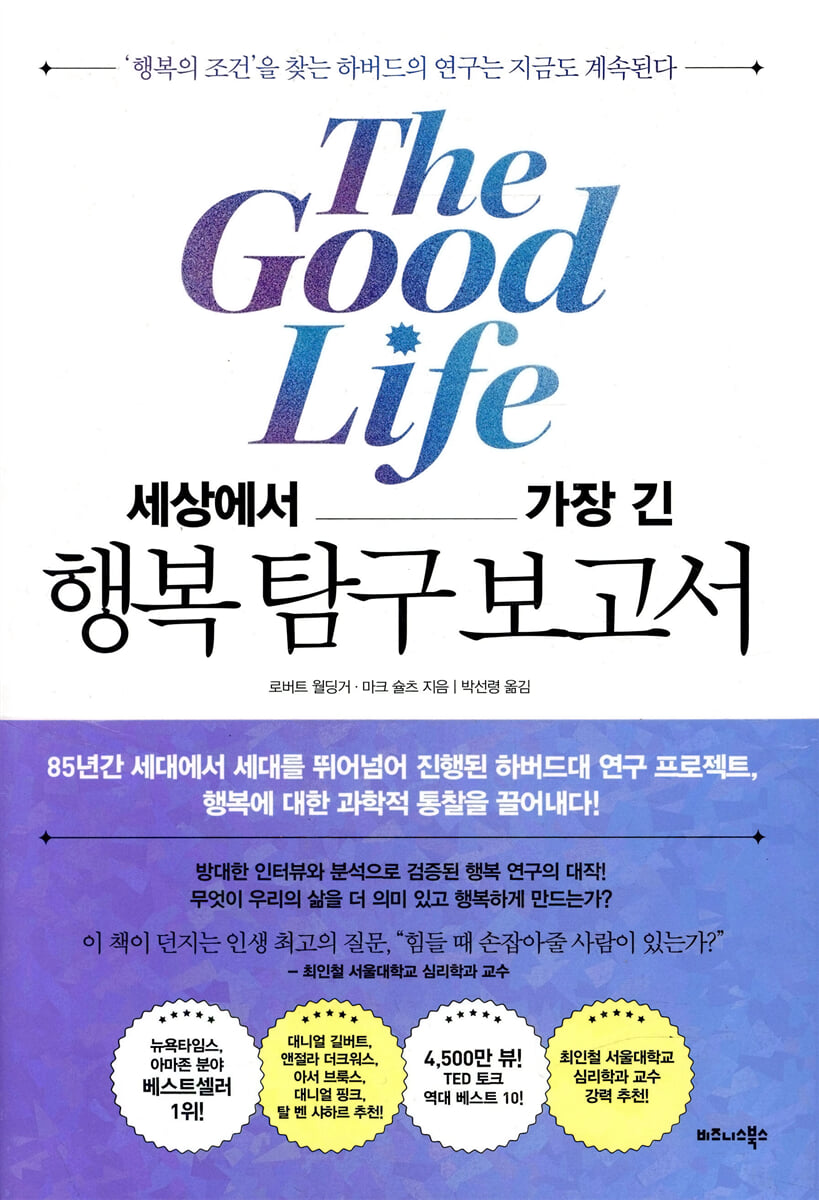
The World's Longest Happiness Quest Report
 |
Description
Book Introduction
45 million views! The 10 best TED Talks of all time! Highly recommended by Professor Choi In-cheol of the Department of Psychology at Seoul National University! The Harvard University Happiness Research Project, which has been conducted from generation to generation for 85 years, Discover the secrets of happiness through unparalleled and unprecedented research on human growth! What are the secrets to happiness revealed by the world's longest-running research project, the Harvard Study of Adult Development? In 2007, a survey was conducted targeting millennials, asking them about their most important life goals. 76% of respondents said becoming rich was their top priority, while 50% said they wanted to become famous. A decade later, we asked similar questions to millennials, who have spent more time as adults. How would their answers have changed? The desire for fame has become a lower priority. However, things like making a lot of money, building a successful career, and living debt-free were still among the most important goals. These are common, practical goals that continue to spread across generations and borders. But we all know that that alone does not make for a happy life. That is why, even now, research is being conducted all over the world to determine what happiness is and what conditions are necessary to live a happy life. The longest study on happiness ever conducted is the "Adult Development Study," which is still ongoing at Harvard University. In 1938, the Harvard Medical School's Adult Development Research Center divided 268 Harvard sophomores and 456 late-teenagers from Boston's poorest neighborhoods into two groups and tracked their lives for 85 years. This study has endured through all kinds of adversity and continues to this day. 84% of the participants have continued to participate in the study for 85 years, 60 of whom are over 90 years old, and 1,305 of their children are also participating in the study. Prospective studies like this one, conducted over a lifetime, are extremely rare. Sometimes participants drop out, change names, or move without telling the research team, sometimes research funding dries up, or the research team loses interest. But the ever-evolving and expanding Harvard Study of Adult Development is the longest and most in-depth longitudinal study of the human lifespan. Many happiness experts are paying attention to this valuable research and are looking forward to seeing the results published in a book. This book is a compilation of the Harvard University Adult Development Study, the world's longest-running study on happiness, by Robert Waldinger and Mark Schultz, the fourth directors of the Harvard Adult Development Study. Through 85 years of accumulated cases and scientific research results, it informs readers about what a happy life is. It draws directly from the Harvard study and is supported by hundreds of other scientific studies involving thousands of participants around the world. The decisive factors for a healthy and happy life, as revealed in this study, were neither wealth, fame, nor academic background. It shows with extensive case studies and scientific insights that the most important things in life are separate. Upon its publication, the book received praise from numerous happiness experts, including Daniel Gilbert and Angela Duckworth. Professor Choi In-cheol of the Department of Psychology at Seoul National University, who read the original book when it was published in the United States, praised the book, saying, “There is no book that doesn’t feel burdened by the description ‘the only book you must read about happiness,’ but this is a book that inspires reckless courage.” |
- You can preview some of the book's contents.
Preview
index
Recommended Article: Research on Immortal Happiness
Author's Note
Introduction How can we create a truly happy and good life?
Chapter 1: What Makes a Good Life?
What scares us most in life?
How Childhood Development Affects Life
What is different about happily married couples?
Good relationships are the key to happiness.
Studying different types of boys in Boston's West End
Longitudinal studies are a lens through time.
Data collected and questioned for longitudinal research
What does happiness mean and what does it look like?
Studying everyday life beyond data
Catch up with the insight and wisdom of the ancients who preceded us.
We approach the truth through a arduous path of discovery.
A good life isn't always far away.
Chapter 2: Why Relationships Determine Happiness and Abundance
What is needed to survive as a social being?
Positive relationships are essential to human happiness.
The starkly different lives of two men who started life under favorable circumstances
Why don't we talk to strangers on the train?
A culture that obsessively engages with our perspectives and well-being
Common phrases we use when talking about money
Why Alan from Charlestown Lived a Good Life
How much of our happiness can we control?
How do we reach our different happiness set points?
Relationships are the engine that drives a good life.
Chapter 3: People We Meet on the Map of Life
Finding My Coordinates on the Map and Territory of Life
Try your own mini Harvard study at home
The immutable truth is that no matter where we are in life, we change.
The life cycle to understand human growth and change
The meaning and changes of relationships centered on the life cycle
Wes and his wife, even long journeys are short with a good companion.
Life's turning points, what we learn from the unexpected
Looking back on his life, Wes said he enjoyed being with his wife the most.
Our perspective on life changes depending on our position.
Chapter 4: Social Compatibility and Maintaining Good Relationships
The mind is the body and the body is the mind?
Sterling, a man who misses his family but refuses to see them.
Loneliness becomes a disease
Life in Numbers: A New Perspective
Two Key Variables Predicting Happiness
The little stars surrounding the universe called 'me', the people I've met
Why did he distance himself from the two most important people in his life?
Self-reflection by answering questions that penetrate the core of relationships.
Recognize the difference between where you are now and where you want to go
Some principles and suggestions to revitalize and invigorate your relationships.
From curiosity to understanding, the magic of relationships happens.
Regularly review and review your relationships
Chapter 5: Focus on the present and pay attention to those around you.
Time and attention are essential ingredients for happiness.
The illusion that you don't have time today but will have plenty of time tomorrow
The irony of not being able to spend time on what's truly important
Hummingbird flapping its wings vs.
A lonely, focused owl
Leo's family, overflowing with interest, was also overflowing with love.
In every age, there are thieves who steal our attention and time.
Building relationships online
Online interaction vs.
Offline interaction
The equation of isolation and connection created by the coronavirus pandemic
Four Ways to Use Online and Social Media Wisely
Let's be faithful to the present moment, here and now.
The effort to empathize is more important than the accuracy of empathy.
Leo gets a B+ for effort
Restructuring and reallocation of attention and time is necessary.
Chapter 6: How to Ride the Waves of Relationships Without Being Swept Away
The things that make us happiest are also the things that make us most miserable.
You can't stop the waves, but you can learn to surf them.
Coping Styles for Emotions: Reflective vs.
reflective
Problem Solving Styles: Face the Situation vs.
Avoid
Unraveling the Mysteries of Stress and Its Responses
The WISER model for responding to human relationships and emotional situations
If the same problem keeps happening, let's get out of here.
As the suffering of the pandemic grew, people turned to each other.
The German family that saved Mark and his family
The mystery, wonder, and danger of humans living together
Chapter 7 How do you get along with those closest to you?
How can two halves become one?
A person who cannot open up even to close friends
Attachment styles that children exhibit for survival
Anxious avoidance in people who have not formed secure attachments
Affectionate touch is as powerful as drugs.
Emotions are a kind of indicator of the depth of a relationship.
Couples who express a lot of empathy and affection last longer.
Is it possible to avoid conflicts arising from differences?
Couples also need to adapt and synchronize their steps as if they were dancing.
A chance to see each other's true feelings beneath the surface
When intimate relationships are shaken, life as a whole is shaken.
Intimate relationships also grow with attention and care.
The Lasting Impact of Intimate Partnerships on Health
Satisfaction with intimate relationships leads to life satisfaction.
A partner to share your vulnerabilities, the difference between happiness and despair.
The burden that was too heavy was lifted from 'my other half'
How to Walk the Path of Life Well with Your Partner
Chapter 8: Family, Close Yet Far, Perhaps Our Life Itself
Family is the most involved and part of our lives.
What is family?
How to deal with the ghosts of childhood?
The difference between protected and unprotected children
How did Neil McCarthy's childhood experiences shape his life?
Rely on positive experiences to overcome negative ones
Never turn a blind eye to family problems, whether you step back or intervene.
Even if you had a difficult childhood, you can still have a good life.
Let's change our perspective and think again from the other person's perspective.
Why Family Relationships Are Worth the Work
A shining family legacy illuminates future generations.
Chapter 9: Better Workplace Relationships Improve Your Quality of Life
A life consumed by work and work
Work vs.
Life? Or is it all life?
What happens when you come home in a bad mood
Other types of poverty, disconnection, and loneliness
The Impact of Inequality at Work and Home on Relationships
Mentoring that helps both mentors and mentees grow
How changes in careers and workplaces affect our lives
The problems caused by technological advancement and inequality in prosperity
After all, work is also our life.
Chapter 10: Friendship Protects Us from Life's Rough Waves
Friendship also requires proper care.
Friendship makes us healthy and increases our survival skills.
Even the strongest person needs the help of friends.
Good friends are like armor on the battlefield.
What we want in friendship has nothing to do with gender identity.
Friendship at the heart of Harvard research
The Importance of 'Unimportant' Relationships
The broad influence of weak ties
Friends made through various stages of life
Some Ways to Maintain Friendships
It's never too late
Conclusion: It's never too late to be happy.
Acknowledgements
main
References
Search
Author's Note
Introduction How can we create a truly happy and good life?
Chapter 1: What Makes a Good Life?
What scares us most in life?
How Childhood Development Affects Life
What is different about happily married couples?
Good relationships are the key to happiness.
Studying different types of boys in Boston's West End
Longitudinal studies are a lens through time.
Data collected and questioned for longitudinal research
What does happiness mean and what does it look like?
Studying everyday life beyond data
Catch up with the insight and wisdom of the ancients who preceded us.
We approach the truth through a arduous path of discovery.
A good life isn't always far away.
Chapter 2: Why Relationships Determine Happiness and Abundance
What is needed to survive as a social being?
Positive relationships are essential to human happiness.
The starkly different lives of two men who started life under favorable circumstances
Why don't we talk to strangers on the train?
A culture that obsessively engages with our perspectives and well-being
Common phrases we use when talking about money
Why Alan from Charlestown Lived a Good Life
How much of our happiness can we control?
How do we reach our different happiness set points?
Relationships are the engine that drives a good life.
Chapter 3: People We Meet on the Map of Life
Finding My Coordinates on the Map and Territory of Life
Try your own mini Harvard study at home
The immutable truth is that no matter where we are in life, we change.
The life cycle to understand human growth and change
The meaning and changes of relationships centered on the life cycle
Wes and his wife, even long journeys are short with a good companion.
Life's turning points, what we learn from the unexpected
Looking back on his life, Wes said he enjoyed being with his wife the most.
Our perspective on life changes depending on our position.
Chapter 4: Social Compatibility and Maintaining Good Relationships
The mind is the body and the body is the mind?
Sterling, a man who misses his family but refuses to see them.
Loneliness becomes a disease
Life in Numbers: A New Perspective
Two Key Variables Predicting Happiness
The little stars surrounding the universe called 'me', the people I've met
Why did he distance himself from the two most important people in his life?
Self-reflection by answering questions that penetrate the core of relationships.
Recognize the difference between where you are now and where you want to go
Some principles and suggestions to revitalize and invigorate your relationships.
From curiosity to understanding, the magic of relationships happens.
Regularly review and review your relationships
Chapter 5: Focus on the present and pay attention to those around you.
Time and attention are essential ingredients for happiness.
The illusion that you don't have time today but will have plenty of time tomorrow
The irony of not being able to spend time on what's truly important
Hummingbird flapping its wings vs.
A lonely, focused owl
Leo's family, overflowing with interest, was also overflowing with love.
In every age, there are thieves who steal our attention and time.
Building relationships online
Online interaction vs.
Offline interaction
The equation of isolation and connection created by the coronavirus pandemic
Four Ways to Use Online and Social Media Wisely
Let's be faithful to the present moment, here and now.
The effort to empathize is more important than the accuracy of empathy.
Leo gets a B+ for effort
Restructuring and reallocation of attention and time is necessary.
Chapter 6: How to Ride the Waves of Relationships Without Being Swept Away
The things that make us happiest are also the things that make us most miserable.
You can't stop the waves, but you can learn to surf them.
Coping Styles for Emotions: Reflective vs.
reflective
Problem Solving Styles: Face the Situation vs.
Avoid
Unraveling the Mysteries of Stress and Its Responses
The WISER model for responding to human relationships and emotional situations
If the same problem keeps happening, let's get out of here.
As the suffering of the pandemic grew, people turned to each other.
The German family that saved Mark and his family
The mystery, wonder, and danger of humans living together
Chapter 7 How do you get along with those closest to you?
How can two halves become one?
A person who cannot open up even to close friends
Attachment styles that children exhibit for survival
Anxious avoidance in people who have not formed secure attachments
Affectionate touch is as powerful as drugs.
Emotions are a kind of indicator of the depth of a relationship.
Couples who express a lot of empathy and affection last longer.
Is it possible to avoid conflicts arising from differences?
Couples also need to adapt and synchronize their steps as if they were dancing.
A chance to see each other's true feelings beneath the surface
When intimate relationships are shaken, life as a whole is shaken.
Intimate relationships also grow with attention and care.
The Lasting Impact of Intimate Partnerships on Health
Satisfaction with intimate relationships leads to life satisfaction.
A partner to share your vulnerabilities, the difference between happiness and despair.
The burden that was too heavy was lifted from 'my other half'
How to Walk the Path of Life Well with Your Partner
Chapter 8: Family, Close Yet Far, Perhaps Our Life Itself
Family is the most involved and part of our lives.
What is family?
How to deal with the ghosts of childhood?
The difference between protected and unprotected children
How did Neil McCarthy's childhood experiences shape his life?
Rely on positive experiences to overcome negative ones
Never turn a blind eye to family problems, whether you step back or intervene.
Even if you had a difficult childhood, you can still have a good life.
Let's change our perspective and think again from the other person's perspective.
Why Family Relationships Are Worth the Work
A shining family legacy illuminates future generations.
Chapter 9: Better Workplace Relationships Improve Your Quality of Life
A life consumed by work and work
Work vs.
Life? Or is it all life?
What happens when you come home in a bad mood
Other types of poverty, disconnection, and loneliness
The Impact of Inequality at Work and Home on Relationships
Mentoring that helps both mentors and mentees grow
How changes in careers and workplaces affect our lives
The problems caused by technological advancement and inequality in prosperity
After all, work is also our life.
Chapter 10: Friendship Protects Us from Life's Rough Waves
Friendship also requires proper care.
Friendship makes us healthy and increases our survival skills.
Even the strongest person needs the help of friends.
Good friends are like armor on the battlefield.
What we want in friendship has nothing to do with gender identity.
Friendship at the heart of Harvard research
The Importance of 'Unimportant' Relationships
The broad influence of weak ties
Friends made through various stages of life
Some Ways to Maintain Friendships
It's never too late
Conclusion: It's never too late to be happy.
Acknowledgements
main
References
Search
Detailed image
.jpg)
Into the book
Think about what you had for dinner last Tuesday night, or who you talked to on this day last year.
Then we will realize how much of our lives has disappeared from our memories.
As time passes, we tend to forget more details, and this study shows that the very act of recalling an event can actually alter our memories.
In short, when viewed as a tool for studying past events, human memory is not only inaccurate, but in the worst cases, it can even create events that never happened.
But what if we could continuously monitor people's entire lives as they unfold over time? What if we could study people from their teens through old age to determine what factors truly matter for their health and well-being, and which investments truly pay off? That's exactly what we did.
--- From Chapter 1, “What Makes a Good Life?”
Benjamin Franklin said, “Money never made men happy, and it never will.”
Maia Angelo says, “Don’t make money your goal.
Rather, let's pursue what we love and do it so well that people can't take their eyes off of it."
Their story can be summarized in one word: the cliché, 'Money can't buy happiness.'
This idea is so common that it is part of global capitalist culture.
People always say that money is not the answer, yet money remains a central object of desire in almost every culture.
Why did that happen? Seeing how money impacts people's daily lives every day made me think money can buy happiness.
--- From Chapter 2, “Why Relationships Determine Happiness and Abundance”
It is true that we cannot completely control our destiny.
Just because you were lucky doesn't mean you earned it on your own, and just because you were unlucky doesn't mean you deserve to suffer like that.
We cannot transcend the chaos of life.
But the more positive relationships you cultivate, the more likely you are to survive and thrive on this arduous journey.
--- From "Chapter 3: People We Meet on the Map of Life"
Many of the Harvard study participants complete questionnaires and are interviewed regularly every two years.
He says that thanks to this, he has gained a positive perspective on his life and relationships.
We ask them to reflect deeply on themselves and their loved ones.
Because the process of thinking that way is helpful.
But as I said before, these benefits are secondary.
They volunteered for the study and our main goal is to learn about their lives.
As you work through this chapter, we'll help you develop your own mini-Harvard study.
We've compiled a number of useful questions we asked our research participants into a tool to help you gauge your social fit.
--- From Chapter 4, Social Compatibility and Maintaining Good Relationships
Let's pay attention to verbs for which we cannot avoid responsibility, such as 'to waste' time or 'to waste' nerves.
Modern language, especially English, is so full of economic jargon that these words sound natural and make sense.
But our time and attention are far more valuable than these words suggest.
Time and attention cannot be replenished.
That is our life itself.
When we give our time and attention, we don't simply waste it or waste it.
It is about dedicating one's life.
--- From Chapter 5, “Focus on the present and pay attention to those around you”
The two women Bob met when he was a medical student had completely different approaches to coping.
Abigail overcame her fear by denying the significance of what she had learned, and in doing so, she turned a blind eye to her predicament.
She didn't involve her loved ones and didn't take any action.
(...) Lucia was also afraid, but she used this fear as a springboard to face her predicament and take the necessary steps to protect her health.
She viewed her situation as a bigger problem than herself, a problem her family had to face together.
(...) It was discovered that both women had cancer.
Abigail didn't tell her family or her doctor about the lump and ignored it until it started hurting.
By then it was too late, cancer had taken her life.
Lucia's cancer was detected early and she survived after a long course of treatment.
--- From Chapter 6, “How to Ride the Waves of Relationships Without Being Swept Away”
One of his study participants was a Vietnam War veteran with intense combat experience.
However, he refused to participate in the study without his wife by his side.
Cohen was willing to accommodate him because he wanted him to participate so badly, and his wife was able to stay with him while he lay in the fMRI (brain scanning) machine.
Because the fMRI machine is noisy, the man became agitated when the test began and wanted to stop.
His wife, sitting next to him, sensed his agitation and instinctively grabbed his hand.
This really worked and he was able to continue his testing.
--- From Chapter 7, “How do you get along with the people closest to you?”
Unsurprisingly, most of the most important findings came after participants had already lived a significant portion of their lives.
So they missed out on the benefits of our research when it would have been most helpful to them.
That's why we wrote this book.
I wanted to share with you what I couldn't share with them.
Because a wealth of research on human flourishing—our longitudinal study and dozens of others—clearly shows that everyone can make positive changes in their lives, regardless of age, where they are in their life cycle, whether they're married or not, or whether they're introverted or extroverted.
Then we will realize how much of our lives has disappeared from our memories.
As time passes, we tend to forget more details, and this study shows that the very act of recalling an event can actually alter our memories.
In short, when viewed as a tool for studying past events, human memory is not only inaccurate, but in the worst cases, it can even create events that never happened.
But what if we could continuously monitor people's entire lives as they unfold over time? What if we could study people from their teens through old age to determine what factors truly matter for their health and well-being, and which investments truly pay off? That's exactly what we did.
--- From Chapter 1, “What Makes a Good Life?”
Benjamin Franklin said, “Money never made men happy, and it never will.”
Maia Angelo says, “Don’t make money your goal.
Rather, let's pursue what we love and do it so well that people can't take their eyes off of it."
Their story can be summarized in one word: the cliché, 'Money can't buy happiness.'
This idea is so common that it is part of global capitalist culture.
People always say that money is not the answer, yet money remains a central object of desire in almost every culture.
Why did that happen? Seeing how money impacts people's daily lives every day made me think money can buy happiness.
--- From Chapter 2, “Why Relationships Determine Happiness and Abundance”
It is true that we cannot completely control our destiny.
Just because you were lucky doesn't mean you earned it on your own, and just because you were unlucky doesn't mean you deserve to suffer like that.
We cannot transcend the chaos of life.
But the more positive relationships you cultivate, the more likely you are to survive and thrive on this arduous journey.
--- From "Chapter 3: People We Meet on the Map of Life"
Many of the Harvard study participants complete questionnaires and are interviewed regularly every two years.
He says that thanks to this, he has gained a positive perspective on his life and relationships.
We ask them to reflect deeply on themselves and their loved ones.
Because the process of thinking that way is helpful.
But as I said before, these benefits are secondary.
They volunteered for the study and our main goal is to learn about their lives.
As you work through this chapter, we'll help you develop your own mini-Harvard study.
We've compiled a number of useful questions we asked our research participants into a tool to help you gauge your social fit.
--- From Chapter 4, Social Compatibility and Maintaining Good Relationships
Let's pay attention to verbs for which we cannot avoid responsibility, such as 'to waste' time or 'to waste' nerves.
Modern language, especially English, is so full of economic jargon that these words sound natural and make sense.
But our time and attention are far more valuable than these words suggest.
Time and attention cannot be replenished.
That is our life itself.
When we give our time and attention, we don't simply waste it or waste it.
It is about dedicating one's life.
--- From Chapter 5, “Focus on the present and pay attention to those around you”
The two women Bob met when he was a medical student had completely different approaches to coping.
Abigail overcame her fear by denying the significance of what she had learned, and in doing so, she turned a blind eye to her predicament.
She didn't involve her loved ones and didn't take any action.
(...) Lucia was also afraid, but she used this fear as a springboard to face her predicament and take the necessary steps to protect her health.
She viewed her situation as a bigger problem than herself, a problem her family had to face together.
(...) It was discovered that both women had cancer.
Abigail didn't tell her family or her doctor about the lump and ignored it until it started hurting.
By then it was too late, cancer had taken her life.
Lucia's cancer was detected early and she survived after a long course of treatment.
--- From Chapter 6, “How to Ride the Waves of Relationships Without Being Swept Away”
One of his study participants was a Vietnam War veteran with intense combat experience.
However, he refused to participate in the study without his wife by his side.
Cohen was willing to accommodate him because he wanted him to participate so badly, and his wife was able to stay with him while he lay in the fMRI (brain scanning) machine.
Because the fMRI machine is noisy, the man became agitated when the test began and wanted to stop.
His wife, sitting next to him, sensed his agitation and instinctively grabbed his hand.
This really worked and he was able to continue his testing.
--- From Chapter 7, “How do you get along with the people closest to you?”
Unsurprisingly, most of the most important findings came after participants had already lived a significant portion of their lives.
So they missed out on the benefits of our research when it would have been most helpful to them.
That's why we wrote this book.
I wanted to share with you what I couldn't share with them.
Because a wealth of research on human flourishing—our longitudinal study and dozens of others—clearly shows that everyone can make positive changes in their lives, regardless of age, where they are in their life cycle, whether they're married or not, or whether they're introverted or extroverted.
--- From "Conclusion: It's never too late to be happy"
Publisher's Review
The longest and most scientific study of happiness in history
Praise from happiness experts around the world!
A book containing the results of 85 years of research on happiness by the Harvard Adult Development Research Team has finally been published.
《The World's Longest Quest for Happiness》 is considered a masterpiece in happiness research and rose to the top of the New York Times and Amazon bestseller lists immediately after its publication.
Scholars around the world who are studying what makes our lives more meaningful and happy have also paid immense tribute to this book.
Angela Duckworth, author of the best-selling book Grit, says, “The field of happiness research is overflowing with life advice based on scientific research, but Schultz and Waldinger’s advice stands out among them.
“They are the most thorough study of adult development in human history, and they tell us what makes a good life,” said Arthur Brooks, a professor at Harvard Kennedy School and Harvard Business School, adding, “This excellent book will reveal the secrets of a good life.”
Daniel Gilbert, author of Stumbling on Happiness, says, “Adult development research is a rare and fascinating field that has been ongoing for a long time.
“It reveals the secret to happiness, but ultimately it reminds us that it wasn’t a secret at all,” he said, reflecting on the book’s significance.
“I have been talking about Dr. Waldinger and Dr. Schultz’s work for a long time and recommending Dr. Waldinger’s TED Talk to people around the world,” said Tal Ben-Shahar, author of “Harvard Teaches Happiness.”
He did not hide his expectations for this book, saying, “I want to recommend this book quickly.”
Daniel Pink, a world-renowned bestselling author, called it “a book full of excellent research and actionable advice,” while Jay Shetty, another bestselling author, wrote in his review that “the ancient wisdom that ‘a good life is made of good relationships’ is proven right.”
Many readers who read this book also left reviews.
Amazon reader INK left an impressive review, saying, “I’m off now, armed with at least one map to find my way home,” while another reader, Tammy V., said, “It makes me take a step back and think about what’s most important in life.”
This October, the Korean version was published in Korea and is attracting a lot of attention.
Professor Choi In-cheol of the Department of Psychology at Seoul National University, Korea's leading expert on happiness, strongly recommended this book in his 'Recommendation' titled 'Study on Immortal Happiness' included in this book.
Before that, let me tell you a personal story. The original title of this book, “The Good Life,” is the same as the title of “The Good Life,” which I wrote in 2018 as the recommender.
I can't help but feel the joy of meeting twin brothers I was separated from when I was young.
The reason why both books provide a deep and intense intellectual pleasure beyond simple joy is because of their awareness of the problem of choosing 'Good Life' as the title instead of 'Happiness'.
Both books are imbued with the academic belief that happiness is more than just an emotion, and that true happiness lies not only in momentary pleasure but also in the strong presence of meaning and purpose in life.
We are focusing on a bigger and more fundamental question than the question, “What makes us happy?”: “What makes our lives good?”
There are plenty of reasons why I recommend this book, aside from the fact that I wrote a book with the same title.
(syncopation)
Ultimately, the message is clear.
“When you’re tired and struggling, is there someone to hold your hand?” This is the greatest question in life that this book poses to us.
- From the 'Recommendation' by Professor Choi In-cheol of the Department of Psychology at Seoul National University
What is happiness and what does it look like?
What 'science' tells us about a healthy and happy life!
When asked what they want in life, many people say, "I want to be happy."
Happiness is a common concern of all mankind around the world.
So what does happiness mean? What does happiness look like in our lives? One way to answer this question is to ask people what makes them happy and find commonalities.
The problem is that there are widespread unfounded beliefs about what constitutes a happy life.
The biggest problem among them is the idea that happiness comes from one's own 'accomplishment'.
I believe that life is a journey towards a destination, that I will overcome all obstacles that stand in my way, and that when I finally get there, I will be happy.
But scientific research shows that happiness doesn't work that way.
The primary purpose of this study is to explore: "How can we live a good life? What makes people happy? How do childhood factors shape lifelong physical and mental health?"
A team of Harvard Medical School researchers studying the lives of hundreds of people has found that a vast number of factors influence our happiness.
Our lives are constantly changing as various economic, social, psychological, and health-related factors strike a complex and delicate balance.
So, while it's rare to be able to assert that any single factor causes any single outcome, there is actually an answer to this question.
We wonder if it is too late to live a happy life.
People often think that life and lifestyle are fixed once they become adults, but the Harvard Study of Adult Development confirms that we can make meaningful changes throughout our lives.
The authors of this book have given hundreds of lectures about their research, and the author, Robert Waldinger, even gave a TED Talk titled "What makes a good life."
This talk has been viewed over 45 million times to date and is ranked among the top 10 TED Talks of all time.
After the lectures, people often came up to us and said they felt relieved after hearing what we had learned.
Because research has made it very clear that a good life isn't always out of reach.
“To achieve health and happiness in the future, you must make important choices now.
“What would you choose?”
This book begins by asking the same question, showing that a good life isn't something you can achieve in the distant future after professional success, nor is it set to begin after you've made a fortune.
The good life is right in front of you, and sometimes just within arm's reach.
And it starts now.
Praise from happiness experts around the world!
A book containing the results of 85 years of research on happiness by the Harvard Adult Development Research Team has finally been published.
《The World's Longest Quest for Happiness》 is considered a masterpiece in happiness research and rose to the top of the New York Times and Amazon bestseller lists immediately after its publication.
Scholars around the world who are studying what makes our lives more meaningful and happy have also paid immense tribute to this book.
Angela Duckworth, author of the best-selling book Grit, says, “The field of happiness research is overflowing with life advice based on scientific research, but Schultz and Waldinger’s advice stands out among them.
“They are the most thorough study of adult development in human history, and they tell us what makes a good life,” said Arthur Brooks, a professor at Harvard Kennedy School and Harvard Business School, adding, “This excellent book will reveal the secrets of a good life.”
Daniel Gilbert, author of Stumbling on Happiness, says, “Adult development research is a rare and fascinating field that has been ongoing for a long time.
“It reveals the secret to happiness, but ultimately it reminds us that it wasn’t a secret at all,” he said, reflecting on the book’s significance.
“I have been talking about Dr. Waldinger and Dr. Schultz’s work for a long time and recommending Dr. Waldinger’s TED Talk to people around the world,” said Tal Ben-Shahar, author of “Harvard Teaches Happiness.”
He did not hide his expectations for this book, saying, “I want to recommend this book quickly.”
Daniel Pink, a world-renowned bestselling author, called it “a book full of excellent research and actionable advice,” while Jay Shetty, another bestselling author, wrote in his review that “the ancient wisdom that ‘a good life is made of good relationships’ is proven right.”
Many readers who read this book also left reviews.
Amazon reader INK left an impressive review, saying, “I’m off now, armed with at least one map to find my way home,” while another reader, Tammy V., said, “It makes me take a step back and think about what’s most important in life.”
This October, the Korean version was published in Korea and is attracting a lot of attention.
Professor Choi In-cheol of the Department of Psychology at Seoul National University, Korea's leading expert on happiness, strongly recommended this book in his 'Recommendation' titled 'Study on Immortal Happiness' included in this book.
Before that, let me tell you a personal story. The original title of this book, “The Good Life,” is the same as the title of “The Good Life,” which I wrote in 2018 as the recommender.
I can't help but feel the joy of meeting twin brothers I was separated from when I was young.
The reason why both books provide a deep and intense intellectual pleasure beyond simple joy is because of their awareness of the problem of choosing 'Good Life' as the title instead of 'Happiness'.
Both books are imbued with the academic belief that happiness is more than just an emotion, and that true happiness lies not only in momentary pleasure but also in the strong presence of meaning and purpose in life.
We are focusing on a bigger and more fundamental question than the question, “What makes us happy?”: “What makes our lives good?”
There are plenty of reasons why I recommend this book, aside from the fact that I wrote a book with the same title.
(syncopation)
Ultimately, the message is clear.
“When you’re tired and struggling, is there someone to hold your hand?” This is the greatest question in life that this book poses to us.
- From the 'Recommendation' by Professor Choi In-cheol of the Department of Psychology at Seoul National University
What is happiness and what does it look like?
What 'science' tells us about a healthy and happy life!
When asked what they want in life, many people say, "I want to be happy."
Happiness is a common concern of all mankind around the world.
So what does happiness mean? What does happiness look like in our lives? One way to answer this question is to ask people what makes them happy and find commonalities.
The problem is that there are widespread unfounded beliefs about what constitutes a happy life.
The biggest problem among them is the idea that happiness comes from one's own 'accomplishment'.
I believe that life is a journey towards a destination, that I will overcome all obstacles that stand in my way, and that when I finally get there, I will be happy.
But scientific research shows that happiness doesn't work that way.
The primary purpose of this study is to explore: "How can we live a good life? What makes people happy? How do childhood factors shape lifelong physical and mental health?"
A team of Harvard Medical School researchers studying the lives of hundreds of people has found that a vast number of factors influence our happiness.
Our lives are constantly changing as various economic, social, psychological, and health-related factors strike a complex and delicate balance.
So, while it's rare to be able to assert that any single factor causes any single outcome, there is actually an answer to this question.
We wonder if it is too late to live a happy life.
People often think that life and lifestyle are fixed once they become adults, but the Harvard Study of Adult Development confirms that we can make meaningful changes throughout our lives.
The authors of this book have given hundreds of lectures about their research, and the author, Robert Waldinger, even gave a TED Talk titled "What makes a good life."
This talk has been viewed over 45 million times to date and is ranked among the top 10 TED Talks of all time.
After the lectures, people often came up to us and said they felt relieved after hearing what we had learned.
Because research has made it very clear that a good life isn't always out of reach.
“To achieve health and happiness in the future, you must make important choices now.
“What would you choose?”
This book begins by asking the same question, showing that a good life isn't something you can achieve in the distant future after professional success, nor is it set to begin after you've made a fortune.
The good life is right in front of you, and sometimes just within arm's reach.
And it starts now.
GOODS SPECIFICS
- Date of issue: October 24, 2023
- Page count, weight, size: 508 pages | 724g | 152*225*25mm
- ISBN13: 9791162543481
- ISBN10: 1162543485
You may also like
카테고리
korean


korean

![GQ KOREA Mark (Monthly): December [2025]](http://librairie.coreenne.fr/cdn/shop/files/8ef265dbbfbf186523ed75ba7319009d.jpg?v=1765340328&width=3840)


