

So that other people's emotions do not control me
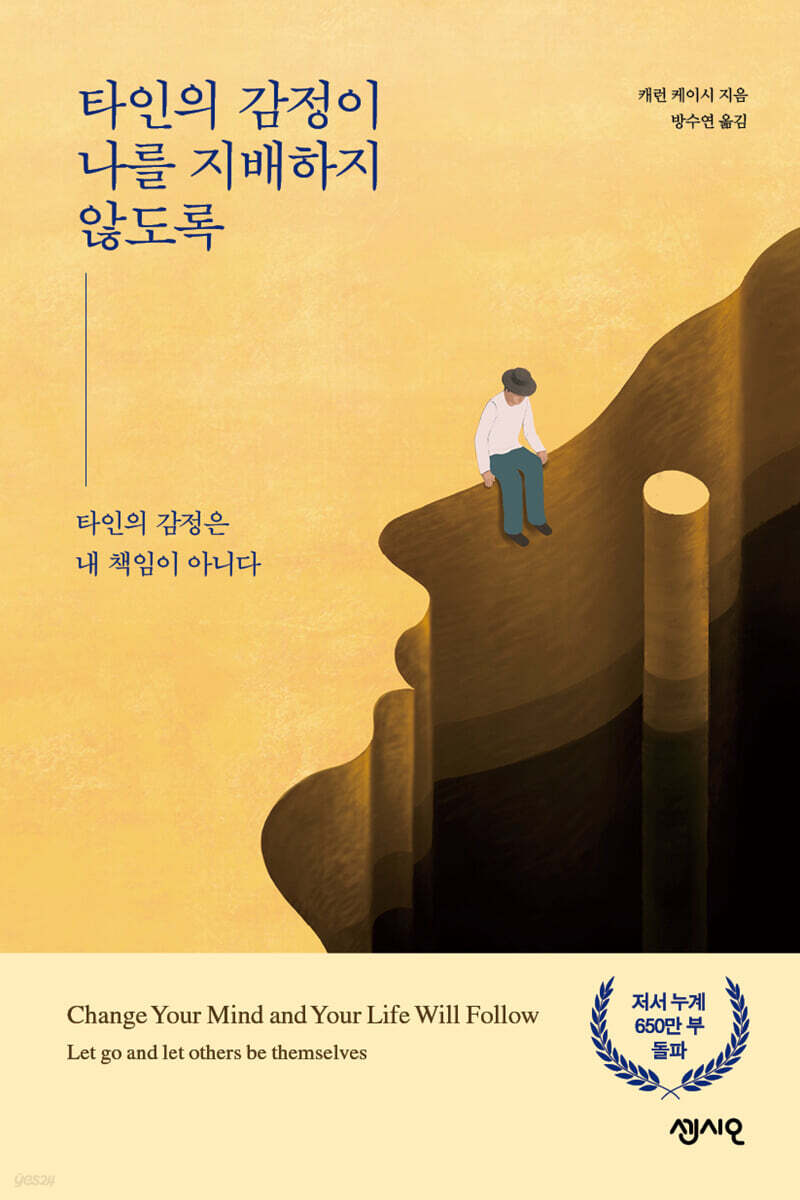 |
Description
Book Introduction
Other people's feelings are not my responsibility. A book titled "Don't Let Other People's Emotions Control You" has been published, advising people not to let other people's emotions determine their own moods. The reason the author says this is clear. Other people's feelings are not mine, so they are not my responsibility. He advises that peace of mind comes from focusing on your own life rather than letting others dictate how you spend your day. The author is Dr. Karen Casey, a leading American author in the field of psychological spirituality, whose books have been read by 6.7 million readers in over 40 countries around the world. The author, who had an unhappy childhood, divorce, and a life marked by alcoholism, says that for a long time he judged himself based on external stimuli from others. He confesses that he studied people's expressions to figure out his own worth, and that whenever someone frowned or said something harsh, his confidence and self-esteem gradually eroded. To escape this dark tunnel, I explored various spiritual paths and achieved complete recovery only after realizing that "I can decide for myself what kind of life I want to live, not others." The message I received at that time is being spread through books and lectures, and readers around the world are showing great sympathy. In this book, the author explains that in order to avoid being swayed by other people's emotions, you must first change your own thoughts. Because we cannot control how other people think and act. Since the only thing we can control is ourselves, we are urged to let others live their lives and listen to our inner voice instead of others. And I advise you to never forget that the choice is always yours and that you are always in the driver's seat of your mind. The book also explains 12 principles, including how to cultivate your inner garden without being swayed by the emotions of others. The warm and profound messages that come from the author's experiences in each sentence resonate deeply. This book is like a compass that helps us find and maintain peace of mind as we live in relationships with others. |
- You can preview some of the book's contents.
Preview
index
Preface to the Revised Edition
As I enter, I walk towards myself, not towards others.
Chapter 1: If I'm swayed by other people's feelings, I might lose myself.
Chapter 2: Small things are small
Chapter 3: Joy is Here Now
Chapter 4: It's faster to change your own mind than someone else's.
Chapter 5: Other People's Feelings Are Other People's
Chapter 6: When you separate yourself from me, peace comes.
Chapter 7: Let Go of Trying to Control Other People's Emotions
Chapter 8: When you point at someone with your finger, the other fingers point back at you.
Chapter 9: Practice One Thing Every Day and Your Life Will Change
Chapter 10 The self that chattering ceaselessly is far away
Chapter 11: We Are All Connected
Chapter 12: There are two voices in the heart, and one is always wrong.
Chapter 13 You Can't Change Your Life Overnight, But There Are Shortcuts
As I enter, I walk towards myself, not towards others.
Chapter 1: If I'm swayed by other people's feelings, I might lose myself.
Chapter 2: Small things are small
Chapter 3: Joy is Here Now
Chapter 4: It's faster to change your own mind than someone else's.
Chapter 5: Other People's Feelings Are Other People's
Chapter 6: When you separate yourself from me, peace comes.
Chapter 7: Let Go of Trying to Control Other People's Emotions
Chapter 8: When you point at someone with your finger, the other fingers point back at you.
Chapter 9: Practice One Thing Every Day and Your Life Will Change
Chapter 10 The self that chattering ceaselessly is far away
Chapter 11: We Are All Connected
Chapter 12: There are two voices in the heart, and one is always wrong.
Chapter 13 You Can't Change Your Life Overnight, But There Are Shortcuts
Detailed image

Into the book
I was walking down the streets of New York with a friend as usual.
We stopped together at a newsstand where a friend always stopped by to buy newspapers.
But upon closer inspection, I noticed that the stall owner was extremely rude even though he had received a large tip.
As I left the stall, I couldn't help but ask my friend why he was being so friendly to such a rude person.
My friend replied:
“Why should I let that person decide how my day will be?” My friend’s response was shocking.
It was then that I first vaguely realized that I could choose how I react to others, that I could interpret most of my life's experiences differently if I wanted to.
Since I was little, I've had the habit of judging my worth by looking at people's expressions.
Most of my family members had stiff faces or didn't even look at me.
Most of the time, if the other person frowned at me or said even a single harsh word, my confidence and self-esteem would gradually decline.
I tried to at least make eye contact, let alone speak directly, but it was rare for anyone to return my gaze, so I often felt like I was invisible at that time.
For a long time, I evaluated myself solely based on external stimuli.
Even though affection and attention were rare, I tried hard to confirm affection, but I ended up becoming discouraged and begging even more.
It's embarrassing to admit, but I've been living this way for a long time.
But fortunately, I now know that no one's actions—not my parents, not my friends, not my husband, not my boss—can influence my thoughts or actions.
It took me a long time to understand this, and even longer to actually accept it.
It took decades of effort before it was fully accepted.
But as a result, I gained a precious freedom that I can never give up.
--- p.68~69
As I quit drinking, I realized deeply that there are no coincidences.
There is a purpose to where we are, to where I am now.
Of course, you too.
Over the years that I've cultivated this perspective, I've explored various spiritual paths, but I've also tried to listen to the inner voice that I believe is the source of all knowledge.
Once I took the perspective that everything I needed to know was within me, every aspect of my life made sense and flowed effortlessly.
This perspective also influenced my decision-making.
It led me to write and publish dozens of books.
This book is about the power of perspective.
Abraham Lincoln said, “A man is about as happy as he makes up his mind to be.”
I like this idea.
When you think about it this way, life's challenges become simpler.
We can live a better life if we put our minds to it.
The choice is ours.
Wherever we go, we live the way we decide to live.
We decide.
This is a truly amazing fact.
It is up to us to decide whether we will live a bitter life or a sweet life.
At every moment, we decide whether we will respond with peace or with fear.
In fact, it doesn't take much effort to make life 'sweeter'.
All it takes is will.
It means the will to slightly change your perspective on the experiences you encounter on the path of life and your life partner.
We can choose to approach every person and event as an opportunity for peace, rather than perceiving it as a potential threat or obstacle.
Every time we choose a peaceful response, we open the way not only to our own happiness but also to a peaceful life.
This book introduces twelve principles that will help you heal yourself.
There are only twelve principles to learn, that's all.
Would you like to join us?
--- p.13~14
If you can continue to listen to your calm, gentle inner voice, you will have no reason to doubt the decisions you make.
If you seek the right place for spiritual nourishment, guidance, comfort, and peace, you will not be shaken.
If this message still seems faint to you, drowned out by the loud clamor of your ego, remember this:
If you express only love to everyone you meet on your life's journey, there is no goal you cannot achieve.
Yes, that's right.
If you are unsure, just show love, kindness, and comfort to everyone.
The guidance you seek will be revealed in kind acts.
Even if you are not sure, you may have contributed to peace in the process.
--- p.161
When someone 'openly' attacks me or picks a fight, I'm often overcome with the desire to retaliate.
In the past, in situations like that, I would have made up my mind to respond with even harsher and more vicious words.
My father and I easily fell into this kind of 'fight'.
I would get angry and get angry when my father attacked not only me but also my younger brother or my mother.
No one won.
My actions didn't help my mother either.
It was the same for my younger brother and me.
I thought there was a reason I was angry, but that reason quickly disappeared without a trace.
Instead, most of the time, I felt shame, guilt, embarrassment, or something more painful.
I've never felt good about looking back on my reactions.
Still, I had no intention of apologizing.
Being verbally or even physically 'attacked' doesn't necessarily mean you have to retaliate.
But at that time I didn't realize it.
When I was younger, walking away was seen as surrender, and I was consumed with the will to make my point.
I kept reacting like that.
I didn't understand that avoiding someone's presence didn't mean I agreed with them.
Rather, I didn't know that it was an active choice to get out of that situation.
And I had plenty of opportunities to practice avoiding the situation.
Those people were my father, my first husband, or my boss who I worked with for a long time.
Yet, until I recovered from my addiction, I never once interpreted the "aggression" as a sign that the abuser was afraid.
But in reality, that's the case most of the time.
--- p.32
When we let go of our desire to control everyone and every situation, we create time and opportunity to learn, change, and grow internally.
We come to know that we can move on to the next level of spiritual awareness that awaits us.
There's also the unexpected benefit of letting go of control and living peacefully with purpose: others often change in ways we'd hoped.
Isn't that ironic? A close friend once said this.
“The more you try to force things, the more difficult life becomes.” I wholeheartedly agree with this statement.
Trying to manipulate people or situations only drains your energy.
As I keep saying, it's not easy to accept that we are not the center of the universe, nor are we the center of anyone else's life.
At times like these, it helps to have someone to remind us that we're all just awkward beings on the same bus, and that this is nothing to be ashamed of.
Find solace in your clumsiness and live each day freely.
You will actually feel a great sense of relief.
--- p.105
You've probably heard and seen many times that if you want to be happy, you have to live completely in the present.
It is worth emphasizing that much.
Every time I see and hear it, I resolve to do the same.
And as we all know, focusing on the present takes practice! Most of us are very accustomed to living in the future.
When I was young, I planned the day I would drive.
When I was a teenager, I planned when I would go to college or get married, and when I got a job, I planned my first promotion and the next one.
Of course, there are positive aspects to thinking about the future.
You need to plan out your goals for life, both professionally and personally, so you can prepare accordingly.
The problem arises when we live our lives focused on future plans rather than present experiences.
Then you'll miss out on all the lessons life has to offer you every day.
We get too caught up in planning for the future, but at the same time we get stuck in the past.
As I said earlier, we often rely on past experiences to understand what is happening now.
But the moment you go back to the past to know the present, the present is no longer visible.
The present does not wait for us to know ourselves, to savor ourselves, to become enlightened and to feel gratitude.
That can't be possible.
The present disappears in an instant, the very moment you let your mind wander to another space and time.
--- p.44
When I first encountered the concept of 'letting go', I felt resistance.
That's understandable, because I'm the kind of person who believes in helping others make the right decisions and take the right actions.
I believed that if you love someone, you should do it even more.
I also thought that if there was a situation where intervention was necessary, it should be actively controlled.
I was convinced that was what I was interested in and what I should do.
But thanks to the mental practice of 'letting go,' I realized that anyone, including my spouse, family, friends, neighbors, and random strangers, should live as they are.
Everyone has to experience mistakes firsthand.
There should be reasons to celebrate the things you've learned along the way and the successes you've achieved.
There are many reasons why we should give up such useless behavior.
The most important reason is that controlling others can never be successful, and you can never experience peace in your life if you are always preoccupied with how others live or should live.
If you want to be at peace, let go of what life others choose.
And focus on just one life.
This is my own life.
We stopped together at a newsstand where a friend always stopped by to buy newspapers.
But upon closer inspection, I noticed that the stall owner was extremely rude even though he had received a large tip.
As I left the stall, I couldn't help but ask my friend why he was being so friendly to such a rude person.
My friend replied:
“Why should I let that person decide how my day will be?” My friend’s response was shocking.
It was then that I first vaguely realized that I could choose how I react to others, that I could interpret most of my life's experiences differently if I wanted to.
Since I was little, I've had the habit of judging my worth by looking at people's expressions.
Most of my family members had stiff faces or didn't even look at me.
Most of the time, if the other person frowned at me or said even a single harsh word, my confidence and self-esteem would gradually decline.
I tried to at least make eye contact, let alone speak directly, but it was rare for anyone to return my gaze, so I often felt like I was invisible at that time.
For a long time, I evaluated myself solely based on external stimuli.
Even though affection and attention were rare, I tried hard to confirm affection, but I ended up becoming discouraged and begging even more.
It's embarrassing to admit, but I've been living this way for a long time.
But fortunately, I now know that no one's actions—not my parents, not my friends, not my husband, not my boss—can influence my thoughts or actions.
It took me a long time to understand this, and even longer to actually accept it.
It took decades of effort before it was fully accepted.
But as a result, I gained a precious freedom that I can never give up.
--- p.68~69
As I quit drinking, I realized deeply that there are no coincidences.
There is a purpose to where we are, to where I am now.
Of course, you too.
Over the years that I've cultivated this perspective, I've explored various spiritual paths, but I've also tried to listen to the inner voice that I believe is the source of all knowledge.
Once I took the perspective that everything I needed to know was within me, every aspect of my life made sense and flowed effortlessly.
This perspective also influenced my decision-making.
It led me to write and publish dozens of books.
This book is about the power of perspective.
Abraham Lincoln said, “A man is about as happy as he makes up his mind to be.”
I like this idea.
When you think about it this way, life's challenges become simpler.
We can live a better life if we put our minds to it.
The choice is ours.
Wherever we go, we live the way we decide to live.
We decide.
This is a truly amazing fact.
It is up to us to decide whether we will live a bitter life or a sweet life.
At every moment, we decide whether we will respond with peace or with fear.
In fact, it doesn't take much effort to make life 'sweeter'.
All it takes is will.
It means the will to slightly change your perspective on the experiences you encounter on the path of life and your life partner.
We can choose to approach every person and event as an opportunity for peace, rather than perceiving it as a potential threat or obstacle.
Every time we choose a peaceful response, we open the way not only to our own happiness but also to a peaceful life.
This book introduces twelve principles that will help you heal yourself.
There are only twelve principles to learn, that's all.
Would you like to join us?
--- p.13~14
If you can continue to listen to your calm, gentle inner voice, you will have no reason to doubt the decisions you make.
If you seek the right place for spiritual nourishment, guidance, comfort, and peace, you will not be shaken.
If this message still seems faint to you, drowned out by the loud clamor of your ego, remember this:
If you express only love to everyone you meet on your life's journey, there is no goal you cannot achieve.
Yes, that's right.
If you are unsure, just show love, kindness, and comfort to everyone.
The guidance you seek will be revealed in kind acts.
Even if you are not sure, you may have contributed to peace in the process.
--- p.161
When someone 'openly' attacks me or picks a fight, I'm often overcome with the desire to retaliate.
In the past, in situations like that, I would have made up my mind to respond with even harsher and more vicious words.
My father and I easily fell into this kind of 'fight'.
I would get angry and get angry when my father attacked not only me but also my younger brother or my mother.
No one won.
My actions didn't help my mother either.
It was the same for my younger brother and me.
I thought there was a reason I was angry, but that reason quickly disappeared without a trace.
Instead, most of the time, I felt shame, guilt, embarrassment, or something more painful.
I've never felt good about looking back on my reactions.
Still, I had no intention of apologizing.
Being verbally or even physically 'attacked' doesn't necessarily mean you have to retaliate.
But at that time I didn't realize it.
When I was younger, walking away was seen as surrender, and I was consumed with the will to make my point.
I kept reacting like that.
I didn't understand that avoiding someone's presence didn't mean I agreed with them.
Rather, I didn't know that it was an active choice to get out of that situation.
And I had plenty of opportunities to practice avoiding the situation.
Those people were my father, my first husband, or my boss who I worked with for a long time.
Yet, until I recovered from my addiction, I never once interpreted the "aggression" as a sign that the abuser was afraid.
But in reality, that's the case most of the time.
--- p.32
When we let go of our desire to control everyone and every situation, we create time and opportunity to learn, change, and grow internally.
We come to know that we can move on to the next level of spiritual awareness that awaits us.
There's also the unexpected benefit of letting go of control and living peacefully with purpose: others often change in ways we'd hoped.
Isn't that ironic? A close friend once said this.
“The more you try to force things, the more difficult life becomes.” I wholeheartedly agree with this statement.
Trying to manipulate people or situations only drains your energy.
As I keep saying, it's not easy to accept that we are not the center of the universe, nor are we the center of anyone else's life.
At times like these, it helps to have someone to remind us that we're all just awkward beings on the same bus, and that this is nothing to be ashamed of.
Find solace in your clumsiness and live each day freely.
You will actually feel a great sense of relief.
--- p.105
You've probably heard and seen many times that if you want to be happy, you have to live completely in the present.
It is worth emphasizing that much.
Every time I see and hear it, I resolve to do the same.
And as we all know, focusing on the present takes practice! Most of us are very accustomed to living in the future.
When I was young, I planned the day I would drive.
When I was a teenager, I planned when I would go to college or get married, and when I got a job, I planned my first promotion and the next one.
Of course, there are positive aspects to thinking about the future.
You need to plan out your goals for life, both professionally and personally, so you can prepare accordingly.
The problem arises when we live our lives focused on future plans rather than present experiences.
Then you'll miss out on all the lessons life has to offer you every day.
We get too caught up in planning for the future, but at the same time we get stuck in the past.
As I said earlier, we often rely on past experiences to understand what is happening now.
But the moment you go back to the past to know the present, the present is no longer visible.
The present does not wait for us to know ourselves, to savor ourselves, to become enlightened and to feel gratitude.
That can't be possible.
The present disappears in an instant, the very moment you let your mind wander to another space and time.
--- p.44
When I first encountered the concept of 'letting go', I felt resistance.
That's understandable, because I'm the kind of person who believes in helping others make the right decisions and take the right actions.
I believed that if you love someone, you should do it even more.
I also thought that if there was a situation where intervention was necessary, it should be actively controlled.
I was convinced that was what I was interested in and what I should do.
But thanks to the mental practice of 'letting go,' I realized that anyone, including my spouse, family, friends, neighbors, and random strangers, should live as they are.
Everyone has to experience mistakes firsthand.
There should be reasons to celebrate the things you've learned along the way and the successes you've achieved.
There are many reasons why we should give up such useless behavior.
The most important reason is that controlling others can never be successful, and you can never experience peace in your life if you are always preoccupied with how others live or should live.
If you want to be at peace, let go of what life others choose.
And focus on just one life.
This is my own life.
--- p.19~20
Publisher's Review
If you are always concerned about others and not yourself…
“I remember as a child, trying to figure out if I was the reason my father was constantly angry and my mother was sad.
“I naturally developed the habit of looking at my parents’ faces because I didn’t know what to feel or what to do.”
Dr. Casey, author of "Don't Let Other People's Feelings Control You," was an alcoholic.
From a young age, I was raised in an environment where addictions such as alcohol and cigarettes were easily accessible. I chose college to escape from such a home, and I chose marriage to live as I pleased.
“I reluctantly entered college, and at the time, I was focused on finding a husband who loved to party.”
Dr. Casey, who had been swayed and dependent on others, found a new life through one choice a day. "Don't Let Others' Emotions Control Me" is a navigation guide that guides her on that journey.
Other people's feelings are their own
Let them live their lives
How can we live peacefully without worrying about others? Dr. Casey says it's about detaching yourself from the emotions of others.
And he says that in order to escape from other people's feelings, you just have to change your own behavior.
What a clear and wonderful way this is.
Remember! When I accept that I cannot control others' thoughts and actions, and separate myself from them, my life and the world change.
“I was walking down the street in New York with a friend.
We stopped together at a newsstand to buy newspapers.
However, the stall owner was very rude even though he had received a large tip.
Yet, my friend treated the stall owner with such a peaceful expression.
As I walked away from the stall, I couldn't help but ask my friend why he was being so friendly to such a rude person.
My friend replied:
"Why should I let that person decide how I spend my day?" My friend's response was shocking.
In this way, we can choose peace in the face of others' uncomfortable feelings and actions.
Like Powell's friend who responded kindly to the rudeness of the annoying stall owner.
Other people's feelings and attitudes are not mine and therefore not my responsibility.
The author emphasizes that since the only thing we can control is ourselves, we should let others live their own lives and return to dealing with how we respond to our own lives, not others.
We can choose peace.
Only then will we obtain the peace we seek and deserve.
There is always a choice
The decision is always yours
You can decide and choose whether you want to live a bitter life or a sweet life.
Every moment we encounter and encounter with people, we decide whether to respond with peace or fear.
In fact, it doesn't take much effort to make life 'sweeter'.
But will is needed.
You can choose whether to view every person and event you encounter on your life's path as a potential threat or obstacle, or as an opportunity for peace.
You just need to learn 12 principles.
That's all.
Won't you join us?
“I remember as a child, trying to figure out if I was the reason my father was constantly angry and my mother was sad.
“I naturally developed the habit of looking at my parents’ faces because I didn’t know what to feel or what to do.”
Dr. Casey, author of "Don't Let Other People's Feelings Control You," was an alcoholic.
From a young age, I was raised in an environment where addictions such as alcohol and cigarettes were easily accessible. I chose college to escape from such a home, and I chose marriage to live as I pleased.
“I reluctantly entered college, and at the time, I was focused on finding a husband who loved to party.”
Dr. Casey, who had been swayed and dependent on others, found a new life through one choice a day. "Don't Let Others' Emotions Control Me" is a navigation guide that guides her on that journey.
Other people's feelings are their own
Let them live their lives
How can we live peacefully without worrying about others? Dr. Casey says it's about detaching yourself from the emotions of others.
And he says that in order to escape from other people's feelings, you just have to change your own behavior.
What a clear and wonderful way this is.
Remember! When I accept that I cannot control others' thoughts and actions, and separate myself from them, my life and the world change.
“I was walking down the street in New York with a friend.
We stopped together at a newsstand to buy newspapers.
However, the stall owner was very rude even though he had received a large tip.
Yet, my friend treated the stall owner with such a peaceful expression.
As I walked away from the stall, I couldn't help but ask my friend why he was being so friendly to such a rude person.
My friend replied:
"Why should I let that person decide how I spend my day?" My friend's response was shocking.
In this way, we can choose peace in the face of others' uncomfortable feelings and actions.
Like Powell's friend who responded kindly to the rudeness of the annoying stall owner.
Other people's feelings and attitudes are not mine and therefore not my responsibility.
The author emphasizes that since the only thing we can control is ourselves, we should let others live their own lives and return to dealing with how we respond to our own lives, not others.
We can choose peace.
Only then will we obtain the peace we seek and deserve.
There is always a choice
The decision is always yours
You can decide and choose whether you want to live a bitter life or a sweet life.
Every moment we encounter and encounter with people, we decide whether to respond with peace or fear.
In fact, it doesn't take much effort to make life 'sweeter'.
But will is needed.
You can choose whether to view every person and event you encounter on your life's path as a potential threat or obstacle, or as an opportunity for peace.
You just need to learn 12 principles.
That's all.
Won't you join us?
GOODS SPECIFICS
- Date of issue: October 17, 2023
- Page count, weight, size: 224 pages | 348g | 166*236*13mm
- ISBN13: 9791166571237
- ISBN10: 1166571238
You may also like
카테고리
korean


korean

![GQ KOREA Mark (Monthly): December [2025]](http://librairie.coreenne.fr/cdn/shop/files/8ef265dbbfbf186523ed75ba7319009d.jpg?v=1765340328&width=3840)


