

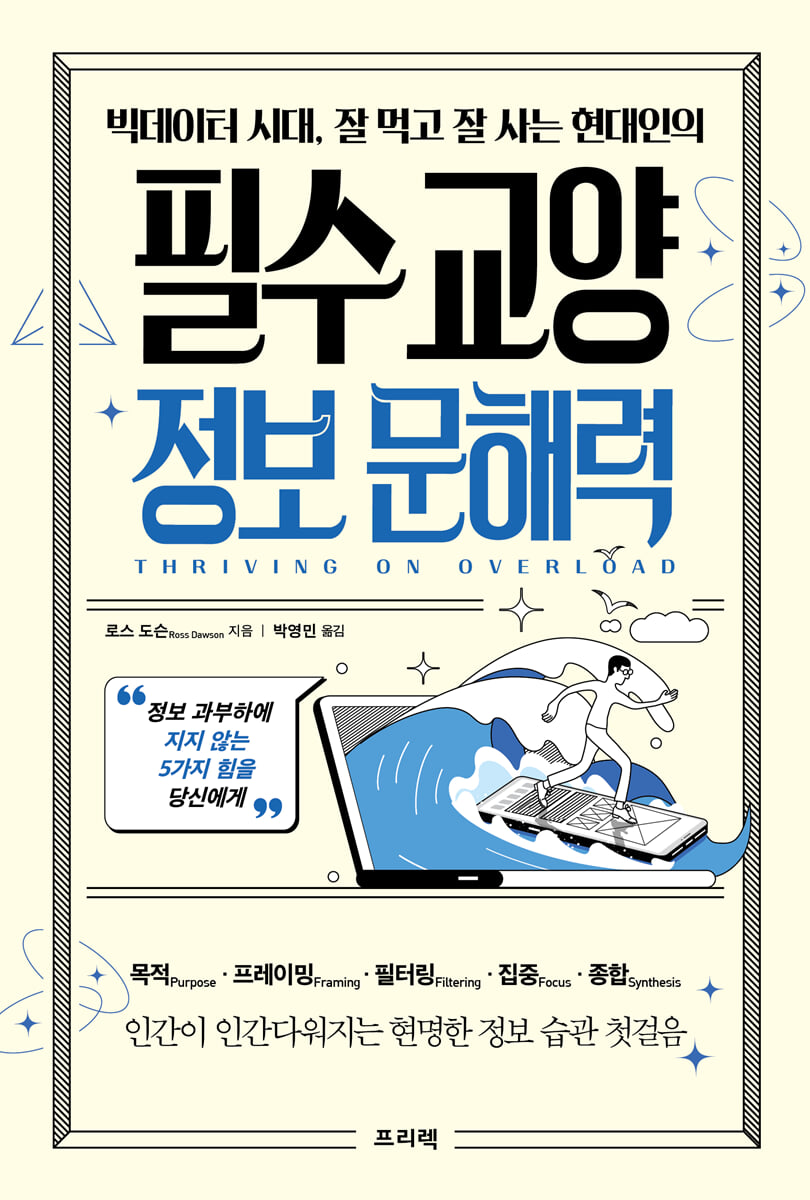
In the era of big data, information literacy is essential for modern people who want to eat well and live well.
 |
Description
Book Introduction
“Are you going to be overwhelmed by information overload, or are you going to learn how to thrive in overload?”
In this age of information overload, information literacy is essential to eating well and living well!
The world changes so rapidly that we can't even recognize it every day. The vast ocean of information is no longer a mere rhetoric; it's a reality right before our eyes.
There's so much to see and so much to do.
The overwhelming information overload threatens to drown us, but it also holds the economic and spiritual resources of all that is valuable today.
The ability to properly read and wisely utilize this infinite amount of information is the most powerful force for achieving success and happiness today.
‘Information literacy’ is the key that determines our daily lives, lives, careers, and success.
However, when asked what 'how to handle information well' is, it is difficult to give a straight answer.
Here's a clear answer, based on 25 years of research by renowned futurist Ross Dawson.
Let's develop five capabilities that will evolve our brains into 'information brains.'
First, understand why you are looking for information, and then create a framework to turn that information into meaningful patterns.
Let's filter out the information that is valuable to me through that framework.
Maximize your efficiency by utilizing 200% of your time in 6 focus modes.
By combining these four forces and creatively integrating ideas, you can seize opportunities and make better decisions.
This book's clear vision, systematic guidance, helpful tips, and questions will help you develop information habits and strategies that will help you distill information overload into "my rich expertise, sharp insights, and higher performance."
The moment you acquire information literacy, success and prosperity in this era will come to you.
In this age of information overload, information literacy is essential to eating well and living well!
The world changes so rapidly that we can't even recognize it every day. The vast ocean of information is no longer a mere rhetoric; it's a reality right before our eyes.
There's so much to see and so much to do.
The overwhelming information overload threatens to drown us, but it also holds the economic and spiritual resources of all that is valuable today.
The ability to properly read and wisely utilize this infinite amount of information is the most powerful force for achieving success and happiness today.
‘Information literacy’ is the key that determines our daily lives, lives, careers, and success.
However, when asked what 'how to handle information well' is, it is difficult to give a straight answer.
Here's a clear answer, based on 25 years of research by renowned futurist Ross Dawson.
Let's develop five capabilities that will evolve our brains into 'information brains.'
First, understand why you are looking for information, and then create a framework to turn that information into meaningful patterns.
Let's filter out the information that is valuable to me through that framework.
Maximize your efficiency by utilizing 200% of your time in 6 focus modes.
By combining these four forces and creatively integrating ideas, you can seize opportunities and make better decisions.
This book's clear vision, systematic guidance, helpful tips, and questions will help you develop information habits and strategies that will help you distill information overload into "my rich expertise, sharp insights, and higher performance."
The moment you acquire information literacy, success and prosperity in this era will come to you.
- You can preview some of the book's contents.
Preview
index
Recommendation
Translator's Note
introduction.
Learn to succeed
Five Keys to Success in the Age of Information Overload
___Competency 1.
Purpose | Purpose
___Competency 2.
Framing
___Competency 3.
Filtering | Filtering
___Competency 4.
Focus | Focus
___Competency 5.
Synthesis
paradoxical combination
How to read this book
Learn to be free
Chapter 1.
The Power of Purpose
Identity | Identity
Expertise | Expertise
Startups | Ventures
Social Community | Society
Well-being | Well-Being
Passion | Passion
In the flood of information
#Creating your first puzzle
#Sneak peek at the first puzzle
Chapter 2.
The power of framing
Conceptual framework
___A map that predicts the future
Producing knowledge
___pattern recognition and pattern formation
___The power of visual thinking
frame one's thoughts
___First Frame: Tree
___Second Frame: Network
___Third Frame: System
___Another framework: Writing and connecting notes
Framework for communication
A framework for the future
Predictions for ___'Sensemaking'
___Scenario Signal
Create your own visual framework
#Creating a second puzzle
#Second Puzzle Peek
Chapter 3.
The power of filtering
Overcoming Overload
___What information would be helpful?
Overcoming Bias
___probabilistic thinking
___Explore Surprises
___Time value of information
Finding treasure among the nonsense
___Go to original source
Select a portal
___Diverse information portfolio
___Media
___people
___RSS Feed
___algorithm
___Media Aggregator
Building an Information Portfolio
___Diversify media formats
The power of curation
Inbound filtering
Setting the standard for ___'yes'
#Making the third puzzle
#A sneak peek at the third puzzle
Chapter 4.
The power of concentration
Target interference
6 focus modes
___focus time block
___Detecting | Scanning
___Explore | Seeking
Assimilating
Deep-Diving
___Exploring | Exploring
___Recovering | Regenerating
The importance of information routines
___Chronotype Optimization
___Timeboxing information processing
___Things to consider when setting up an information routine
Overcoming information addiction
___Techniques that enhance freedom and choice
Enhance concentration
___Meditation and Awareness
___How to start meditating
___Awareness Practice
#Creating the fourth puzzle
#A sneak peek at the fourth puzzle
Chapter 5.
The power of synthesis
Comprehensive Competence and Human Development
___Benefits of holistic thinking
Your mental model
___tacit wisdom
Five Sources of Comprehensive Competence
___1.
Openness to ideas
___2.
Creative Connections
___3.
Integrative thinking
___4.
Richer mental models
___5.
Cognitive state suitable for insight
Informed Decisions in an Uncertain World
___Repeated decision making
___Betting, making a bet and deciding
___Think of the opposing view
Comprehensive Capabilities and the Future of Humanity
#Creating the fifth puzzle
#Peek at the fifth puzzle
Chapter 6.
From excess to abundance
Integrating the Five Competencies
___Steps toward prosperity
Opportunities in a Future of Information Overload
___Better tools
___The danger of polarization
___Information Literacy Curriculum
cognitive evolution
Today's prosperity leads to tomorrow
#Making the sixth puzzle
#Sneak Peek at the Sixth Puzzle
supplement.
Information Literacy Resource Center
Acknowledgements
Search
Translator's Note
introduction.
Learn to succeed
Five Keys to Success in the Age of Information Overload
___Competency 1.
Purpose | Purpose
___Competency 2.
Framing
___Competency 3.
Filtering | Filtering
___Competency 4.
Focus | Focus
___Competency 5.
Synthesis
paradoxical combination
How to read this book
Learn to be free
Chapter 1.
The Power of Purpose
Identity | Identity
Expertise | Expertise
Startups | Ventures
Social Community | Society
Well-being | Well-Being
Passion | Passion
In the flood of information
#Creating your first puzzle
#Sneak peek at the first puzzle
Chapter 2.
The power of framing
Conceptual framework
___A map that predicts the future
Producing knowledge
___pattern recognition and pattern formation
___The power of visual thinking
frame one's thoughts
___First Frame: Tree
___Second Frame: Network
___Third Frame: System
___Another framework: Writing and connecting notes
Framework for communication
A framework for the future
Predictions for ___'Sensemaking'
___Scenario Signal
Create your own visual framework
#Creating a second puzzle
#Second Puzzle Peek
Chapter 3.
The power of filtering
Overcoming Overload
___What information would be helpful?
Overcoming Bias
___probabilistic thinking
___Explore Surprises
___Time value of information
Finding treasure among the nonsense
___Go to original source
Select a portal
___Diverse information portfolio
___Media
___people
___RSS Feed
___algorithm
___Media Aggregator
Building an Information Portfolio
___Diversify media formats
The power of curation
Inbound filtering
Setting the standard for ___'yes'
#Making the third puzzle
#A sneak peek at the third puzzle
Chapter 4.
The power of concentration
Target interference
6 focus modes
___focus time block
___Detecting | Scanning
___Explore | Seeking
Assimilating
Deep-Diving
___Exploring | Exploring
___Recovering | Regenerating
The importance of information routines
___Chronotype Optimization
___Timeboxing information processing
___Things to consider when setting up an information routine
Overcoming information addiction
___Techniques that enhance freedom and choice
Enhance concentration
___Meditation and Awareness
___How to start meditating
___Awareness Practice
#Creating the fourth puzzle
#A sneak peek at the fourth puzzle
Chapter 5.
The power of synthesis
Comprehensive Competence and Human Development
___Benefits of holistic thinking
Your mental model
___tacit wisdom
Five Sources of Comprehensive Competence
___1.
Openness to ideas
___2.
Creative Connections
___3.
Integrative thinking
___4.
Richer mental models
___5.
Cognitive state suitable for insight
Informed Decisions in an Uncertain World
___Repeated decision making
___Betting, making a bet and deciding
___Think of the opposing view
Comprehensive Capabilities and the Future of Humanity
#Creating the fifth puzzle
#Peek at the fifth puzzle
Chapter 6.
From excess to abundance
Integrating the Five Competencies
___Steps toward prosperity
Opportunities in a Future of Information Overload
___Better tools
___The danger of polarization
___Information Literacy Curriculum
cognitive evolution
Today's prosperity leads to tomorrow
#Making the sixth puzzle
#Sneak Peek at the Sixth Puzzle
supplement.
Information Literacy Resource Center
Acknowledgements
Search
Detailed image

Into the book
"Information Literacy: Essential Knowledge for Modern People Who Eat Well and Live Well in the Big Data Era" begins with the fundamental premise that our identity, life, and destiny are determined by our interrelationship with information.
Humans exist in an environment full of information.
Information is everything we receive through our senses, and its scope and depth are expanding day by day.
Because every type of content imaginable is exploding.
We must learn how to thrive in an information-intensive world we have never experienced before.
This learning is very practical and may be an essential part of human evolution.
--- p.16, from “Preface_Talking about Success”
I have no doubt that each of us has a fundamental choice when it comes to navigating information overload.
Will you be overwhelmed by information overload, or will you learn to thrive in this overload? You and I have been born into an era of unprecedented change, living in an environment where anyone can access an explosive amount of information.
It is up to each of us to decide whether we view this reality as a problem to be solved or as an opportunity for growth and development.
--- p.25, from “Preface_Talking about Success”
The goal of this book is not to help you find your life's purpose.
Rather, in a world where information is the core of life and livelihood, we want to help you thrive without being swayed by it.
The essential first step to avoid being overwhelmed by information overload is to be conscious of what you want from work and life.
Only then will I understand the role information plays in my life, discern what is useful to me and what is not, and use it in the most productive way possible.
--- p.29, from “Chapter 1_The Power of Purpose”
The word 'purpose' carries considerable weight.
We can see this in the way self-development experts constantly emphasize finding your purpose in life.
We all act with intention every day, whether or not we've discovered our "why."
And yet, a significant portion of our waking hours are spent dealing with countless different forms of information.
Therefore, to ensure that our journey with information doesn't lead us astray, it's essential to know 'why we do this.'
Make your intentions clear.
Then you will be able to properly define your relationship with the information that is most beneficial to you.
Your information habits should be shaped by your unique priorities.
--- p.32, from “Chapter 1_The Power of Purpose”
For us, who are constantly being sucked into a vortex of information today, the most dangerous thing is not being able to step back and see the bigger picture.
Having a unique perspective allows you to digest the deluge of information, identify connections and priorities, and uncover the insights you need to achieve your goals.
Our intention should not be to conquer the torrent of information.
Such goals only endanger us and keep us stuck in a never-ending cycle of updates.
It is our job to produce useful knowledge, understand the nature of what we are doing, and accurately predict the consequences of our actions.
In short, as we struggle to understand the world, we must both create and recognize 'patterns' to do so.
--- p.66, from “Chapter 2_The Power of Framing”
Curating information with others in mind, as well as yourself, is a very useful guide in the process of filtering and understanding information.
Filtering is not a mindless search for information.
It serves as a crucial tool to avoid being swept away by the information overload by assessing and sometimes preempting the incoming information flow.
--- p.116, from “Chapter 3_The Power of Filtering”
Our brain operates in different states depending on the situation.
Neurological patterns vary significantly depending on whether we're watching a movie, studying for a test, browsing social media, showering, or engaging in another activity.
However, maintaining one of these mental states for too long is not only impossible, but also undesirable.
The role of each focus mode is to create the life we want.
The trick is determining when each focus mode is most useful to you on your journey with information.
--- p.175, from “Chapter 4_The Power of Concentration”
In an economy built on information abundance, who creates the most value? It's the individual with the ability to synthesize diverse factors.
In other words, people who can grasp the big picture, build expertise, make better, more informed decisions, seize opportunities, and stay ahead of machines.
The ultimate moment when comprehensive capabilities shine is when you make better decisions.
Decisions that foster learning, refine our judgments about possibilities, and tolerate conflicting ideas are the path to greatest success in these times of extreme uncertainty.
--- p.218, from “Chapter 5_The Power of Synthesis”
First, we must recognize that information literacy is fundamental to all human endeavors and an essential skill for success in many areas of work and life.
With this awareness in mind, educators and leaders should prioritize and design systems that enhance educational and work environments that promote information literacy.
Look at the successful people around you.
The most successful people are actually those who have learned to make the most of information overload.
Even those people could benefit from a clear focus on improving their daily information habits through education.
Let alone ordinary people.
Humans exist in an environment full of information.
Information is everything we receive through our senses, and its scope and depth are expanding day by day.
Because every type of content imaginable is exploding.
We must learn how to thrive in an information-intensive world we have never experienced before.
This learning is very practical and may be an essential part of human evolution.
--- p.16, from “Preface_Talking about Success”
I have no doubt that each of us has a fundamental choice when it comes to navigating information overload.
Will you be overwhelmed by information overload, or will you learn to thrive in this overload? You and I have been born into an era of unprecedented change, living in an environment where anyone can access an explosive amount of information.
It is up to each of us to decide whether we view this reality as a problem to be solved or as an opportunity for growth and development.
--- p.25, from “Preface_Talking about Success”
The goal of this book is not to help you find your life's purpose.
Rather, in a world where information is the core of life and livelihood, we want to help you thrive without being swayed by it.
The essential first step to avoid being overwhelmed by information overload is to be conscious of what you want from work and life.
Only then will I understand the role information plays in my life, discern what is useful to me and what is not, and use it in the most productive way possible.
--- p.29, from “Chapter 1_The Power of Purpose”
The word 'purpose' carries considerable weight.
We can see this in the way self-development experts constantly emphasize finding your purpose in life.
We all act with intention every day, whether or not we've discovered our "why."
And yet, a significant portion of our waking hours are spent dealing with countless different forms of information.
Therefore, to ensure that our journey with information doesn't lead us astray, it's essential to know 'why we do this.'
Make your intentions clear.
Then you will be able to properly define your relationship with the information that is most beneficial to you.
Your information habits should be shaped by your unique priorities.
--- p.32, from “Chapter 1_The Power of Purpose”
For us, who are constantly being sucked into a vortex of information today, the most dangerous thing is not being able to step back and see the bigger picture.
Having a unique perspective allows you to digest the deluge of information, identify connections and priorities, and uncover the insights you need to achieve your goals.
Our intention should not be to conquer the torrent of information.
Such goals only endanger us and keep us stuck in a never-ending cycle of updates.
It is our job to produce useful knowledge, understand the nature of what we are doing, and accurately predict the consequences of our actions.
In short, as we struggle to understand the world, we must both create and recognize 'patterns' to do so.
--- p.66, from “Chapter 2_The Power of Framing”
Curating information with others in mind, as well as yourself, is a very useful guide in the process of filtering and understanding information.
Filtering is not a mindless search for information.
It serves as a crucial tool to avoid being swept away by the information overload by assessing and sometimes preempting the incoming information flow.
--- p.116, from “Chapter 3_The Power of Filtering”
Our brain operates in different states depending on the situation.
Neurological patterns vary significantly depending on whether we're watching a movie, studying for a test, browsing social media, showering, or engaging in another activity.
However, maintaining one of these mental states for too long is not only impossible, but also undesirable.
The role of each focus mode is to create the life we want.
The trick is determining when each focus mode is most useful to you on your journey with information.
--- p.175, from “Chapter 4_The Power of Concentration”
In an economy built on information abundance, who creates the most value? It's the individual with the ability to synthesize diverse factors.
In other words, people who can grasp the big picture, build expertise, make better, more informed decisions, seize opportunities, and stay ahead of machines.
The ultimate moment when comprehensive capabilities shine is when you make better decisions.
Decisions that foster learning, refine our judgments about possibilities, and tolerate conflicting ideas are the path to greatest success in these times of extreme uncertainty.
--- p.218, from “Chapter 5_The Power of Synthesis”
First, we must recognize that information literacy is fundamental to all human endeavors and an essential skill for success in many areas of work and life.
With this awareness in mind, educators and leaders should prioritize and design systems that enhance educational and work environments that promote information literacy.
Look at the successful people around you.
The most successful people are actually those who have learned to make the most of information overload.
Even those people could benefit from a clear focus on improving their daily information habits through education.
Let alone ordinary people.
--- p.272, from “Chapter 6_From Excess to Abundance”
Publisher's Review
In the information age, the first step toward developing wise information habits that will make humans more human.
Join us for success with the 5 powers of information literacy.
Introducing "information literacy," a skill essential for success amidst the maelstrom of tremendous change! These five inseparable competencies form a single, organic whole.
When these forces are combined and unleashed together, a superpower emerges that surpasses the simple sum of their individual capabilities, enabling you to stand tall and unburdened by the deluge of information.
1.
Purpose: Find the 'why'
In a world overflowing with information, it's essential to consciously improve our relationship with it.
To do so, we must have a clear purpose: 'why' we are trying to keep up with the endless stream of information.
There are six areas in our lives where we should examine our purpose for engaging with information.
These are identity, expertise, entrepreneurship, social community, well-being, and passion.
Note that this does not set a permanent, unchanging goal.
The goal is to make information exploration an ongoing journey, concretizing what you want and illuminating the path you want to take.
The goal is to improve your relationship with information and gain a clearer understanding of your career path.
2.
Framing: Map Your Thoughts
Fragmented information is meaningless.
For the information you acquire to be meaningful, you need to be able to understand the relationships between the information, identify consistent patterns, and build a framework that explains the connections between elements.
This framework clearly defines your scope of interest and expertise, and tells you where to focus your efforts.
It also allows us to understand new ideas and information within a contextual framework.
This book will show you a variety of ways to distill information and establish a framework that will refine your expertise and insights.
3.
Filtering: Weed out the useful stuff
It is a well-known fact that human cognitive abilities have limitations.
You need to cast a wide net to discover information relevant to you, but you don't want to harvest so much information that your brain can't process it.
I need to learn how to filter out information that is helpful to me, and how to overcome my own biases to find the pearls.
We'll explain the portfolio selection criteria, which form the basis of your information consumption habits, one by one.
On the one hand, we all face a torrent of information that comes crashing down on us like a bigger wave.
By developing and clearly utilizing filters to filter out the influx of information, you can reduce the amount of information you have to process each day.
4.
Focus: Distribute your consciousness according to your intention.
We know that we must focus on what is important and not be distracted by what is not.
However, attention is not a single entity divided into presence or absence.
There are times when we are drowning in dense information and need to extract insights and develop a framework for thinking.
Sometimes you have to wander around here and there to find specific information.
However, keep in mind that your 'attention' is a finite resource, and you must also learn how to regain your focus.
We'll show you six focus modes you need to discover value in information.
5.
Synthesis: Develop creative integration skills.
Synthesis is the act of connecting and integrating multiple fragmented concepts, and is one of the most unique abilities humans possess.
Its value has grown even more recently as artificial intelligence has emerged, demonstrating superior capabilities to humans and beginning to replace us in various fields.
Fundamentally, we need to be open to new ideas.
This openness is a great advantage for us living in an accelerating world.
Another important skill we learn is to creatively capture connections between ideas.
This enriches the mental models in our heads, which are at the core of our thinking ability.
As your overall capabilities grow, you will ultimately be able to make better decisions and achieve more successful outcomes.
[Information Literacy: Highly Recommended for These People]
● When I wake up in the morning, I first access the internet and social media with my smartphone.
● I am exhausted and confused by the flood of information and don't know what is important.
● I can't stand feeling anxious if I don't keep checking the news.
● I am busy and tired every day, and I am constantly distracted, so it is very difficult to concentrate.
● There are so many things to see and do that it is not easy to choose or decide what to do first.
If any of these apply to you, you need information literacy.
Master the five powers of information literacy, confidently ride the wave of information, and choose freedom and prosperity!
Join us for success with the 5 powers of information literacy.
Introducing "information literacy," a skill essential for success amidst the maelstrom of tremendous change! These five inseparable competencies form a single, organic whole.
When these forces are combined and unleashed together, a superpower emerges that surpasses the simple sum of their individual capabilities, enabling you to stand tall and unburdened by the deluge of information.
1.
Purpose: Find the 'why'
In a world overflowing with information, it's essential to consciously improve our relationship with it.
To do so, we must have a clear purpose: 'why' we are trying to keep up with the endless stream of information.
There are six areas in our lives where we should examine our purpose for engaging with information.
These are identity, expertise, entrepreneurship, social community, well-being, and passion.
Note that this does not set a permanent, unchanging goal.
The goal is to make information exploration an ongoing journey, concretizing what you want and illuminating the path you want to take.
The goal is to improve your relationship with information and gain a clearer understanding of your career path.
2.
Framing: Map Your Thoughts
Fragmented information is meaningless.
For the information you acquire to be meaningful, you need to be able to understand the relationships between the information, identify consistent patterns, and build a framework that explains the connections between elements.
This framework clearly defines your scope of interest and expertise, and tells you where to focus your efforts.
It also allows us to understand new ideas and information within a contextual framework.
This book will show you a variety of ways to distill information and establish a framework that will refine your expertise and insights.
3.
Filtering: Weed out the useful stuff
It is a well-known fact that human cognitive abilities have limitations.
You need to cast a wide net to discover information relevant to you, but you don't want to harvest so much information that your brain can't process it.
I need to learn how to filter out information that is helpful to me, and how to overcome my own biases to find the pearls.
We'll explain the portfolio selection criteria, which form the basis of your information consumption habits, one by one.
On the one hand, we all face a torrent of information that comes crashing down on us like a bigger wave.
By developing and clearly utilizing filters to filter out the influx of information, you can reduce the amount of information you have to process each day.
4.
Focus: Distribute your consciousness according to your intention.
We know that we must focus on what is important and not be distracted by what is not.
However, attention is not a single entity divided into presence or absence.
There are times when we are drowning in dense information and need to extract insights and develop a framework for thinking.
Sometimes you have to wander around here and there to find specific information.
However, keep in mind that your 'attention' is a finite resource, and you must also learn how to regain your focus.
We'll show you six focus modes you need to discover value in information.
5.
Synthesis: Develop creative integration skills.
Synthesis is the act of connecting and integrating multiple fragmented concepts, and is one of the most unique abilities humans possess.
Its value has grown even more recently as artificial intelligence has emerged, demonstrating superior capabilities to humans and beginning to replace us in various fields.
Fundamentally, we need to be open to new ideas.
This openness is a great advantage for us living in an accelerating world.
Another important skill we learn is to creatively capture connections between ideas.
This enriches the mental models in our heads, which are at the core of our thinking ability.
As your overall capabilities grow, you will ultimately be able to make better decisions and achieve more successful outcomes.
[Information Literacy: Highly Recommended for These People]
● When I wake up in the morning, I first access the internet and social media with my smartphone.
● I am exhausted and confused by the flood of information and don't know what is important.
● I can't stand feeling anxious if I don't keep checking the news.
● I am busy and tired every day, and I am constantly distracted, so it is very difficult to concentrate.
● There are so many things to see and do that it is not easy to choose or decide what to do first.
If any of these apply to you, you need information literacy.
Master the five powers of information literacy, confidently ride the wave of information, and choose freedom and prosperity!
GOODS SPECIFICS
- Date of issue: September 1, 2023
- Page count, weight, size: 296 pages | 520g | 152*225*17mm
- ISBN13: 9788965403661
- ISBN10: 8965403669
You may also like
카테고리
korean


korean

![GQ KOREA Mark (Monthly): December [2025]](http://librairie.coreenne.fr/cdn/shop/files/8ef265dbbfbf186523ed75ba7319009d.jpg?v=1765340328&width=3840)


