

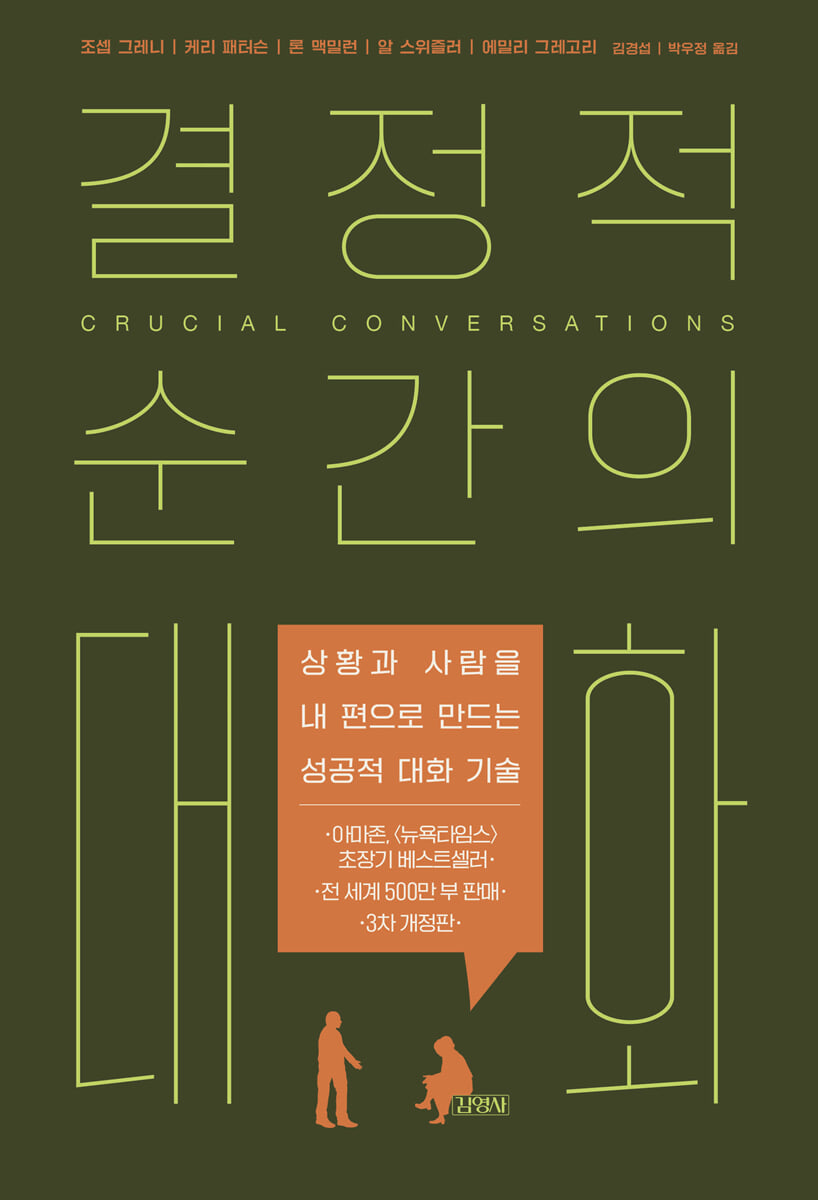
Conversation at a Decisive Moment
 |
Description
Book Introduction
*New York Times and Amazon long-term bestseller
*Highly recommended by Stephen Covey, "The 7 Habits of Highly Effective People," and Angela Duckworth, "Grit."
*Latest revised edition reflecting new changes in the new era
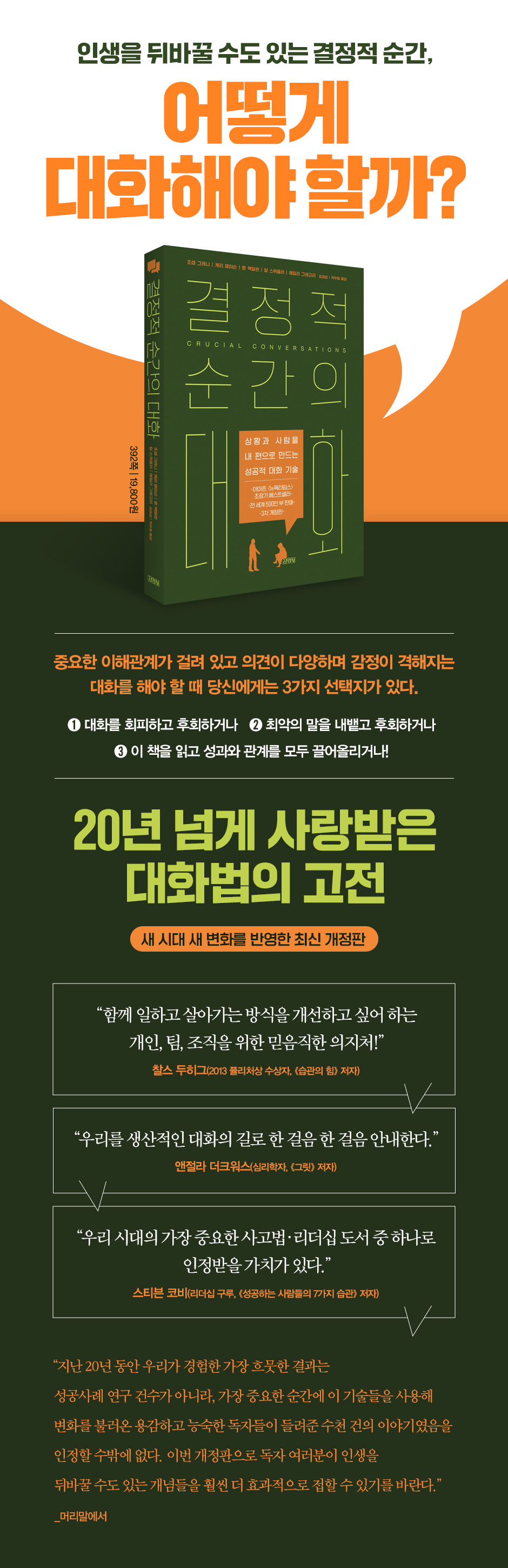
The 'decisive moment' that could change your life
Successful conversation skills that bring situations and people to your side
How do you speak and listen during those "defining moments" that profoundly impact your life, for better or worse? When conversations veer into difficult topics, people often become agitated, shout, walk away, or blurt out things they later regret.
At moments when we desperately need the best conversation, we unknowingly make the worst move.
Because complex interests, sharp conflicts of opinion, and intense emotions cause us to lose our sense of reason.
When you're pressing a friend to repay a loan, pointing out a spouse's mistakes, or giving feedback at work—how should you communicate respectfully, honestly, and problem-solve? The answer lies in the classic conversation method, "Crucial Conversations," which has been a lifeline for five million readers since its publication in 2002.
The revised third edition is even more powerful, with more topics and communication methods to explore, from overcoming political and social differences to effectively utilizing online media.
*Highly recommended by Stephen Covey, "The 7 Habits of Highly Effective People," and Angela Duckworth, "Grit."
*Latest revised edition reflecting new changes in the new era
The 'decisive moment' that could change your life
Successful conversation skills that bring situations and people to your side
How do you speak and listen during those "defining moments" that profoundly impact your life, for better or worse? When conversations veer into difficult topics, people often become agitated, shout, walk away, or blurt out things they later regret.
At moments when we desperately need the best conversation, we unknowingly make the worst move.
Because complex interests, sharp conflicts of opinion, and intense emotions cause us to lose our sense of reason.
When you're pressing a friend to repay a loan, pointing out a spouse's mistakes, or giving feedback at work—how should you communicate respectfully, honestly, and problem-solve? The answer lies in the classic conversation method, "Crucial Conversations," which has been a lifeline for five million readers since its publication in 2002.
The revised third edition is even more powerful, with more topics and communication methods to explore, from overcoming political and social differences to effectively utilizing online media.
- You can preview some of the book's contents.
Preview
index
preface
1.
What is a critical moment conversation: and who does it?
2.
Mastering Crucial Conversations: The Power of Conversation
STEP 1.
Things to do before opening your mouth
3.
Choose a topic to focus on: How to ensure you're having a relevant conversation
4.
Start with Sincerity: How to Stay Focused on What You Really Want
5.
Look Back at My Story: How to Keep the Conversation Going When You're Angry, Scared, or Hurt
STEP 2.
How to open your mouth
6.
Watch the Process: How to Recognize When Your Sense of Security Is Threatened
7.
Create a Safe Zone: How to Make Conversations Safe So You Can Talk About Anything
8.
State Your Position: How to Speak Persuasively and Non-Intrusively
9.
Understand the other person's perspective: How to listen when someone is angry or silent
10.
Reclaim Your Pen: How to Recover from Harsh Feedback
STEP 3.
How to end a conversation
11.
Take Action: How to Turn Crucial Conversations into Action and Get Results
12.
"Yes, but": Advice for Tricky Situations
13.
Conversation Principles: A Tool for Preparing for and Learning Conversation
Explanation of key concepts
main
Search
1.
What is a critical moment conversation: and who does it?
2.
Mastering Crucial Conversations: The Power of Conversation
STEP 1.
Things to do before opening your mouth
3.
Choose a topic to focus on: How to ensure you're having a relevant conversation
4.
Start with Sincerity: How to Stay Focused on What You Really Want
5.
Look Back at My Story: How to Keep the Conversation Going When You're Angry, Scared, or Hurt
STEP 2.
How to open your mouth
6.
Watch the Process: How to Recognize When Your Sense of Security Is Threatened
7.
Create a Safe Zone: How to Make Conversations Safe So You Can Talk About Anything
8.
State Your Position: How to Speak Persuasively and Non-Intrusively
9.
Understand the other person's perspective: How to listen when someone is angry or silent
10.
Reclaim Your Pen: How to Recover from Harsh Feedback
STEP 3.
How to end a conversation
11.
Take Action: How to Turn Crucial Conversations into Action and Get Results
12.
"Yes, but": Advice for Tricky Situations
13.
Conversation Principles: A Tool for Preparing for and Learning Conversation
Explanation of key concepts
main
Search
Detailed image
Into the book
If I don't discuss a problem with my boss, spouse, or neighbor, will it magically disappear? No.
Rather, you see the other person through the lens of that problem.
And your perspective is reflected in your actions.
If you harbor hostility toward someone, it will show in the way you treat that person.
--- p.21~22, from “What is a conversation at a decisive moment?”
Let's examine our own behavior and reflect on the motivation behind it.
If you honestly try to find the motivation behind your actions, you might find yourself thinking, “Let’s see, I’m cutting people off and being overly assertive.
Moreover, whenever other people talk, you shake your head.
Aha! You might end up thinking, "We started this conversation to plan a great vacation, but now our goal has shifted to winning an argument."
Once you humbly acknowledge that what you want is changing, you can consciously decide to change your mind again.
--- p.98~99, from “Start with Sincerity”
We are, in fact, partly responsible, but when a story conveniently absolves us of that responsibility, we move from rational explanations to clever stories.
The other person is not entirely bad or wrong, and we are not necessarily right or good.
The truth lies somewhere in the middle.
But if we can make others wrong and ourselves right, we absolve ourselves of responsibility.
Here, if we demonize others, we can insult and curse them if we want.
--- p.142, from “Looking Back at My Story”
Master conversationalists don't play games.
end.
They know that to solve a problem, they must address the problem itself, without being pretentious, benign, or deceptive.
So they do something completely different.
It's about getting out of the conversation, creating a safe zone, and then coming back.
Once you feel safe, you can talk about almost anything.
--- p.195, from “Create a Safe Zone”
Most arguments arise because of the 5-10% of facts and stories that people disagree with.
(...) The reason we do this is because we are trained from a young age to find even the smallest errors.
For example, a child who gets the answer right in kindergarten receives the teacher's affection.
It's a good thing to get the right answer.
Of course, if another child knows the answer, that child gets the favor.
So it's better to get the answer right first.
Eventually, you learn to find even the tiniest flaw in other people's facts, thoughts, and logic, and point it out.
--- p.295~296, from “Find out the other person’s position”
Sometimes feedback includes economic threats (“I’m going to fire you”), social threats (“I’m going to leave you”), or physical threats (“I’m going to beat you up”).
In such cases, it is natural to feel some degree of fear.
But what puts us at risk more than the feedback itself is often our defensive, combative, or resentful response to it.
One of the reasons we are so defensive is because we underestimate our ability to protect ourselves.
When you are confident, you don't get angry.
When I'm scared, I get angry.
--- p.319, from “Get Your Pen Back”
When it comes time to assign assignments, remember that there is no "we."
When assigning tasks, 'we' means 'not me'.
That's the meaning of the password.
Even when people aren't trying to avoid a task, the term "we" can lead people to believe that someone else is in charge.
Name every responsibility.
This is true not only at work but also at home.
--- p.340, from “Take Action”
One thing our research clearly shows is that perfection does not equal progress.
There's no need to worry about stumbling along.
I guarantee that if you consistently strive to put these concepts into practice, you will dramatically improve your relationships and performance.
That moment is truly decisive, and even the smallest change can lead to enormous progress.
Rather, you see the other person through the lens of that problem.
And your perspective is reflected in your actions.
If you harbor hostility toward someone, it will show in the way you treat that person.
--- p.21~22, from “What is a conversation at a decisive moment?”
Let's examine our own behavior and reflect on the motivation behind it.
If you honestly try to find the motivation behind your actions, you might find yourself thinking, “Let’s see, I’m cutting people off and being overly assertive.
Moreover, whenever other people talk, you shake your head.
Aha! You might end up thinking, "We started this conversation to plan a great vacation, but now our goal has shifted to winning an argument."
Once you humbly acknowledge that what you want is changing, you can consciously decide to change your mind again.
--- p.98~99, from “Start with Sincerity”
We are, in fact, partly responsible, but when a story conveniently absolves us of that responsibility, we move from rational explanations to clever stories.
The other person is not entirely bad or wrong, and we are not necessarily right or good.
The truth lies somewhere in the middle.
But if we can make others wrong and ourselves right, we absolve ourselves of responsibility.
Here, if we demonize others, we can insult and curse them if we want.
--- p.142, from “Looking Back at My Story”
Master conversationalists don't play games.
end.
They know that to solve a problem, they must address the problem itself, without being pretentious, benign, or deceptive.
So they do something completely different.
It's about getting out of the conversation, creating a safe zone, and then coming back.
Once you feel safe, you can talk about almost anything.
--- p.195, from “Create a Safe Zone”
Most arguments arise because of the 5-10% of facts and stories that people disagree with.
(...) The reason we do this is because we are trained from a young age to find even the smallest errors.
For example, a child who gets the answer right in kindergarten receives the teacher's affection.
It's a good thing to get the right answer.
Of course, if another child knows the answer, that child gets the favor.
So it's better to get the answer right first.
Eventually, you learn to find even the tiniest flaw in other people's facts, thoughts, and logic, and point it out.
--- p.295~296, from “Find out the other person’s position”
Sometimes feedback includes economic threats (“I’m going to fire you”), social threats (“I’m going to leave you”), or physical threats (“I’m going to beat you up”).
In such cases, it is natural to feel some degree of fear.
But what puts us at risk more than the feedback itself is often our defensive, combative, or resentful response to it.
One of the reasons we are so defensive is because we underestimate our ability to protect ourselves.
When you are confident, you don't get angry.
When I'm scared, I get angry.
--- p.319, from “Get Your Pen Back”
When it comes time to assign assignments, remember that there is no "we."
When assigning tasks, 'we' means 'not me'.
That's the meaning of the password.
Even when people aren't trying to avoid a task, the term "we" can lead people to believe that someone else is in charge.
Name every responsibility.
This is true not only at work but also at home.
--- p.340, from “Take Action”
One thing our research clearly shows is that perfection does not equal progress.
There's no need to worry about stumbling along.
I guarantee that if you consistently strive to put these concepts into practice, you will dramatically improve your relationships and performance.
That moment is truly decisive, and even the smallest change can lead to enormous progress.
--- p.380, from “Summary of Dialogue Principles”
Publisher's Review
30 years of research, 5 million copies sold worldwide
A classic conversation technique loved for over 20 years
The authors, who are world-renowned management consultants, describe this book as “a book about performance, not communication.”
Studying organizations around the world, from Fortune 500 companies to nonprofits in conflict zones, he found that “at the heart of nearly every chronic problem in relationships, teams, organizations, and even nations is the fact that people don’t have, or aren’t having, critical conversations at the critical moment.”
After 30 years of tracking and observing thousands of 'opinion leaders' recognized for their outstanding abilities, we completed a conversation model of the decisive moment.
This book is full of stories of people who had the best conversations and achieved the best results.
Nuclear power plants became safer, financial services firms enjoyed greater customer loyalty, hospitals saved more lives, and government organizations provided better services.
One family resolved a dispute over a will after their father died, while another found a way to mend a strained relationship after one member admitted to his sexual orientation.
This revised edition, which has been back for a decade, includes examples of non-profit organizations established to help criminals achieve economic independence.
When we first experimented with critical moment conversation techniques at The Other Side Academy (TOSA), people were understandably hesitant to embrace the new conversation method.
But after a few small successes, the mood changed.
TOSA's current moving, construction, and second-hand trading services are achieving results that are the envy of the world's top companies every year.
How was such a dramatic change possible? What is the secret to conversations that positively impact every aspect of life, from work to relationships to health?
Solving complex problems simply
3-Step Conversation Strategy
STEP 1.
How to Control Your Emotions Before a Conversation
70% of conversations at critical moments happen in our heads, not with our mouths.
If you feel like the conversation is going in the wrong direction, or if you've had this conversation before, try to discern whether the content, the pattern, or the relationship is at fault.
Ask yourself, “What do I really want?” and simplify your interest into one sentence.
And choose a topic to focus on.
Does the person you're talking to feel like a villain? Or do you feel like a helpless, wronged victim? If so, retrace your actions and the other person's.
According to the 'behavioral path model', people observe the behavior of others and infer the motivations behind those actions.
Furthermore, it evaluates whether the action is good or bad.
These speculations and evaluations, or 'stories', are what trigger emotions.
Focusing on the facts as they are can help you refine your story and manage your emotions.
STEP 2.
How to know what the other person is thinking during a conversation
When the other person responds with attack or silence, we feel we have to choose between telling the truth and maintaining the friendship.
But skilled communicators find ways to kill two birds with one stone: work and people.
The key is to make the parties involved feel 'safe'.
When you create a safe space, you can talk openly about any topic.
If you clearly disrespected the other person, apologize.
What if others misunderstand your purpose or intention? Use the "contrast technique," which involves saying something you didn't mean or meant, and then explaining your intention or meaning.
Identify the "common purpose" of the conversation and brainstorm new problem-solving strategies.
STEP 3.
How to take action and achieve results after a conversation
If the arduous discussions have finally reached a conclusion, it's time to plan who will do what, by when, and how to review it later.
Document in detail your decision-making process and future tasks.
If you trust your memory, you will end up repeating the same conversation over and over again.
Don't fall into the trap of just talking without doing anything.
If the conversational techniques presented in this book are too diverse to digest all at once, turn to the last chapter and review the "Summary of Conversation Principles" table and the situational conversation examples.
Put your learning into action.
“I guarantee that if you consistently strive to put these concepts into practice, you will dramatically improve your relationships and performance.
“That moment is truly decisive, and even the smallest change can lead to enormous progress.”
A classic conversation technique loved for over 20 years
The authors, who are world-renowned management consultants, describe this book as “a book about performance, not communication.”
Studying organizations around the world, from Fortune 500 companies to nonprofits in conflict zones, he found that “at the heart of nearly every chronic problem in relationships, teams, organizations, and even nations is the fact that people don’t have, or aren’t having, critical conversations at the critical moment.”
After 30 years of tracking and observing thousands of 'opinion leaders' recognized for their outstanding abilities, we completed a conversation model of the decisive moment.
This book is full of stories of people who had the best conversations and achieved the best results.
Nuclear power plants became safer, financial services firms enjoyed greater customer loyalty, hospitals saved more lives, and government organizations provided better services.
One family resolved a dispute over a will after their father died, while another found a way to mend a strained relationship after one member admitted to his sexual orientation.
This revised edition, which has been back for a decade, includes examples of non-profit organizations established to help criminals achieve economic independence.
When we first experimented with critical moment conversation techniques at The Other Side Academy (TOSA), people were understandably hesitant to embrace the new conversation method.
But after a few small successes, the mood changed.
TOSA's current moving, construction, and second-hand trading services are achieving results that are the envy of the world's top companies every year.
How was such a dramatic change possible? What is the secret to conversations that positively impact every aspect of life, from work to relationships to health?
Solving complex problems simply
3-Step Conversation Strategy
STEP 1.
How to Control Your Emotions Before a Conversation
70% of conversations at critical moments happen in our heads, not with our mouths.
If you feel like the conversation is going in the wrong direction, or if you've had this conversation before, try to discern whether the content, the pattern, or the relationship is at fault.
Ask yourself, “What do I really want?” and simplify your interest into one sentence.
And choose a topic to focus on.
Does the person you're talking to feel like a villain? Or do you feel like a helpless, wronged victim? If so, retrace your actions and the other person's.
According to the 'behavioral path model', people observe the behavior of others and infer the motivations behind those actions.
Furthermore, it evaluates whether the action is good or bad.
These speculations and evaluations, or 'stories', are what trigger emotions.
Focusing on the facts as they are can help you refine your story and manage your emotions.
STEP 2.
How to know what the other person is thinking during a conversation
When the other person responds with attack or silence, we feel we have to choose between telling the truth and maintaining the friendship.
But skilled communicators find ways to kill two birds with one stone: work and people.
The key is to make the parties involved feel 'safe'.
When you create a safe space, you can talk openly about any topic.
If you clearly disrespected the other person, apologize.
What if others misunderstand your purpose or intention? Use the "contrast technique," which involves saying something you didn't mean or meant, and then explaining your intention or meaning.
Identify the "common purpose" of the conversation and brainstorm new problem-solving strategies.
STEP 3.
How to take action and achieve results after a conversation
If the arduous discussions have finally reached a conclusion, it's time to plan who will do what, by when, and how to review it later.
Document in detail your decision-making process and future tasks.
If you trust your memory, you will end up repeating the same conversation over and over again.
Don't fall into the trap of just talking without doing anything.
If the conversational techniques presented in this book are too diverse to digest all at once, turn to the last chapter and review the "Summary of Conversation Principles" table and the situational conversation examples.
Put your learning into action.
“I guarantee that if you consistently strive to put these concepts into practice, you will dramatically improve your relationships and performance.
“That moment is truly decisive, and even the smallest change can lead to enormous progress.”
GOODS SPECIFICS
- Date of issue: September 1, 2023
- Page count, weight, size: 380 pages | 560g | 150*220*20mm
- ISBN13: 9788934977964
- ISBN10: 8934977965
You may also like
카테고리
korean


korean

![GQ KOREA Mark (Monthly): December [2025]](http://librairie.coreenne.fr/cdn/shop/files/8ef265dbbfbf186523ed75ba7319009d.jpg?v=1765340328&width=3840)


