

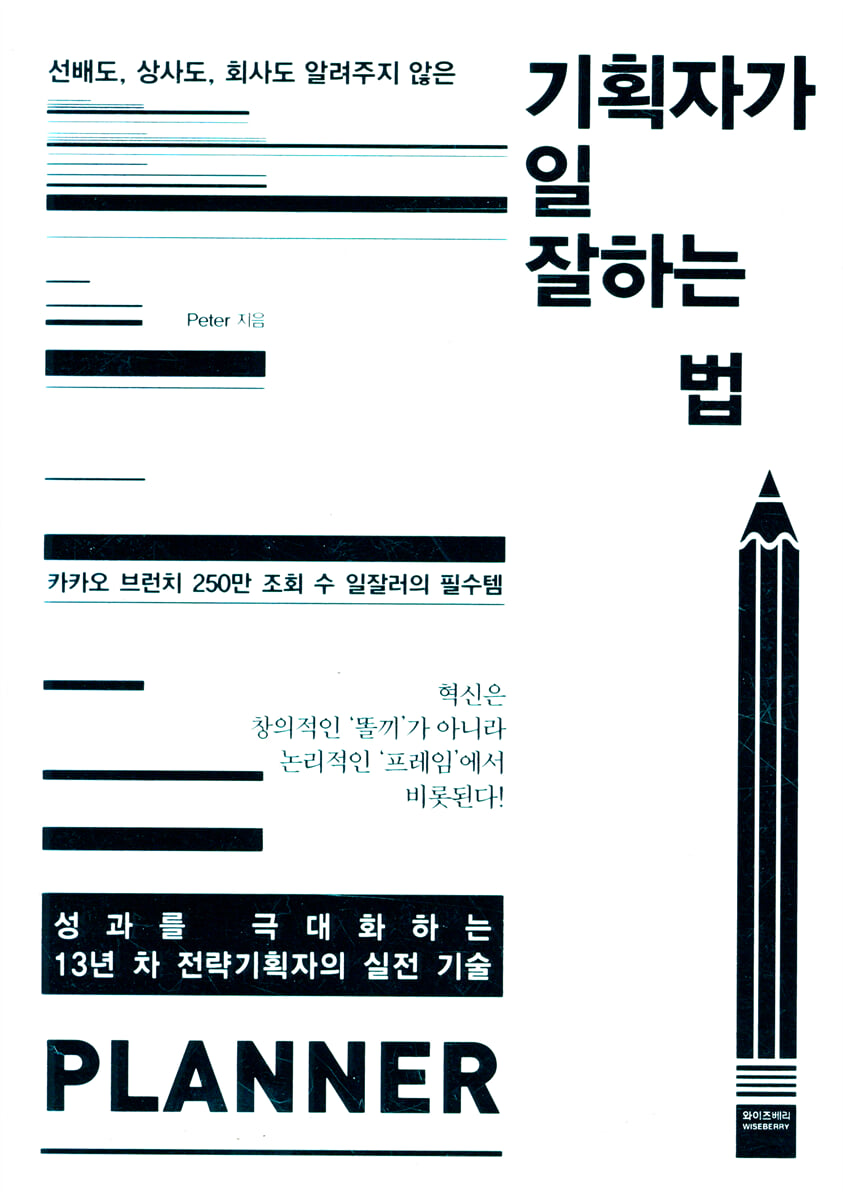
How to make a planner do his job well
 |
Description
Book Introduction
To you who think inspiration is everything in planning
Understanding strategic planning will change your productivity, performance, and reputation!
An online mentor supported by 2.5 million Kakao Brunch views and 40,000 Kakao Page subscribers.
Practical techniques to maximize performance, taught by a 13-year strategic planner.
A practical guidebook for planners who dream of becoming "professionals" who don't compromise on innovation or performance.
From product development to marketing, sales, finance, IT, and service, all planning work goes beyond creation.
No matter how good an idea is, if it doesn't align with the organization's business direction or fails to understand customer needs and changes, it's nothing more than a pleasant fantasy.
Ultimately, planning is a business that must convince both the company and the customer to survive.
The author, who has been in charge of strategic planning at a consumer goods company for 13 years, advises that applying the "Strategic Planning Framework," which suggests the direction the company should take, to work can make a difference in results.
Centered around four core frameworks: "the ability to read the company's board," "logical thinking," "market analysis skills," and "a process that speaks in numbers," it reveals the secrets to producing creative results that satisfy both the company and its customers, as well as maximizing individual productivity, performance, and evaluation.
Also, based on questions received while serializing on Kakao Brunch for six years, I have included useful techniques that can be applied immediately in practice, such as how to write a report that passes in one go, how to proceed with work quickly, how to utilize data, and how to study as a planner.
Understanding strategic planning will change your productivity, performance, and reputation!
An online mentor supported by 2.5 million Kakao Brunch views and 40,000 Kakao Page subscribers.
Practical techniques to maximize performance, taught by a 13-year strategic planner.
A practical guidebook for planners who dream of becoming "professionals" who don't compromise on innovation or performance.
From product development to marketing, sales, finance, IT, and service, all planning work goes beyond creation.
No matter how good an idea is, if it doesn't align with the organization's business direction or fails to understand customer needs and changes, it's nothing more than a pleasant fantasy.
Ultimately, planning is a business that must convince both the company and the customer to survive.
The author, who has been in charge of strategic planning at a consumer goods company for 13 years, advises that applying the "Strategic Planning Framework," which suggests the direction the company should take, to work can make a difference in results.
Centered around four core frameworks: "the ability to read the company's board," "logical thinking," "market analysis skills," and "a process that speaks in numbers," it reveals the secrets to producing creative results that satisfy both the company and its customers, as well as maximizing individual productivity, performance, and evaluation.
Also, based on questions received while serializing on Kakao Brunch for six years, I have included useful techniques that can be applied immediately in practice, such as how to write a report that passes in one go, how to proceed with work quickly, how to utilize data, and how to study as a planner.
- You can preview some of the book's contents.
Preview
index
Prologue: It's more important to work hard than what board you're working on.
Part 1_Knowing Planning Makes Work Go Smoothly: The Basics of Work
01 Planning vs. Strategic Planning
02 Why do companies focus on planning?
03 Be sensitive to the company's management plan.
04 Interpret the organizational chart in which the reorganization is taking place.
05 Understand how companies create and spread work.
06 Read the essence behind the phenomenon
07 The feedback is incorrect
08 How Planning Creates Creativity
Part 2_The Art of Strategic Planning that Transforms Results: Planning Practice
09 Market Segmentation Methods for Strategic Planners
10 Customer Needs Analysis is an Absolute Key to Success
11. Digging deep and broad into corporate capabilities
12 Collect Best Practices
13 Let's start with KPIs.
14 Things I Wish I Knew Before Setting KPIs
15 Essential Items for a Day Job: Reading and Speaking in Numbers
Part 3: How to Survive as a Professional Worker at a Company: A Planner's Study Guide
16 How are the numbers called performance created?
17 Will it show the past or predict the future?
18 Reasons Why Planners Should Enjoy the News
19 How to Get Things Done Faster Than Anyone Else
20 How Great Planners Learn
21 A Planner's Attitude to Coping with a Rapidly Changing Environment
Epilogue: A Story I Wanted to Tell My Junior Planner
Detailed image

Into the book
Strategic planning requires the consensus of all members of the company.
Considering the results of strategic planning work, which involves creating logic and establishing a basis for business advancement, an appropriate process where everyone listens and considers the findings is an essential device for enhancing transparency.
So, a well-written strategic plan is more like a flowing thesis.
It is not the fresh and creative group that usually comes to mind when you hear the word planning.
This is where the story begins.
From the reality that you can do your job well only if you know strategic planning, which is work that is rooted in reality and aims for higher goals.
--- p.22
A look at the organizational chart over the years will give you a clear idea of where the company is headed.
The company divides its business into the classic 'BCG Matrix' and moves its resources in a thoroughly committed manner.
Financial details like budgets and investments are difficult to understand at an individual level, but it's easy to see how much people have increased or decreased.
Simply put, even if an organization currently has a large surplus, if it is not a priority in future plans, it will reduce its workforce, while if it has low current profits but high future investment potential, it will continue to increase its workforce.
I can get a more objective idea of what position my organization holds within the company by looking at the changes in its members over the years.
--- p.51
Peter Drucker said another way to achieve results is to “spend your time on what matters most.”
Depending on how you spend your time, you may or may not achieve your goals.
It's not just time.
Financial investment must also be involved.
If we look into the reasons for failure to achieve goals, we often find that it was not implemented due to lack of investment or organization.
That's why it's important to take the time to look at how much of your resources you prioritized along with your goal setting when giving feedback.
--- p.89 From “07_The feedback was wrong”
The foundation of planning is a clear message.
When writing a report, it is ideal to not include more than two messages on one page.
Even if you're not a consulting firm like McKinsey, companies with in-house consulting organizations often provide training on how to write concise reports.
The same goes for interviews.
Deciding on the outcome of the interview in advance creates the power to keep the entire interview focused and oriented.
That's the root of the problem, that's what we're looking for.
--- p.126
Although the details of the question may vary, the direction the question seeks applies equally to my work.
One thing to remember is why we review external best practices.
Chris Zook, a management consultant at Bain & Company, emphasizes that the importance of reviewing best practices lies in viewing the company from the perspective of the market, not from within the company.
He argues that the core principles of change are whether the company is securing a strategy through core competencies and differentiation ahead of competitors, focusing externally to narrow the gap between managers, frontline organizations, and the market, and establishing a systematic learning system to secure, process, and utilize market feedback.
In other words, the point is that a company must regularly train itself to internalize the process of synthesis by introducing a new paradigm, rather than the paradigm it thinks about every day, so that it does not lose the customer value that the company pursues as its essence.
Considering the results of strategic planning work, which involves creating logic and establishing a basis for business advancement, an appropriate process where everyone listens and considers the findings is an essential device for enhancing transparency.
So, a well-written strategic plan is more like a flowing thesis.
It is not the fresh and creative group that usually comes to mind when you hear the word planning.
This is where the story begins.
From the reality that you can do your job well only if you know strategic planning, which is work that is rooted in reality and aims for higher goals.
--- p.22
A look at the organizational chart over the years will give you a clear idea of where the company is headed.
The company divides its business into the classic 'BCG Matrix' and moves its resources in a thoroughly committed manner.
Financial details like budgets and investments are difficult to understand at an individual level, but it's easy to see how much people have increased or decreased.
Simply put, even if an organization currently has a large surplus, if it is not a priority in future plans, it will reduce its workforce, while if it has low current profits but high future investment potential, it will continue to increase its workforce.
I can get a more objective idea of what position my organization holds within the company by looking at the changes in its members over the years.
--- p.51
Peter Drucker said another way to achieve results is to “spend your time on what matters most.”
Depending on how you spend your time, you may or may not achieve your goals.
It's not just time.
Financial investment must also be involved.
If we look into the reasons for failure to achieve goals, we often find that it was not implemented due to lack of investment or organization.
That's why it's important to take the time to look at how much of your resources you prioritized along with your goal setting when giving feedback.
--- p.89 From “07_The feedback was wrong”
The foundation of planning is a clear message.
When writing a report, it is ideal to not include more than two messages on one page.
Even if you're not a consulting firm like McKinsey, companies with in-house consulting organizations often provide training on how to write concise reports.
The same goes for interviews.
Deciding on the outcome of the interview in advance creates the power to keep the entire interview focused and oriented.
That's the root of the problem, that's what we're looking for.
--- p.126
Although the details of the question may vary, the direction the question seeks applies equally to my work.
One thing to remember is why we review external best practices.
Chris Zook, a management consultant at Bain & Company, emphasizes that the importance of reviewing best practices lies in viewing the company from the perspective of the market, not from within the company.
He argues that the core principles of change are whether the company is securing a strategy through core competencies and differentiation ahead of competitors, focusing externally to narrow the gap between managers, frontline organizations, and the market, and establishing a systematic learning system to secure, process, and utilize market feedback.
In other words, the point is that a company must regularly train itself to internalize the process of synthesis by introducing a new paradigm, rather than the paradigm it thinks about every day, so that it does not lose the customer value that the company pursues as its essence.
--- p.152
Publisher's Review
The Secret to Great Results with Less Work
The problem is the 'frame'!
When we think of 'planning,' most people think of it as a difficult job that involves working overtime to come up with creative ideas for things like advertising copy, publishing, and products.
Most of the planning books on the market focus on the idea of 'how to think'.
Even now, there are many people who stay up all night, wrestling with their computer monitors with their heads wrapped around their necks, or gulping down coffee after coffee, to create plans and reports.
But time and ideas are not proportional.
Also, not all efforts translate into results.
This is where the book begins.
The author, a strategic planner, says that creative results are not discovered with a "Eureka!" moment, but rather "derived through systematic research and analysis."
He emphasizes that finding and applying a successful framework rather than just working hard is an efficient way to escape overtime and stress and create rewarding results.
The source is the 'logical frame', which is the core of strategic planning that defines the direction of a company.
Four strategic planning frameworks to overcome the limitations of creativity
Planning to create something out of nothing is a burdensome task not only for newcomers but also for seasoned planners.
It is inevitable that you will often struggle with time, feeling lost and wondering, 'How and where do I start?'
However, people who are good at their jobs at work approach things ‘logically’.
Rather than relying on brilliant ideas, we logically plan and analyze hypotheses, convince our team members with valid results, and move forward to the next step.
Achievements and recognition are a natural bonus.
In this way, our actions and the resulting numbers change depending on the frame we work with.
This book explains how four strategic planning frameworks create innovation through case studies from global companies like Amazon, LG, McKinsey, and Zara, as well as startups like Zigbang.
The first frame, 'Eyes that Read the Company's Board', talks about the essence of planning and the planner's target as found in management theory.
The second is ‘logical thinking’, which must be taken first in practice.
Finding the optimal answer requires insight that connects past data to current phenomena and provides accurate feedback.
The third frame is 'market analysis technology', which is related to the special nature of planning that requires a broad view of the market, from customer research to data interpretation.
Finally, the 'process of speaking in numbers' is the core of a business and is a method that must be known to maximize performance.
Creative innovation like this involves a systematic process of research, analysis, evaluation, and improvement.
“A planner is not someone who works hard, but someone who creates visible ‘results.’”
-The 'real' principles of planning as taught by a senior strategic planner with 13 years of experience.
The most important message that runs through the entire book is that great planners are not born with it, but rather are trained to do so.
In other words, anyone can develop sufficient logical thinking skills through training and effectively apply logical frameworks in practice.
Whether you need to quickly plan a new product or service, are tasked with analyzing data, need to adapt your strategy to a rapidly changing market, or need to create reports that will impress your boss and executives, this book will help you get things done quickly and solve problems for better results.
This is because, unlike theories, there are not many companies or instructors who teach the skills needed in real-world situations, so I wrote this book with the hope that it would be of practical help to those in the industry.
Ultimately, this book will provide the most practical advice to all working professionals who want to break free from the unnecessary time and inefficient work cycles in the real-world workplace, transform their personal efforts and concerns into outstanding performance, and become recognized as "good workers" at work.
“Innovation comes from a logical ‘frame’, not a creative ‘brain’.”
The problem is the 'frame'!
When we think of 'planning,' most people think of it as a difficult job that involves working overtime to come up with creative ideas for things like advertising copy, publishing, and products.
Most of the planning books on the market focus on the idea of 'how to think'.
Even now, there are many people who stay up all night, wrestling with their computer monitors with their heads wrapped around their necks, or gulping down coffee after coffee, to create plans and reports.
But time and ideas are not proportional.
Also, not all efforts translate into results.
This is where the book begins.
The author, a strategic planner, says that creative results are not discovered with a "Eureka!" moment, but rather "derived through systematic research and analysis."
He emphasizes that finding and applying a successful framework rather than just working hard is an efficient way to escape overtime and stress and create rewarding results.
The source is the 'logical frame', which is the core of strategic planning that defines the direction of a company.
Four strategic planning frameworks to overcome the limitations of creativity
Planning to create something out of nothing is a burdensome task not only for newcomers but also for seasoned planners.
It is inevitable that you will often struggle with time, feeling lost and wondering, 'How and where do I start?'
However, people who are good at their jobs at work approach things ‘logically’.
Rather than relying on brilliant ideas, we logically plan and analyze hypotheses, convince our team members with valid results, and move forward to the next step.
Achievements and recognition are a natural bonus.
In this way, our actions and the resulting numbers change depending on the frame we work with.
This book explains how four strategic planning frameworks create innovation through case studies from global companies like Amazon, LG, McKinsey, and Zara, as well as startups like Zigbang.
The first frame, 'Eyes that Read the Company's Board', talks about the essence of planning and the planner's target as found in management theory.
The second is ‘logical thinking’, which must be taken first in practice.
Finding the optimal answer requires insight that connects past data to current phenomena and provides accurate feedback.
The third frame is 'market analysis technology', which is related to the special nature of planning that requires a broad view of the market, from customer research to data interpretation.
Finally, the 'process of speaking in numbers' is the core of a business and is a method that must be known to maximize performance.
Creative innovation like this involves a systematic process of research, analysis, evaluation, and improvement.
“A planner is not someone who works hard, but someone who creates visible ‘results.’”
-The 'real' principles of planning as taught by a senior strategic planner with 13 years of experience.
The most important message that runs through the entire book is that great planners are not born with it, but rather are trained to do so.
In other words, anyone can develop sufficient logical thinking skills through training and effectively apply logical frameworks in practice.
Whether you need to quickly plan a new product or service, are tasked with analyzing data, need to adapt your strategy to a rapidly changing market, or need to create reports that will impress your boss and executives, this book will help you get things done quickly and solve problems for better results.
This is because, unlike theories, there are not many companies or instructors who teach the skills needed in real-world situations, so I wrote this book with the hope that it would be of practical help to those in the industry.
Ultimately, this book will provide the most practical advice to all working professionals who want to break free from the unnecessary time and inefficient work cycles in the real-world workplace, transform their personal efforts and concerns into outstanding performance, and become recognized as "good workers" at work.
“Innovation comes from a logical ‘frame’, not a creative ‘brain’.”
GOODS SPECIFICS
- Publication date: November 12, 2021
- Page count, weight, size: 296 pages | 484g | 148*210*20mm
- ISBN13: 9791164139934
- ISBN10: 1164139932
You may also like
카테고리
korean


korean

![GQ KOREA Mark (Monthly): December [2025]](http://librairie.coreenne.fr/cdn/shop/files/8ef265dbbfbf186523ed75ba7319009d.jpg?v=1765340328&width=3840)


