

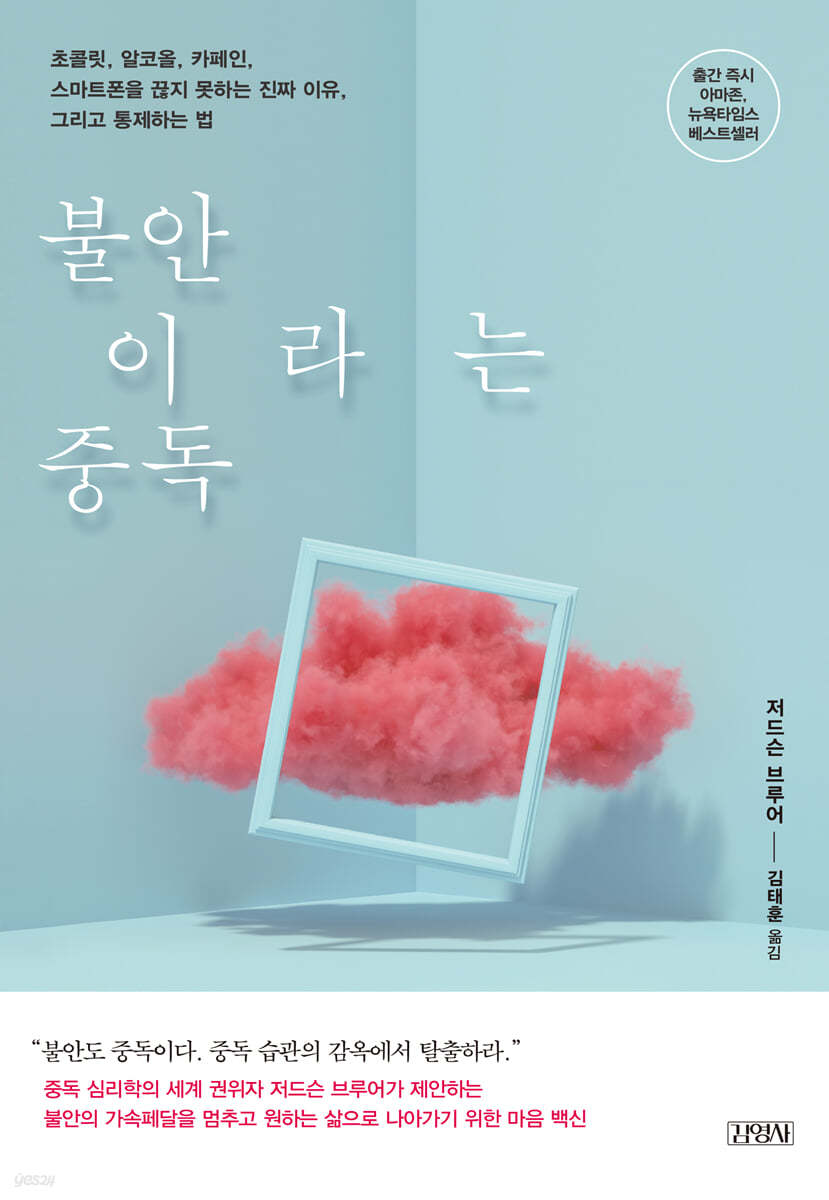
The addiction of anxiety
 |
Description
Book Introduction
- A word from MD
- Overeating and smoking, nightly beers, weekends spent staring at your phone, habitual online shopping...
Why can't we stop these bad behaviors? In this book, Dr. Judson Brewer, a world authority on addiction psychology, explains the brain's mechanisms of addiction and offers ways to escape the prison of anxiety addiction.
- Self-development MD Kang Hyeon-jeong
Depression, burnout, obsessive-compulsive disorder, alcoholism…
It all starts with anxiety!
Judson Brewer, a world authority on addiction psychology, suggests:
A mental vaccine to stop the accelerator of anxiety and move forward toward the life you want.
Bulimia and smoking that I can't seem to quit
A can of beer that I drink every night at 9 o'clock
The weekend flew by just looking at my phone.
Clicking the online shopping purchase button even though it is not something you need
Why can't you stop this bad behavior?
What's going on in your head and in your heart?
Dr. Judson Brewer, a world authority on addiction psychology, provides clear answers to these questions in his book, Unwinding Anxiety.
It explains the addictive substances that anxious modern people easily fall into, such as alcohol, chocolate, caffeine, and smartphones, and the brain's addiction mechanism that solidifies into bad habits, and guides you through ways to escape the prison of anxiety addiction.
In particular, we scientifically analyze the effects of 'mindfulness', which is being newly illuminated through modern brain science, psychology, and neuroscience, and introduce methods to restore daily life ruined by anxiety and create new habits.
This book will help you move beyond a life plagued by anxiety, addiction, and cravings to one of self-regulation and resilience.
It all starts with anxiety!
Judson Brewer, a world authority on addiction psychology, suggests:
A mental vaccine to stop the accelerator of anxiety and move forward toward the life you want.
Bulimia and smoking that I can't seem to quit
A can of beer that I drink every night at 9 o'clock
The weekend flew by just looking at my phone.
Clicking the online shopping purchase button even though it is not something you need
Why can't you stop this bad behavior?
What's going on in your head and in your heart?
Dr. Judson Brewer, a world authority on addiction psychology, provides clear answers to these questions in his book, Unwinding Anxiety.
It explains the addictive substances that anxious modern people easily fall into, such as alcohol, chocolate, caffeine, and smartphones, and the brain's addiction mechanism that solidifies into bad habits, and guides you through ways to escape the prison of anxiety addiction.
In particular, we scientifically analyze the effects of 'mindfulness', which is being newly illuminated through modern brain science, psychology, and neuroscience, and introduce methods to restore daily life ruined by anxiety and create new habits.
This book will help you move beyond a life plagued by anxiety, addiction, and cravings to one of self-regulation and resilience.
- You can preview some of the book's contents.
Preview
index
prolog
Part 0 / How Does Anxiety Become an Addiction?
1 Anxiety Spreading Like an Epidemic
2 Why does anxiety consume us?
3 You are addicted to anxiety
4 Ways to Free Yourself from Anxiety and Burnout
Part 1: Breaking the Chains of Your Anxiety Habits
5 Changing habits doesn't have to be painful.
6 Three Reasons Why You Can't Beat Anxiety
7 The myth that all anxiety increases performance
8 Self-Driving Cars That Are Anxious
9 What personality type are you?
Part 2: Why You Can't Break Free from Anxiety Addiction
10 Brain Science Reasons Why It's So Hard to Break Habits
11 No matter how much I eat, I can't eat anxiety.
12 Your brain tells you to eat chocolate when you're stressed.
13 Overthinking and planning are like chocolate.
14 How long does it take to change a habit?
Part 3: A Bigger, Better Proposal to Break the Cycle of Anxiety
15 New Habits That Change Your Perception
16 Curiosity is an innate superpower.
17 Breathing Exercises: Be Curious About Your Breath
Lane 18 Training: How to Avoid Being Panicked by Sudden Anxiety
19 Loving-Kindness Practice: The Power to Expand Your Inner Self
Part 4 / How to move towards the life you want?
20 Focus on the 'what', not the 'why'
21 Stay completely here and now
22 Develop the habit of faith
23. Break free from anxiety and move toward a life of communication.
Epilogue: Six Years and Five Minutes
Acknowledgements
main
Part 0 / How Does Anxiety Become an Addiction?
1 Anxiety Spreading Like an Epidemic
2 Why does anxiety consume us?
3 You are addicted to anxiety
4 Ways to Free Yourself from Anxiety and Burnout
Part 1: Breaking the Chains of Your Anxiety Habits
5 Changing habits doesn't have to be painful.
6 Three Reasons Why You Can't Beat Anxiety
7 The myth that all anxiety increases performance
8 Self-Driving Cars That Are Anxious
9 What personality type are you?
Part 2: Why You Can't Break Free from Anxiety Addiction
10 Brain Science Reasons Why It's So Hard to Break Habits
11 No matter how much I eat, I can't eat anxiety.
12 Your brain tells you to eat chocolate when you're stressed.
13 Overthinking and planning are like chocolate.
14 How long does it take to change a habit?
Part 3: A Bigger, Better Proposal to Break the Cycle of Anxiety
15 New Habits That Change Your Perception
16 Curiosity is an innate superpower.
17 Breathing Exercises: Be Curious About Your Breath
Lane 18 Training: How to Avoid Being Panicked by Sudden Anxiety
19 Loving-Kindness Practice: The Power to Expand Your Inner Self
Part 4 / How to move towards the life you want?
20 Focus on the 'what', not the 'why'
21 Stay completely here and now
22 Develop the habit of faith
23. Break free from anxiety and move toward a life of communication.
Epilogue: Six Years and Five Minutes
Acknowledgements
main
Detailed image

Into the book
Anxiety is hidden in people's habits.
Even if you try to disconnect from anxiety, it doesn't go away; instead, it hides deep inside your body.
--- p.11
Anxiety is contagious, like the coronavirus.
In psychology, the transmission of emotions from one person to another is aptly called 'social contagion.'
Just talking to an anxious person can trigger anxiety.
Their words, filled with fear, are like a sneeze straight into our brains.
--- p.43~44
The changes in our world over the past 20 years far outstrip all the changes in the previous 200 years.
The brain and body could not keep up with the pace of change.
And it's killing us.
--- p.52
The brain's job is to help us survive.
At some point, our brains linked problem solving with worry.
So I think worrying is the best way.
Ultimately, the brain keeps pulling the lever on the slot machine of worry, hoping to hit the jackpot of a solution.
--- p.66
Simply put, making resolutions, gritting your teeth, or pushing yourself to “just do it” can be counterproductive strategies.
While these strategies may help in the short term (or at least make you feel like you're trying), they may not contribute to the long-term results that really matter.
--- p.99
It's a very neat way to manipulate the brain's reward-based learning system, and it has nothing to do with willpower.
Now you know how your brain works.
So, it's not your brain that leads you, it's you that leads your brain.
--- p.155
The basic explanation of third gear is to find an alternative action.
This behavior is preferred over old habits because it is bigger and better.
Because replacement behaviors have a greater reward value, they initially help you break out of old habit loops, and once they are ingrained in your brain, they become new paths for your brain to follow (a new habit, so to speak).
--- p.222
It's a long road to overcome mental obstacles, obstacles, and habits.
In particular, we must learn the rich and endlessly interesting realm of the mind.
So don't force yourself to move forward and tire yourself out.
Let curiosity lead you naturally.
Build the capacity to overcome new challenges in the future and save your strength for when you need it.
--- p.251
All we have is now.
What we think about in this moment creates the beads that will be added to our necklace.
The past predicts the future in the present.
This is important, so I'll repeat it again.
What we do now sets the course of our lives.
Even if you try to disconnect from anxiety, it doesn't go away; instead, it hides deep inside your body.
--- p.11
Anxiety is contagious, like the coronavirus.
In psychology, the transmission of emotions from one person to another is aptly called 'social contagion.'
Just talking to an anxious person can trigger anxiety.
Their words, filled with fear, are like a sneeze straight into our brains.
--- p.43~44
The changes in our world over the past 20 years far outstrip all the changes in the previous 200 years.
The brain and body could not keep up with the pace of change.
And it's killing us.
--- p.52
The brain's job is to help us survive.
At some point, our brains linked problem solving with worry.
So I think worrying is the best way.
Ultimately, the brain keeps pulling the lever on the slot machine of worry, hoping to hit the jackpot of a solution.
--- p.66
Simply put, making resolutions, gritting your teeth, or pushing yourself to “just do it” can be counterproductive strategies.
While these strategies may help in the short term (or at least make you feel like you're trying), they may not contribute to the long-term results that really matter.
--- p.99
It's a very neat way to manipulate the brain's reward-based learning system, and it has nothing to do with willpower.
Now you know how your brain works.
So, it's not your brain that leads you, it's you that leads your brain.
--- p.155
The basic explanation of third gear is to find an alternative action.
This behavior is preferred over old habits because it is bigger and better.
Because replacement behaviors have a greater reward value, they initially help you break out of old habit loops, and once they are ingrained in your brain, they become new paths for your brain to follow (a new habit, so to speak).
--- p.222
It's a long road to overcome mental obstacles, obstacles, and habits.
In particular, we must learn the rich and endlessly interesting realm of the mind.
So don't force yourself to move forward and tire yourself out.
Let curiosity lead you naturally.
Build the capacity to overcome new challenges in the future and save your strength for when you need it.
--- p.251
All we have is now.
What we think about in this moment creates the beads that will be added to our necklace.
The past predicts the future in the present.
This is important, so I'll repeat it again.
What we do now sets the course of our lives.
--- p.333
Publisher's Review
★A New York Times and Amazon bestseller immediately after publication
★TED Talk surpasses 16 million views
Depression, burnout, obsessive-compulsive disorder, alcoholism…
It all starts with anxiety!
Judson Brewer, a world authority on addiction psychology, suggests:
A mental vaccine to stop the accelerator of anxiety and move forward toward the life you want.
Bulimia and smoking that I can't seem to quit
A can of beer that I drink every night at 9 o'clock
The weekend flew by just looking at my phone.
Clicking the online shopping purchase button even though it is not something you need
Why can't you stop this bad behavior?
What's going on in your head and in your heart?
Dr. Judson Brewer, a world authority on addiction psychology, provides clear answers to these questions in his book, Unwinding Anxiety.
It explains the addictive substances that anxious modern people easily fall into, such as alcohol, chocolate, caffeine, and smartphones, and the brain's addiction mechanism that solidifies into bad habits, and guides you through ways to escape the prison of anxiety addiction.
In particular, we scientifically analyze the effects of 'mindfulness', which is being newly illuminated through modern brain science, psychology, and neuroscience, and introduce methods to restore daily life ruined by anxiety and create new habits.
This book will help you move beyond a life plagued by anxiety, addiction, and cravings to one of self-regulation and resilience.
The moment you look at your habit loop, you realize why you're anxious.
'Anxious (trigger) - eat (behavior) - temporarily escape from anxiety (reward, consequence)'.
This habit loop is how we break free from the anxiety we have been accustomed to for so long.
The author gives patients who come to him with anxiety and addiction problems a piece of paper and asks them to break the habit loop.
People are often stuck in a habit loop without being able to identify the source of their anxiety.
When we are stressed or in a bad mood, we often fail to find a fundamental solution and fall back to the easy solution.
Eat chocolate, drink alcohol, and smoke cigarettes.
This may make you feel better temporarily, but the effect will soon wear off.
Eventually, if you keep repeating this, your health will deteriorate and your daily life will fall apart.
Fortunately, if you understand this habit loop and can get into the three gears the author suggests, you can learn how to break the vicious cycle of anxiety addiction, break bad habits, and form good ones.
The most scientific and simple solution to break all kinds of bad habits and destructive lifestyle patterns.
3-stage gear: Understanding, Curiosity, and Redesign
Judson Brewer used fMRI equipment to observe changes in brain activity in real time and revealed the effects of addictive habits on the brain.
We also compared and observed how the brain changes when experiencing mindfulness, compassion, or immersion.
Based on that research, we present a practical three-step gear for those struggling to break out of the vicious cycle.
Step 1: Understand: What does your addiction look like?
Understand how the addiction that plagues you is triggered and what consequences it leads to.
This is the stage where you put aside the desire to hastily cure the addiction and simply observe it.
And look at your problems clearly.
Step 2: Curiosity: Understand the consequences of addiction.
We realize that addiction may provide temporary comfort or pleasure, but in the long run, it causes us more anxiety.
This is the stage where the brain becomes disillusioned with the terrible consequences of addiction.
The more we practice this, the more clearly we see the consequences of our own bad behavior.
Step 3, Redesign: From Anxiety to Flow, Peace, and Inner Growth.
Our brains know that engagement, peace, and inner growth are far more valuable than anxiety.
The brain breaks bad habits like addictions and forms new good habits through replacement behaviors.
Being curious and paying attention to what's going on inside our bodies and minds can lead to greater satisfaction and happiness.
The shortest path from a life shattered by anxiety to a life free from it.
Anxious people constantly worry about impending problems.
Like “Olympic athletes competing in sports that compete in anxiety endurance” (p. 32).
But worrying doesn't solve any problems.
It only makes us fall into the swamp of addiction.
The program introduced in this book focuses on relieving current anxiety.
Because I can take a step forward with this mind that is not anxious right now.
“What we do now determines the course of our lives.” (p. 333) Instead of worrying about the future, why not say goodbye to the present anxiety?
★TED Talk surpasses 16 million views
Depression, burnout, obsessive-compulsive disorder, alcoholism…
It all starts with anxiety!
Judson Brewer, a world authority on addiction psychology, suggests:
A mental vaccine to stop the accelerator of anxiety and move forward toward the life you want.
Bulimia and smoking that I can't seem to quit
A can of beer that I drink every night at 9 o'clock
The weekend flew by just looking at my phone.
Clicking the online shopping purchase button even though it is not something you need
Why can't you stop this bad behavior?
What's going on in your head and in your heart?
Dr. Judson Brewer, a world authority on addiction psychology, provides clear answers to these questions in his book, Unwinding Anxiety.
It explains the addictive substances that anxious modern people easily fall into, such as alcohol, chocolate, caffeine, and smartphones, and the brain's addiction mechanism that solidifies into bad habits, and guides you through ways to escape the prison of anxiety addiction.
In particular, we scientifically analyze the effects of 'mindfulness', which is being newly illuminated through modern brain science, psychology, and neuroscience, and introduce methods to restore daily life ruined by anxiety and create new habits.
This book will help you move beyond a life plagued by anxiety, addiction, and cravings to one of self-regulation and resilience.
The moment you look at your habit loop, you realize why you're anxious.
'Anxious (trigger) - eat (behavior) - temporarily escape from anxiety (reward, consequence)'.
This habit loop is how we break free from the anxiety we have been accustomed to for so long.
The author gives patients who come to him with anxiety and addiction problems a piece of paper and asks them to break the habit loop.
People are often stuck in a habit loop without being able to identify the source of their anxiety.
When we are stressed or in a bad mood, we often fail to find a fundamental solution and fall back to the easy solution.
Eat chocolate, drink alcohol, and smoke cigarettes.
This may make you feel better temporarily, but the effect will soon wear off.
Eventually, if you keep repeating this, your health will deteriorate and your daily life will fall apart.
Fortunately, if you understand this habit loop and can get into the three gears the author suggests, you can learn how to break the vicious cycle of anxiety addiction, break bad habits, and form good ones.
The most scientific and simple solution to break all kinds of bad habits and destructive lifestyle patterns.
3-stage gear: Understanding, Curiosity, and Redesign
Judson Brewer used fMRI equipment to observe changes in brain activity in real time and revealed the effects of addictive habits on the brain.
We also compared and observed how the brain changes when experiencing mindfulness, compassion, or immersion.
Based on that research, we present a practical three-step gear for those struggling to break out of the vicious cycle.
Step 1: Understand: What does your addiction look like?
Understand how the addiction that plagues you is triggered and what consequences it leads to.
This is the stage where you put aside the desire to hastily cure the addiction and simply observe it.
And look at your problems clearly.
Step 2: Curiosity: Understand the consequences of addiction.
We realize that addiction may provide temporary comfort or pleasure, but in the long run, it causes us more anxiety.
This is the stage where the brain becomes disillusioned with the terrible consequences of addiction.
The more we practice this, the more clearly we see the consequences of our own bad behavior.
Step 3, Redesign: From Anxiety to Flow, Peace, and Inner Growth.
Our brains know that engagement, peace, and inner growth are far more valuable than anxiety.
The brain breaks bad habits like addictions and forms new good habits through replacement behaviors.
Being curious and paying attention to what's going on inside our bodies and minds can lead to greater satisfaction and happiness.
The shortest path from a life shattered by anxiety to a life free from it.
Anxious people constantly worry about impending problems.
Like “Olympic athletes competing in sports that compete in anxiety endurance” (p. 32).
But worrying doesn't solve any problems.
It only makes us fall into the swamp of addiction.
The program introduced in this book focuses on relieving current anxiety.
Because I can take a step forward with this mind that is not anxious right now.
“What we do now determines the course of our lives.” (p. 333) Instead of worrying about the future, why not say goodbye to the present anxiety?
GOODS SPECIFICS
- Publication date: August 30, 2021
- Page count, weight, size: 360 pages | 478g | 145*210*17mm
- ISBN13: 9788934944232
- ISBN10: 8934944234
You may also like
카테고리
korean


korean

![GQ KOREA Mark (Monthly): December [2025]](http://librairie.coreenne.fr/cdn/shop/files/8ef265dbbfbf186523ed75ba7319009d.jpg?v=1765340328&width=3840)


