

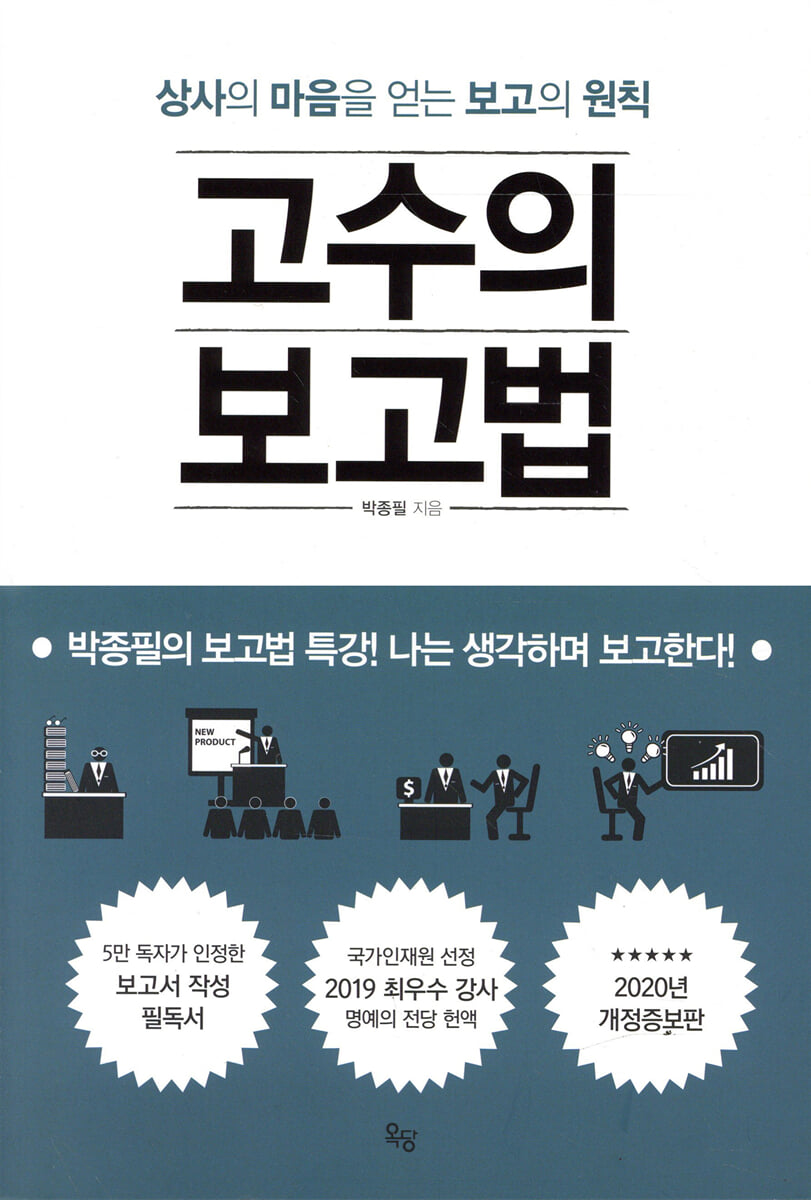
The expert's reporting method
 |
Description
Book Introduction
The latest revised edition of "The Expert's Reporting Method," which has been considered the best book on report and plan writing since its publication in 2015, has been published.
Since its publication, this book has been called the bible of report writing by not only civil servants but also employees of public institutions and corporations, and has maintained its position as an unwavering steady seller in the field of reporting law.
This revised edition includes updated reporting materials and up-to-date data for immediate use, as well as helpful advice for reporting in today's changing business environment.
Since its publication, this book has been called the bible of report writing by not only civil servants but also employees of public institutions and corporations, and has maintained its position as an unwavering steady seller in the field of reporting law.
This revised edition includes updated reporting materials and up-to-date data for immediate use, as well as helpful advice for reporting in today's changing business environment.
index
- Prologue | What should I do with a memorable report?
1 | Planning_Organizing thoughts to find a story
- Let's first ask 'why'
- Think in chunks
- Eliminate duplication and omission
- Let's find the coordinates by comparing them.
- Let's finish and revise
2 | Writing_Expressing Your Thoughts in a Way Anyone Can Understand
- If you write an inscription, a scream will come out.
- If I write too long, I feel suffocated.
- Just listing the information doesn't make sense.
- If you only write the principles, the content disappears.
- If you write it in a difficult way, no one will know
3 | Edit_Showing thoughts that draw my thoughts
- Let's solve it with the keyboard instead of holding the mouse.
- Let's be consistent and not confuse.
- Don't read the words, understand the context.
- Let's show meaning, not just appearance.
- Don't just finish it. Let's read it again.
4 | Speaking: Communicating Your Thoughts in an Easy-to-Understand Way
- Let's find the right timing
- Let's choose the method that suits the situation.
- Let's create a speaking style that suits the content.
5 | Training_Type-Specific Report Writing
- Policy Review Report | Check the title first
- Planning Report | Add a story to your event
- Situation Report | Write quickly, but carefully
- Summary Report | The shorter the better
- Conference Reference Materials | To help you on the spot
- External Reports | Reports, Discussions, Explanations, and Speeches
6 | Training_Situational Reporting
- 1:1 face-to-face meeting | Understanding the other person
- Meeting | As everyone knows
- Presentation | With pictures, not documents
- Event | Speaking on the spot is a regular practice
- TIP | In this case, do this
① When discussing work with colleagues
② When coaching subordinates
- Epilogue | Think from the Other Person's Perspective
Special Lecture_ Understanding Competency Assessment
- Four misconceptions and misunderstandings about competency assessment
- Think about the meaning of each evaluation method
- Competency assessment prepared in advance
1 | Planning_Organizing thoughts to find a story
- Let's first ask 'why'
- Think in chunks
- Eliminate duplication and omission
- Let's find the coordinates by comparing them.
- Let's finish and revise
2 | Writing_Expressing Your Thoughts in a Way Anyone Can Understand
- If you write an inscription, a scream will come out.
- If I write too long, I feel suffocated.
- Just listing the information doesn't make sense.
- If you only write the principles, the content disappears.
- If you write it in a difficult way, no one will know
3 | Edit_Showing thoughts that draw my thoughts
- Let's solve it with the keyboard instead of holding the mouse.
- Let's be consistent and not confuse.
- Don't read the words, understand the context.
- Let's show meaning, not just appearance.
- Don't just finish it. Let's read it again.
4 | Speaking: Communicating Your Thoughts in an Easy-to-Understand Way
- Let's find the right timing
- Let's choose the method that suits the situation.
- Let's create a speaking style that suits the content.
5 | Training_Type-Specific Report Writing
- Policy Review Report | Check the title first
- Planning Report | Add a story to your event
- Situation Report | Write quickly, but carefully
- Summary Report | The shorter the better
- Conference Reference Materials | To help you on the spot
- External Reports | Reports, Discussions, Explanations, and Speeches
6 | Training_Situational Reporting
- 1:1 face-to-face meeting | Understanding the other person
- Meeting | As everyone knows
- Presentation | With pictures, not documents
- Event | Speaking on the spot is a regular practice
- TIP | In this case, do this
① When discussing work with colleagues
② When coaching subordinates
- Epilogue | Think from the Other Person's Perspective
Special Lecture_ Understanding Competency Assessment
- Four misconceptions and misunderstandings about competency assessment
- Think about the meaning of each evaluation method
- Competency assessment prepared in advance
Publisher's Review
What's wrong with you, you stay up all night getting ready and come out broken?
Park Jong-pil, a civil servant planning and reporting expert, reveals his hidden reporting know-how!
Completion of work in the workplace lies in reporting.
Even if you work diligently, it is difficult to receive a good evaluation if you do not report well.
What would happen if you took the report you worked on all night and just read it without any order? No matter how excellent the content, if you can't convince the other person to give it the OK, it'll be a worthless report.
Is there a way to excel at reporting, the number one source of workplace stress for office workers? Park Jong-pil, a veteran of planning and reporting duties during his 18 years as a civil servant, offers solutions in "Reporting Techniques for Experts."
“There is no such thing as just in Baduk.
…When I try to do something, I have to figure out what the other person is thinking and planning.
“That’s called reading the other person’s mind.”
This is a line from the popular webtoon 'Misaeng'.
The author explains that the secret to doing a good job of reporting lies in this line.
In other words, the core of reporting work is to read the boss's intentions, and the first principle of reporting is to convey content that matches the boss's intentions.
So, how can we read our boss's mind and convey the right message?
“If you were me, would you pay?”
The Hidden Principle of a Master's Reporting Method for Changing Your Boss's Mind
A subordinate's report of telling his boss, who has to leave soon for a business meeting, to talk leisurely about important matters is in accordance with the principles, but lacks technical skills.
You are likely to hear complaints like, “I’m so busy, why are you reporting this important thing now?”
If I had demonstrated the 'skill' of checking my boss's schedule before reporting, I would have been able to organize the report in advance to match my boss's appointment time.
There is no one more tactless and frustrating than a subordinate who comes in with a thick report before the boss who just arrived at work can even catch his breath, or who shoves a report in front of the boss who hasn't even brushed his teeth yet after lunch.
For those who make these mistakes countless times, the author advises that if you look at just four things when reporting, you can reduce failures by more than half.
First, let's figure out whether your boss is in a situation where he can focus on the report.
I can't just report to my boss, who is obviously tired from the company dinner the day before, and go my own way.
Not only does it not convey the message, it also leaves a bad impression on your boss.
It is also important to understand your boss's personality.
The author points out that “since each person has a different logical structure of understanding, it is important to report to your superior in a way that is familiar to him or her.”
In reality, some people find it easier to understand something in writing, while others find it easier to hear it spoken.
In front of a boss who is more comfortable with written communication, it is better to wait silently while he reads the report.
Of course, you should prepare in advance for your boss to ask questions along the way.
Conversely, in front of a boss who likes to hear from you, it is better to summarize the report and explain it orally from the beginning.
It is also important to choose a delivery method that suits the situation.
Most reports are made in person, but if not, there are various ways to report, such as by email, memo, text message, or phone call.
When reporting only through a report without a face-to-face meeting, the contents of the face-to-face report can be conveyed through email or memo.
If you write down what you want to report verbally, the report can be more intimate.
Since letters cannot be written at length due to their nature, they are naturally reported briefly and to the point, so there are not many cases of major mistakes.
However, it is different when reporting by phone.
Generally, reporting by phone is done when the matter is urgent or important.
So, if you report in an already intimidated situation, if you call without preparation, you will end up talking nonsense.
You can avoid these mistakes by making notes in advance about how you will convey the message and then reporting it.
Above all, reporting requires preparation in advance.
For example, you may have organized the information you need to report in your work notebook, but when it comes time to report, you can't find the information and end up flipping through your notebook.
In times like these, it is useful to write a note on a post-it note and stick it on the cover of your work notebook.
Write a report from the other person's perspective
Tie the report content into a story.
The core of the reporting method emphasized in this book is “Write the report from the other person’s perspective and organize the report content into a story.”
Storytelling is a superior technique for eliciting empathy from others than any logical words.
The author says that even reports need stories.
Even if the report contains the same content, there is a big difference from the reader's perspective between a simple listing and a coherent story.
Often, when a boss reads a report that's just a list of information, they react with something like, "Are you asking me to read all this stuff now? What's the point?"
When you read something as dry as a report and the content doesn't make sense at a glance, it can be frustrating.
Turning a report into a story also benefits the person writing the report.
This is because the content to be reported becomes clear in the process of thinking about the story.
(Chapter 1: Organizing Your Thoughts)
Meanwhile, when writing reports, many people complain about their writing skills and the difficulty in writing reports.
However, the report does not require any special writing skills.
The author emphasizes that, like the six principles of newspaper articles, concise sentences are key to accurately conveying facts in reports.
This book uses examples of sentences in reports that are unclear or contain unclear expressions to explain various revision methods that accurately convey the intent without changing the content.
(Chapter 2: Unpacking Your Thoughts)
The author also explains presentation methods.
Office workers accustomed to documents tend to think of presentations as materials rather than screens, but the author emphasizes that presentations should be viewed from the perspective of being read.
Even the text expressed in the presentation should be expressed so that it can be perceived as a single image, and when composing the content, the beginning and the end should be considered as important as the main body.
No matter how well you try to convey the main content, it is difficult to leave a good impression if the beginning and end lack impact.
(Chapter 6 Reporting by Situation)
Report from a novice vs. a master
Find the reporting method that works for you
How great would it be if there were universal principles or agreed-upon methods for effective reporting? Even if there were, it's not easy to deliver effective reports in a rapidly changing work environment.
There is no choice but to become proficient by directly encountering situations that change from moment to moment.
While we can suggest more effective reporting methods, the key lies in your ability to apply the reporting method that best suits your situation.
This book presents a variety of reporting situations and helps readers find their own method by comparing and analyzing good and bad reports.
Additionally, the reporting process is divided into four stages, from planning the report, writing, editing, and reporting, and the last two chapters are organized as training stages.
And, 'competency assessment', which has recently emerged as a hot issue in public institutions, was also included as a special lecture.
The author of this book, Jongpil Park, has worked in public service for 18 years and has experienced numerous reporting tasks, from the lowest level to the position of manager.
The author has passed on this know-how through lectures to over 5,000 civil servants since 2012.
This book is the essence of reporting methods, based on the lecture content and adding specific examples.
I hope that through this book, office workers who have good content but struggle to express it properly will be able to develop their own reporting method and be freed from the stress of reporting.
Park Jong-pil, a civil servant planning and reporting expert, reveals his hidden reporting know-how!
Completion of work in the workplace lies in reporting.
Even if you work diligently, it is difficult to receive a good evaluation if you do not report well.
What would happen if you took the report you worked on all night and just read it without any order? No matter how excellent the content, if you can't convince the other person to give it the OK, it'll be a worthless report.
Is there a way to excel at reporting, the number one source of workplace stress for office workers? Park Jong-pil, a veteran of planning and reporting duties during his 18 years as a civil servant, offers solutions in "Reporting Techniques for Experts."
“There is no such thing as just in Baduk.
…When I try to do something, I have to figure out what the other person is thinking and planning.
“That’s called reading the other person’s mind.”
This is a line from the popular webtoon 'Misaeng'.
The author explains that the secret to doing a good job of reporting lies in this line.
In other words, the core of reporting work is to read the boss's intentions, and the first principle of reporting is to convey content that matches the boss's intentions.
So, how can we read our boss's mind and convey the right message?
“If you were me, would you pay?”
The Hidden Principle of a Master's Reporting Method for Changing Your Boss's Mind
A subordinate's report of telling his boss, who has to leave soon for a business meeting, to talk leisurely about important matters is in accordance with the principles, but lacks technical skills.
You are likely to hear complaints like, “I’m so busy, why are you reporting this important thing now?”
If I had demonstrated the 'skill' of checking my boss's schedule before reporting, I would have been able to organize the report in advance to match my boss's appointment time.
There is no one more tactless and frustrating than a subordinate who comes in with a thick report before the boss who just arrived at work can even catch his breath, or who shoves a report in front of the boss who hasn't even brushed his teeth yet after lunch.
For those who make these mistakes countless times, the author advises that if you look at just four things when reporting, you can reduce failures by more than half.
First, let's figure out whether your boss is in a situation where he can focus on the report.
I can't just report to my boss, who is obviously tired from the company dinner the day before, and go my own way.
Not only does it not convey the message, it also leaves a bad impression on your boss.
It is also important to understand your boss's personality.
The author points out that “since each person has a different logical structure of understanding, it is important to report to your superior in a way that is familiar to him or her.”
In reality, some people find it easier to understand something in writing, while others find it easier to hear it spoken.
In front of a boss who is more comfortable with written communication, it is better to wait silently while he reads the report.
Of course, you should prepare in advance for your boss to ask questions along the way.
Conversely, in front of a boss who likes to hear from you, it is better to summarize the report and explain it orally from the beginning.
It is also important to choose a delivery method that suits the situation.
Most reports are made in person, but if not, there are various ways to report, such as by email, memo, text message, or phone call.
When reporting only through a report without a face-to-face meeting, the contents of the face-to-face report can be conveyed through email or memo.
If you write down what you want to report verbally, the report can be more intimate.
Since letters cannot be written at length due to their nature, they are naturally reported briefly and to the point, so there are not many cases of major mistakes.
However, it is different when reporting by phone.
Generally, reporting by phone is done when the matter is urgent or important.
So, if you report in an already intimidated situation, if you call without preparation, you will end up talking nonsense.
You can avoid these mistakes by making notes in advance about how you will convey the message and then reporting it.
Above all, reporting requires preparation in advance.
For example, you may have organized the information you need to report in your work notebook, but when it comes time to report, you can't find the information and end up flipping through your notebook.
In times like these, it is useful to write a note on a post-it note and stick it on the cover of your work notebook.
Write a report from the other person's perspective
Tie the report content into a story.
The core of the reporting method emphasized in this book is “Write the report from the other person’s perspective and organize the report content into a story.”
Storytelling is a superior technique for eliciting empathy from others than any logical words.
The author says that even reports need stories.
Even if the report contains the same content, there is a big difference from the reader's perspective between a simple listing and a coherent story.
Often, when a boss reads a report that's just a list of information, they react with something like, "Are you asking me to read all this stuff now? What's the point?"
When you read something as dry as a report and the content doesn't make sense at a glance, it can be frustrating.
Turning a report into a story also benefits the person writing the report.
This is because the content to be reported becomes clear in the process of thinking about the story.
(Chapter 1: Organizing Your Thoughts)
Meanwhile, when writing reports, many people complain about their writing skills and the difficulty in writing reports.
However, the report does not require any special writing skills.
The author emphasizes that, like the six principles of newspaper articles, concise sentences are key to accurately conveying facts in reports.
This book uses examples of sentences in reports that are unclear or contain unclear expressions to explain various revision methods that accurately convey the intent without changing the content.
(Chapter 2: Unpacking Your Thoughts)
The author also explains presentation methods.
Office workers accustomed to documents tend to think of presentations as materials rather than screens, but the author emphasizes that presentations should be viewed from the perspective of being read.
Even the text expressed in the presentation should be expressed so that it can be perceived as a single image, and when composing the content, the beginning and the end should be considered as important as the main body.
No matter how well you try to convey the main content, it is difficult to leave a good impression if the beginning and end lack impact.
(Chapter 6 Reporting by Situation)
Report from a novice vs. a master
Find the reporting method that works for you
How great would it be if there were universal principles or agreed-upon methods for effective reporting? Even if there were, it's not easy to deliver effective reports in a rapidly changing work environment.
There is no choice but to become proficient by directly encountering situations that change from moment to moment.
While we can suggest more effective reporting methods, the key lies in your ability to apply the reporting method that best suits your situation.
This book presents a variety of reporting situations and helps readers find their own method by comparing and analyzing good and bad reports.
Additionally, the reporting process is divided into four stages, from planning the report, writing, editing, and reporting, and the last two chapters are organized as training stages.
And, 'competency assessment', which has recently emerged as a hot issue in public institutions, was also included as a special lecture.
The author of this book, Jongpil Park, has worked in public service for 18 years and has experienced numerous reporting tasks, from the lowest level to the position of manager.
The author has passed on this know-how through lectures to over 5,000 civil servants since 2012.
This book is the essence of reporting methods, based on the lecture content and adding specific examples.
I hope that through this book, office workers who have good content but struggle to express it properly will be able to develop their own reporting method and be freed from the stress of reporting.
GOODS SPECIFICS
- Date of issue: August 30, 2020
- Page count, weight, size: 335 pages | 494g | 152*224*30mm
- ISBN13: 9791189936280
- ISBN10: 1189936283
You may also like
카테고리
korean


korean

![GQ KOREA Mark (Monthly): December [2025]](http://librairie.coreenne.fr/cdn/shop/files/8ef265dbbfbf186523ed75ba7319009d.jpg?v=1765340328&width=3840)


