

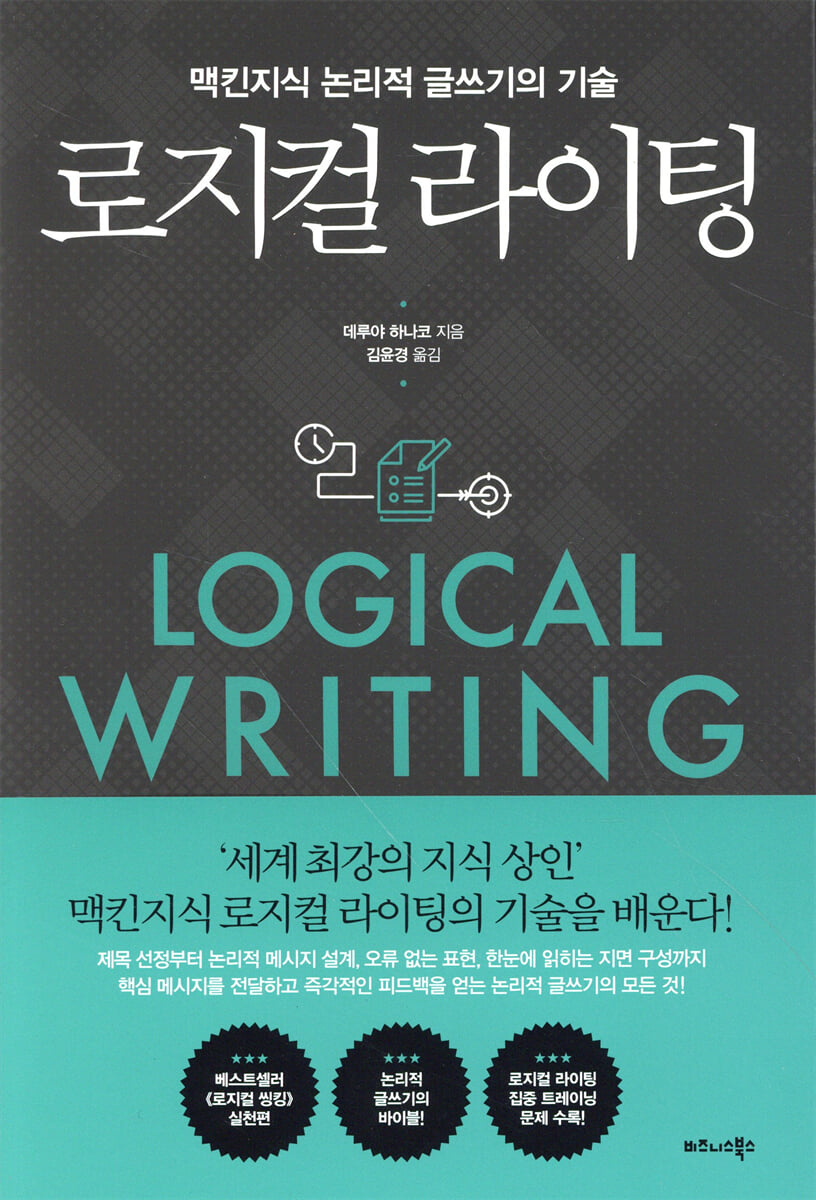
Logical Lighting
 |
Description
Book Introduction
Logical writing skills taught by Japan's top communication expert!
How do you write to persuade others and achieve the results you want?
In the business world, writing is an essential skill that everyone, from new graduates to mid-level executives, must possess.
When people meet in person and communicate verbally, the situation can be understood through the other person's questions or facial expressions, allowing the communicator to provide additional explanations or corrections.
However, when expressing one's thoughts in writing, the document is everything, so writing must be done with much more precision and care than speaking.
In social life, we often suffer losses due to poor writing skills.
When my report, which took me days to prepare, is rejected, someone else gets praised for a two-page report.
Even overall work ability is undervalued.
What exactly is the difference? How can I accurately express the arguments I've organized in my head? How can I write to persuade my counterpart and achieve the desired outcome? Many businesspeople struggle with these concerns.
The refreshing solution lies in the 'logical writing technique' of management consulting firm McKinsey & Company, or 'Logical Writing'.
It is a technique that allows the writer of a document to convey the message as quickly and accurately as possible, allowing the other person to understand the writer's intention.
"Logical Writing" is the practical version of "Logical Thinking," which became a bestseller and created a huge sensation in Korea and Japan.
This book teaches you how to write effective business documents using logical writing techniques, with clear expression and logical organization.
If 『Logical Thinking』 covered the techniques for logically organizing thoughts, 『Logical Writing』 is a book that explains how to apply this to writing and is a workbook for practical practice.
"Logical Writing" contains the logical writing know-how of Hanako Teruya, a communications expert who worked at McKinsey for many years.
Tom Peters, known as the 'founder of modern management,' called McKinsey 'the world's greatest knowledge merchant.'
McKinsey is a collection of top talents who possess outstanding business knowledge, who can appropriately convey that knowledge, and who can achieve desired results.
How do you write to persuade others and achieve the results you want?
In the business world, writing is an essential skill that everyone, from new graduates to mid-level executives, must possess.
When people meet in person and communicate verbally, the situation can be understood through the other person's questions or facial expressions, allowing the communicator to provide additional explanations or corrections.
However, when expressing one's thoughts in writing, the document is everything, so writing must be done with much more precision and care than speaking.
In social life, we often suffer losses due to poor writing skills.
When my report, which took me days to prepare, is rejected, someone else gets praised for a two-page report.
Even overall work ability is undervalued.
What exactly is the difference? How can I accurately express the arguments I've organized in my head? How can I write to persuade my counterpart and achieve the desired outcome? Many businesspeople struggle with these concerns.
The refreshing solution lies in the 'logical writing technique' of management consulting firm McKinsey & Company, or 'Logical Writing'.
It is a technique that allows the writer of a document to convey the message as quickly and accurately as possible, allowing the other person to understand the writer's intention.
"Logical Writing" is the practical version of "Logical Thinking," which became a bestseller and created a huge sensation in Korea and Japan.
This book teaches you how to write effective business documents using logical writing techniques, with clear expression and logical organization.
If 『Logical Thinking』 covered the techniques for logically organizing thoughts, 『Logical Writing』 is a book that explains how to apply this to writing and is a workbook for practical practice.
"Logical Writing" contains the logical writing know-how of Hanako Teruya, a communications expert who worked at McKinsey for many years.
Tom Peters, known as the 'founder of modern management,' called McKinsey 'the world's greatest knowledge merchant.'
McKinsey is a collection of top talents who possess outstanding business knowledge, who can appropriately convey that knowledge, and who can achieve desired results.
- You can preview some of the book's contents.
Preview
index
Reviewer's Note: People who are good at their jobs write logically.
Getting Started_The Top 1 Percent's Logical Writing Secrets
Part 1: Structure of the Message
Chapter 1 Preparation of the composition
1.
Understanding Business Writing
Purpose of writing
Pitfalls to Watch Out for Before Writing
2.
Check your communication settings
Check the topic: What questions can you change it to?
Identifying the desired response: What do you want the reader to do?
Reader's Check: Are there any undisclosed reviewers?
Authorship Verification: Who is the sender of the document?
3.
Outline the composition
The basic principles of composition
Hints for composition
Chapter 2: Structure of the Main Text 1 - Introduction to Logical Thinking
1.
Understand the meaning of 'logical'
2.
Acquire tools to organize your thoughts logically.
MECE: Divide without duplication, omission, or confusion
So What?/Why So?: Ultimately, it brings out the point precisely.
3.
Get tools to organize logically
Basic structure of logic
Parallel logic type
explanatory logic type
Chapter 3: Structure of the Main Text 2 - Putting Logical Thinking into Practice
1.
Understand how to construct logical types
A structure that develops from 'conclusion to evidence'
Structure that develops from 'evidence to conclusion'
2.
Constructs a logical type
Beta's Case: Setting
Step 1.
Check the question and select the logic type
Step 2.
Create a framework that fits MECE from top to bottom
Step 3.
So What?/Why So? from bottom to top
3.
Self-diagnose your logic type
Check 1.
Does it adequately answer the reader's Why So??
Check 2.
Is the point clear?
Check 3.
Should I give the conclusion first or the evidence first?
supplement
Self-diagnosis for various types of logic
Chapter 4 Introduction Structure
1.
Learn from mistakes
Buried type
Title repetition type
Consistent greeting type
2.
Understand what an introduction is
First Perspective: Sharing Communication Settings
Second Perspective: Observing Communication from the Reader's Perspective
Things to keep in mind when configuring
3.
Construct the introduction
First Perspective: Sharing Communication Settings
Second Perspective: Observing Communication from the Reader's Perspective
Part 2: Expression of the Message
Chapter 5: Visualizing the Composition
1.
Create documents that are understandable at a glance
2.
Point 1: Specify the report title and subtitle.
The title of the report suggests the topic and expected response.
Specify the composition with a subtitle
How to Use Intermediate Titles Between Item-Type and So What? Type
3.
Point 2: Use symbols and spacing.
Distinguish logical types of positions by symbols and intervals
The Relationship Between MECE and So What?/Why So? as Revealed in Symbols
4.
Point 3: State the criteria for the description at the beginning.
Bad practice: The criteria for explanation are buried in the documentation.
Preferred practice: The criteria for explanation are at the beginning.
supplement
Applications of visualization
Chapter 6: Sentence Expression in Messages
1.
Understand the three most important requirements in business documents.
2.
This is 1.
Express it specifically
Express the core of the issue
Be careful with ambiguous words or notations.
3.
This is 2.
Express logical relationships correctly
Reveals MECE relationships
It shows the relationship between So What?/Why So?
4.
This is 3.
Express it concisely
Simplify sentences
Eliminate useless expressions
supplement
Checklist for Self-Editing
Concluding Remarks: Anyone Can Write Logically
Getting Started_The Top 1 Percent's Logical Writing Secrets
Part 1: Structure of the Message
Chapter 1 Preparation of the composition
1.
Understanding Business Writing
Purpose of writing
Pitfalls to Watch Out for Before Writing
2.
Check your communication settings
Check the topic: What questions can you change it to?
Identifying the desired response: What do you want the reader to do?
Reader's Check: Are there any undisclosed reviewers?
Authorship Verification: Who is the sender of the document?
3.
Outline the composition
The basic principles of composition
Hints for composition
Chapter 2: Structure of the Main Text 1 - Introduction to Logical Thinking
1.
Understand the meaning of 'logical'
2.
Acquire tools to organize your thoughts logically.
MECE: Divide without duplication, omission, or confusion
So What?/Why So?: Ultimately, it brings out the point precisely.
3.
Get tools to organize logically
Basic structure of logic
Parallel logic type
explanatory logic type
Chapter 3: Structure of the Main Text 2 - Putting Logical Thinking into Practice
1.
Understand how to construct logical types
A structure that develops from 'conclusion to evidence'
Structure that develops from 'evidence to conclusion'
2.
Constructs a logical type
Beta's Case: Setting
Step 1.
Check the question and select the logic type
Step 2.
Create a framework that fits MECE from top to bottom
Step 3.
So What?/Why So? from bottom to top
3.
Self-diagnose your logic type
Check 1.
Does it adequately answer the reader's Why So??
Check 2.
Is the point clear?
Check 3.
Should I give the conclusion first or the evidence first?
supplement
Self-diagnosis for various types of logic
Chapter 4 Introduction Structure
1.
Learn from mistakes
Buried type
Title repetition type
Consistent greeting type
2.
Understand what an introduction is
First Perspective: Sharing Communication Settings
Second Perspective: Observing Communication from the Reader's Perspective
Things to keep in mind when configuring
3.
Construct the introduction
First Perspective: Sharing Communication Settings
Second Perspective: Observing Communication from the Reader's Perspective
Part 2: Expression of the Message
Chapter 5: Visualizing the Composition
1.
Create documents that are understandable at a glance
2.
Point 1: Specify the report title and subtitle.
The title of the report suggests the topic and expected response.
Specify the composition with a subtitle
How to Use Intermediate Titles Between Item-Type and So What? Type
3.
Point 2: Use symbols and spacing.
Distinguish logical types of positions by symbols and intervals
The Relationship Between MECE and So What?/Why So? as Revealed in Symbols
4.
Point 3: State the criteria for the description at the beginning.
Bad practice: The criteria for explanation are buried in the documentation.
Preferred practice: The criteria for explanation are at the beginning.
supplement
Applications of visualization
Chapter 6: Sentence Expression in Messages
1.
Understand the three most important requirements in business documents.
2.
This is 1.
Express it specifically
Express the core of the issue
Be careful with ambiguous words or notations.
3.
This is 2.
Express logical relationships correctly
Reveals MECE relationships
It shows the relationship between So What?/Why So?
4.
This is 3.
Express it concisely
Simplify sentences
Eliminate useless expressions
supplement
Checklist for Self-Editing
Concluding Remarks: Anyone Can Write Logically
Detailed image
Into the book
When checking readers, be aware of the existence of 'undisclosed reviewers'.
When the proposal is submitted to customer C, the person who reads it directly is the person in charge, C.
However, if Mr. C evaluated the proposal positively, it is highly likely that the proposal will be forwarded to his supervisor, Manager D, or the relevant department for review.
Therefore, to elicit the desired response from the customer, the sender must write the document with the recipients behind Mr. C, such as Manager D or the decision-makers in the relevant department, in mind, that is, the unseen reviewers.
--- From Chapter 1, 'Preparation for Composition'
There's a So What?/Why So? training method that anyone can do right now.
Do not use words like 'as below' or 'as follows'.
Let's say your presentation explaining your sales strategy includes a detailed schedule of the strategy.
When explaining that schedule, doesn't it say 'The schedule is as follows'?
Also, doesn't the report note state, "The tasks to strengthen the sales power of our branch are as follows," and doesn't it list the tasks in eight different items below it?
In this way, the important core is not clearly stated, and the explanation is vague with terms such as 'below' and 'next', making it impossible to clearly understand 'what is the schedule in the end' or 'what is the task in short?'
--- From Chapter 2, "Structure of the Main Text 1 - Introduction to Logical Thinking"
Specifically, the basis for So What? is to clearly present the subject, object, and predicate in the structure of 'who, what, and how'.
Therefore, when writing business documents, you must be especially careful about using noun endings.
Noun-type endings are those that end a sentence with a noun or a nominalized word, such as 'emphasis on independence'.
Although the expression of summarizing sentences briefly is not wrong in itself, in business documents, if the subject, predicate, and object are unclear, it may be difficult for the other person to clearly understand the content.
When doing So What?, you should focus on specificity and draw out results rather than just summarizing them briefly.
After that, I recommend writing in the order of deleting any unnecessary elements.
--- From Chapter 3, "Structure of the Main Text 2 - Practicing Logical Thinking"
In the introduction, before the main topic, let's organize the overall communication in an easy-to-understand flow.
If possible, put the underlying topic and expected response of the introduction up front.
That is, after describing the topic, the background of the topic setting, the expected response, and the benefits of taking that response, if other elements are needed, the location of the explanation is determined by considering the compatibility with the topic and the expected response.
After explaining the topic, state the purpose of the main text and then place the expected response to make the flow natural.
Elements that reveal the writer, such as the company's performance, can be explained in the previous stage of the introduction as background for setting the topic.
Meanwhile, regardless of the background of the topic, when a writer introduces himself, he can avoid the risk of it becoming self-praise by putting it towards the end of the introduction.
--- From Chapter 4, “Introduction”
Visualizing a structure allows a person scanning a document to grasp the entire structure at a glance.
Visualization is not just about creating a striking surface.
The goal of visualization is to logically organize the text and inform the reader of the content and its order.
Organizing a document by visualizing its structure is also the task of revising the structure so that it becomes a logical and understandable text in terms of expression.
--- From Chapter 5, “Visualization of Composition”
When you ask people, “What is important when it comes to writing in business documents?” the most common answer is “conciseness.”
While brevity is certainly important, focusing on keeping things short can easily lead to insufficient explanation.
However, you should not write documents that make people wonder, 'What on earth does this mean?' when they read them.
And some people overuse trendy economic terms or foreign words, thinking they are using cool language.
No matter how nice the expression is,
What good is a document if the reader cannot properly understand its meaning?
A writer must express what he wants to convey in a way that the reader can understand accurately and quickly.
This is the most important point in the sentence expression of business documents.
If such a sentence expression is possible, it can also be used in speech.
When the proposal is submitted to customer C, the person who reads it directly is the person in charge, C.
However, if Mr. C evaluated the proposal positively, it is highly likely that the proposal will be forwarded to his supervisor, Manager D, or the relevant department for review.
Therefore, to elicit the desired response from the customer, the sender must write the document with the recipients behind Mr. C, such as Manager D or the decision-makers in the relevant department, in mind, that is, the unseen reviewers.
--- From Chapter 1, 'Preparation for Composition'
There's a So What?/Why So? training method that anyone can do right now.
Do not use words like 'as below' or 'as follows'.
Let's say your presentation explaining your sales strategy includes a detailed schedule of the strategy.
When explaining that schedule, doesn't it say 'The schedule is as follows'?
Also, doesn't the report note state, "The tasks to strengthen the sales power of our branch are as follows," and doesn't it list the tasks in eight different items below it?
In this way, the important core is not clearly stated, and the explanation is vague with terms such as 'below' and 'next', making it impossible to clearly understand 'what is the schedule in the end' or 'what is the task in short?'
--- From Chapter 2, "Structure of the Main Text 1 - Introduction to Logical Thinking"
Specifically, the basis for So What? is to clearly present the subject, object, and predicate in the structure of 'who, what, and how'.
Therefore, when writing business documents, you must be especially careful about using noun endings.
Noun-type endings are those that end a sentence with a noun or a nominalized word, such as 'emphasis on independence'.
Although the expression of summarizing sentences briefly is not wrong in itself, in business documents, if the subject, predicate, and object are unclear, it may be difficult for the other person to clearly understand the content.
When doing So What?, you should focus on specificity and draw out results rather than just summarizing them briefly.
After that, I recommend writing in the order of deleting any unnecessary elements.
--- From Chapter 3, "Structure of the Main Text 2 - Practicing Logical Thinking"
In the introduction, before the main topic, let's organize the overall communication in an easy-to-understand flow.
If possible, put the underlying topic and expected response of the introduction up front.
That is, after describing the topic, the background of the topic setting, the expected response, and the benefits of taking that response, if other elements are needed, the location of the explanation is determined by considering the compatibility with the topic and the expected response.
After explaining the topic, state the purpose of the main text and then place the expected response to make the flow natural.
Elements that reveal the writer, such as the company's performance, can be explained in the previous stage of the introduction as background for setting the topic.
Meanwhile, regardless of the background of the topic, when a writer introduces himself, he can avoid the risk of it becoming self-praise by putting it towards the end of the introduction.
--- From Chapter 4, “Introduction”
Visualizing a structure allows a person scanning a document to grasp the entire structure at a glance.
Visualization is not just about creating a striking surface.
The goal of visualization is to logically organize the text and inform the reader of the content and its order.
Organizing a document by visualizing its structure is also the task of revising the structure so that it becomes a logical and understandable text in terms of expression.
--- From Chapter 5, “Visualization of Composition”
When you ask people, “What is important when it comes to writing in business documents?” the most common answer is “conciseness.”
While brevity is certainly important, focusing on keeping things short can easily lead to insufficient explanation.
However, you should not write documents that make people wonder, 'What on earth does this mean?' when they read them.
And some people overuse trendy economic terms or foreign words, thinking they are using cool language.
No matter how nice the expression is,
What good is a document if the reader cannot properly understand its meaning?
A writer must express what he wants to convey in a way that the reader can understand accurately and quickly.
This is the most important point in the sentence expression of business documents.
If such a sentence expression is possible, it can also be used in speech.
--- From Chapter 6, “Message Sentence Expression”
Publisher's Review
Highly recommended by successful businessmen
The complete guide to logical writing!
There are so many writing books on the market.
The reason why "Logical Writing" has become a must-read highly recommended by successful businesspeople is that it goes beyond simple writing and perfectly covers the core of strategies for accurately and easily conveying one's thoughts to others.
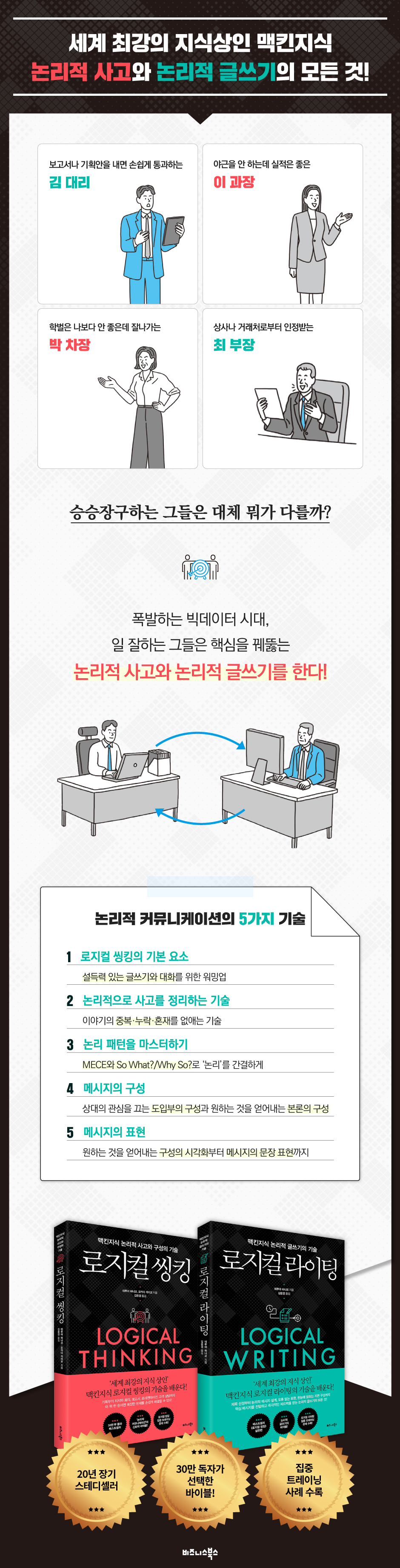
《Logical Writing》 is largely divided into two parts: 'Message Composition' and 'Message Sentence Expression'.
Since business documents are tools for conducting business, it is important to clearly structure the message to be conveyed. Since only the content expressed in writing is conveyed to the other party, the content must be written accurately.
After mastering these theories, you can further internalize logical writing by comparing good and bad examples and solving intensive training problems.
Ultimately, in written communication, what is conveyed and how is the key.
Document writers should structure their content and write in concise sentences so that the conclusion to be conveyed is clearly connected to the evidence supporting it.
In most cases, bullet points (bullet marks) are used to summarize the document so that the reader can grasp the main points at a glance.
To achieve this, Logical Writing proposes three principles: MECE, So What?, and Why So?. MECE is a principle that establishes horizontal relationships in a report, examining whether all required information has been included, whether there is overlap, and whether similar content is grouped together.
So What? and Why So? are principles that constitute a vertical relationship. Simply put, when going up from a small symbol to a symbol above it, the relationship of So What? must be established, and when going down from a large symbol to a small symbol, the relationship of Why So? must be established.
If we follow the principles introduced in "Logical Writing," the documents we write will be well-organized and logical.
You no longer have to worry about writing documents or fear that your work skills will be evaluated poorly because of it.
The top 1 percent's logical writing secrets!
You too can write persuasively and gain recognition!
In an organization, the more important the matter, the more likely it is to be conveyed in the form of documents such as proposals, plans, reports, notices, and requests.
‘Knowing something well’ and ‘communicating it well’ are separate abilities.
Moreover, unlike words, documents retain their form, so if an error occurs, it can have fatal consequences.
This is why many companies are strengthening their writing training.
《Logical Writing》 is the logical writing secret of the top 1% of McKinsey talent.
If you've learned the theory and practice of logical writing through this book, it's time to practice it consistently in your daily life.
Among the reviews left by readers of this book, some shared tips such as, “I keep this book on my desk so I can refer to it often,” and others offered advice such as, “Reading it alongside Logical Thinking will deepen your understanding.”
The environment surrounding us is constantly changing, with the advent of the Fourth Industrial Revolution and the era of big data.
Even amidst these powerful waves of change, the power of communication and the importance of documentation remain constant.
Therefore, we must have 'logical lighting skills' to survive.
Why is logical lighting a technology?
It is not a special ability that depends on innate talent or sense, but can be acquired by anyone through repeated training.
Let's master the logical writing skills contained in "Logical Writing" and apply them widely in our daily lives, including business documents, everyday writing, and even social media.
The complete guide to logical writing!
There are so many writing books on the market.
The reason why "Logical Writing" has become a must-read highly recommended by successful businesspeople is that it goes beyond simple writing and perfectly covers the core of strategies for accurately and easily conveying one's thoughts to others.
《Logical Writing》 is largely divided into two parts: 'Message Composition' and 'Message Sentence Expression'.
Since business documents are tools for conducting business, it is important to clearly structure the message to be conveyed. Since only the content expressed in writing is conveyed to the other party, the content must be written accurately.
After mastering these theories, you can further internalize logical writing by comparing good and bad examples and solving intensive training problems.
Ultimately, in written communication, what is conveyed and how is the key.
Document writers should structure their content and write in concise sentences so that the conclusion to be conveyed is clearly connected to the evidence supporting it.
In most cases, bullet points (bullet marks) are used to summarize the document so that the reader can grasp the main points at a glance.
To achieve this, Logical Writing proposes three principles: MECE, So What?, and Why So?. MECE is a principle that establishes horizontal relationships in a report, examining whether all required information has been included, whether there is overlap, and whether similar content is grouped together.
So What? and Why So? are principles that constitute a vertical relationship. Simply put, when going up from a small symbol to a symbol above it, the relationship of So What? must be established, and when going down from a large symbol to a small symbol, the relationship of Why So? must be established.
If we follow the principles introduced in "Logical Writing," the documents we write will be well-organized and logical.
You no longer have to worry about writing documents or fear that your work skills will be evaluated poorly because of it.
The top 1 percent's logical writing secrets!
You too can write persuasively and gain recognition!
In an organization, the more important the matter, the more likely it is to be conveyed in the form of documents such as proposals, plans, reports, notices, and requests.
‘Knowing something well’ and ‘communicating it well’ are separate abilities.
Moreover, unlike words, documents retain their form, so if an error occurs, it can have fatal consequences.
This is why many companies are strengthening their writing training.
《Logical Writing》 is the logical writing secret of the top 1% of McKinsey talent.
If you've learned the theory and practice of logical writing through this book, it's time to practice it consistently in your daily life.
Among the reviews left by readers of this book, some shared tips such as, “I keep this book on my desk so I can refer to it often,” and others offered advice such as, “Reading it alongside Logical Thinking will deepen your understanding.”
The environment surrounding us is constantly changing, with the advent of the Fourth Industrial Revolution and the era of big data.
Even amidst these powerful waves of change, the power of communication and the importance of documentation remain constant.
Therefore, we must have 'logical lighting skills' to survive.
Why is logical lighting a technology?
It is not a special ability that depends on innate talent or sense, but can be acquired by anyone through repeated training.
Let's master the logical writing skills contained in "Logical Writing" and apply them widely in our daily lives, including business documents, everyday writing, and even social media.
GOODS SPECIFICS
- Date of issue: July 29, 2019
- Page count, weight, size: 252 pages | 470g | 153*224*15mm
- ISBN13: 9791162540961
- ISBN10: 1162540966
You may also like
카테고리
korean


korean

![GQ KOREA Mark (Monthly): December [2025]](http://librairie.coreenne.fr/cdn/shop/files/8ef265dbbfbf186523ed75ba7319009d.jpg?v=1765340328&width=3840)


