

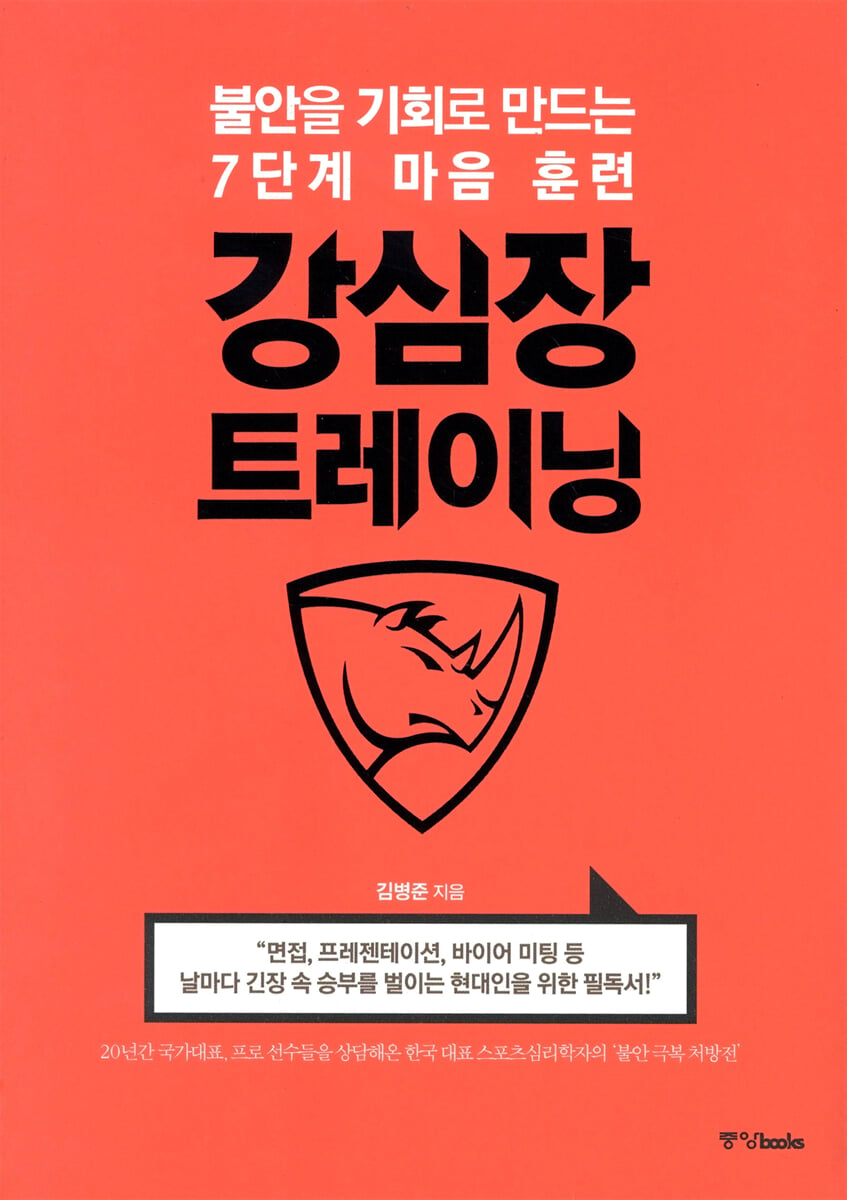
Strong Heart Training
 |
Description
Book Introduction
Professor Kim Byeong-jun, a leading authority on sports psychology in Korea, has published a book titled [Strong Heart Training], which compiles his expertise gained from counseling national and professional athletes for 20 years.
This book contains methods for converting the 'anxiety' and 'tension' we feel before big events in life, such as interviews, presentations, and buyer meetings, into positive energy to achieve the best results.
There are countless books on the market that cover methods for overcoming anxiety, including meditation and mind control.
Unlike those books, Professor Kim Byung-jun introduces specific methods that athletes actually use to perform at their best in real-life situations.
Professor Kim Byung-jun was the first in Korea to be invited by coach Gunes to work as a psychological counselor for the FC Seoul professional football team. He is also famous for teaching players in various sports, including golf, baseball, table tennis, soccer, archery, figure skating, dance, and baduk, how to develop a super mentality so that they can perform at their best in real matches through their own mental training.
In this book, the author introduces seven methods of strong-hearted training that will help you avoid panicking in any situation and turn anxiety into positive energy, turning it into an opportunity to demonstrate your skills.
By completing the 7 steps of mental training, including awakening inner positivity, visualizing success scenes in three dimensions, checking what you can control, focusing and immersing yourself in the present, awakening the thought that you can do it, training for actual situations rather than simple practice, and creating a habit routine for success, you will have laid the foundation for becoming a 'strong heart' that can display your skills in any situation.
The author introduces us to the training methods of athletes known to us as 'strong-hearted'.
Professional golfer Kyung-Ju Choi knows that competitions are more mentally challenging than physically challenging, so she says she never worries or thinks about golf during a match.
All course management readings are completed before the start of the game, and during the game, the player walks while reciting Bible verses.
This mental training method, which Choi Kyung-ju has mastered on her own, is her own unique training method for overcoming anxiety and nervousness about competition and leading to victory.
In addition, you can see the mental training methods of top athletes who achieve the results they want through their own methods, such as anecdotes of FC players who always carry a mental preparation manual with positive thoughts and behaviors to keep during matches, a professional golfer who imagines blowing away a bad thought by opening the lid of his head whenever it comes to him, national team shooter Kim Mi-jin who never gets caught up in that thought even when she misses the target, and a baseball player who achieves good results through a routine of self-suggestion that he can do better next time even if he makes a mistake during the game.
The author says that just as you climb stairs, you should take each step accurately, so you should also take each step accurately.
I hope that anyone who has easily missed a task due to anxiety and nervousness will find their own way to overcome anxiety by taking the steps of mental training through this book.
If you suddenly find yourself speechless, swallowing twice or tapping your neck with your right hand, or if you have your own plan to refocus, that alone is enough to make you strong-hearted.
This book contains methods for converting the 'anxiety' and 'tension' we feel before big events in life, such as interviews, presentations, and buyer meetings, into positive energy to achieve the best results.
There are countless books on the market that cover methods for overcoming anxiety, including meditation and mind control.
Unlike those books, Professor Kim Byung-jun introduces specific methods that athletes actually use to perform at their best in real-life situations.
Professor Kim Byung-jun was the first in Korea to be invited by coach Gunes to work as a psychological counselor for the FC Seoul professional football team. He is also famous for teaching players in various sports, including golf, baseball, table tennis, soccer, archery, figure skating, dance, and baduk, how to develop a super mentality so that they can perform at their best in real matches through their own mental training.
In this book, the author introduces seven methods of strong-hearted training that will help you avoid panicking in any situation and turn anxiety into positive energy, turning it into an opportunity to demonstrate your skills.
By completing the 7 steps of mental training, including awakening inner positivity, visualizing success scenes in three dimensions, checking what you can control, focusing and immersing yourself in the present, awakening the thought that you can do it, training for actual situations rather than simple practice, and creating a habit routine for success, you will have laid the foundation for becoming a 'strong heart' that can display your skills in any situation.
The author introduces us to the training methods of athletes known to us as 'strong-hearted'.
Professional golfer Kyung-Ju Choi knows that competitions are more mentally challenging than physically challenging, so she says she never worries or thinks about golf during a match.
All course management readings are completed before the start of the game, and during the game, the player walks while reciting Bible verses.
This mental training method, which Choi Kyung-ju has mastered on her own, is her own unique training method for overcoming anxiety and nervousness about competition and leading to victory.
In addition, you can see the mental training methods of top athletes who achieve the results they want through their own methods, such as anecdotes of FC players who always carry a mental preparation manual with positive thoughts and behaviors to keep during matches, a professional golfer who imagines blowing away a bad thought by opening the lid of his head whenever it comes to him, national team shooter Kim Mi-jin who never gets caught up in that thought even when she misses the target, and a baseball player who achieves good results through a routine of self-suggestion that he can do better next time even if he makes a mistake during the game.
The author says that just as you climb stairs, you should take each step accurately, so you should also take each step accurately.
I hope that anyone who has easily missed a task due to anxiety and nervousness will find their own way to overcome anxiety by taking the steps of mental training through this book.
If you suddenly find yourself speechless, swallowing twice or tapping your neck with your right hand, or if you have your own plan to refocus, that alone is enough to make you strong-hearted.
- You can preview some of the book's contents.
Preview
index
Prologue: The Secrets of the Best Players in Real-World Competitions
Part 1 Are you strong-hearted or weak-hearted?
01 Strong Heart Turns Anxiety into Opportunity
Avoiding tension is not the answer/ How do you overcome anxiety/ Anxiety can also be a source of energy for success/ What is the optimal energy zone that suits me/ Emotional states can be switched in an instant/ How to escape from the worst panic state/ You can control your mind only when you are compatible
Part 2: Warming Up for a Strong Heart
01 Awaken your inner positivity
Positive, positive, positive again / Self-suggestion to build a strong heart / Positive resilience to overcome slumps / How to turn negative self-suggestion into positive self-suggestion
02 Image association method that connects imagination to success
The Amazing Power of Imagination / Imagining Success in 3D / What You Gain from Imagination / Smart Image Training Methods / Image Training of Successful People
Part 3: Strong Heart Practical Training
01 Controllability Training
How to resist negative words/Distinguishing controllability/The attitude of effort over show-off/The advantages of effort/The steeler's way created by effort/Breaking jinxes with routines
02 Concentration Training
Focus on one thing at a time/Wherever your body goes, your mind goes with it/How to be completely present in the present/A refocusing plan that eliminates regrets/Get lost in the goodness of it/The optimal energy for me
03 Confidence Training
Set an expiration date on your anxiety/Confidence is the wing that controls your abilities/Why the can-do mindset is important/4 sources of confidence/4 secrets to improving your confidence/Have a target in mind
04 Training for real-world situations
The Traps of Practice/Training, Not Practice/Create Harsh Conditions/Harsh Condition Training Methods Learned from Badminton/60/40 Practice/Simulated Pitching Training
05 Training that solidifies success into a habit Habits and routines that bring success/Optimal conditions are always consistent/The power of a routine to overcome mistakes/Good habits of mini and macro routines/The best plan, the mental plan
Use your mentality as if you were climbing the epilogue stairs.
Part 1 Are you strong-hearted or weak-hearted?
01 Strong Heart Turns Anxiety into Opportunity
Avoiding tension is not the answer/ How do you overcome anxiety/ Anxiety can also be a source of energy for success/ What is the optimal energy zone that suits me/ Emotional states can be switched in an instant/ How to escape from the worst panic state/ You can control your mind only when you are compatible
Part 2: Warming Up for a Strong Heart
01 Awaken your inner positivity
Positive, positive, positive again / Self-suggestion to build a strong heart / Positive resilience to overcome slumps / How to turn negative self-suggestion into positive self-suggestion
02 Image association method that connects imagination to success
The Amazing Power of Imagination / Imagining Success in 3D / What You Gain from Imagination / Smart Image Training Methods / Image Training of Successful People
Part 3: Strong Heart Practical Training
01 Controllability Training
How to resist negative words/Distinguishing controllability/The attitude of effort over show-off/The advantages of effort/The steeler's way created by effort/Breaking jinxes with routines
02 Concentration Training
Focus on one thing at a time/Wherever your body goes, your mind goes with it/How to be completely present in the present/A refocusing plan that eliminates regrets/Get lost in the goodness of it/The optimal energy for me
03 Confidence Training
Set an expiration date on your anxiety/Confidence is the wing that controls your abilities/Why the can-do mindset is important/4 sources of confidence/4 secrets to improving your confidence/Have a target in mind
04 Training for real-world situations
The Traps of Practice/Training, Not Practice/Create Harsh Conditions/Harsh Condition Training Methods Learned from Badminton/60/40 Practice/Simulated Pitching Training
05 Training that solidifies success into a habit Habits and routines that bring success/Optimal conditions are always consistent/The power of a routine to overcome mistakes/Good habits of mini and macro routines/The best plan, the mental plan
Use your mentality as if you were climbing the epilogue stairs.
Detailed image

Into the book
The level of anxiety experienced by athletes is by far the highest compared to the anxiety we face in our daily lives.
Even in the Olympics, which took four years to prepare for, the results of those four years of hard work are decided in an instant.
The medalists get recognition, but everyone else is a loser.
The anxiety and tension among the players will be incomparable as the outcome of four years will be decided in such a short moment.
(Page 5)
Anxiety can be either negative or positive, depending on how you interpret it.
What matters more is how we perceive (interpret) our anxiety than how severely we feel it (intensity).
You need to develop the habit of interpreting anxiety positively to overcome the vague anxiety and nervousness that interfere with your performance.
(Page 31)
Negative self-suggestion does no good.
First of all, your confidence drops significantly.
This is because autosuggestion is a belief that an individual has.
Negative beliefs reduce concentration and lower motivation.
It's incredibly unfortunate when you, and not anyone else, do something that lowers your confidence, focus, and motivation.
The only person you can trust completely is yourself, so it is never good to judge yourself negatively, let alone others.
(Page 68)
Jang Mi-ran is famous for doing image training ahead of the Beijing Olympics.
She said that during her regular training sessions, she would sit with her eyes closed facing the wall of the training ground and draw out in great detail how she would act on the field.
And a few months later, the scene in the image actually came true.
(Page 97)
When you hear unnecessary negative comments about yourself, ask yourself, “Isn’t that about them, not me?”
Unfounded, bad words often reflect a person's psychological state.
I have worked hard to achieve good things, but there may be intentional attempts to point out my bad points.
(Page 133)
We live in an age of multitasking, but our brain's ability to focus doesn't.
The human brain is wired to like to focus on one thing at a time.
If you focus on the future, you can't focus on the present.
Likewise, if you focus on the past, you cannot focus on the present.
(Page 171)
Mia Hamm, recognized as a living legend in women's soccer, left a famous quote.
“Practice and training are different.
Practice means mastering movements that you lack.
“When training, concentration and tension are at their peak.” (Omitted) Practice should be thought of only as repetition and mastery to make up for what you lack.
It should be distinguished from training that prepares for actual combat.
(Page 245)
Even in the Olympics, which took four years to prepare for, the results of those four years of hard work are decided in an instant.
The medalists get recognition, but everyone else is a loser.
The anxiety and tension among the players will be incomparable as the outcome of four years will be decided in such a short moment.
(Page 5)
Anxiety can be either negative or positive, depending on how you interpret it.
What matters more is how we perceive (interpret) our anxiety than how severely we feel it (intensity).
You need to develop the habit of interpreting anxiety positively to overcome the vague anxiety and nervousness that interfere with your performance.
(Page 31)
Negative self-suggestion does no good.
First of all, your confidence drops significantly.
This is because autosuggestion is a belief that an individual has.
Negative beliefs reduce concentration and lower motivation.
It's incredibly unfortunate when you, and not anyone else, do something that lowers your confidence, focus, and motivation.
The only person you can trust completely is yourself, so it is never good to judge yourself negatively, let alone others.
(Page 68)
Jang Mi-ran is famous for doing image training ahead of the Beijing Olympics.
She said that during her regular training sessions, she would sit with her eyes closed facing the wall of the training ground and draw out in great detail how she would act on the field.
And a few months later, the scene in the image actually came true.
(Page 97)
When you hear unnecessary negative comments about yourself, ask yourself, “Isn’t that about them, not me?”
Unfounded, bad words often reflect a person's psychological state.
I have worked hard to achieve good things, but there may be intentional attempts to point out my bad points.
(Page 133)
We live in an age of multitasking, but our brain's ability to focus doesn't.
The human brain is wired to like to focus on one thing at a time.
If you focus on the future, you can't focus on the present.
Likewise, if you focus on the past, you cannot focus on the present.
(Page 171)
Mia Hamm, recognized as a living legend in women's soccer, left a famous quote.
“Practice and training are different.
Practice means mastering movements that you lack.
“When training, concentration and tension are at their peak.” (Omitted) Practice should be thought of only as repetition and mastery to make up for what you lack.
It should be distinguished from training that prepares for actual combat.
(Page 245)
--- From the text
GOODS SPECIFICS
- Date of publication: December 26, 2014
- Page count, weight, size: 315 pages | 538g | 150*215*30mm
- ISBN13: 9788927806004
- ISBN10: 892780600X
You may also like
카테고리
korean


korean

![GQ KOREA Mark (Monthly): December [2025]](http://librairie.coreenne.fr/cdn/shop/files/8ef265dbbfbf186523ed75ba7319009d.jpg?v=1765340328&width=3840)


