

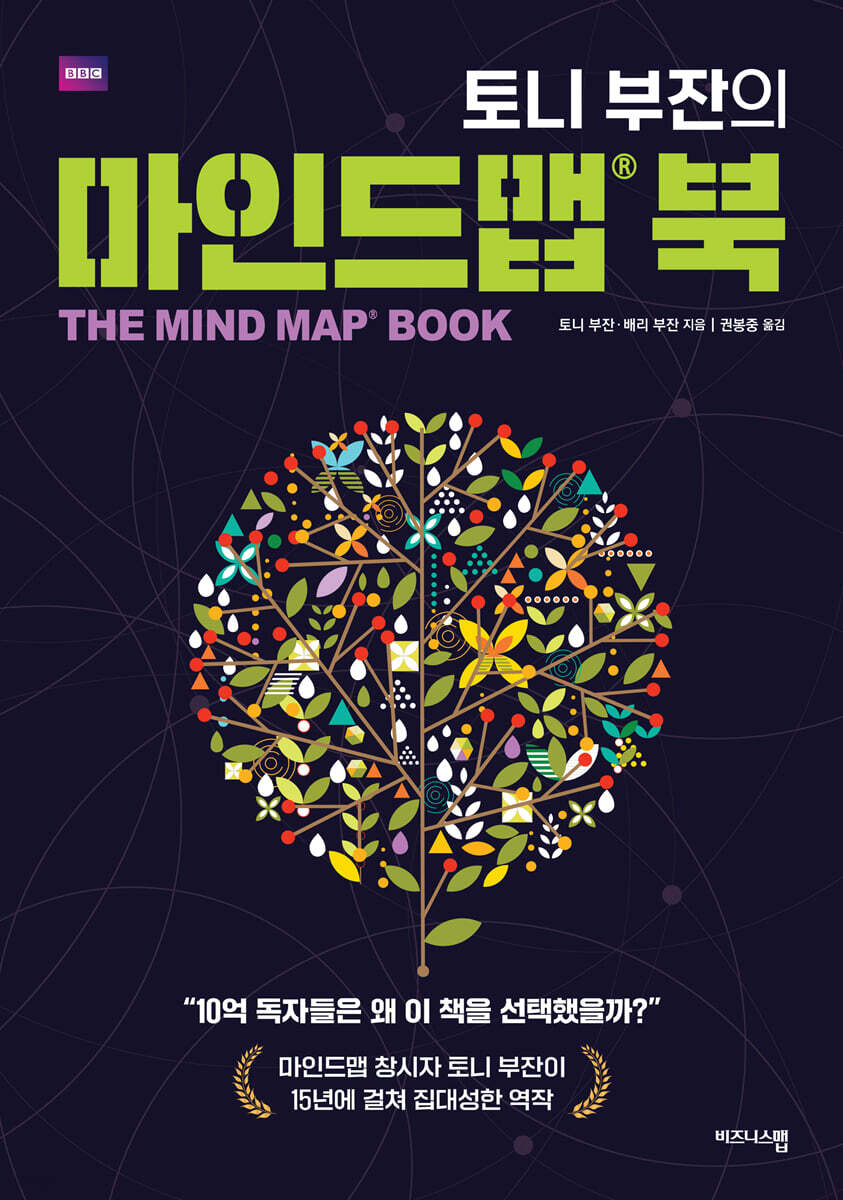
Tony Buzan's Mind Map Book
 |
Description
Book Introduction
Mind Map: A Brain-Wakening Thinking Tool
“A picture creates a map of thoughts.”
In today's world, information overload and complexity make it easy to lose your way of thinking.
The ability to efficiently process the endless stream of data and derive creative insights has become essential for survival.
Here is the definitive version of the visual thinking method that has transformed the lives of countless people around the world for decades.
This is Tony Buzan's Mind Map Book, the creator of mind maps.
Mind mapping is more than just a note-taking technique; it's an innovative way of thinking that comprehensively enhances memory, creativity, concentration, communication skills, thinking and learning skills, and even general intelligence.
Expanding your thinking with a single line or keyword, this visual tool helps you associate and reconstruct information in the same way the human brain works.
This book is the culmination of 15 years of work by Tony Buzan.
The author emphasizes that anyone can develop the ability to "remember easily, recall quickly, and structure persuasively" through training.
The results have immediate implications for our work and lives.
The structure of your presentations and reports will become more robust, the logic of your negotiations and persuasion will become clearer, and the process of setting personal goals and moving toward a more proactive life will become clearer.
“A picture creates a map of thoughts.”
In today's world, information overload and complexity make it easy to lose your way of thinking.
The ability to efficiently process the endless stream of data and derive creative insights has become essential for survival.
Here is the definitive version of the visual thinking method that has transformed the lives of countless people around the world for decades.
This is Tony Buzan's Mind Map Book, the creator of mind maps.
Mind mapping is more than just a note-taking technique; it's an innovative way of thinking that comprehensively enhances memory, creativity, concentration, communication skills, thinking and learning skills, and even general intelligence.
Expanding your thinking with a single line or keyword, this visual tool helps you associate and reconstruct information in the same way the human brain works.
This book is the culmination of 15 years of work by Tony Buzan.
The author emphasizes that anyone can develop the ability to "remember easily, recall quickly, and structure persuasively" through training.
The results have immediate implications for our work and lives.
The structure of your presentations and reports will become more robust, the logic of your negotiations and persuasion will become clearer, and the process of setting personal goals and moving toward a more proactive life will become clearer.
- You can preview some of the book's contents.
Preview
index
Acknowledgments · 8
About the Author · 10
Author's Preface to the Korean Edition · 14
Author's Preface · 16
How to Use This Book · 24
Part 1 Natural Structure
Chapter 1: The Amazing Brain · 37
Chapter 2: Great Brains · 52
Chapter 3: The Brain in a Corner · 57
Chapter 4: Radiation Accidents · 68
Chapter 5: Future Thinking · 74
Part 2: The Foundation of Mind Maps
Chapter 6 Vocabulary Brainstorming · 81
Chapter 7 Image Brainstorming · 90
Chapter 8: From Brainstorming to Mind Mapping · 99
Chapter 9 Mind Mapping · 104
Part 3: The Structure of a Mind Map
Chapter 10 Mind Mapping Guidelines · 115
Chapter 11: Developing Your Own Unique Style · 142
Part 4: Applying Mind Maps
Chapter 12 Decision Making · 153
Chapter 13: Organizing Your Thoughts · 162
Chapter 14: Organizing Other People's Thoughts · 170
Chapter 15: Memory · 179
Chapter 16: Creative Thinking · 186
Chapter 17 Group Mind Map · 199
Part 5: Using Mind Maps
SECTION A INDIVIDUAL
Chapter 18: Self-Analysis · 211
Chapter 19: Problem Solving · 219
Chapter 20 Mind Map Diary · 228
SECTION B Family
Chapter 21: Family Study and Storytelling · 237
SECTION C EDUCATIONAL MIND MAP
Chapter 22: Thought · 250
Chapter 23 Teaching Mind Map · 262
Chapter 24: Creating a Master Mind Map · 277
SECTION D BUSINESS AND PROFESSIONALS
Chapter 25: Meeting Mind Maps · 287
Chapter 26: Presentation Mind Map · 295
Chapter 27: Management Mind Maps · 305
Chapter 28: Creating a Computer Mind Map · 321
SECTION E The Future
Chapter 29: Radiation Accidents and the World of Mental Literacy · 340
supplement
Great Brains' Notes Quiz · 356
Natural Structure Illustration · 366
Great Brains' Notes Quiz Answers · 368
References · 370
About the Author · 10
Author's Preface to the Korean Edition · 14
Author's Preface · 16
How to Use This Book · 24
Part 1 Natural Structure
Chapter 1: The Amazing Brain · 37
Chapter 2: Great Brains · 52
Chapter 3: The Brain in a Corner · 57
Chapter 4: Radiation Accidents · 68
Chapter 5: Future Thinking · 74
Part 2: The Foundation of Mind Maps
Chapter 6 Vocabulary Brainstorming · 81
Chapter 7 Image Brainstorming · 90
Chapter 8: From Brainstorming to Mind Mapping · 99
Chapter 9 Mind Mapping · 104
Part 3: The Structure of a Mind Map
Chapter 10 Mind Mapping Guidelines · 115
Chapter 11: Developing Your Own Unique Style · 142
Part 4: Applying Mind Maps
Chapter 12 Decision Making · 153
Chapter 13: Organizing Your Thoughts · 162
Chapter 14: Organizing Other People's Thoughts · 170
Chapter 15: Memory · 179
Chapter 16: Creative Thinking · 186
Chapter 17 Group Mind Map · 199
Part 5: Using Mind Maps
SECTION A INDIVIDUAL
Chapter 18: Self-Analysis · 211
Chapter 19: Problem Solving · 219
Chapter 20 Mind Map Diary · 228
SECTION B Family
Chapter 21: Family Study and Storytelling · 237
SECTION C EDUCATIONAL MIND MAP
Chapter 22: Thought · 250
Chapter 23 Teaching Mind Map · 262
Chapter 24: Creating a Master Mind Map · 277
SECTION D BUSINESS AND PROFESSIONALS
Chapter 25: Meeting Mind Maps · 287
Chapter 26: Presentation Mind Map · 295
Chapter 27: Management Mind Maps · 305
Chapter 28: Creating a Computer Mind Map · 321
SECTION E The Future
Chapter 29: Radiation Accidents and the World of Mental Literacy · 340
supplement
Great Brains' Notes Quiz · 356
Natural Structure Illustration · 366
Great Brains' Notes Quiz Answers · 368
References · 370
Into the book
The fact that common associations for a given word, image, or concept are so rare suggests that we are all mysteriously and inexplicably different from one another.
In other words, every human being is far more individual and unique than we have ever known.
You, the person reading this sentence at this very moment, have millions of trillions of associations in your brain that you share with no one in the past, present, or future.
--- p.86
Memory occurs in a process that promotes responses, a process that spreads from words to associated words through connections.
--- p.100
Mind mapping is a uniquely powerful technique that engages all areas of the brain's functions: words, images, numbers, logic, rhythm, color, and spatial perception.
These features of mind maps give you the freedom to explore the vast world of your brain.
--- p.105
Zeus symbolizes strength and power.
According to mythology, applying power and authority to memory produces a fertilizing effect that brings creativity.
This relationship has important implications in mind map theory.
Mind mapping is a theory that was created based on research on recall that occurs during learning and memory processes.
Therefore, mind mapping, which was originally a memory method, naturally evolved into a creative and multi-purpose thinking technique based on Sperry's brain research and Torrance's creativity research.
--- p.180
The fact that the principles of creative thinking and memory are essentially the same confirms that mind mapping is an essential and natural manifestation and tool of these forms of thinking.
It also provides strong evidence for theorists who argue that creativity and memory are in fact mirror images of the same process, whereas most of the literature on creativity and memory suggests that the two processes are distinct and separate.
--- p.189
It's impossible to distinguish between a well-crafted group mind map and one created by a single, great thinker.
--- p.200
Literacy generally means understanding the letters of the alphabet, numbers, and the infinite combinations of letters and numbers.
Mental literacy is understanding the brain's biological alphabet and its behavioral aspects, including the cerebral cortex, brain cells, learning, memory, and creativity.
In other words, every human being is far more individual and unique than we have ever known.
You, the person reading this sentence at this very moment, have millions of trillions of associations in your brain that you share with no one in the past, present, or future.
--- p.86
Memory occurs in a process that promotes responses, a process that spreads from words to associated words through connections.
--- p.100
Mind mapping is a uniquely powerful technique that engages all areas of the brain's functions: words, images, numbers, logic, rhythm, color, and spatial perception.
These features of mind maps give you the freedom to explore the vast world of your brain.
--- p.105
Zeus symbolizes strength and power.
According to mythology, applying power and authority to memory produces a fertilizing effect that brings creativity.
This relationship has important implications in mind map theory.
Mind mapping is a theory that was created based on research on recall that occurs during learning and memory processes.
Therefore, mind mapping, which was originally a memory method, naturally evolved into a creative and multi-purpose thinking technique based on Sperry's brain research and Torrance's creativity research.
--- p.180
The fact that the principles of creative thinking and memory are essentially the same confirms that mind mapping is an essential and natural manifestation and tool of these forms of thinking.
It also provides strong evidence for theorists who argue that creativity and memory are in fact mirror images of the same process, whereas most of the literature on creativity and memory suggests that the two processes are distinct and separate.
--- p.189
It's impossible to distinguish between a well-crafted group mind map and one created by a single, great thinker.
--- p.200
Literacy generally means understanding the letters of the alphabet, numbers, and the infinite combinations of letters and numbers.
Mental literacy is understanding the brain's biological alphabet and its behavioral aspects, including the cerebral cortex, brain cells, learning, memory, and creativity.
--- p.344
Publisher's Review
Mind Map: A Thinking Tool That Unlocks Intellectual Potential
Mind mapping, often called the "MacGyver knife of the brain," is a representative visual thinking method used in educational settings and business organizations around the world.
Since the first publication in 1995, mind map research has been a core topic in major brain and learning journals.
In particular, its authority has been proven by the fact that world leaders such as Bill Gates and former US Vice President Al Gore have actually used it to organize work and derive insights.
In Korea, it was introduced through a drama under the name 'Memory Tree', which helped to increase its public awareness.
This book, "Tony Buzan's Mind Map Book," is a textbook that compiles human thinking techniques developed by its founder, Tony Buzan, over 15 years.
The author clearly explains the basic operating principles of the human brain, also known as a "biocomputer," in language that readers can easily understand.
The core of mind mapping is ‘radiant thinking.’
It structures complex ideas into a simple yet powerful map by branching out from a central concept and connecting them like a tree.
What this book offers to readers is clear.
The innovative concept of radiation thinking demonstrates that we can effectively regulate and develop our innate thought processes, thereby awakening our latent creativity and intellectual abilities.
Beyond simple memorization and organizing techniques, this book is recommended as a must-read for anyone who wants to experience "intellectual liberation" by expanding and structuring their thinking in all areas of daily life, including planning, presentations, and collaboration.
Mind mapping, often called the "MacGyver knife of the brain," is a representative visual thinking method used in educational settings and business organizations around the world.
Since the first publication in 1995, mind map research has been a core topic in major brain and learning journals.
In particular, its authority has been proven by the fact that world leaders such as Bill Gates and former US Vice President Al Gore have actually used it to organize work and derive insights.
In Korea, it was introduced through a drama under the name 'Memory Tree', which helped to increase its public awareness.
This book, "Tony Buzan's Mind Map Book," is a textbook that compiles human thinking techniques developed by its founder, Tony Buzan, over 15 years.
The author clearly explains the basic operating principles of the human brain, also known as a "biocomputer," in language that readers can easily understand.
The core of mind mapping is ‘radiant thinking.’
It structures complex ideas into a simple yet powerful map by branching out from a central concept and connecting them like a tree.
What this book offers to readers is clear.
The innovative concept of radiation thinking demonstrates that we can effectively regulate and develop our innate thought processes, thereby awakening our latent creativity and intellectual abilities.
Beyond simple memorization and organizing techniques, this book is recommended as a must-read for anyone who wants to experience "intellectual liberation" by expanding and structuring their thinking in all areas of daily life, including planning, presentations, and collaboration.
GOODS SPECIFICS
- Date of issue: October 24, 2025
- Page count, weight, size: 376 pages | 173*246*30mm
- ISBN13: 9791124030011
- ISBN10: 1124030018
You may also like
카테고리
korean


korean

![GQ KOREA Mark (Monthly): December [2025]](http://librairie.coreenne.fr/cdn/shop/files/8ef265dbbfbf186523ed75ba7319009d.jpg?v=1765340328&width=3840)


