

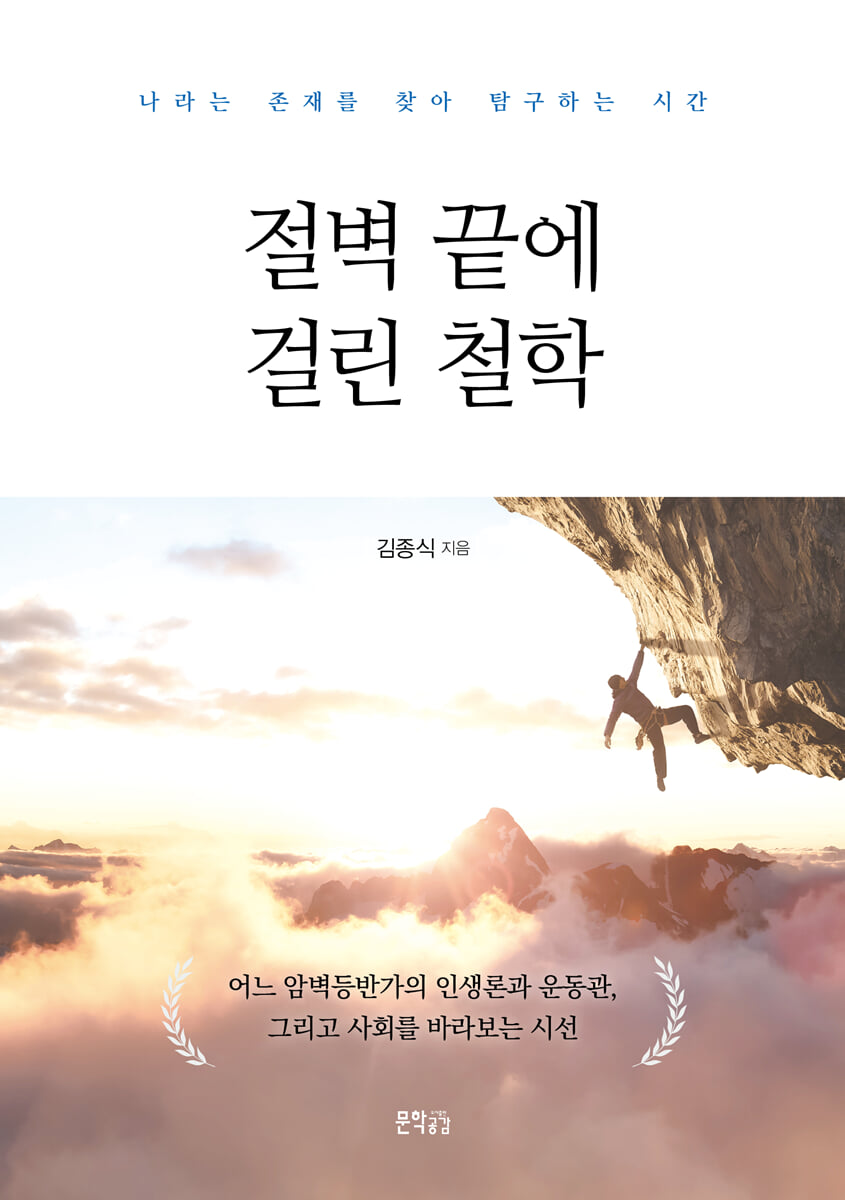
Philosophy on the edge of a cliff
 |
Description
Book Introduction
A rock climber's philosophy on life and exercise,
And a view of society
Author Kim Jong-sik began rock climbing at the age of forty-three and re-established his philosophy at fifty-nine.
His life started late, but it was never too late.
"Philosophy on the Edge of a Cliff" is a philosophy he wrote with his body and a record of his climbing with his thoughts.
In this book, the author divides his life into three parts.
In Part 1, 'A Life of Thought', I unravel the lessons I have learned from my life so far, now approaching my sixties.
'Part 2: A Life of Exercise' compares what I realized while exercising to life.
Part 3, Social Life, goes beyond the individual realm and talks about the problems of the society we live in.
The 'aphorisms' that contain the author's short thoughts here and there evoke a little sympathy.
“Thinking is the movement of the head, and movement is the thinking of the body.”
The author has personally learned this truth through many years of climbing and training.
This book revives philosophy not as a language of the podium but as a language of life, not as a language of theory but as a language of experience.
To those who have lost their way at the peak of life, and to those who think only with their heads, 『Philosophy on the Edge of a Cliff』 asks:
“Where is the peak of your life right now?”
And a view of society
Author Kim Jong-sik began rock climbing at the age of forty-three and re-established his philosophy at fifty-nine.
His life started late, but it was never too late.
"Philosophy on the Edge of a Cliff" is a philosophy he wrote with his body and a record of his climbing with his thoughts.
In this book, the author divides his life into three parts.
In Part 1, 'A Life of Thought', I unravel the lessons I have learned from my life so far, now approaching my sixties.
'Part 2: A Life of Exercise' compares what I realized while exercising to life.
Part 3, Social Life, goes beyond the individual realm and talks about the problems of the society we live in.
The 'aphorisms' that contain the author's short thoughts here and there evoke a little sympathy.
“Thinking is the movement of the head, and movement is the thinking of the body.”
The author has personally learned this truth through many years of climbing and training.
This book revives philosophy not as a language of the podium but as a language of life, not as a language of theory but as a language of experience.
To those who have lost their way at the peak of life, and to those who think only with their heads, 『Philosophy on the Edge of a Cliff』 asks:
“Where is the peak of your life right now?”
- You can preview some of the book's contents.
Preview
index
introduction
Part 1 / The Thinking Life
Around the age of sixty
When was the peak of your life?
Aphorism 01: Turning Your Life Around
Is achievement a talent or a hard work?
Three Types of Fear in a Crisis
Don't speak carelessly about lives different from your own.
Aphorism 02 Anus and Mouth
Circling the Earth with only wind
Aphorism 03 Wind
Your gaze determines me?
How to teach?
Aphorism 04 Narcissism
Can a disadvantage become an advantage?
Aphorism 05 Mirror, the See-Through Wall
Dad, how was I born?
For those who have gone the old way: On courtesy
Aphorism 06 Dust from Me
Interference Accidents: Whose Fault Is It?
Rest and practice
Aphorism 07 Family Functions
I learned the name of a tree I didn't know.
Aphorism 08 Love
Mom and Sachi
I met my father after 59 years
Part 2 / A Life of Exercise
Is there a relationship between exercise and longevity?
Good news: the law of conservation of momentum
There are also grades of acorn keys.
The importance of the five minutes before and after bed
Aphorism 09 The Meaning of Exercise
When you're sick, you need to adjust
3 Action Points for Health
How to escape a slump
How to increase the difficulty?
Pushing and Pulling Strength - Assistance Exercise 1
Up and down, left and right, strength and flexibility - auxiliary exercise 2
Aphorism 10: Strength and Flexibility
Exercise compatibility
Drinking and exercise
Part 3 / Social Life
Where on earth is my 252.51 million won?
30% of ants don't work
Aphorism 11: Individualism and Egoism
Old people or young people, who works more?
Am I conservative or progressive?
Aphorism 12: On Promises
Teaching politics
Become the hundredth monkey
Is our wish unification?
Aphorism 13 Love
On pride and humility, ups and downs
What is ASPD (Antisocial Personality Disorder)?
Number Murder
General and specific perspectives for problem solving
Aphorism 14: On Sacrifice
Will aliens come?
Aphorism 15: The Human Shackles
Are humans good or evil beings?
Aphorism 16 Topic
Part 1 / The Thinking Life
Around the age of sixty
When was the peak of your life?
Aphorism 01: Turning Your Life Around
Is achievement a talent or a hard work?
Three Types of Fear in a Crisis
Don't speak carelessly about lives different from your own.
Aphorism 02 Anus and Mouth
Circling the Earth with only wind
Aphorism 03 Wind
Your gaze determines me?
How to teach?
Aphorism 04 Narcissism
Can a disadvantage become an advantage?
Aphorism 05 Mirror, the See-Through Wall
Dad, how was I born?
For those who have gone the old way: On courtesy
Aphorism 06 Dust from Me
Interference Accidents: Whose Fault Is It?
Rest and practice
Aphorism 07 Family Functions
I learned the name of a tree I didn't know.
Aphorism 08 Love
Mom and Sachi
I met my father after 59 years
Part 2 / A Life of Exercise
Is there a relationship between exercise and longevity?
Good news: the law of conservation of momentum
There are also grades of acorn keys.
The importance of the five minutes before and after bed
Aphorism 09 The Meaning of Exercise
When you're sick, you need to adjust
3 Action Points for Health
How to escape a slump
How to increase the difficulty?
Pushing and Pulling Strength - Assistance Exercise 1
Up and down, left and right, strength and flexibility - auxiliary exercise 2
Aphorism 10: Strength and Flexibility
Exercise compatibility
Drinking and exercise
Part 3 / Social Life
Where on earth is my 252.51 million won?
30% of ants don't work
Aphorism 11: Individualism and Egoism
Old people or young people, who works more?
Am I conservative or progressive?
Aphorism 12: On Promises
Teaching politics
Become the hundredth monkey
Is our wish unification?
Aphorism 13 Love
On pride and humility, ups and downs
What is ASPD (Antisocial Personality Disorder)?
Number Murder
General and specific perspectives for problem solving
Aphorism 14: On Sacrifice
Will aliens come?
Aphorism 15: The Human Shackles
Are humans good or evil beings?
Aphorism 16 Topic
Into the book
Long ago, my teacher asked me this:
It wasn't a question about life in general, it was just a question specific to climbing.
I remember it was when he was just entering his sixties.
“Well, I don’t know… What about you, hyung?”
“I feel like this is the peak.”
It's a rare and at the same time remarkable confession to feel like you've peaked at sixty, especially in sports.
Anyway, if you think that age is the peak, there could be two reasons.
First, you are working harder now than before, or second, you are realizing and applying something important that you didn't know then.
Or it could be both.
--- p.16, from “When is the peak of your life?”
Are there winning and losing stones? While there may be good and bad materials, there are no stones in the world that differ in function.
What determines the outcome is not the material, but the direction, placement, and timing of the stones.
It's okay if you think you're a cheap piece.
If you study and work hard with love, you can enjoy playing Baduk and become quite good at it.
--- p.23, from “Is Achievement Talent or Effort?”
There are climbing routes numbered 1 to 50.
However, there are people who always fail at number 40, but if you start at number 38 instead of number 1, you can get to number 40, or even number 50.
What does this person need? Of course, as time passes, stamina increases, and skills improve, the problem will be solved.
Before that, is there a way for this person to go from 1 to 50 without falling under the same conditions? There is.
The problem is that your stamina will eventually run out at 40, so to solve that problem you need to recharge somewhere before then.
In other words, you need to take breaks, and you need to practice the timing, posture, breathing, etc. regularly to see results in real life.
It wasn't a question about life in general, it was just a question specific to climbing.
I remember it was when he was just entering his sixties.
“Well, I don’t know… What about you, hyung?”
“I feel like this is the peak.”
It's a rare and at the same time remarkable confession to feel like you've peaked at sixty, especially in sports.
Anyway, if you think that age is the peak, there could be two reasons.
First, you are working harder now than before, or second, you are realizing and applying something important that you didn't know then.
Or it could be both.
--- p.16, from “When is the peak of your life?”
Are there winning and losing stones? While there may be good and bad materials, there are no stones in the world that differ in function.
What determines the outcome is not the material, but the direction, placement, and timing of the stones.
It's okay if you think you're a cheap piece.
If you study and work hard with love, you can enjoy playing Baduk and become quite good at it.
--- p.23, from “Is Achievement Talent or Effort?”
There are climbing routes numbered 1 to 50.
However, there are people who always fail at number 40, but if you start at number 38 instead of number 1, you can get to number 40, or even number 50.
What does this person need? Of course, as time passes, stamina increases, and skills improve, the problem will be solved.
Before that, is there a way for this person to go from 1 to 50 without falling under the same conditions? There is.
The problem is that your stamina will eventually run out at 40, so to solve that problem you need to recharge somewhere before then.
In other words, you need to take breaks, and you need to practice the timing, posture, breathing, etc. regularly to see results in real life.
--- p.63, from “Rest and Practice”
Publisher's Review
Thinking is exercise of the head, exercise is thinking of the body.
Life is like rock climbing, taking one step at a time.
Life is often compared to many things.
"Philosophy on the Edge of a Cliff" contains a somewhat unusual perspective on life.
This book contains the author's thoughts and reflections on rock climbing while exercising.
The author discovered a new passion for rock climbing in his 40s and has continued to practice it ever since, now approaching his 60s.
After hearing from his climbing instructor, who was in his sixties, that "the peak of my life is now," the author ponders when the climax of his life will be.
It's not easy to be at your peak athletic performance in middle age, but neither is life.
People worry that they haven't reached the peak of their lives yet, or that they've already passed it.
When I see someone who has achieved great success, I think I want to be like them, but I hesitate because I don't know how many failures there will be before I get there.
However, after much thought, the author comes to a conclusion.
“I’m at the peak right now, and there’s no reason why that won’t be true tomorrow or next year.” Depending on your mindset, the peak of your life could be today, tomorrow, or a month from now.
"Philosophy on the Edge of a Cliff" is not just a collection of essays.
In it, there is a human attitude toward life that he has held on to at the edge of a cliff, and a philosophy of looking at the world through this.
Instead of flowery sentences, there is clear thinking, and instead of abstractions, there is the concrete temperature of life.
Each paragraph, like a climbing hold, draws the reader into his own inner self.
The cliff is not a symbol of danger, but a boundary where reason begins.
Hanging there, the author asks:
“What are you thinking about as you climb today?”
Life is like rock climbing, taking one step at a time.
Life is often compared to many things.
"Philosophy on the Edge of a Cliff" contains a somewhat unusual perspective on life.
This book contains the author's thoughts and reflections on rock climbing while exercising.
The author discovered a new passion for rock climbing in his 40s and has continued to practice it ever since, now approaching his 60s.
After hearing from his climbing instructor, who was in his sixties, that "the peak of my life is now," the author ponders when the climax of his life will be.
It's not easy to be at your peak athletic performance in middle age, but neither is life.
People worry that they haven't reached the peak of their lives yet, or that they've already passed it.
When I see someone who has achieved great success, I think I want to be like them, but I hesitate because I don't know how many failures there will be before I get there.
However, after much thought, the author comes to a conclusion.
“I’m at the peak right now, and there’s no reason why that won’t be true tomorrow or next year.” Depending on your mindset, the peak of your life could be today, tomorrow, or a month from now.
"Philosophy on the Edge of a Cliff" is not just a collection of essays.
In it, there is a human attitude toward life that he has held on to at the edge of a cliff, and a philosophy of looking at the world through this.
Instead of flowery sentences, there is clear thinking, and instead of abstractions, there is the concrete temperature of life.
Each paragraph, like a climbing hold, draws the reader into his own inner self.
The cliff is not a symbol of danger, but a boundary where reason begins.
Hanging there, the author asks:
“What are you thinking about as you climb today?”
GOODS SPECIFICS
- Date of issue: October 23, 2025
- Page count, weight, size: 192 pages | 148*210*20mm
- ISBN13: 9791156229629
- ISBN10: 1156229626
You may also like
카테고리
korean


korean

![GQ KOREA Mark (Monthly): December [2025]](http://librairie.coreenne.fr/cdn/shop/files/8ef265dbbfbf186523ed75ba7319009d.jpg?v=1765340328&width=3840)


