

Serotonin Hara! (Recover Special Edition)
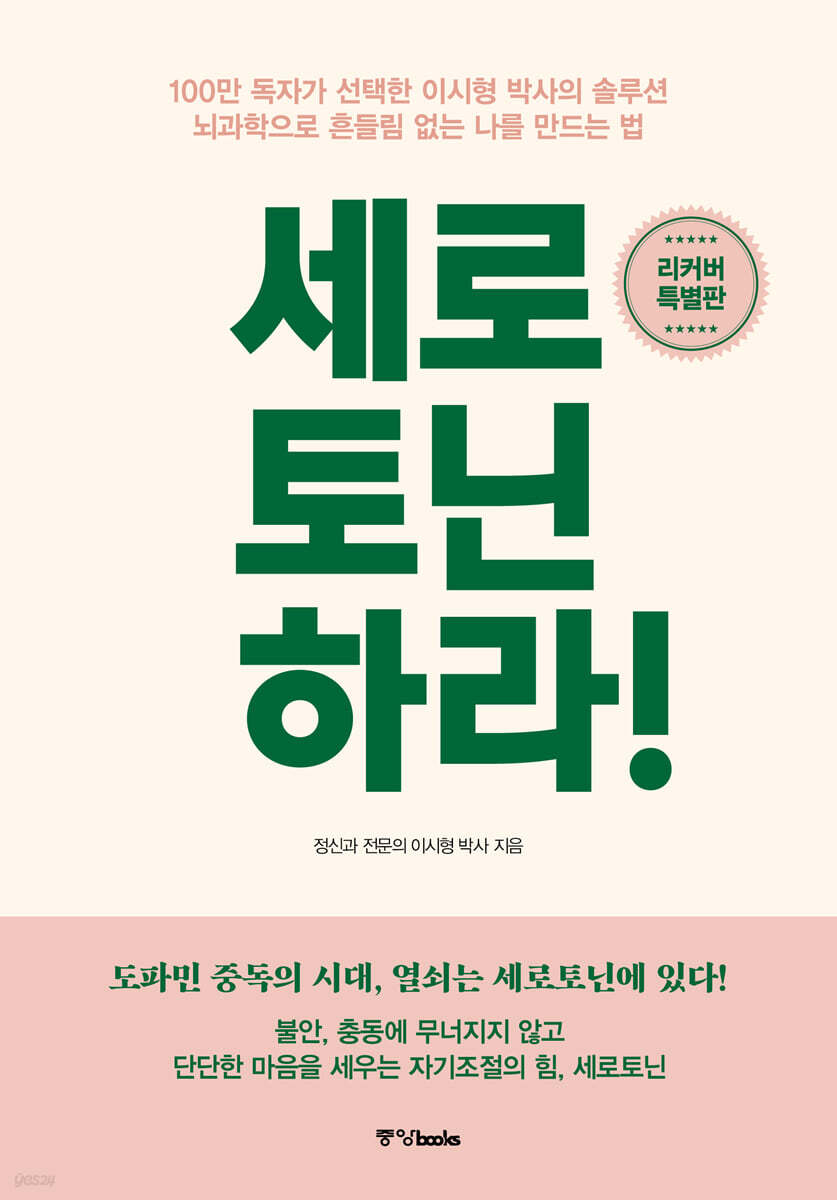 |
Description
Book Introduction
In the age of dopamine addiction, the key to a strong mind is serotonin!
If you don't want to be overwhelmed by anxiety, impulsivity, and stress, get serotonin right now.
This book, suggested by psychiatrist Dr. Lee Si-hyung, is based on brain science and teaches you how to regain control of your life without being swayed by emotions.
Emotions move people, but it is the brain that controls those emotions.
And the key substance that holds the brain firmly together is serotonin.
Serotonin is not simply a 'happiness hormone' that makes you feel good, but a regulatory hormone that calms anxiety and impulsivity and restores motivation and positivity.
For modern people who are swayed by the addictive pleasure of dopamine and the explosive excitement of adrenaline, serotonin serves as a strong safety device that restores balance.
However, serotonin cannot be replenished through drugs or food.
It must be created within the body through daily habits and attitudes.
The method is not grand.
Small practices like how to walk, how to breathe, and how to chew food stimulate the brain and activate serotonin, and these accumulated changes ultimately create a stronger and happier self.
《Serotonin Hara》 became a bestseller immediately after its publication in 2010 and has changed the lives of countless readers.
One reader confessed, “I was able to fix my stress-ridden life with serotonin.”
It has established itself as a practical self-development book that goes beyond simple brain science knowledge and changes one's attitude toward life.
Celebrating its 15th anniversary, this special edition, presented with a new cover and preface, will once again provide a powerful answer to those seeking a strong, unwavering heart in a chaotic world.
If you don't want to be overwhelmed by anxiety, impulsivity, and stress, get serotonin right now.
This book, suggested by psychiatrist Dr. Lee Si-hyung, is based on brain science and teaches you how to regain control of your life without being swayed by emotions.
Emotions move people, but it is the brain that controls those emotions.
And the key substance that holds the brain firmly together is serotonin.
Serotonin is not simply a 'happiness hormone' that makes you feel good, but a regulatory hormone that calms anxiety and impulsivity and restores motivation and positivity.
For modern people who are swayed by the addictive pleasure of dopamine and the explosive excitement of adrenaline, serotonin serves as a strong safety device that restores balance.
However, serotonin cannot be replenished through drugs or food.
It must be created within the body through daily habits and attitudes.
The method is not grand.
Small practices like how to walk, how to breathe, and how to chew food stimulate the brain and activate serotonin, and these accumulated changes ultimately create a stronger and happier self.
《Serotonin Hara》 became a bestseller immediately after its publication in 2010 and has changed the lives of countless readers.
One reader confessed, “I was able to fix my stress-ridden life with serotonin.”
It has established itself as a practical self-development book that goes beyond simple brain science knowledge and changes one's attitude toward life.
Celebrating its 15th anniversary, this special edition, presented with a new cover and preface, will once again provide a powerful answer to those seeking a strong, unwavering heart in a chaotic world.
- You can preview some of the book's contents.
Preview
index
Prologue - The brain is what moves people.
Before we begin - how good is your self-control?
Chapter 1: Why Your Heart Won't Do What You Want
Personality determines destiny
3 Brain Substances That Determine Our Mind
Serotonin will save us
Ask first, where are you running and for what?
Everyone works hard
The courage to know how to rest
Chapter 2: The Brain Science Mechanism That Makes Anything You Wish For Come True
Pay attention to the frontal lobe!
Your brain will help you
Cultivating Resilience: The Power to Overcome Crisis
Blaming yourself is more dangerous than blaming others.
The Amazing Magic of Positive Thinking Created by the Optimism Circuit
The power of brain science to change habits and transform your future.
Chapter 3: The Serotonin Effect That Silently Makes Me Stronger
'Habitual Competitive Obsession' is Dangerous
Throw away the 'Ogi activation'
Serotonin-type human armed with controllability
8 Characteristics of Serotonin-Type People
First, regulate rationally / Second, concentrate fiercely
Third, the goal is clear. Fourth, learn from bitter experiences.
Fifth, right-brained / Sixth, human-smelling
Seventh, be happy by giving / Eighth, have high nature-friendly intelligence
Chapter 4: Increases potential ability by 200%
10 Commandments for Building a Frontal Lobe
First, be moved to tears.
Second, just start.
Third, one hour in the morning determines your fate.
Fourth, good luck follows you when you have books with you.
Fifth, have a sense of ownership.
Sixth, be happy together, but also be happy alone.
Seventh, it's like catching a whale with just one fish.
Eighth, let's still smile
Ninth, gratitude is the most powerful healer.
Tenth, feel with your heart, not your head.
Chapter 5: Walk, Think, and Wake Up Your Brain
To save the frontal lobe weakened by stress
Socratic Walking: Solving Problems While Walking
Walk together to make me your side
Oppose subway route seats
100 days of 30-minute efforts
The Science of Walking: Stimulating the Brain with Your Feet
Epilogue - To Be Happy, First Let Go
Recommendation - Living Serotonin-wise
Before we begin - how good is your self-control?
Chapter 1: Why Your Heart Won't Do What You Want
Personality determines destiny
3 Brain Substances That Determine Our Mind
Serotonin will save us
Ask first, where are you running and for what?
Everyone works hard
The courage to know how to rest
Chapter 2: The Brain Science Mechanism That Makes Anything You Wish For Come True
Pay attention to the frontal lobe!
Your brain will help you
Cultivating Resilience: The Power to Overcome Crisis
Blaming yourself is more dangerous than blaming others.
The Amazing Magic of Positive Thinking Created by the Optimism Circuit
The power of brain science to change habits and transform your future.
Chapter 3: The Serotonin Effect That Silently Makes Me Stronger
'Habitual Competitive Obsession' is Dangerous
Throw away the 'Ogi activation'
Serotonin-type human armed with controllability
8 Characteristics of Serotonin-Type People
First, regulate rationally / Second, concentrate fiercely
Third, the goal is clear. Fourth, learn from bitter experiences.
Fifth, right-brained / Sixth, human-smelling
Seventh, be happy by giving / Eighth, have high nature-friendly intelligence
Chapter 4: Increases potential ability by 200%
10 Commandments for Building a Frontal Lobe
First, be moved to tears.
Second, just start.
Third, one hour in the morning determines your fate.
Fourth, good luck follows you when you have books with you.
Fifth, have a sense of ownership.
Sixth, be happy together, but also be happy alone.
Seventh, it's like catching a whale with just one fish.
Eighth, let's still smile
Ninth, gratitude is the most powerful healer.
Tenth, feel with your heart, not your head.
Chapter 5: Walk, Think, and Wake Up Your Brain
To save the frontal lobe weakened by stress
Socratic Walking: Solving Problems While Walking
Walk together to make me your side
Oppose subway route seats
100 days of 30-minute efforts
The Science of Walking: Stimulating the Brain with Your Feet
Epilogue - To Be Happy, First Let Go
Recommendation - Living Serotonin-wise
Detailed image

Into the book
We know endorphins as happiness substances, but that is a big misconception.
First of all, endorphins bring about a strong sense of pleasure, but the problem is that they are addictive… Whether it’s drugs, gambling, or alcohol, if you do it often enough, you become addicted.
Dopamine and endorphins are scientifically known to have no self-control ability… The happy substance is not endorphins, but serotonin.
That passionate moment when lovers embrace passionately is joy, not happiness.
After the hug, after catching our breath, when we hold hands and face each other in a sunny window, only then does a faint feeling creep in. That is happiness. ---p.42
If you wish for it earnestly, it will come true! Our ancestors already knew that.
I prayed earnestly for 100 days to make my wish come true.
While we pray with all our heart, information about the problem is constantly input into our frontal and temporal lobes, and our brain's subconscious uses that information to find solutions.
And without me knowing, my heart also moves in that direction.
It's one step closer to solving the problem. ---p.78
In psychiatry, the ability to recover is called 'resilience', and it is an ability that is formed only through adversity... but there is a condition.
Going through adversity doesn't necessarily mean your adversity index will increase.
We must learn why we failed through serious self-reflection and humility… Small failures and setbacks make us stronger. ---p.84
Let's think about the first time you jumped on a jumping jack... The prefrontal cortex asks the hippocampus and amygdala... The hippocampus answers, 'This is my first time jumping on a jumping jack, but I've had similar experiences.'
The amygdala also responds, 'No problem, I'm confident.'
If the hippocampus and amygdala answer 'yes' like this, the frontal lobe decides 'let's run'.
Then, run forward with strength and jump bravely… This is the brain science mechanism by which the optimism circuit creates a success circuit.
In other words, it leads to 'small experience → confidence in the optimistic circuit → courageous challenge → small success → emotion and praise → bigger challenge → big success.' ---p.91
Recent brain science has proven that habits can be changed. Forget the idea of doing something all at once. You can avoid triggering the amygdala's fear response by gradually taking small steps.
No matter how good something is, if you force yourself to do something that your amygdala doesn't like, it will only last three days and you will eventually fail... Try making small changes consciously and continuously for three weeks.
New changes are entered into the hippocampus as short-term memory.
If this is repeated, the hippocampus recognizes its importance, organizes and consolidates the memory, and settles it in the temporal lobe or throughout the brain, thereby transferring it to and storing it as mid- to long-term memory.
This leads to unconscious behavior, which soon becomes a habit. ---p.97
How can a serotonin-type person not experience the pain of failure?
But he recovers quickly.
This is different.
He knows and believes that no matter how deep and long the night, dawn will come.
So now I'm in pain, but I'm not panicking or doing anything out of the blue.
It's about not getting caught up in immediate negative emotions.
This is the unique function of serotonin.
First of all, endorphins bring about a strong sense of pleasure, but the problem is that they are addictive… Whether it’s drugs, gambling, or alcohol, if you do it often enough, you become addicted.
Dopamine and endorphins are scientifically known to have no self-control ability… The happy substance is not endorphins, but serotonin.
That passionate moment when lovers embrace passionately is joy, not happiness.
After the hug, after catching our breath, when we hold hands and face each other in a sunny window, only then does a faint feeling creep in. That is happiness. ---p.42
If you wish for it earnestly, it will come true! Our ancestors already knew that.
I prayed earnestly for 100 days to make my wish come true.
While we pray with all our heart, information about the problem is constantly input into our frontal and temporal lobes, and our brain's subconscious uses that information to find solutions.
And without me knowing, my heart also moves in that direction.
It's one step closer to solving the problem. ---p.78
In psychiatry, the ability to recover is called 'resilience', and it is an ability that is formed only through adversity... but there is a condition.
Going through adversity doesn't necessarily mean your adversity index will increase.
We must learn why we failed through serious self-reflection and humility… Small failures and setbacks make us stronger. ---p.84
Let's think about the first time you jumped on a jumping jack... The prefrontal cortex asks the hippocampus and amygdala... The hippocampus answers, 'This is my first time jumping on a jumping jack, but I've had similar experiences.'
The amygdala also responds, 'No problem, I'm confident.'
If the hippocampus and amygdala answer 'yes' like this, the frontal lobe decides 'let's run'.
Then, run forward with strength and jump bravely… This is the brain science mechanism by which the optimism circuit creates a success circuit.
In other words, it leads to 'small experience → confidence in the optimistic circuit → courageous challenge → small success → emotion and praise → bigger challenge → big success.' ---p.91
Recent brain science has proven that habits can be changed. Forget the idea of doing something all at once. You can avoid triggering the amygdala's fear response by gradually taking small steps.
No matter how good something is, if you force yourself to do something that your amygdala doesn't like, it will only last three days and you will eventually fail... Try making small changes consciously and continuously for three weeks.
New changes are entered into the hippocampus as short-term memory.
If this is repeated, the hippocampus recognizes its importance, organizes and consolidates the memory, and settles it in the temporal lobe or throughout the brain, thereby transferring it to and storing it as mid- to long-term memory.
This leads to unconscious behavior, which soon becomes a habit. ---p.97
How can a serotonin-type person not experience the pain of failure?
But he recovers quickly.
This is different.
He knows and believes that no matter how deep and long the night, dawn will come.
So now I'm in pain, but I'm not panicking or doing anything out of the blue.
It's about not getting caught up in immediate negative emotions.
This is the unique function of serotonin.
---p.136
Publisher's Review
Are you driven by your emotions or do you control them?
What needs to be changed is not your mind, but your brain that moves your mind!
Everyone dreams of change.
I need to quit smoking, I need to go on a diet, I need to wake up early and go to English school starting tomorrow… But most of us just say, “Starting tomorrow…” and let it slide.
Then I either blame myself for being so weak-willed or rationalize that the mind is inherently helpless.
Is the mind truly beyond our control? Psychiatrist Dr. Lee Si-hyung answers, "No."
It is not an external crisis that shakes me, but my mind that cannot make any decisions.
The author explains that the reason why 'my mind doesn't do what I want' is because of the battle that occurs in our brain.
When the prefrontal cortex, which controls reason, says, "Let's change starting today," the amygdala, which controls instinct, responds by saying, "No."
It is difficult for reason to overcome instinct.
Thoughts always end up as mere resolutions after three days.
Therefore, if you do not control the amygdala and activate the prefrontal cortex, change will never occur.
For modern people who struggle with stress, competition, depression, and impulsive tendencies, the skill of controlling the mind is very important.
Not only does it reduce stress right away, it also helps you develop unwavering strength in any situation.
In an age where everything is shaking, the ability to silently and strongly become a 'self-controlling person' is an absolutely necessary ability.
In order to change, the first thing you need to change is not your weak mind, but your brain that moves your mind.
Are you driven by your emotions, or are you in control of them?
It is not an external crisis that shakes me, but my mind that cannot make any decisions.
The key to self-control: Serotonin your body and mind right now!
This book contains the self-control power taught by psychiatrist Dr. Lee Si-hyung in a single volume.
What moves people is emotion, but what controls those emotions is the 'brain'.
Therefore, if you know your brain well, you can control your impulses and depression, and even improve your decision-making ability and work efficiency.
The amygdala controls instincts, and the neurotransmitter that controls the amygdala is serotonin.
Serotonin is deeply involved in brain activity, so much so that it is called the 'regulatory hormone', 'happiness hormone', and 'study hormone'.
And because it creates a gentle, positive, and motivated state of mind, it is widely used in the treatment of depression, obsessive-compulsive disorder, and impulse control disorders.
In short, serotonin can be said to be the key to self-regulation that helps us control our wavering minds.
Serotonin cannot be obtained through medication or food; it is only produced in the body.
Moreover, the amount of secretion is small and does not last long.
One way is to learn how to utilize serotonin.
The author fully utilizes his expertise as a neuroscientist in this section.
We provide methods that effectively stimulate the brain, but are easy for anyone to practice.
Just by changing the way you walk, breathe, and chew your food, your brain changes.
I encourage you to make small changes like these to boost serotonin and change your life little by little.
In other words, it tells us to 'serotonin!'
For modern people who struggle with stress, competition, depression, and impulsive tendencies, the skill of controlling the mind is very important.
Not only does it reduce stress right away, it also helps you develop unwavering strength in any situation.
‘Serotonin’ is a way to become strong without making a sound in an era when everything is shaking.
What needs to be changed is not your mind, but your brain that moves your mind!
Everyone dreams of change.
I need to quit smoking, I need to go on a diet, I need to wake up early and go to English school starting tomorrow… But most of us just say, “Starting tomorrow…” and let it slide.
Then I either blame myself for being so weak-willed or rationalize that the mind is inherently helpless.
Is the mind truly beyond our control? Psychiatrist Dr. Lee Si-hyung answers, "No."
It is not an external crisis that shakes me, but my mind that cannot make any decisions.
The author explains that the reason why 'my mind doesn't do what I want' is because of the battle that occurs in our brain.
When the prefrontal cortex, which controls reason, says, "Let's change starting today," the amygdala, which controls instinct, responds by saying, "No."
It is difficult for reason to overcome instinct.
Thoughts always end up as mere resolutions after three days.
Therefore, if you do not control the amygdala and activate the prefrontal cortex, change will never occur.
For modern people who struggle with stress, competition, depression, and impulsive tendencies, the skill of controlling the mind is very important.
Not only does it reduce stress right away, it also helps you develop unwavering strength in any situation.
In an age where everything is shaking, the ability to silently and strongly become a 'self-controlling person' is an absolutely necessary ability.
In order to change, the first thing you need to change is not your weak mind, but your brain that moves your mind.
Are you driven by your emotions, or are you in control of them?
It is not an external crisis that shakes me, but my mind that cannot make any decisions.
The key to self-control: Serotonin your body and mind right now!
This book contains the self-control power taught by psychiatrist Dr. Lee Si-hyung in a single volume.
What moves people is emotion, but what controls those emotions is the 'brain'.
Therefore, if you know your brain well, you can control your impulses and depression, and even improve your decision-making ability and work efficiency.
The amygdala controls instincts, and the neurotransmitter that controls the amygdala is serotonin.
Serotonin is deeply involved in brain activity, so much so that it is called the 'regulatory hormone', 'happiness hormone', and 'study hormone'.
And because it creates a gentle, positive, and motivated state of mind, it is widely used in the treatment of depression, obsessive-compulsive disorder, and impulse control disorders.
In short, serotonin can be said to be the key to self-regulation that helps us control our wavering minds.
Serotonin cannot be obtained through medication or food; it is only produced in the body.
Moreover, the amount of secretion is small and does not last long.
One way is to learn how to utilize serotonin.
The author fully utilizes his expertise as a neuroscientist in this section.
We provide methods that effectively stimulate the brain, but are easy for anyone to practice.
Just by changing the way you walk, breathe, and chew your food, your brain changes.
I encourage you to make small changes like these to boost serotonin and change your life little by little.
In other words, it tells us to 'serotonin!'
For modern people who struggle with stress, competition, depression, and impulsive tendencies, the skill of controlling the mind is very important.
Not only does it reduce stress right away, it also helps you develop unwavering strength in any situation.
‘Serotonin’ is a way to become strong without making a sound in an era when everything is shaking.
GOODS SPECIFICS
- Date of issue: September 15, 2025
- Page count, weight, size: 224 pages | 150*215*20mm
- ISBN13: 9788927813446
- ISBN10: 8927813448
You may also like
카테고리
korean


korean

![GQ KOREA Mark (Monthly): December [2025]](http://librairie.coreenne.fr/cdn/shop/files/8ef265dbbfbf186523ed75ba7319009d.jpg?v=1765340328&width=3840)


