

Sharp
 |
Description
Book Introduction
Certified by the world's best medical institutions
Behavioral Strategies for Changing Your Life with Brain Science
A practical and scientific guide to sharpening your mind.
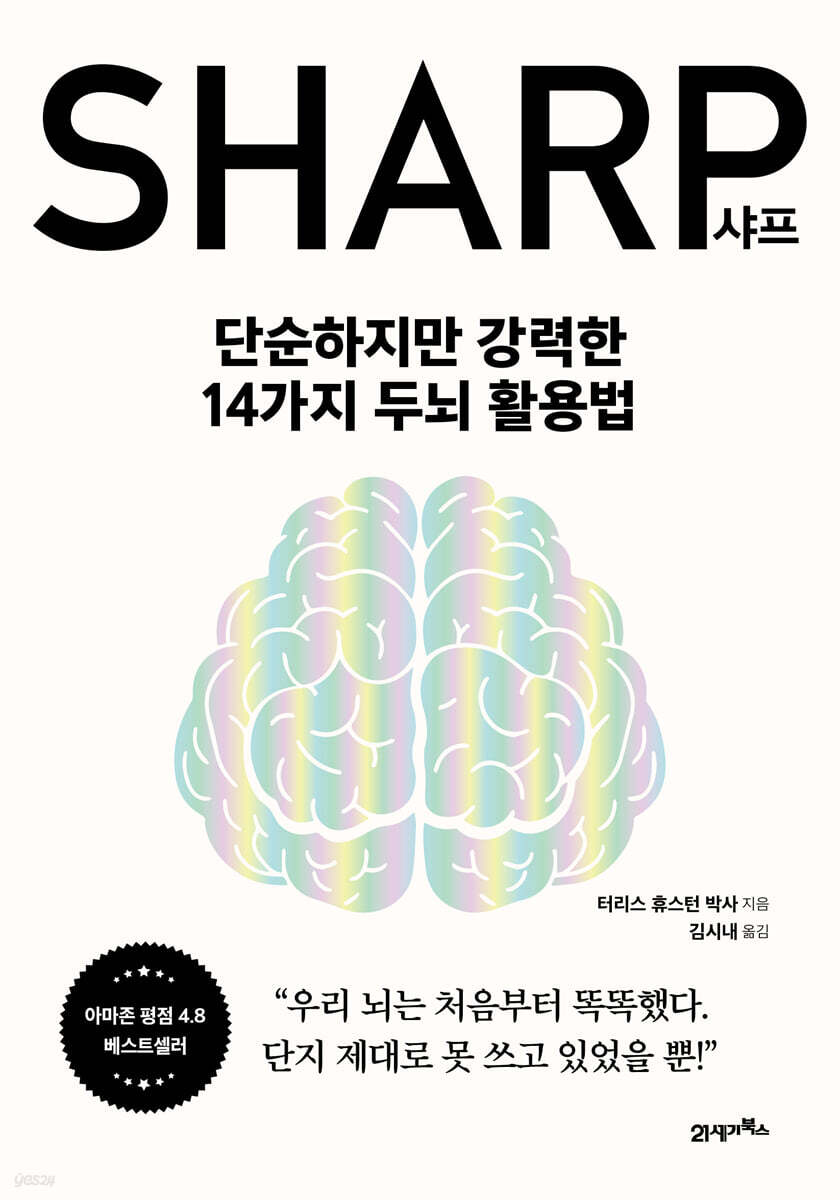
Sharp is a story about the brain.
The author, Turis Houston, is a cognitive scientist at Seattle University who has long worked on applying neuroscience to real-world problems.
The author, who was wondering how to use his brain more efficiently, discovered an immediately actionable strategy backed by solid psychological research.
As readers encounter the various strategies contained in this book, they will be able to use some of them to become a more intelligent version of themselves.
Let's meet my brain that has become smarter through this book, "Sharp."
Behavioral Strategies for Changing Your Life with Brain Science
A practical and scientific guide to sharpening your mind.
Sharp is a story about the brain.
The author, Turis Houston, is a cognitive scientist at Seattle University who has long worked on applying neuroscience to real-world problems.
The author, who was wondering how to use his brain more efficiently, discovered an immediately actionable strategy backed by solid psychological research.
As readers encounter the various strategies contained in this book, they will be able to use some of them to become a more intelligent version of themselves.
Let's meet my brain that has become smarter through this book, "Sharp."
- You can preview some of the book's contents.
Preview
index
introduction
How to succeed at work
Let's get started
Let's focus on Chapter 1
Chapter 2: Let's Be Creative
Chapter 3: Let's boost your motivation
Let's do our best
Chapter 4: Achieving More
Chapter 5: Think Fast
Chapter 6: Learn More, Faster
Chapter 7: Reduce Mistakes
Let's do better for others
Chapter 8 Let's Empathize More
Chapter 9: Let's Throw Away Prejudice and Look Fairly
How to live life properly
Take control of your destiny
Chapter 10: Make Better Decisions
Chapter 11: Reduce Pain and Live Healthier
Let's relax and connect our hearts and minds.
Chapter 12: Managing Chronic Stress
Chapter 13: Managing Acute Stress
Chapter 14: Be a Strength to Your Spouse
A final word of advice to you wise ones
Acknowledgements
Appendix│The Fastest Strategy to Become a Better You
References
How to succeed at work
Let's get started
Let's focus on Chapter 1
Chapter 2: Let's Be Creative
Chapter 3: Let's boost your motivation
Let's do our best
Chapter 4: Achieving More
Chapter 5: Think Fast
Chapter 6: Learn More, Faster
Chapter 7: Reduce Mistakes
Let's do better for others
Chapter 8 Let's Empathize More
Chapter 9: Let's Throw Away Prejudice and Look Fairly
How to live life properly
Take control of your destiny
Chapter 10: Make Better Decisions
Chapter 11: Reduce Pain and Live Healthier
Let's relax and connect our hearts and minds.
Chapter 12: Managing Chronic Stress
Chapter 13: Managing Acute Stress
Chapter 14: Be a Strength to Your Spouse
A final word of advice to you wise ones
Acknowledgements
Appendix│The Fastest Strategy to Become a Better You
References
Detailed image

Into the book
I expect you'll read this book on the bus, during your lunch break, just before bed, and whenever you can during your busy day, hoping to find new strategies that fit your schedule.
So, with the busiest situations in mind, I tried to include at least one strategy in each chapter that would take no more than 10 minutes a day to implement.
--- p.16, from the "Preface"
I'm not saying you only use 10% of your brain.
This claim is a widespread misconception, believed by more than one in three people worldwide.
Completely wrong.
As a Mayo Clinic neuroscientist observed, 'Evidence suggests that we use 100% of our brains each day.'
--- p.21, from the "Preface"
There is one thing you should ask yourself first when deciding whether or not to hold on to a job.
Am I a morning person or a night person? Psychologists have actually discovered that people fall into two types.
If you are, without a doubt, a night person, you will probably have a hard time staying awake in the morning.
So, let's clear our schedule for the afternoon or evening and focus on what's most important.
Conversely, if you are a morning person, make sure to reserve the first hour of your day for important tasks.
--- p.32, from “Let’s Focus on Chapter 1”
Even if you don't think you're creative, there are more ways to be creative than you might think.
You have to be creative at work, whether you're coming up with cost-saving ideas, coaching colleagues, drafting documents, or even finding loopholes in contracts.
Plus, you'll need to be creative when figuring out what to do with leftover chicken when you get home, where to go for that precious three-day holiday, or even how to help your kids earn some pocket money.
--- p.51, from “Chapter 2: Let’s Be Creative”
Since dopamine makes us want to do things that are both desirable and familiar, it's easy to see why we'd be drawn to things we already enjoy, like eating our favorite ice cream, playing a board game, or lying in a hammock in the backyard.
I used to really enjoy doing this kind of thing, and I know it can be rewarding.
--- p.75-76, from “Chapter 3: Raising Motivation”
If done right, visualization can help you achieve your goals.
There is a secret here.
Let's imagine the 'process' of moving toward the desired goal, rather than the goal itself.
Researchers have found that imagining the process of moving toward an outcome increases the likelihood that you will work harder and achieve the outcome.
--- p.93, from “Chapter 4: Let’s Achieve More”
Perhaps the most important skill today is cognitive flexibility.
If you're worried about dealing with unexpected questions, solving technical problems, or adapting to unexpected situations, you need cognitive flexibility.
--- p.109, from “Chapter 5: Think Fast”
The hippocampus is a small brain region, about 4 to 5 cm long.
It's not big enough to contain 'every' detail that allows you to recall everything from the packaging of your favorite chocolate bar as a child to the feeling you had when you took a bite of chocolate the last time.
Instead, a recent study from Rockefeller University found that the hippocampus stores "general" memories, such as "I liked candy necklaces as a child," while more refined details, such as the color of the candy necklace or how it felt on your neck, are stored elsewhere in the brain.
--- p.127, from “Chapter 6: Let’s Learn More, Faster”
If you have a growth mindset, mistakes are opportunities.
I hope you don't misunderstand.
Failure can still be painful.
But as Dweck says, with a growth mindset, “failure doesn’t define you.
“Failure is just a problem that we have to face and learn from.”
When you make a mistake, the next step is to accept the problem, not avoid it.
--- p.150, from “Chapter 7: Let’s Reduce Mistakes”
Many experts agree that there are at least two types of empathy, both of which involve understanding another person's feelings.
One type is affective empathy, which involves feeling another person's pleasure or pain and sharing their emotional experiences.
Another type is cognitive empathy, commonly called perspective taking, which involves recognizing that another person is experiencing pleasure or pain and inferring how that emotion might affect them.
--- p.168-169, from “Chapter 8: Let’s Empathize More”
Bias is a tendency to favor or oppose something in one's environment.
It can be as harmless as liking a particular brand, or as harmful as racial bias that leads to unfair treatment.
Let's think of bias as a tilt.
When you have a bias, you either lean towards something or someone or, conversely, move away from them.
--- p.189, from “Chapter 9 Let’s Throw Away Prejudice and Look Fairly”
It turns out that emotions play a surprisingly important role in decision-making.
Even the most analytical people rely on the subtle ripples of emotion to make decisions, whether they're conscious of it or not.
--- p.214, from “Chapter 10: Making Better Decisions”
If the doctor doesn't make eye contact or doesn't smile much, the patient's health deteriorates and the pain gets worse.
The way your doctor treats you may not seem like much, but if you are not satisfied, your body will not respond to treatment.
A good doctor is ultimately someone who 'understands' his patients.
--- p.229-230, from “Chapter 11: Live Less Painfully and Healthier”
Life is a series of stresses.
Whether it's money problems, pressure at work, health issues, relationship problems, or a shocking news story, we all face times when things feel out of control and stress takes over.
If I had to pick one area where smart strategies could be employed in these situations, it would be stress management.
--- p.247, from “Chapter 12 Managing Chronic Stress”
Cortisol is the body's main stress hormone, helping to keep the body's arousal levels high when it feels threatened.
Moreover, the amount of cortisol in the bloodstream is an objective indicator of stress levels.
In general, many factors can affect cortisol levels, but the more stressful situations you experience during the day and the more distressed you are, the higher your cortisol levels will be.
--- p.274, from “Chapter 13: Managing Acute Stress”
Social support refers to helping or comforting others to cope with difficult situations.
Social support is the backbone of many intimate relationships, and it takes many forms, from the very practical, like clearing snow from your parents' front door after a heavy snowfall, to the emotional, like listening attentively to a friend who's lost.
So, with the busiest situations in mind, I tried to include at least one strategy in each chapter that would take no more than 10 minutes a day to implement.
--- p.16, from the "Preface"
I'm not saying you only use 10% of your brain.
This claim is a widespread misconception, believed by more than one in three people worldwide.
Completely wrong.
As a Mayo Clinic neuroscientist observed, 'Evidence suggests that we use 100% of our brains each day.'
--- p.21, from the "Preface"
There is one thing you should ask yourself first when deciding whether or not to hold on to a job.
Am I a morning person or a night person? Psychologists have actually discovered that people fall into two types.
If you are, without a doubt, a night person, you will probably have a hard time staying awake in the morning.
So, let's clear our schedule for the afternoon or evening and focus on what's most important.
Conversely, if you are a morning person, make sure to reserve the first hour of your day for important tasks.
--- p.32, from “Let’s Focus on Chapter 1”
Even if you don't think you're creative, there are more ways to be creative than you might think.
You have to be creative at work, whether you're coming up with cost-saving ideas, coaching colleagues, drafting documents, or even finding loopholes in contracts.
Plus, you'll need to be creative when figuring out what to do with leftover chicken when you get home, where to go for that precious three-day holiday, or even how to help your kids earn some pocket money.
--- p.51, from “Chapter 2: Let’s Be Creative”
Since dopamine makes us want to do things that are both desirable and familiar, it's easy to see why we'd be drawn to things we already enjoy, like eating our favorite ice cream, playing a board game, or lying in a hammock in the backyard.
I used to really enjoy doing this kind of thing, and I know it can be rewarding.
--- p.75-76, from “Chapter 3: Raising Motivation”
If done right, visualization can help you achieve your goals.
There is a secret here.
Let's imagine the 'process' of moving toward the desired goal, rather than the goal itself.
Researchers have found that imagining the process of moving toward an outcome increases the likelihood that you will work harder and achieve the outcome.
--- p.93, from “Chapter 4: Let’s Achieve More”
Perhaps the most important skill today is cognitive flexibility.
If you're worried about dealing with unexpected questions, solving technical problems, or adapting to unexpected situations, you need cognitive flexibility.
--- p.109, from “Chapter 5: Think Fast”
The hippocampus is a small brain region, about 4 to 5 cm long.
It's not big enough to contain 'every' detail that allows you to recall everything from the packaging of your favorite chocolate bar as a child to the feeling you had when you took a bite of chocolate the last time.
Instead, a recent study from Rockefeller University found that the hippocampus stores "general" memories, such as "I liked candy necklaces as a child," while more refined details, such as the color of the candy necklace or how it felt on your neck, are stored elsewhere in the brain.
--- p.127, from “Chapter 6: Let’s Learn More, Faster”
If you have a growth mindset, mistakes are opportunities.
I hope you don't misunderstand.
Failure can still be painful.
But as Dweck says, with a growth mindset, “failure doesn’t define you.
“Failure is just a problem that we have to face and learn from.”
When you make a mistake, the next step is to accept the problem, not avoid it.
--- p.150, from “Chapter 7: Let’s Reduce Mistakes”
Many experts agree that there are at least two types of empathy, both of which involve understanding another person's feelings.
One type is affective empathy, which involves feeling another person's pleasure or pain and sharing their emotional experiences.
Another type is cognitive empathy, commonly called perspective taking, which involves recognizing that another person is experiencing pleasure or pain and inferring how that emotion might affect them.
--- p.168-169, from “Chapter 8: Let’s Empathize More”
Bias is a tendency to favor or oppose something in one's environment.
It can be as harmless as liking a particular brand, or as harmful as racial bias that leads to unfair treatment.
Let's think of bias as a tilt.
When you have a bias, you either lean towards something or someone or, conversely, move away from them.
--- p.189, from “Chapter 9 Let’s Throw Away Prejudice and Look Fairly”
It turns out that emotions play a surprisingly important role in decision-making.
Even the most analytical people rely on the subtle ripples of emotion to make decisions, whether they're conscious of it or not.
--- p.214, from “Chapter 10: Making Better Decisions”
If the doctor doesn't make eye contact or doesn't smile much, the patient's health deteriorates and the pain gets worse.
The way your doctor treats you may not seem like much, but if you are not satisfied, your body will not respond to treatment.
A good doctor is ultimately someone who 'understands' his patients.
--- p.229-230, from “Chapter 11: Live Less Painfully and Healthier”
Life is a series of stresses.
Whether it's money problems, pressure at work, health issues, relationship problems, or a shocking news story, we all face times when things feel out of control and stress takes over.
If I had to pick one area where smart strategies could be employed in these situations, it would be stress management.
--- p.247, from “Chapter 12 Managing Chronic Stress”
Cortisol is the body's main stress hormone, helping to keep the body's arousal levels high when it feels threatened.
Moreover, the amount of cortisol in the bloodstream is an objective indicator of stress levels.
In general, many factors can affect cortisol levels, but the more stressful situations you experience during the day and the more distressed you are, the higher your cortisol levels will be.
--- p.274, from “Chapter 13: Managing Acute Stress”
Social support refers to helping or comforting others to cope with difficult situations.
Social support is the backbone of many intimate relationships, and it takes many forms, from the very practical, like clearing snow from your parents' front door after a heavy snowfall, to the emotional, like listening attentively to a friend who's lost.
--- p.294-295, from “Chapter 14: Be a Strength to Your Spouse”
Publisher's Review
Common misconceptions about the brain
Sometimes we experience days when ideas flow and everything seems clear, but other times we have days when our minds feel foggy and our understanding is slow.
I often experience these ups and downs at work, at home, and in my relationships, and sometimes I even feel frustrated.
Is there a way out of this uncertainty? Could we make our brains work harder to become smarter?
It was commonly believed that humans only use 10% of their brains.
That's why the saying that Einstein, a genius scientist, used 20% of his brain was often passed around as if it were true.
However, this is merely a widely known misconception, neither of which has been scientifically proven.
In fact, even when we're resting or daydreaming, we use far more than 10% of our brain, and even more brain areas are activated when solving difficult problems.
The fact that damage to even a small part of the brain can cause serious dysfunction shows that we are already using our brains to their full potential.
A new approach focused on practicality
Humans always dream of a smarter life than we have now.
The most powerful tool that makes this possible is probably the brain.
However, the author says that the reason the brain has not been properly utilized until now is because there was no separate user manual.
Of course, many people are using their brains even now, but the author emphasizes that this book can help them use them much better.
This book unpacks complex neuroscience research into accessible language, guiding readers to understand their brains and unlock their potential.
In particular, it clearly explains how specific areas of the brain are involved in learning, memory, decision-making, attention, empathy, and stress coping, and provides specific examples of how you can improve your own cognitive abilities.
For example, Chapter 6 builds on what we know about the brain science surrounding memory and strategies for reducing stress hormones to help you remember names, and Chapter 13 offers some surprising tools to help you cope with stress.
Once you know the strategy, you'll find that remembering someone's name, something you used to find stressful, becomes easier.
Through concrete and clear examples and strategies like these, we expand the scope of what our brains can do.
Book structure and features
《Sharp》 is largely composed of two parts.
The first half introduces ways to be smarter at work, and the second half applies similar principles to your personal life.
However, the places where the introduced strategy can be utilized are not set in stone.
The strategies presented can be applied 'anywhere' in life.
When reading "Sharp," which consists of 14 chapters, you can read it from beginning to end without missing anything, or you can choose a topic that interests you and read it first.
The author hopes that readers will develop the mindset to make this book their own and experiment with it.
At the end of each chapter, we provide a "toolkit" of practical, scientist-approved strategies to help readers put what they've learned into practice.
Most of the strategies are free to use and, considering the busy lifestyles of modern people, can be implemented in just 5 to 20 minutes a day.
We've also added a section called "Behaviors That Actually Don't Work" to highlight scientifically unsupported strategies, and added "Is Age the Problem?" with better strategies for adults over 60.
Sharp is a book that shows how to effectively use your brain in all aspects of life, from increasing productivity at work to making better decisions in your personal life, managing chronic stress, improving your health, and enhancing your relationships.
However, I am drawing the line at absolutely blindly believing in it.
The author encourages readers to consider their own health and safety as their top priority and to seek professional medical advice if necessary.
This book will guide readers to experiment with their own mindset, find strategies that work for them, and enrich their lives.
Sometimes we experience days when ideas flow and everything seems clear, but other times we have days when our minds feel foggy and our understanding is slow.
I often experience these ups and downs at work, at home, and in my relationships, and sometimes I even feel frustrated.
Is there a way out of this uncertainty? Could we make our brains work harder to become smarter?
It was commonly believed that humans only use 10% of their brains.
That's why the saying that Einstein, a genius scientist, used 20% of his brain was often passed around as if it were true.
However, this is merely a widely known misconception, neither of which has been scientifically proven.
In fact, even when we're resting or daydreaming, we use far more than 10% of our brain, and even more brain areas are activated when solving difficult problems.
The fact that damage to even a small part of the brain can cause serious dysfunction shows that we are already using our brains to their full potential.
A new approach focused on practicality
Humans always dream of a smarter life than we have now.
The most powerful tool that makes this possible is probably the brain.
However, the author says that the reason the brain has not been properly utilized until now is because there was no separate user manual.
Of course, many people are using their brains even now, but the author emphasizes that this book can help them use them much better.
This book unpacks complex neuroscience research into accessible language, guiding readers to understand their brains and unlock their potential.
In particular, it clearly explains how specific areas of the brain are involved in learning, memory, decision-making, attention, empathy, and stress coping, and provides specific examples of how you can improve your own cognitive abilities.
For example, Chapter 6 builds on what we know about the brain science surrounding memory and strategies for reducing stress hormones to help you remember names, and Chapter 13 offers some surprising tools to help you cope with stress.
Once you know the strategy, you'll find that remembering someone's name, something you used to find stressful, becomes easier.
Through concrete and clear examples and strategies like these, we expand the scope of what our brains can do.
Book structure and features
《Sharp》 is largely composed of two parts.
The first half introduces ways to be smarter at work, and the second half applies similar principles to your personal life.
However, the places where the introduced strategy can be utilized are not set in stone.
The strategies presented can be applied 'anywhere' in life.
When reading "Sharp," which consists of 14 chapters, you can read it from beginning to end without missing anything, or you can choose a topic that interests you and read it first.
The author hopes that readers will develop the mindset to make this book their own and experiment with it.
At the end of each chapter, we provide a "toolkit" of practical, scientist-approved strategies to help readers put what they've learned into practice.
Most of the strategies are free to use and, considering the busy lifestyles of modern people, can be implemented in just 5 to 20 minutes a day.
We've also added a section called "Behaviors That Actually Don't Work" to highlight scientifically unsupported strategies, and added "Is Age the Problem?" with better strategies for adults over 60.
Sharp is a book that shows how to effectively use your brain in all aspects of life, from increasing productivity at work to making better decisions in your personal life, managing chronic stress, improving your health, and enhancing your relationships.
However, I am drawing the line at absolutely blindly believing in it.
The author encourages readers to consider their own health and safety as their top priority and to seek professional medical advice if necessary.
This book will guide readers to experiment with their own mindset, find strategies that work for them, and enrich their lives.
GOODS SPECIFICS
- Date of issue: September 11, 2025
- Page count, weight, size: 360 pages | 536g | 140*200*22mm
- ISBN13: 9791173574627
- ISBN10: 117357462X
You may also like
카테고리
korean


korean

![GQ KOREA Mark (Monthly): December [2025]](http://librairie.coreenne.fr/cdn/shop/files/8ef265dbbfbf186523ed75ba7319009d.jpg?v=1765340328&width=3840)


