

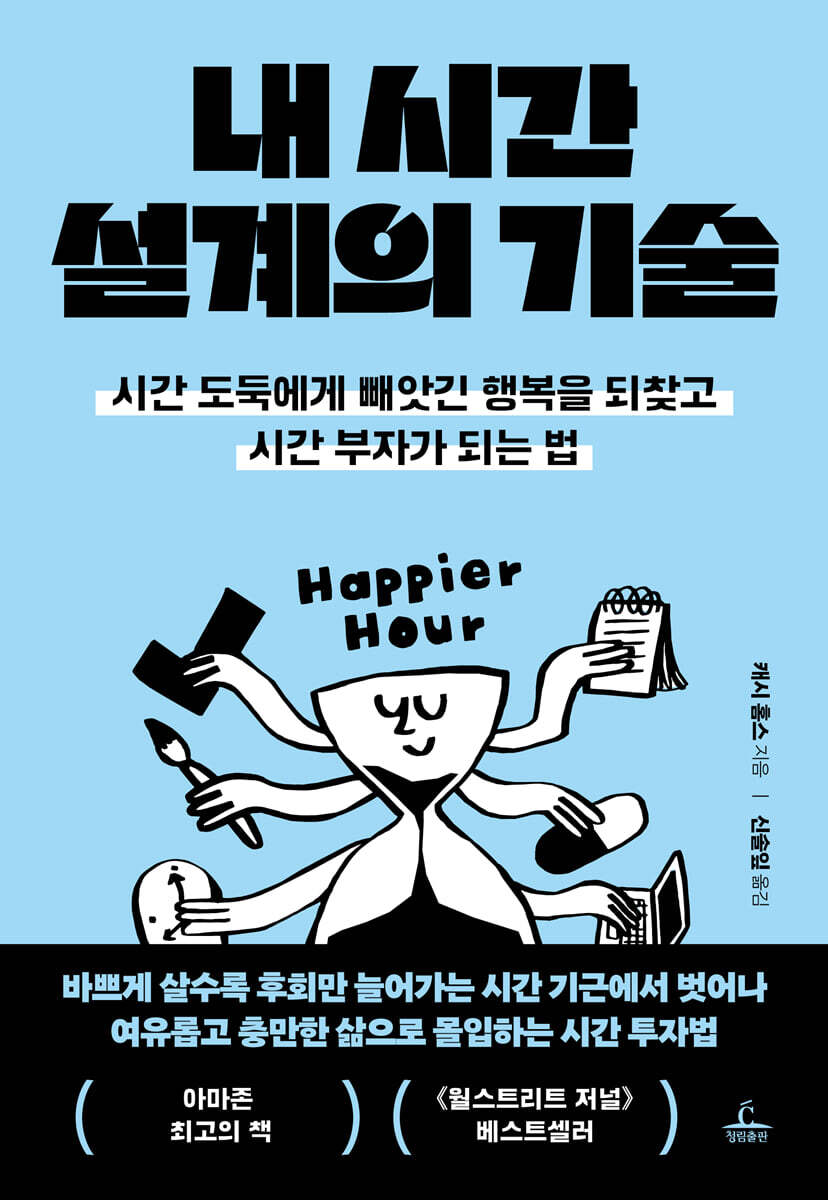
The Art of Designing My Time
 |
Description
index
Prologue: For those of you who want to do everything well
Would I really be happy if I wasn't busy?
Why do we always say we don't have enough time?
The Principle of Happiness: The Art of Time Design
Chapter 1: A Warm-Up to Escape Time Poverty
What the Time Poor Miss in Life
As self-efficacy increases, time becomes abundant.
Don't be afraid to use your time wisely.
Chapter 2: How to Spend Your Time Wisely
How to Track Your Time to Find True Happiness
Analyzing My Time Tracking Data
The greatest happiness comes from close relationships
Just going outdoors increases happiness.
Analyzing my most unhappy times
Find a mood booster
The more you focus on valuable time, the happier you will be.
Chapter 3: Small Habits That Don't Waste Time
Hard work doesn't have to be hard.
Work can be fun too
Do something you enjoy on your commute
Chapter 4: Why We Need Leisure in Our Lives
Perceive each day anew
How to savor the little pleasures of life
The power of rituals that make the ordinary extraordinary
Even rituals need a break
Add freshness to your daily life and relationships
Chapter 5: Mindset for Focusing on the Moment
Four Strategies to Stay Focused on the Present
Treat the weekend like a vacation
Meditate for mindfulness
Create an immersive environment
Try a digital detox
Chapter 6: Filling the Glass Bottle of Time
How to manage stolen time
What is most important to you?
Spend time on your priorities first
Chapter 7: How to Design Time Like a Mosaic
Prioritize happy times
Step 1: Determine your fixed time
Step 2: Identify What Brings You Joy
Step 3: Leave time to enjoy your leisure time.
Step 4: Organize, distribute, and consolidate all your schedules.
The effectiveness of the mosaic time design method
Chapter 8: The Power of Time for the Days to Come
How to Complete the Big Picture of Your Life
Eulogy Writing Training: Reflecting on Life
Training to learn wisdom from someone you respect
Life is made of choices
main
Would I really be happy if I wasn't busy?
Why do we always say we don't have enough time?
The Principle of Happiness: The Art of Time Design
Chapter 1: A Warm-Up to Escape Time Poverty
What the Time Poor Miss in Life
As self-efficacy increases, time becomes abundant.
Don't be afraid to use your time wisely.
Chapter 2: How to Spend Your Time Wisely
How to Track Your Time to Find True Happiness
Analyzing My Time Tracking Data
The greatest happiness comes from close relationships
Just going outdoors increases happiness.
Analyzing my most unhappy times
Find a mood booster
The more you focus on valuable time, the happier you will be.
Chapter 3: Small Habits That Don't Waste Time
Hard work doesn't have to be hard.
Work can be fun too
Do something you enjoy on your commute
Chapter 4: Why We Need Leisure in Our Lives
Perceive each day anew
How to savor the little pleasures of life
The power of rituals that make the ordinary extraordinary
Even rituals need a break
Add freshness to your daily life and relationships
Chapter 5: Mindset for Focusing on the Moment
Four Strategies to Stay Focused on the Present
Treat the weekend like a vacation
Meditate for mindfulness
Create an immersive environment
Try a digital detox
Chapter 6: Filling the Glass Bottle of Time
How to manage stolen time
What is most important to you?
Spend time on your priorities first
Chapter 7: How to Design Time Like a Mosaic
Prioritize happy times
Step 1: Determine your fixed time
Step 2: Identify What Brings You Joy
Step 3: Leave time to enjoy your leisure time.
Step 4: Organize, distribute, and consolidate all your schedules.
The effectiveness of the mosaic time design method
Chapter 8: The Power of Time for the Days to Come
How to Complete the Big Picture of Your Life
Eulogy Writing Training: Reflecting on Life
Training to learn wisdom from someone you respect
Life is made of choices
main
Detailed image

Into the book
Time can be both an obstacle and a solution to achieving greater happiness.
Time is the only resource that, if invested properly, can lead to a good life, perhaps even a great life.
If you realize how to invest your time and actually invest it, you can become happier.
Ultimately, you have to figure out how to manage your time to achieve the results that matter to you, the things that will make you feel satisfied and fulfilled when you look back on your days, your years, and your life.
And being completely immersed in what you do can make that time even happier.
---From "Prologue: To You Who Wants to Do Everything Well"
I came to realize that time poverty is ultimately a matter of perception.
It's entirely up to you what you think should be on your to-do list, and whether you feel confident enough to get it all done.
This self-efficacy is not just about what you believe you can achieve, but also has a direct impact on what you can actually achieve.
The process of deciding what you want to spend your time on creates a virtuous cycle that ultimately affects your self-efficacy and the happiness you feel.
Spending time doing things that move your body, connect with others, or just feel more connected overall can be incredibly effective in expanding your confidence that you can do something.
---From "Chapter 1: Warming Up to Escape Time Poverty"
Analyzing your most unfortunate activities can provide great insights into how to invest your time more wisely.
Because you can figure out where you shouldn't be spending your time.
When we are sad, we often think we are alone, but the root causes of unhappiness are the same for everyone.
Humans are predictable beings.
If any activity fails to satisfy one of three basic needs: relatedness (feeling connected to others), autonomy (a sense of personal control), and competence (feeling capable), you are more likely to feel unhappy.
---From "Chapter 2: How to Spend Your Time Wisely"
The most striking finding from the study is that when our daily lives are so consumed by chores that we have no time left for the things we truly care about, we feel unhappy and dissatisfied.
With an eight-hour workday, commuting, cleaning the house, doing laundry, grocery shopping, cooking, assembling furniture, washing the car, and even going to the laundromat, there's not a single moment left.
But if you can spend a little money to free up some of that time, you can spend it on things that really matter to you.
The time you wisely purchase can be spent on more fun and meaningful activities.
---From "Chapter 3: Small Habits That Don't Waste Time"
What if you realize your loved one won't be by your side forever? Or, less dramatically, what if circumstances have reduced the number of moments you spend together? Ultimately, time together comes to an end.
But before that moment comes, the number of times the two of you do things together that you used to enjoy will start to decrease.
Or even if we can be together, some factors may change and those moments may not be as perfect as before.
(Omitted) When will we realize that our time is limited? What is it that makes us savor life's little pleasures?
---From "Chapter 4: Why We Need Leisure in Our Lives"
When distractions disappear, the reality of your current situation becomes apparent.
During the COVID-19 quarantine, people with nothing else to do were stuck at home, either with toxic companions or feeling the loneliness of being alone.
During that time, rates of anxiety, depression and domestic violence increased.
When there are no distractions to distract us, we are forced to confront the fundamentals of our lives and ourselves.
I really want you to think about whether this change is necessary.
Above all, I hope that everyone has the means and the will to correct what is wrong.
---From "Chapter 5: Mindset for Focusing on the Moment"
Like the space inside a glass bottle, our time is limited.
There are 24 hours in a day, and one-third of that is spent sleeping.
That leaves only 16 hours left.
At first glance, it may seem like plenty of time, but on a weekday, half of that time is spent at work, an hour commuting (30 minutes to get to work, 30 minutes back home), and an hour getting ready in the morning.
After all, you only have six hours a day to do all the other things, or a quarter of the day.
(Omitted) It is impossible to do all of this in six hours a day.
Even if you do this for a week, you will only be able to do a select few of these.
Therefore, you must choose your tasks carefully.
---From "Chapter 6: Filling the Glass Bottle of Time"
If you look at your time as a mosaic, you will see clearly that one hour does not determine your worth or your life.
An hour doesn't define who you are.
All those times added up can explain everything you value and every dimension that makes up who you are.
(Omitted) When you answer the question of when to do something rather than what to do, you can do things that connect deeply with your life and give you a sense of purpose.
Your canvas, filled with joy and meaning, will bring you a sense of accomplishment.
---From "Chapter 7: How to Design Time Like a Mosaic"
How do you want to be remembered? As you reflect on your life's journey, what do you want people to say about you and share with you? Simply put, what legacy do you want to leave behind? (Omitted) Contemplating your own death can be quite uncomfortable.
But the potential benefits are enormous.
Facing the reality of our own inevitable death is one of the most powerful motivators for living life more fully.
By answering the questions above, you will ultimately come to a clearer understanding of what is most important to you and your values.
These answers will give you direction on how to spend today, tomorrow, and the days ahead.
Time is the only resource that, if invested properly, can lead to a good life, perhaps even a great life.
If you realize how to invest your time and actually invest it, you can become happier.
Ultimately, you have to figure out how to manage your time to achieve the results that matter to you, the things that will make you feel satisfied and fulfilled when you look back on your days, your years, and your life.
And being completely immersed in what you do can make that time even happier.
---From "Prologue: To You Who Wants to Do Everything Well"
I came to realize that time poverty is ultimately a matter of perception.
It's entirely up to you what you think should be on your to-do list, and whether you feel confident enough to get it all done.
This self-efficacy is not just about what you believe you can achieve, but also has a direct impact on what you can actually achieve.
The process of deciding what you want to spend your time on creates a virtuous cycle that ultimately affects your self-efficacy and the happiness you feel.
Spending time doing things that move your body, connect with others, or just feel more connected overall can be incredibly effective in expanding your confidence that you can do something.
---From "Chapter 1: Warming Up to Escape Time Poverty"
Analyzing your most unfortunate activities can provide great insights into how to invest your time more wisely.
Because you can figure out where you shouldn't be spending your time.
When we are sad, we often think we are alone, but the root causes of unhappiness are the same for everyone.
Humans are predictable beings.
If any activity fails to satisfy one of three basic needs: relatedness (feeling connected to others), autonomy (a sense of personal control), and competence (feeling capable), you are more likely to feel unhappy.
---From "Chapter 2: How to Spend Your Time Wisely"
The most striking finding from the study is that when our daily lives are so consumed by chores that we have no time left for the things we truly care about, we feel unhappy and dissatisfied.
With an eight-hour workday, commuting, cleaning the house, doing laundry, grocery shopping, cooking, assembling furniture, washing the car, and even going to the laundromat, there's not a single moment left.
But if you can spend a little money to free up some of that time, you can spend it on things that really matter to you.
The time you wisely purchase can be spent on more fun and meaningful activities.
---From "Chapter 3: Small Habits That Don't Waste Time"
What if you realize your loved one won't be by your side forever? Or, less dramatically, what if circumstances have reduced the number of moments you spend together? Ultimately, time together comes to an end.
But before that moment comes, the number of times the two of you do things together that you used to enjoy will start to decrease.
Or even if we can be together, some factors may change and those moments may not be as perfect as before.
(Omitted) When will we realize that our time is limited? What is it that makes us savor life's little pleasures?
---From "Chapter 4: Why We Need Leisure in Our Lives"
When distractions disappear, the reality of your current situation becomes apparent.
During the COVID-19 quarantine, people with nothing else to do were stuck at home, either with toxic companions or feeling the loneliness of being alone.
During that time, rates of anxiety, depression and domestic violence increased.
When there are no distractions to distract us, we are forced to confront the fundamentals of our lives and ourselves.
I really want you to think about whether this change is necessary.
Above all, I hope that everyone has the means and the will to correct what is wrong.
---From "Chapter 5: Mindset for Focusing on the Moment"
Like the space inside a glass bottle, our time is limited.
There are 24 hours in a day, and one-third of that is spent sleeping.
That leaves only 16 hours left.
At first glance, it may seem like plenty of time, but on a weekday, half of that time is spent at work, an hour commuting (30 minutes to get to work, 30 minutes back home), and an hour getting ready in the morning.
After all, you only have six hours a day to do all the other things, or a quarter of the day.
(Omitted) It is impossible to do all of this in six hours a day.
Even if you do this for a week, you will only be able to do a select few of these.
Therefore, you must choose your tasks carefully.
---From "Chapter 6: Filling the Glass Bottle of Time"
If you look at your time as a mosaic, you will see clearly that one hour does not determine your worth or your life.
An hour doesn't define who you are.
All those times added up can explain everything you value and every dimension that makes up who you are.
(Omitted) When you answer the question of when to do something rather than what to do, you can do things that connect deeply with your life and give you a sense of purpose.
Your canvas, filled with joy and meaning, will bring you a sense of accomplishment.
---From "Chapter 7: How to Design Time Like a Mosaic"
How do you want to be remembered? As you reflect on your life's journey, what do you want people to say about you and share with you? Simply put, what legacy do you want to leave behind? (Omitted) Contemplating your own death can be quite uncomfortable.
But the potential benefits are enormous.
Facing the reality of our own inevitable death is one of the most powerful motivators for living life more fully.
By answering the questions above, you will ultimately come to a clearer understanding of what is most important to you and your values.
These answers will give you direction on how to spend today, tomorrow, and the days ahead.
---From "Chapter 8: The Power of Time for the Days to Come"
Publisher's Review
★★★ Amazon's Best Books ★★★
★★★Wall Street Journal Bestseller★★★
★★★ Highly recommended by Adam Grant and Angela Duckworth ★★★
“Will you let time be stolen from you, or will you master it?”
How to Change Your Perception of Time and Build Self-Efficacy
Think about what is the first thing you give up on in your daily life because of time constraints.
Most of us will put aside the things that interest us, the things that make us interesting people.
Once you've done all the things you 'have to do', there's bound to be less time left to do the things you 'want to do'.
Moreover, we, who are accustomed to doing productive work based on performance-oriented thinking, often regard a hectic life as a symbol of success.
However, if you live a 'time-poor' life, pressed for time, you will lose interest in leisure activities such as exercise, hobbies, walking, and reading, as well as in cherished relationships with family and friends, and your life satisfaction will decrease.
Ultimately, this results in us moving further and further away from happiness, which is the key to a better life.
Like money, time is a scarce resource.
But unlike money, everyone starts with the same balance.
Everyone is given equal minutes and hours to spend at the end of the day.
Yet, we always feel like there's not enough time to do everything well—to achieve our goals, be kind to our family and others, and find fulfilling joy in the things we care about.
Self-efficacy is closely related to time.
The process of deciding what you're going to spend your time on has a remarkable effect on expanding your confidence that you can do something.
You can achieve greater happiness by experiencing and focusing on more things, rather than controlling and saving time.
Also, the moments of awe that come from various experiences will remain in your mind for a long time.
By changing your perception of time in this way, you can spend and invest your time wisely.
“Recognize small, insignificant joys often.”
Time tracking training to reduce wasted time and immerse yourself in happy moments
How can we use our waking hours to live a happy and fulfilling life? To answer this question, the author recommends tracking how you spend your time each day for one to two weeks and what emotions you experience during that time.
Create a schedule for your day, dividing it into 30-minute increments, describe in detail what you did, and then rate each activity on a scale of 1 to 10.
Once you have all your data, figure out what your "happiest" and "unhappiest" activities are.
This time tracking exercise will help you identify how much happiness you find in various activities and give you a clear picture of how you're currently spending your time.
If you find yourself wasting time on something unpleasant, it might be a good idea to consider how you can transform it into something worthwhile and enjoyable.
Outsource the tasks that can be solved by paying money, and use the "temptation bundling" strategy to tie enjoyable tasks to the tasks that need to be done.
It's also effective to clearly identify your purpose for doing something, calculate how much time you have left in life, or create rituals that add special stimulation to your ordinary daily life.
We also need a mindset that focuses on moments of joy, avoiding distractions like meditation or digital detox.
If you try the methods introduced in this book in your daily life and make them a habit, you will be able to rediscover the small pleasures and leisure in life and immerse yourself in happy moments.
“Happiness is always available, just in different forms.”
A Strategy for a Life Without Regrets: Mosaic Time Planning
Time is finite, and our lives are limited.
Therefore, you need to prioritize what is truly important to you so that you can make time for it and keep it.
One-third of the 24 hours in a day are spent sleeping, leaving 16 hours.
Half of this is spent at work, with an average of an hour spent preparing for and commuting to work.
After all, you only have six hours a day, a quarter of the time, to do all the other things.
Therefore, securing time for enjoyable and meaningful activities requires intentional, proactive strategies for managing your time.
The author presents the 'Mosaic Time Planning Method' to help you plan your optimal week.
That is, when designing time, we assume that the activities we do are tiles, and then we show practical examples step by step of how to complete the empty space into a beautiful mosaic work.
First, set aside fixed time to identify the time that cannot change, and then place the activities that bring you joy in the ideal location.
Next, intentionally set aside some free time to relax, reflect, or do nothing.
Finally, all schedules are organized into one, well-organized, or distributed and integrated.
Unlike other time management approaches, this design method is not about efficiency, but about spending time on things that matter most to you and that bring you joy.
At the end of their lives, most people regret things they should have done.
Therefore, we must weave negative events into the larger story of life and focus on the experiences and happiness we will remember fondly.
Through this book, you will learn how to transform crisis into a driving force for happiness and choose your own happiness.
★★★Wall Street Journal Bestseller★★★
★★★ Highly recommended by Adam Grant and Angela Duckworth ★★★
“Will you let time be stolen from you, or will you master it?”
How to Change Your Perception of Time and Build Self-Efficacy
Think about what is the first thing you give up on in your daily life because of time constraints.
Most of us will put aside the things that interest us, the things that make us interesting people.
Once you've done all the things you 'have to do', there's bound to be less time left to do the things you 'want to do'.
Moreover, we, who are accustomed to doing productive work based on performance-oriented thinking, often regard a hectic life as a symbol of success.
However, if you live a 'time-poor' life, pressed for time, you will lose interest in leisure activities such as exercise, hobbies, walking, and reading, as well as in cherished relationships with family and friends, and your life satisfaction will decrease.
Ultimately, this results in us moving further and further away from happiness, which is the key to a better life.
Like money, time is a scarce resource.
But unlike money, everyone starts with the same balance.
Everyone is given equal minutes and hours to spend at the end of the day.
Yet, we always feel like there's not enough time to do everything well—to achieve our goals, be kind to our family and others, and find fulfilling joy in the things we care about.
Self-efficacy is closely related to time.
The process of deciding what you're going to spend your time on has a remarkable effect on expanding your confidence that you can do something.
You can achieve greater happiness by experiencing and focusing on more things, rather than controlling and saving time.
Also, the moments of awe that come from various experiences will remain in your mind for a long time.
By changing your perception of time in this way, you can spend and invest your time wisely.
“Recognize small, insignificant joys often.”
Time tracking training to reduce wasted time and immerse yourself in happy moments
How can we use our waking hours to live a happy and fulfilling life? To answer this question, the author recommends tracking how you spend your time each day for one to two weeks and what emotions you experience during that time.
Create a schedule for your day, dividing it into 30-minute increments, describe in detail what you did, and then rate each activity on a scale of 1 to 10.
Once you have all your data, figure out what your "happiest" and "unhappiest" activities are.
This time tracking exercise will help you identify how much happiness you find in various activities and give you a clear picture of how you're currently spending your time.
If you find yourself wasting time on something unpleasant, it might be a good idea to consider how you can transform it into something worthwhile and enjoyable.
Outsource the tasks that can be solved by paying money, and use the "temptation bundling" strategy to tie enjoyable tasks to the tasks that need to be done.
It's also effective to clearly identify your purpose for doing something, calculate how much time you have left in life, or create rituals that add special stimulation to your ordinary daily life.
We also need a mindset that focuses on moments of joy, avoiding distractions like meditation or digital detox.
If you try the methods introduced in this book in your daily life and make them a habit, you will be able to rediscover the small pleasures and leisure in life and immerse yourself in happy moments.
“Happiness is always available, just in different forms.”
A Strategy for a Life Without Regrets: Mosaic Time Planning
Time is finite, and our lives are limited.
Therefore, you need to prioritize what is truly important to you so that you can make time for it and keep it.
One-third of the 24 hours in a day are spent sleeping, leaving 16 hours.
Half of this is spent at work, with an average of an hour spent preparing for and commuting to work.
After all, you only have six hours a day, a quarter of the time, to do all the other things.
Therefore, securing time for enjoyable and meaningful activities requires intentional, proactive strategies for managing your time.
The author presents the 'Mosaic Time Planning Method' to help you plan your optimal week.
That is, when designing time, we assume that the activities we do are tiles, and then we show practical examples step by step of how to complete the empty space into a beautiful mosaic work.
First, set aside fixed time to identify the time that cannot change, and then place the activities that bring you joy in the ideal location.
Next, intentionally set aside some free time to relax, reflect, or do nothing.
Finally, all schedules are organized into one, well-organized, or distributed and integrated.
Unlike other time management approaches, this design method is not about efficiency, but about spending time on things that matter most to you and that bring you joy.
At the end of their lives, most people regret things they should have done.
Therefore, we must weave negative events into the larger story of life and focus on the experiences and happiness we will remember fondly.
Through this book, you will learn how to transform crisis into a driving force for happiness and choose your own happiness.
GOODS SPECIFICS
- Date of issue: August 20, 2025
- Page count, weight, size: 344 pages | 580g | 145*210*22mm
- ISBN13: 9788935214822
- ISBN10: 8935214825
You may also like
카테고리
korean


korean

![GQ KOREA Mark (Monthly): December [2025]](http://librairie.coreenne.fr/cdn/shop/files/8ef265dbbfbf186523ed75ba7319009d.jpg?v=1765340328&width=3840)


