

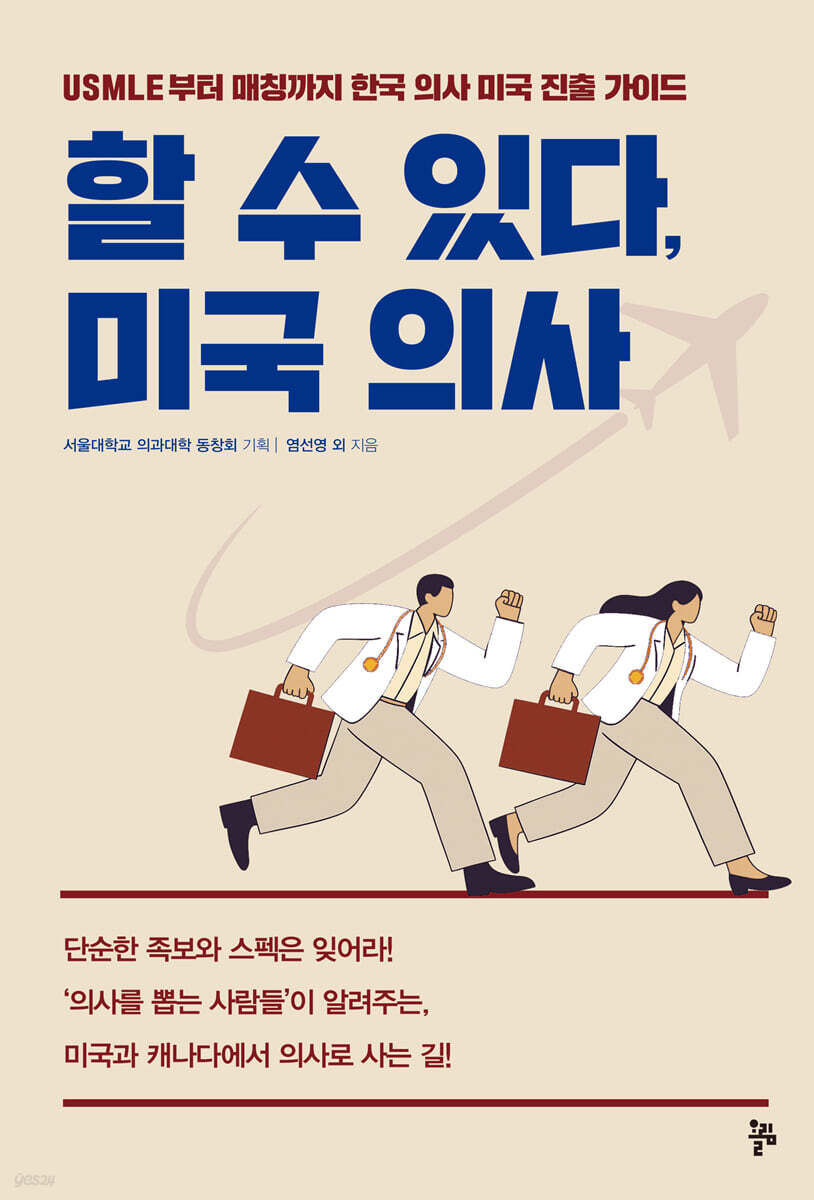
You can do it, American doctor
 |
Description
Book Introduction
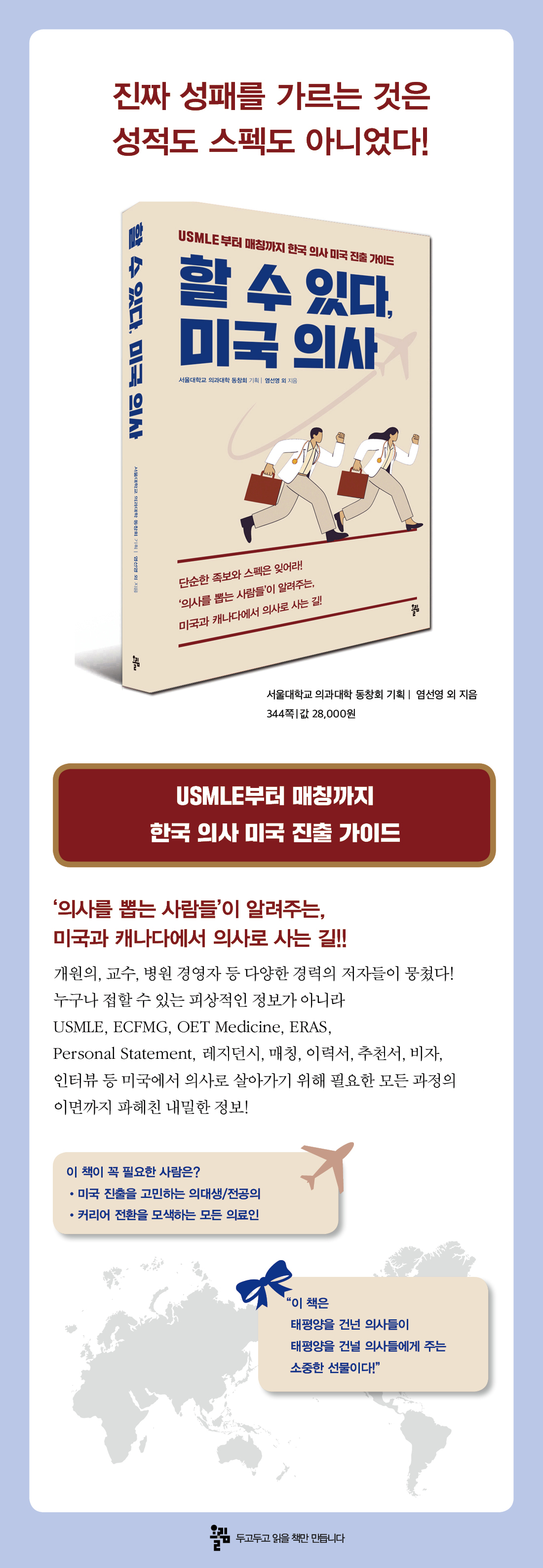
"Can Do It, American Doctor": What kind of book is it and what makes it different?
I can't speak English, I've never been abroad, and my USMLE score is low.
So should you give up? American residency programs prioritize your future potential over your past accomplishments.
It's not about looking for someone with a perfect background, it's about looking for someone who has the will to grow and can demonstrate behaviors that align with your goals.
That is, we want people who have the character to persistently pursue goals, be able to set their own direction and move forward, be able to cooperate with others, and pursue greater values beyond themselves.
These are the very qualities that can be cultivated from now on, regardless of past achievements.
You can't change your academic background or test scores, but you can continuously develop your personal maturity through conscious effort.
This is why we must move forward and not live in the past.
As you mature, opportunities will open up that were previously unattainable through grades.
This book goes beyond simply teaching you how to score high on tests. It also includes strategic advice based on first-hand experience from doctors who have been active in the American medical field for a long time, as well as in-depth stories about cultural adaptation and identity struggles.
The intimate information from the perspective of the 'selector' can be said to be a unique feature of this book.
Another unique feature of this book is that it is not a story of one individual's success, but is based on the experiences of 14 doctors with diverse careers.
The career journeys of alumni with diverse specialties, including internal medicine, oncology, pediatric anesthesiology, and psychiatry, and their growth processes as practitioners, hospital managers, and researchers are vividly introduced.
It covers a wide range of topics, including never-before-seen medical immigration for middle-aged specialists and cases of advancement into Canada, making it a valuable guide for medical professionals of various ages and circumstances.
Beyond simple pedigrees and qualifications, here's the path to becoming a doctor in the US and Canada, as told by those who "select doctors"! This is a treasure trove of insider information, delving into every step of the process required to become a doctor in the US, including USMLE, ECFMG, OET Medicine, ERAS, Personal Statement, residency, matching, resumes, letters of recommendation, visas, and interviews.
If I had to sum up this book in one word, it would be, “It is a precious gift from doctors who have crossed the Pacific to doctors who will cross the Pacific!”
I can't speak English, I've never been abroad, and my USMLE score is low.
So should you give up? American residency programs prioritize your future potential over your past accomplishments.
It's not about looking for someone with a perfect background, it's about looking for someone who has the will to grow and can demonstrate behaviors that align with your goals.
That is, we want people who have the character to persistently pursue goals, be able to set their own direction and move forward, be able to cooperate with others, and pursue greater values beyond themselves.
These are the very qualities that can be cultivated from now on, regardless of past achievements.
You can't change your academic background or test scores, but you can continuously develop your personal maturity through conscious effort.
This is why we must move forward and not live in the past.
As you mature, opportunities will open up that were previously unattainable through grades.
This book goes beyond simply teaching you how to score high on tests. It also includes strategic advice based on first-hand experience from doctors who have been active in the American medical field for a long time, as well as in-depth stories about cultural adaptation and identity struggles.
The intimate information from the perspective of the 'selector' can be said to be a unique feature of this book.
Another unique feature of this book is that it is not a story of one individual's success, but is based on the experiences of 14 doctors with diverse careers.
The career journeys of alumni with diverse specialties, including internal medicine, oncology, pediatric anesthesiology, and psychiatry, and their growth processes as practitioners, hospital managers, and researchers are vividly introduced.
It covers a wide range of topics, including never-before-seen medical immigration for middle-aged specialists and cases of advancement into Canada, making it a valuable guide for medical professionals of various ages and circumstances.
Beyond simple pedigrees and qualifications, here's the path to becoming a doctor in the US and Canada, as told by those who "select doctors"! This is a treasure trove of insider information, delving into every step of the process required to become a doctor in the US, including USMLE, ECFMG, OET Medicine, ERAS, Personal Statement, residency, matching, resumes, letters of recommendation, visas, and interviews.
If I had to sum up this book in one word, it would be, “It is a precious gift from doctors who have crossed the Pacific to doctors who will cross the Pacific!”
- You can preview some of the book's contents.
Preview
index
Preface 4
Opening a new path toward the future
Han Gyu-seop
Compiling a book 7
At the moment of choice, you are not alone.
Yeom Seon-yeong
Part 1
Doctors who crossed the Pacific
To the doctors crossing the Pacific
Honest advice from seniors for those dreaming of advancing to the US
Living as Your True Self 21
Oh Mu-yeon | Rehabilitation medicine specialist, hospital manager, former medical educator
Direction, not speed; me, not specs. 27
Cheon Hyo-rim | Internal Medicine Specialist, Medical Educator
The Reality of American Private Practice 38
Lee Do-eun | Endocrinologist, Private Practitioner
A Doctor's Honest Immigration Story, Part 43
Anonymous | Infectious Disease Specialist
50 Journeys of Challenges toward Dreams
Park Jong-cheol, MD, Oncologist
Between Research and Clinical Practice: 56 Practical Advice for Breaking into the American Medical Field
Kim Tae-gon, MD, MD, Oncologist
The Deepest Me, Taken Out of a Strange Land, 69
Eun-kyung Park | Nuclear Medicine Specialist
A New Challenge in Middle Age: A Korean Specialist's Life as a Doctor in the US 84
Lee Jeong-rim | Pediatric Anesthesiologist
Finding Your Way in the Dark 90
Anonymous | Professor of Internal Medicine
Beyond Fear 98
Kwak Ho-joong | Professor of Basic Medical Sciences
Passion and Empathy 104
Chae Young-kwang, MD ...
The Courage to Start Again, Part 109 of My Second Major
Lee Ju-young | Korean-American child psychiatrist, clinical instructor at a university hospital
Living as a Doctor in Canada 123
Kim Tae-kyung, radiologist
Part 2
American Medical Examination and ECFMG Certificate
Yeom Seon-yeong
Overview 145
Test Support 148
USMLE Step 1 152
USMLE Step 2 Clinical Knowledge (CK) 165
OET Medicine 175
Pathway 1 and ECFMG Certification 185
USMLE Step 3 190
Part 3
A Guide to Applying to US Medical Schools
(Editor: Oh Mu-yeon)
Guide to the US Resident Application System 205
Yeom Seon-yeong and Cheon Hyo-rim
Organic Linking of ERAS Documents: The Perfect Marketing Strategy 219
Yeom Seon-yeong
The Real Role of Your Resume: A Tool to Predict Your Job Abilities 233
Yeom Seon-yeong and Cheon Hyo-rim
The Real Role of a Letter of Recommendation: A Personal Guarantee 242
Yeom Seon-yeong
The Essence of an Interview: Finding Out if You're a Good Teammate 251
Yeom Seon-yeong and Cheon Hyo-rim
Part 4
Personal Statement is
Self-introduction?
Personal Statement 265
Lee Joo-young
PS Changes Your Life 273
Yeom Seon-yeong
What I Want to Do 289
Yeom Seon-yeong
I want to know that 1
Can I do it too?' 298
Self-Assessment and Preparation Strategies
I Want to Know That 2
US Visa and Permanent Residence 304
Lee Joo-young
supplement
My junior asked
Senior answers
Junior asks, senior answers 1
Common Interest Q&A 315
Junior asks, senior answers 2
Q&A 322 on Resident Applications
Opening a new path toward the future
Han Gyu-seop
Compiling a book 7
At the moment of choice, you are not alone.
Yeom Seon-yeong
Part 1
Doctors who crossed the Pacific
To the doctors crossing the Pacific
Honest advice from seniors for those dreaming of advancing to the US
Living as Your True Self 21
Oh Mu-yeon | Rehabilitation medicine specialist, hospital manager, former medical educator
Direction, not speed; me, not specs. 27
Cheon Hyo-rim | Internal Medicine Specialist, Medical Educator
The Reality of American Private Practice 38
Lee Do-eun | Endocrinologist, Private Practitioner
A Doctor's Honest Immigration Story, Part 43
Anonymous | Infectious Disease Specialist
50 Journeys of Challenges toward Dreams
Park Jong-cheol, MD, Oncologist
Between Research and Clinical Practice: 56 Practical Advice for Breaking into the American Medical Field
Kim Tae-gon, MD, MD, Oncologist
The Deepest Me, Taken Out of a Strange Land, 69
Eun-kyung Park | Nuclear Medicine Specialist
A New Challenge in Middle Age: A Korean Specialist's Life as a Doctor in the US 84
Lee Jeong-rim | Pediatric Anesthesiologist
Finding Your Way in the Dark 90
Anonymous | Professor of Internal Medicine
Beyond Fear 98
Kwak Ho-joong | Professor of Basic Medical Sciences
Passion and Empathy 104
Chae Young-kwang, MD ...
The Courage to Start Again, Part 109 of My Second Major
Lee Ju-young | Korean-American child psychiatrist, clinical instructor at a university hospital
Living as a Doctor in Canada 123
Kim Tae-kyung, radiologist
Part 2
American Medical Examination and ECFMG Certificate
Yeom Seon-yeong
Overview 145
Test Support 148
USMLE Step 1 152
USMLE Step 2 Clinical Knowledge (CK) 165
OET Medicine 175
Pathway 1 and ECFMG Certification 185
USMLE Step 3 190
Part 3
A Guide to Applying to US Medical Schools
(Editor: Oh Mu-yeon)
Guide to the US Resident Application System 205
Yeom Seon-yeong and Cheon Hyo-rim
Organic Linking of ERAS Documents: The Perfect Marketing Strategy 219
Yeom Seon-yeong
The Real Role of Your Resume: A Tool to Predict Your Job Abilities 233
Yeom Seon-yeong and Cheon Hyo-rim
The Real Role of a Letter of Recommendation: A Personal Guarantee 242
Yeom Seon-yeong
The Essence of an Interview: Finding Out if You're a Good Teammate 251
Yeom Seon-yeong and Cheon Hyo-rim
Part 4
Personal Statement is
Self-introduction?
Personal Statement 265
Lee Joo-young
PS Changes Your Life 273
Yeom Seon-yeong
What I Want to Do 289
Yeom Seon-yeong
I want to know that 1
Can I do it too?' 298
Self-Assessment and Preparation Strategies
I Want to Know That 2
US Visa and Permanent Residence 304
Lee Joo-young
supplement
My junior asked
Senior answers
Junior asks, senior answers 1
Common Interest Q&A 315
Junior asks, senior answers 2
Q&A 322 on Resident Applications
Detailed image
Into the book
While receiving inquiries from over 100 juniors over the past year, I discovered something interesting.
The USMLE exam information in their 'family tree' was well-reflected with the latest trends.
However, most of the easily accessible support experience stories and settlement reviews are from people who have just successfully applied or have recently settled down.
There were many experiences where people tried to follow these reviews written from the applicant's perspective but failed.
What do the people who actually select candidates look for? Looking back, my seniors, who have accumulated years of experience as educators, administrators, and business managers since their residency, are only now beginning to see things.
Parts that I missed at the time, and parts that I sometimes misunderstood.
What are the views of seniors who have been selecting and educating residents in the United States for a long time?
--- p.9
You are a really cool Korean American.
As time goes by, you will find that there are many valuable things you have learned in Korea, such as culture and knowledge, and you will want to share them with your colleagues, patients, and the community here.
Especially consideration for others (I am not saying that you become a 'door mat'!), a kind word, a smiling face - these are the little things that are not small at all.
I hope that I don't focus too much on my goals and miss out on the precious moments of everyday life, because I need to have a little more space in my heart so that I can be more considerate naturally.
--- p.24
Just as success at the first attempt allows you to learn one method, but failure after nine attempts allows you to learn the pros and cons of all ten methods, if you don't fear failure and instead see it as a stepping stone to where you want to go or achieve, I think the path you take will be more leisurely, generous, and comfortable.
--- p.29
I would say that interpersonal skills are an important quality for becoming a successful private practitioner.
The most important thing is the ability to listen to the patient's story, take their symptoms seriously, and empathize.
When you think from the patient's perspective and convey your sincere desire to help, a relationship of trust is naturally formed.
In the United States, there's a culture of patients sharing their satisfactory medical experiences with others and recommending them. Providing sincere and compassionate care naturally expands your patient base.
With humility, listening, eye contact, and genuine effort, you can succeed without any special business acumen.
--- p.40~41
After setting foot on American soil, the path I chose was a bit unusual.
Instead of starting training right away, I decided to first look at the world more broadly.
After two years in a cancer research lab and several years at a pharmaceutical company, a total of seven years of non-clinical work, I finally started my residency in internal medicine.
A long gap of 10 years after graduation.
Of course, matching residency positions wasn't easy.
I asked myself countless times, "Am I going back too far?" But looking back now, all those times have become precious assets.
(
--- p.51
Whatever choice you make, the important thing is to follow your true passion.
Don't be too bound by realistic constraints, and if you prepare yourself and give it your all, any path will be a meaningful journey.
Life is a journey, not a straight line, and sometimes even detours will ultimately lead you to your destination.
--- p.68
But it wasn't easy.
Understanding a new hospital culture and insurance system, and working with people from diverse cultures, was more challenging than I expected.
I thought I was suited to a global society, but I realized I had become a rigid adult who found it difficult to accept "difference."
What would you say are the pros and cons of coming to the United States after obtaining a specialist license?
--- p.81
1.
Any experience in Korea would be helpful.
It's similar to how if you study while you're a student, you can apply for any residency program.
2. It is obviously much more advantageous to take the USMLE.
Among my juniors in the Department of Anesthesiology at Seoul National University, those who had USMLE progressed much faster.
3.
When you meet a foreign/American speaker at an academic conference, actively introduce yourself and build a connection.
Most relationships fade away without meaning, but that's not always the case.
4.
If you have the opportunity to lecture at an international conference, don't turn it down; accept it.
You can learn English, add another line to your resume, and preparing for the lecture itself is a form of study.
--- p.88~89
When I was a researcher, I was able to communicate to some extent while attending classes, and I was even able to help other Korean students who were studying in the US settle in, but American hospitals were a completely different world.
At the hospital, I was the most problematic resident who spoke the worst English and was from a Northeast Asian medical school that no one knew.
--- p.92
Finally, when signing a contract for employment, be sure to review the non-compete clause with your attorney.
This includes restrictions on holding another job or opening a business while working as a public servant, as well as restrictions on changing jobs after resigning.
Also, please ask the interviewer to connect you with a nurse currently working at that hospital.
The most vivid and reliable experience comes from someone who currently works for that employer.
Usually, civil servants talk frankly with each other because they feel that they are in the same boat.
--- p.122
Ultimately, general English skills that wouldn't be a problem in other professions are not enough to function adequately as a doctor in Canada.
English isn't a skill that can be acquired in a short period of time, so it's necessary to develop the habit of reading English books consistently whenever you have time.
Interesting mystery novels or courtroom novels are great for reading consistently without getting bored. If you have a religious background, reading related books can also be a great way to naturally learn advanced vocabulary and expressions.
--- p.137
The moment you think of ERAS documents as individual documents, the game is over.
Successful candidates design their resume, personal statement, and letters of recommendation as an integrated marketing strategy.
--- p.219
Final Checkpoints for Branding Success
· What adjectives will the person who reads my document use to remember me?
· Do these adjectives match the qualities needed for a medical professional?
· Can you get the same consistent impression from all three documents?
· Are all claims supported by specific evidence?
Finally, remember: Successful candidates don't wait for luck.
They design success.
--- p.232
· Common characteristics of applicants who are not invited to interviews
Excellent test scores + sufficient research experience + USCE completion, but all documents other than the figures are illegible (i.e., insincere or poor communication skills)
--- p.234
The best recommendation letter is one that reassures the candidate that "this person is a person with good character, can be trusted in any situation, and is a colleague you would want to work with."
This requires building long-term relationships that focus on personal trust rather than competence.
A letter of recommendation is not a tool to promote your achievements, but rather a certificate that guarantees your personal credibility.
To earn such a recommendation, you must demonstrate maturity and responsibility, even in difficult situations, and earn the trust of your colleagues as a true team player.
--- p.249~250
Is this someone I can work with?
The real criteria for evaluation:
· Personal trustworthiness: Can you maintain constructive relationships with your colleagues?
· Teamwork skills: Do you perform your work cooperatively and responsibly?
· Stress Management: Do you maintain professionalism under pressure?
· Communication skills: Do you communicate effectively with patients, caregivers, and colleagues?
· Program fit: Does it fit with our organizational culture?
--- p.251
However, in the "jokbo" (family register) circulating in Korea, this is often translated as a "self-introduction," leading many juniors to write inappropriate content focused on a "list-style personal history." The ERAS Personal Statement is a document that focuses on "why you chose this major" and "what kind of doctor you hope to become through your residency."
Even though I explained it in detail, there are still juniors who write a 'self-introduction' listing their academic background, career, and personal history, so I translated it as 'Statement of motivation and goals for application'.
--- p.266
You need to pay a lot of attention to grammar and spelling.
Grammar and spelling errors can diminish the credibility of your writing as a whole and your credibility as an applicant, so it's important to check carefully.
Interviewers are more likely to scrutinize the personal statement, especially for Korean applicants whose native language is not English.
These days, with editing features like ChatGPT that use AI prompts, revisions will be less time-consuming and costly than in the past.
I'd love to share with others applying in the same year which AI prompts lead to better editing results.
Be sure to ask someone who has read many of the personal statements of actual residency applicants, not just your colleagues but also those who have worked in U.S. training hospitals, to review them.
Because writing contains cultural elements that go beyond simple spelling.
--- p.271~272
Why do we spend months preparing for exams, yet think writing a personal statement takes only a few days? Perhaps it's because many juniors are accustomed to measurable things.
It would be unfortunate for a patient to encounter a doctor who, in his practice, pursues only the measurable.
The real question is: 'What kind of doctor do you want to be?' When you can answer this question honestly, your personal statement becomes more than just an application.
--- p.296
All successful seniors started with exactly the same question as you.
'Can I do it too?' There is only one difference.
Did you stop at the question or move on to action?
The fact that you are reading this right now is proof that you are ready to get started.
Don't wait to make the perfect plan.
It's time to turn vague dreams into concrete first steps.
Take the first step today.
The rest you'll learn as you go.
The USMLE exam information in their 'family tree' was well-reflected with the latest trends.
However, most of the easily accessible support experience stories and settlement reviews are from people who have just successfully applied or have recently settled down.
There were many experiences where people tried to follow these reviews written from the applicant's perspective but failed.
What do the people who actually select candidates look for? Looking back, my seniors, who have accumulated years of experience as educators, administrators, and business managers since their residency, are only now beginning to see things.
Parts that I missed at the time, and parts that I sometimes misunderstood.
What are the views of seniors who have been selecting and educating residents in the United States for a long time?
--- p.9
You are a really cool Korean American.
As time goes by, you will find that there are many valuable things you have learned in Korea, such as culture and knowledge, and you will want to share them with your colleagues, patients, and the community here.
Especially consideration for others (I am not saying that you become a 'door mat'!), a kind word, a smiling face - these are the little things that are not small at all.
I hope that I don't focus too much on my goals and miss out on the precious moments of everyday life, because I need to have a little more space in my heart so that I can be more considerate naturally.
--- p.24
Just as success at the first attempt allows you to learn one method, but failure after nine attempts allows you to learn the pros and cons of all ten methods, if you don't fear failure and instead see it as a stepping stone to where you want to go or achieve, I think the path you take will be more leisurely, generous, and comfortable.
--- p.29
I would say that interpersonal skills are an important quality for becoming a successful private practitioner.
The most important thing is the ability to listen to the patient's story, take their symptoms seriously, and empathize.
When you think from the patient's perspective and convey your sincere desire to help, a relationship of trust is naturally formed.
In the United States, there's a culture of patients sharing their satisfactory medical experiences with others and recommending them. Providing sincere and compassionate care naturally expands your patient base.
With humility, listening, eye contact, and genuine effort, you can succeed without any special business acumen.
--- p.40~41
After setting foot on American soil, the path I chose was a bit unusual.
Instead of starting training right away, I decided to first look at the world more broadly.
After two years in a cancer research lab and several years at a pharmaceutical company, a total of seven years of non-clinical work, I finally started my residency in internal medicine.
A long gap of 10 years after graduation.
Of course, matching residency positions wasn't easy.
I asked myself countless times, "Am I going back too far?" But looking back now, all those times have become precious assets.
(
--- p.51
Whatever choice you make, the important thing is to follow your true passion.
Don't be too bound by realistic constraints, and if you prepare yourself and give it your all, any path will be a meaningful journey.
Life is a journey, not a straight line, and sometimes even detours will ultimately lead you to your destination.
--- p.68
But it wasn't easy.
Understanding a new hospital culture and insurance system, and working with people from diverse cultures, was more challenging than I expected.
I thought I was suited to a global society, but I realized I had become a rigid adult who found it difficult to accept "difference."
What would you say are the pros and cons of coming to the United States after obtaining a specialist license?
--- p.81
1.
Any experience in Korea would be helpful.
It's similar to how if you study while you're a student, you can apply for any residency program.
2. It is obviously much more advantageous to take the USMLE.
Among my juniors in the Department of Anesthesiology at Seoul National University, those who had USMLE progressed much faster.
3.
When you meet a foreign/American speaker at an academic conference, actively introduce yourself and build a connection.
Most relationships fade away without meaning, but that's not always the case.
4.
If you have the opportunity to lecture at an international conference, don't turn it down; accept it.
You can learn English, add another line to your resume, and preparing for the lecture itself is a form of study.
--- p.88~89
When I was a researcher, I was able to communicate to some extent while attending classes, and I was even able to help other Korean students who were studying in the US settle in, but American hospitals were a completely different world.
At the hospital, I was the most problematic resident who spoke the worst English and was from a Northeast Asian medical school that no one knew.
--- p.92
Finally, when signing a contract for employment, be sure to review the non-compete clause with your attorney.
This includes restrictions on holding another job or opening a business while working as a public servant, as well as restrictions on changing jobs after resigning.
Also, please ask the interviewer to connect you with a nurse currently working at that hospital.
The most vivid and reliable experience comes from someone who currently works for that employer.
Usually, civil servants talk frankly with each other because they feel that they are in the same boat.
--- p.122
Ultimately, general English skills that wouldn't be a problem in other professions are not enough to function adequately as a doctor in Canada.
English isn't a skill that can be acquired in a short period of time, so it's necessary to develop the habit of reading English books consistently whenever you have time.
Interesting mystery novels or courtroom novels are great for reading consistently without getting bored. If you have a religious background, reading related books can also be a great way to naturally learn advanced vocabulary and expressions.
--- p.137
The moment you think of ERAS documents as individual documents, the game is over.
Successful candidates design their resume, personal statement, and letters of recommendation as an integrated marketing strategy.
--- p.219
Final Checkpoints for Branding Success
· What adjectives will the person who reads my document use to remember me?
· Do these adjectives match the qualities needed for a medical professional?
· Can you get the same consistent impression from all three documents?
· Are all claims supported by specific evidence?
Finally, remember: Successful candidates don't wait for luck.
They design success.
--- p.232
· Common characteristics of applicants who are not invited to interviews
Excellent test scores + sufficient research experience + USCE completion, but all documents other than the figures are illegible (i.e., insincere or poor communication skills)
--- p.234
The best recommendation letter is one that reassures the candidate that "this person is a person with good character, can be trusted in any situation, and is a colleague you would want to work with."
This requires building long-term relationships that focus on personal trust rather than competence.
A letter of recommendation is not a tool to promote your achievements, but rather a certificate that guarantees your personal credibility.
To earn such a recommendation, you must demonstrate maturity and responsibility, even in difficult situations, and earn the trust of your colleagues as a true team player.
--- p.249~250
Is this someone I can work with?
The real criteria for evaluation:
· Personal trustworthiness: Can you maintain constructive relationships with your colleagues?
· Teamwork skills: Do you perform your work cooperatively and responsibly?
· Stress Management: Do you maintain professionalism under pressure?
· Communication skills: Do you communicate effectively with patients, caregivers, and colleagues?
· Program fit: Does it fit with our organizational culture?
--- p.251
However, in the "jokbo" (family register) circulating in Korea, this is often translated as a "self-introduction," leading many juniors to write inappropriate content focused on a "list-style personal history." The ERAS Personal Statement is a document that focuses on "why you chose this major" and "what kind of doctor you hope to become through your residency."
Even though I explained it in detail, there are still juniors who write a 'self-introduction' listing their academic background, career, and personal history, so I translated it as 'Statement of motivation and goals for application'.
--- p.266
You need to pay a lot of attention to grammar and spelling.
Grammar and spelling errors can diminish the credibility of your writing as a whole and your credibility as an applicant, so it's important to check carefully.
Interviewers are more likely to scrutinize the personal statement, especially for Korean applicants whose native language is not English.
These days, with editing features like ChatGPT that use AI prompts, revisions will be less time-consuming and costly than in the past.
I'd love to share with others applying in the same year which AI prompts lead to better editing results.
Be sure to ask someone who has read many of the personal statements of actual residency applicants, not just your colleagues but also those who have worked in U.S. training hospitals, to review them.
Because writing contains cultural elements that go beyond simple spelling.
--- p.271~272
Why do we spend months preparing for exams, yet think writing a personal statement takes only a few days? Perhaps it's because many juniors are accustomed to measurable things.
It would be unfortunate for a patient to encounter a doctor who, in his practice, pursues only the measurable.
The real question is: 'What kind of doctor do you want to be?' When you can answer this question honestly, your personal statement becomes more than just an application.
--- p.296
All successful seniors started with exactly the same question as you.
'Can I do it too?' There is only one difference.
Did you stop at the question or move on to action?
The fact that you are reading this right now is proof that you are ready to get started.
Don't wait to make the perfect plan.
It's time to turn vague dreams into concrete first steps.
Take the first step today.
The rest you'll learn as you go.
--- p.303
GOODS SPECIFICS
- Date of issue: August 12, 2025
- Format: Paperback book binding method guide
- Page count, weight, size: 344 pages | 152*225*30mm
- ISBN13: 9791162620656
- ISBN10: 116262065X
You may also like
카테고리
korean


korean

![GQ KOREA Mark (Monthly): December [2025]](http://librairie.coreenne.fr/cdn/shop/files/8ef265dbbfbf186523ed75ba7319009d.jpg?v=1765340328&width=3840)


