

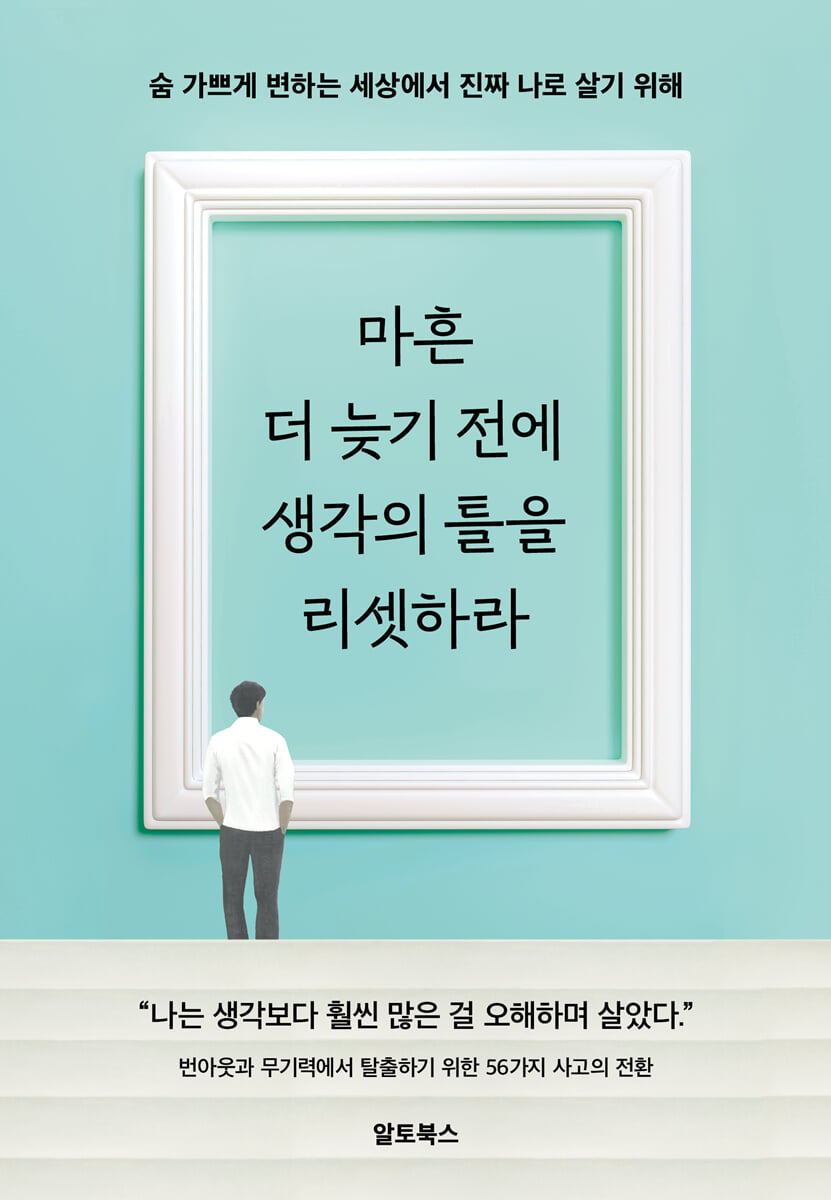
Forty: Reset Your Mindset Before It's Too Late
 |
Description
Book Introduction
Forty: A Life Reset to Bloom Again
I realized this at forty,
56 Misconceptions That Tormented Me
“Am I really right?”
If you don't reset now, the rest of your life will be no different!
In his forties, the author, a veterinarian who cared for life, fell into burnout and a slump, unable to care for his own mind.
Sitting in a corner of the examination room, he was suddenly enveloped in a deep depression and was faced with the question, 'Am I really okay?'
As he began to honestly answer the question he could no longer ignore at a turning point in his life, he began to reset his life.
Letting go of the illusion of perfection, I healed my inner self through small, quiet writing, and broadened my life from a single identity as a veterinarian to a writer and lecturer.
Now he says:
“For life to change, your actions must change, and for actions to change, your thoughts must change first.” This book is a self-examination tool and a practical thinking reset manual that organizes the “thought errors” discovered through the process of such change and the resulting distortions in life.
This journey, born of depression and burnout, led to the insight that “it wasn’t the external reality that made my life difficult, but my way of thinking about that reality.”
Based on this, the author organizes 56 stereotypes that we have unconsciously believed, examines them one by one, and presents a new perspective.
This book is divided into five chapters.
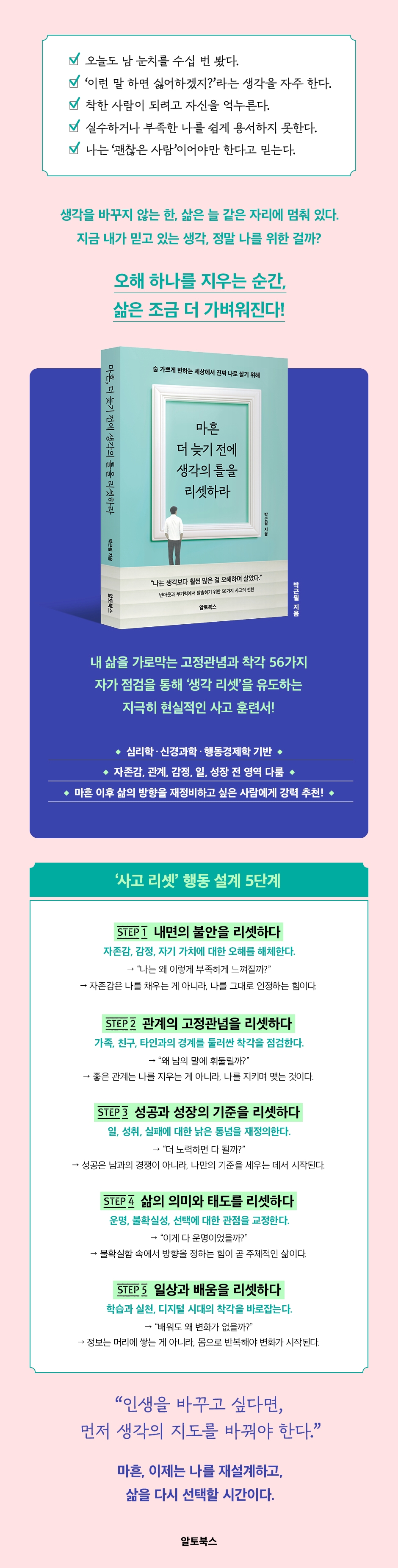
· Reset your inner anxiety - misunderstandings about self-esteem, emotions, and self-worth
· Resetting stereotypes about relationships - misconceptions about boundaries with family, friends, and others
· Resetting the Bar for Success and Growth - Misconceptions About Work, Achievement, and Failure
· Resetting the meaning and attitude of life - Perspectives on fate, uncertainty, and choice
Resetting Daily Life and Learning - Learning, Misconceptions in the AI Era, and Implementation Strategies
To ensure that the insights into 56 stereotypes go beyond mere assertions, the author draws on the latest research findings from psychology, brain science, and behavioral economics, as well as real-world examples, to encourage a practical shift in thinking.
This book is for those who want change rather than comfort, and action rather than empathy.
If you are a reader in your forties or passing through your forties without a strong sense of self-confidence, this book will provide you with a new framework for thinking about life.
The greatest virtue of this book is that it contains the blind spots of life that I was able to grasp because I was once a broken person, and the sincere checklist that I can pass on because I still live with tremors.
I realized this at forty,
56 Misconceptions That Tormented Me
“Am I really right?”
If you don't reset now, the rest of your life will be no different!
In his forties, the author, a veterinarian who cared for life, fell into burnout and a slump, unable to care for his own mind.
Sitting in a corner of the examination room, he was suddenly enveloped in a deep depression and was faced with the question, 'Am I really okay?'
As he began to honestly answer the question he could no longer ignore at a turning point in his life, he began to reset his life.
Letting go of the illusion of perfection, I healed my inner self through small, quiet writing, and broadened my life from a single identity as a veterinarian to a writer and lecturer.
Now he says:
“For life to change, your actions must change, and for actions to change, your thoughts must change first.” This book is a self-examination tool and a practical thinking reset manual that organizes the “thought errors” discovered through the process of such change and the resulting distortions in life.
This journey, born of depression and burnout, led to the insight that “it wasn’t the external reality that made my life difficult, but my way of thinking about that reality.”
Based on this, the author organizes 56 stereotypes that we have unconsciously believed, examines them one by one, and presents a new perspective.
This book is divided into five chapters.
· Reset your inner anxiety - misunderstandings about self-esteem, emotions, and self-worth
· Resetting stereotypes about relationships - misconceptions about boundaries with family, friends, and others
· Resetting the Bar for Success and Growth - Misconceptions About Work, Achievement, and Failure
· Resetting the meaning and attitude of life - Perspectives on fate, uncertainty, and choice
Resetting Daily Life and Learning - Learning, Misconceptions in the AI Era, and Implementation Strategies
To ensure that the insights into 56 stereotypes go beyond mere assertions, the author draws on the latest research findings from psychology, brain science, and behavioral economics, as well as real-world examples, to encourage a practical shift in thinking.
This book is for those who want change rather than comfort, and action rather than empathy.
If you are a reader in your forties or passing through your forties without a strong sense of self-confidence, this book will provide you with a new framework for thinking about life.
The greatest virtue of this book is that it contains the blind spots of life that I was able to grasp because I was once a broken person, and the sincere checklist that I can pass on because I still live with tremors.
- You can preview some of the book's contents.
Preview
index
Prologue: Forty, a Question to a Familiar World
Chapter 1.
Resetting Your Inner Anxiety: Finding a Strong Center of Mind
Reset Button 01.
It's best not to experience depression.
Reset Button 02.
People with depression are weak
Reset Button 03.
A strong mentality is innate.
Reset Button 04.
It's always hard for me, I'm the hardest
Reset Button 05.
Regrets and worries are helpful in life.
Reset Button 06.
My existence is only valuable if it is useful.
Reset Button 07.
You must always maintain high self-esteem.
Reset Button 08.
My life should always be happy
Reset Button 09.
Stress is only harmful to life.
Reset Button 10.
Solitude is the same as isolation.
Reset Button 11.
Negative emotions must be suppressed and hidden.
Reset Button 12.
It's good to live thinking, 'I am special.'
Reset Button 13.
Self-confidence is absolutely dependent on external recognition.
Chapter 2.
Resetting Relationship Stereotypes: Healthy Distance, Mature Connection
Reset Button 14.
It's good to hang out with people who have similar interests.
Reset Button 15.
A person who takes care of himself first is selfish.
Reset Button 16.
Parents should always show their children only the best.
Reset Button 17.
Opportunities in life come from those close to you.
Reset Button 18.
First impressions help us judge people.
Reset Button 19.
It's okay, I meant it well.
Reset Button 20.
'Kkondae' is a word that only applies to older adults.
Reset Button 21.
People don't change
Reset Button 22.
Sharing your weaknesses is detrimental.
Reset Button 23.
Rejection means I don't like it.
Chapter 3.
Resetting the Bar for Success and Growth: Finding Your Own Pace and Direction
Reset Button 24.
Big achievements are better than small ones.
Reset Button 25.
Living a life of giving is a loss; being selfish is the key to success.
Reset Button 26.
Always have Plan A, make the best choice.
Reset Button 27.
Going all-in increases your chances of success.
Reset Button 28.
Compensate for your weaknesses rather than developing your strengths.
Reset Button 29.
The key to success is hard work.
Reset Button 30.
If it seems like it will fail, it's best to avoid it.
Reset Button 31.
Multitasking is also a skill
Reset Button 32.
The biggest cause of failure is within me.
Reset Button 33.
We must sacrifice the present for the future.
Reset Button 34.
To achieve your goals, you need to cut down on sleep.
Reset Button 35.
You just have to dig one well deep.
Reset Button 36.
If you give up, you're a failure, a loser.
Chapter 4.
Resetting the Meaning and Attitude of Life: The Wisdom of Facing the World Flexibly
Reset Button 37.
It's okay to live without meaning or purpose.
Reset Button 38.
A square peg fits in a round hole, so if it bounces, it's a loss.
Reset Button 39.
It's good to live optimistically
Reset Button 40.
Believe what you see rather than what you don't see.
Reset Button 41.
Risk and uncertainty must be avoided.
Reset Button 42.
I must control every situation as much as possible.
Reset Button 43.
What I saw and heard myself is trustworthy enough.
Reset Button 44.
You must take on the challenge when you are fully prepared.
Reset Button 45.
There's no point in doing something you don't like.
Reset Button 46.
We should pay more attention to the big things than the small things.
Reset Button 47.
All successful people are just lucky.
Reset Button 48.
There is a time for everything
Reset Button 49.
A life where the work-life balance is perfectly maintained is a desirable life.
Chapter 5.
Resetting Your Routine and Learning: Making Small, But Significant Changes
Reset Button 50.
When reading, it's best to remember as much as possible.
Reset Button 51.
It's better not to ask stupid questions
Reset Button 52.
The Miracle Morning is essential for a "newborn" life.
Reset Button 53.
Free distribution and sharing the production process are detrimental.
Reset Button 54.
AI will soon replace writing.
Reset Button 55.
The Fire Tribe is the ideal lifestyle
Reset Button 56.
All problems should be resolved immediately and as quickly as possible.
Epilogue: Reset, a New Beginning toward a Life True to Myself
Chapter 1.
Resetting Your Inner Anxiety: Finding a Strong Center of Mind
Reset Button 01.
It's best not to experience depression.
Reset Button 02.
People with depression are weak
Reset Button 03.
A strong mentality is innate.
Reset Button 04.
It's always hard for me, I'm the hardest
Reset Button 05.
Regrets and worries are helpful in life.
Reset Button 06.
My existence is only valuable if it is useful.
Reset Button 07.
You must always maintain high self-esteem.
Reset Button 08.
My life should always be happy
Reset Button 09.
Stress is only harmful to life.
Reset Button 10.
Solitude is the same as isolation.
Reset Button 11.
Negative emotions must be suppressed and hidden.
Reset Button 12.
It's good to live thinking, 'I am special.'
Reset Button 13.
Self-confidence is absolutely dependent on external recognition.
Chapter 2.
Resetting Relationship Stereotypes: Healthy Distance, Mature Connection
Reset Button 14.
It's good to hang out with people who have similar interests.
Reset Button 15.
A person who takes care of himself first is selfish.
Reset Button 16.
Parents should always show their children only the best.
Reset Button 17.
Opportunities in life come from those close to you.
Reset Button 18.
First impressions help us judge people.
Reset Button 19.
It's okay, I meant it well.
Reset Button 20.
'Kkondae' is a word that only applies to older adults.
Reset Button 21.
People don't change
Reset Button 22.
Sharing your weaknesses is detrimental.
Reset Button 23.
Rejection means I don't like it.
Chapter 3.
Resetting the Bar for Success and Growth: Finding Your Own Pace and Direction
Reset Button 24.
Big achievements are better than small ones.
Reset Button 25.
Living a life of giving is a loss; being selfish is the key to success.
Reset Button 26.
Always have Plan A, make the best choice.
Reset Button 27.
Going all-in increases your chances of success.
Reset Button 28.
Compensate for your weaknesses rather than developing your strengths.
Reset Button 29.
The key to success is hard work.
Reset Button 30.
If it seems like it will fail, it's best to avoid it.
Reset Button 31.
Multitasking is also a skill
Reset Button 32.
The biggest cause of failure is within me.
Reset Button 33.
We must sacrifice the present for the future.
Reset Button 34.
To achieve your goals, you need to cut down on sleep.
Reset Button 35.
You just have to dig one well deep.
Reset Button 36.
If you give up, you're a failure, a loser.
Chapter 4.
Resetting the Meaning and Attitude of Life: The Wisdom of Facing the World Flexibly
Reset Button 37.
It's okay to live without meaning or purpose.
Reset Button 38.
A square peg fits in a round hole, so if it bounces, it's a loss.
Reset Button 39.
It's good to live optimistically
Reset Button 40.
Believe what you see rather than what you don't see.
Reset Button 41.
Risk and uncertainty must be avoided.
Reset Button 42.
I must control every situation as much as possible.
Reset Button 43.
What I saw and heard myself is trustworthy enough.
Reset Button 44.
You must take on the challenge when you are fully prepared.
Reset Button 45.
There's no point in doing something you don't like.
Reset Button 46.
We should pay more attention to the big things than the small things.
Reset Button 47.
All successful people are just lucky.
Reset Button 48.
There is a time for everything
Reset Button 49.
A life where the work-life balance is perfectly maintained is a desirable life.
Chapter 5.
Resetting Your Routine and Learning: Making Small, But Significant Changes
Reset Button 50.
When reading, it's best to remember as much as possible.
Reset Button 51.
It's better not to ask stupid questions
Reset Button 52.
The Miracle Morning is essential for a "newborn" life.
Reset Button 53.
Free distribution and sharing the production process are detrimental.
Reset Button 54.
AI will soon replace writing.
Reset Button 55.
The Fire Tribe is the ideal lifestyle
Reset Button 56.
All problems should be resolved immediately and as quickly as possible.
Epilogue: Reset, a New Beginning toward a Life True to Myself
Detailed image
Into the book
*** Have you heard of the term "existential tax"? It's the tax we have no choice but to pay to live as ourselves.
It refers to the discomfort and pain that I have to endure in order to live as myself.
It's like paying taxes, it's unavoidable.
Just as we receive social benefits by paying taxes, paying existential taxes gives us the opportunity to find our true selves and live as ourselves.
If I want to live as myself, if I want to live true to myself, it requires great courage and sometimes involves sacrifice and discomfort.
Existential tax is expensive.
Still, you have to accept it.
Because I have to live my life true to myself to make my existence shine brightest.
Be willing to pay the existential tax and live your life as yourself.
*** Emotions are a part of me.
So rather than suppressing your emotions, try to look into why they appear and understand the message they are conveying.
Above all, if you want to control your emotions, move your body.
Move, Move!
*** The important thing is the difference between 'special' and 'precious'.
Being special always starts from comparing yourself to others.
The focus is on how I differentiate myself from others.
Preciousness is not like that.
I am saying that I am a precious being in and of myself and deserve to be respected.
It does not presuppose comparison.
Because I am precious, and you are precious too.
Even in the midst of ordinariness, you can find your own unique value.
*** If an emergency occurs on a plane, the flight attendants will always give this guidance:
"When the oxygen mask comes down, put on your own mask first, then help the person next to you." Why? Because I must breathe and be healthy before I can help others.
Life is the same.
If I stand upright, my family will stand upright, and if I am healthy, my family will be healthy.
If you don't take care of yourself and only force sacrifices, eventually everyone will fall apart.
*** The essence of opportunity is ‘newness.’
People close to me know me well, so they often give me only familiar advice.
On the other hand, strangers or people with whom I have loose relationships may see my possibilities differently.
Actually, I felt this strongly while working on social media and blogging.
There have been many cases where people I've only contacted once or twice or communicated with through comments have created greater opportunities for me than people I knew closely.
*** Words are not just about conveying information; they are also about emotions and context.
Hiroshi Hitano says this in “Becoming the Father I Dreamed of When I Was Young.”
“If you speak kindly and gently, but end up causing pain, it is no different from cruelty.” This is one of the things we get wrong.
I think it's okay to give advice in a nice tone, but in the end, what matters is how the other person receives it.
*** There is a saying that three factors are important in changing a person.
The three pillars are Time, Space, and People.
People and their lives change depending on how they spend their time, what kind of environment they live in, and who they associate with.
The future of someone who spends every day browsing social media and someone who invests at least an hour a day in reading and self-improvement will be very different.
Space is also important.
When the environment changes, behavior changes, and when behavior changes, the way of thinking also changes.
The most important factor is human relationships.
As the saying goes, “birds of a feather flock together,” and “birds of a feather flock together,” the people you hang out with ultimately determine who you are.
*** “Fail fast, learn faster” is a common saying among Silicon Valley entrepreneurs.
This is not just a slogan.
In fact, many innovative companies embrace failure as a process of growth rather than fearing it.
Elon Musk, who leads innovative companies such as Tesla, SpaceX, and Neuralink, is a representative example.
He kept trying, even though he knew there was a high chance of failure.
Tesla's early models underperformed, and SpaceX's first three rocket launches failed.
But he learned from his failures and never stopped.
On the fourth attempt, the rocket was finally successfully launched, changing the paradigm of the space industry.
*** In a high school in Chicago, USA, failing grades are marked as NY (Not Yet) instead of F (Failed).
It doesn't mean 'failure', but 'not yet reached'.
This concept is very important.
When we view failure as part of a process rather than an event, we can continuously learn.
Thomas Edison is said to have experienced numerous failures before inventing the light bulb, but he considered them to be "discoveries of numerous ways not to succeed."
Failure is not the end, it is a stepping stone to growth.
*** Not asking questions is foolish.
The philosopher Socrates constantly asked questions, saying, “I know that I know nothing.”
His questions were not simply about asking for knowledge, but about expanding thinking and exploring the essence.
Physicist Richard Feynman emphasized the importance of questions, particularly the question "Why?", which he said played a central role in understanding the world.
If there are no questions, there is no inquiry.
Asking questions allows us to gain new perspectives and find better answers.
*** As we enter the AI era, human writing will become an increasingly differentiated skill. AI can become a writing assistant.
But ultimately, only humans can give true meaning to writing and move people's hearts.
As technology advances, there are abilities that become more important.
The ability to organize thoughts, express emotions, and connect with people.
It refers to the discomfort and pain that I have to endure in order to live as myself.
It's like paying taxes, it's unavoidable.
Just as we receive social benefits by paying taxes, paying existential taxes gives us the opportunity to find our true selves and live as ourselves.
If I want to live as myself, if I want to live true to myself, it requires great courage and sometimes involves sacrifice and discomfort.
Existential tax is expensive.
Still, you have to accept it.
Because I have to live my life true to myself to make my existence shine brightest.
Be willing to pay the existential tax and live your life as yourself.
*** Emotions are a part of me.
So rather than suppressing your emotions, try to look into why they appear and understand the message they are conveying.
Above all, if you want to control your emotions, move your body.
Move, Move!
*** The important thing is the difference between 'special' and 'precious'.
Being special always starts from comparing yourself to others.
The focus is on how I differentiate myself from others.
Preciousness is not like that.
I am saying that I am a precious being in and of myself and deserve to be respected.
It does not presuppose comparison.
Because I am precious, and you are precious too.
Even in the midst of ordinariness, you can find your own unique value.
*** If an emergency occurs on a plane, the flight attendants will always give this guidance:
"When the oxygen mask comes down, put on your own mask first, then help the person next to you." Why? Because I must breathe and be healthy before I can help others.
Life is the same.
If I stand upright, my family will stand upright, and if I am healthy, my family will be healthy.
If you don't take care of yourself and only force sacrifices, eventually everyone will fall apart.
*** The essence of opportunity is ‘newness.’
People close to me know me well, so they often give me only familiar advice.
On the other hand, strangers or people with whom I have loose relationships may see my possibilities differently.
Actually, I felt this strongly while working on social media and blogging.
There have been many cases where people I've only contacted once or twice or communicated with through comments have created greater opportunities for me than people I knew closely.
*** Words are not just about conveying information; they are also about emotions and context.
Hiroshi Hitano says this in “Becoming the Father I Dreamed of When I Was Young.”
“If you speak kindly and gently, but end up causing pain, it is no different from cruelty.” This is one of the things we get wrong.
I think it's okay to give advice in a nice tone, but in the end, what matters is how the other person receives it.
*** There is a saying that three factors are important in changing a person.
The three pillars are Time, Space, and People.
People and their lives change depending on how they spend their time, what kind of environment they live in, and who they associate with.
The future of someone who spends every day browsing social media and someone who invests at least an hour a day in reading and self-improvement will be very different.
Space is also important.
When the environment changes, behavior changes, and when behavior changes, the way of thinking also changes.
The most important factor is human relationships.
As the saying goes, “birds of a feather flock together,” and “birds of a feather flock together,” the people you hang out with ultimately determine who you are.
*** “Fail fast, learn faster” is a common saying among Silicon Valley entrepreneurs.
This is not just a slogan.
In fact, many innovative companies embrace failure as a process of growth rather than fearing it.
Elon Musk, who leads innovative companies such as Tesla, SpaceX, and Neuralink, is a representative example.
He kept trying, even though he knew there was a high chance of failure.
Tesla's early models underperformed, and SpaceX's first three rocket launches failed.
But he learned from his failures and never stopped.
On the fourth attempt, the rocket was finally successfully launched, changing the paradigm of the space industry.
*** In a high school in Chicago, USA, failing grades are marked as NY (Not Yet) instead of F (Failed).
It doesn't mean 'failure', but 'not yet reached'.
This concept is very important.
When we view failure as part of a process rather than an event, we can continuously learn.
Thomas Edison is said to have experienced numerous failures before inventing the light bulb, but he considered them to be "discoveries of numerous ways not to succeed."
Failure is not the end, it is a stepping stone to growth.
*** Not asking questions is foolish.
The philosopher Socrates constantly asked questions, saying, “I know that I know nothing.”
His questions were not simply about asking for knowledge, but about expanding thinking and exploring the essence.
Physicist Richard Feynman emphasized the importance of questions, particularly the question "Why?", which he said played a central role in understanding the world.
If there are no questions, there is no inquiry.
Asking questions allows us to gain new perspectives and find better answers.
*** As we enter the AI era, human writing will become an increasingly differentiated skill. AI can become a writing assistant.
But ultimately, only humans can give true meaning to writing and move people's hearts.
As technology advances, there are abilities that become more important.
The ability to organize thoughts, express emotions, and connect with people.
--- From the text
Publisher's Review
“I lived with far more misunderstandings than I thought.”
Break the 'stereotypical thinking' that has been taken for granted for a long time!
If familiar thoughts are making me suffer,
Now is the moment to reset.
I believed that familiar thoughts would sustain me through life.
But looking back, those thoughts were actually weighing me down.
“Why do I live my life so oppressed and tired?” This was the first question I asked myself as I turned forty.
I was being judged by countless standards of success, relationships, and self-esteem, and I was trapped and struggling within them.
Thoughts like, "I'm always the only one who has a hard time," "I have to be a good person," and "I have to live as well as others" are so old that they are taken for granted, but they are the very things that lead to burnout in life.
This book begins right at that point.
The author worked as a veterinarian at an animal hospital and cared for other living beings, but was unable to care for his own heart, and as a result suffered from depression that was difficult to overcome.
As time passes, he realizes.
The problem isn't reality itself, but the "frame of thought" that allows us to view it! Thus, the question, "Am I truly okay?" expands into a new question: "Is this thinking truly helping me?" And the author's life begins to slowly reset.
We look outside ourselves for the reasons why life is difficult.
But sometimes the most powerful obstacles are within me.
When you let go of your stereotypes, life begins to look different.
Every time I correct a misunderstanding, a little weight is lifted from my shoulders.
The age of forty is the perfect time to begin such an examination.
The moment we break free from the thoughts that bind us, we can finally become the masters of our own lives.
This book encourages us to check out that starting point together.
A moment to reset your thoughts
Life begins to move again
· When you let go of your illusions, life becomes visible again.
· Every time you correct a misunderstanding, your life becomes lighter.
· It was my 'thoughts' that were blocking my life.
· Forty: The most important thing is the power to change your thoughts.
"Forty, Reset Your Mindset Before It's Too Late" is a self-help book that aims to dismantle the way of thinking we've become accustomed to and reset it for the better.
The author selects 56 common misconceptions in major areas of life, ranging from self-esteem and emotions to interpersonal relationships, work, learning, and attitudes toward life. He deconstructs and reconstructs each one based on evidence from psychology, neuroscience, and behavioral economics, as well as real-life experience.
This book's persuasive power shines in that it provides a roadmap for grounded change, rather than a simple list of comforts or sentiments.
For example, the belief that "I am special" may seem to support self-esteem, but if taken to excess, it can create a solid wall of self-confidence and result in excluding others.
The same goes for the misconception that you must always maintain high self-esteem.
Healthy self-esteem isn't about maintaining high self-esteem; it's about being able to view yourself positively even when your self-esteem is low.
Rather than blindly believing in the "Miracle Morning" as if it were a fad, it is more important to find a time when you can concentrate according to your own biological rhythm, and this is explained through various examples.
The thought of accepting rejection as a denial of existence may also be due to a lack of understanding of other people's situations and feelings.
This book does not provide a complete guide to changing everyone's life.
Instead, it aims to be a realistic and practical compass that helps readers examine and correct their own thinking.
He consistently emphasizes that it is up to 'myself', not the author or the world, to set the direction of life, and that change begins when the reader asks, 'Is this thought really helpful to me?'
For readers in their forties or nearing their forties, this book is not simply advice, but a thoughtful and warm suggestion from someone who has thought through the same issues.
That suggestion will change your thinking and ultimately your life.
Break the 'stereotypical thinking' that has been taken for granted for a long time!
If familiar thoughts are making me suffer,
Now is the moment to reset.
I believed that familiar thoughts would sustain me through life.
But looking back, those thoughts were actually weighing me down.
“Why do I live my life so oppressed and tired?” This was the first question I asked myself as I turned forty.
I was being judged by countless standards of success, relationships, and self-esteem, and I was trapped and struggling within them.
Thoughts like, "I'm always the only one who has a hard time," "I have to be a good person," and "I have to live as well as others" are so old that they are taken for granted, but they are the very things that lead to burnout in life.
This book begins right at that point.
The author worked as a veterinarian at an animal hospital and cared for other living beings, but was unable to care for his own heart, and as a result suffered from depression that was difficult to overcome.
As time passes, he realizes.
The problem isn't reality itself, but the "frame of thought" that allows us to view it! Thus, the question, "Am I truly okay?" expands into a new question: "Is this thinking truly helping me?" And the author's life begins to slowly reset.
We look outside ourselves for the reasons why life is difficult.
But sometimes the most powerful obstacles are within me.
When you let go of your stereotypes, life begins to look different.
Every time I correct a misunderstanding, a little weight is lifted from my shoulders.
The age of forty is the perfect time to begin such an examination.
The moment we break free from the thoughts that bind us, we can finally become the masters of our own lives.
This book encourages us to check out that starting point together.
A moment to reset your thoughts
Life begins to move again
· When you let go of your illusions, life becomes visible again.
· Every time you correct a misunderstanding, your life becomes lighter.
· It was my 'thoughts' that were blocking my life.
· Forty: The most important thing is the power to change your thoughts.
"Forty, Reset Your Mindset Before It's Too Late" is a self-help book that aims to dismantle the way of thinking we've become accustomed to and reset it for the better.
The author selects 56 common misconceptions in major areas of life, ranging from self-esteem and emotions to interpersonal relationships, work, learning, and attitudes toward life. He deconstructs and reconstructs each one based on evidence from psychology, neuroscience, and behavioral economics, as well as real-life experience.
This book's persuasive power shines in that it provides a roadmap for grounded change, rather than a simple list of comforts or sentiments.
For example, the belief that "I am special" may seem to support self-esteem, but if taken to excess, it can create a solid wall of self-confidence and result in excluding others.
The same goes for the misconception that you must always maintain high self-esteem.
Healthy self-esteem isn't about maintaining high self-esteem; it's about being able to view yourself positively even when your self-esteem is low.
Rather than blindly believing in the "Miracle Morning" as if it were a fad, it is more important to find a time when you can concentrate according to your own biological rhythm, and this is explained through various examples.
The thought of accepting rejection as a denial of existence may also be due to a lack of understanding of other people's situations and feelings.
This book does not provide a complete guide to changing everyone's life.
Instead, it aims to be a realistic and practical compass that helps readers examine and correct their own thinking.
He consistently emphasizes that it is up to 'myself', not the author or the world, to set the direction of life, and that change begins when the reader asks, 'Is this thought really helpful to me?'
For readers in their forties or nearing their forties, this book is not simply advice, but a thoughtful and warm suggestion from someone who has thought through the same issues.
That suggestion will change your thinking and ultimately your life.
GOODS SPECIFICS
- Date of issue: August 10, 2025
- Page count, weight, size: 272 pages | 147*212*20mm
- ISBN13: 9791194655114
- ISBN10: 1194655114
You may also like
카테고리
korean


korean

![GQ KOREA Mark (Monthly): December [2025]](http://librairie.coreenne.fr/cdn/shop/files/8ef265dbbfbf186523ed75ba7319009d.jpg?v=1765340328&width=3840)


