

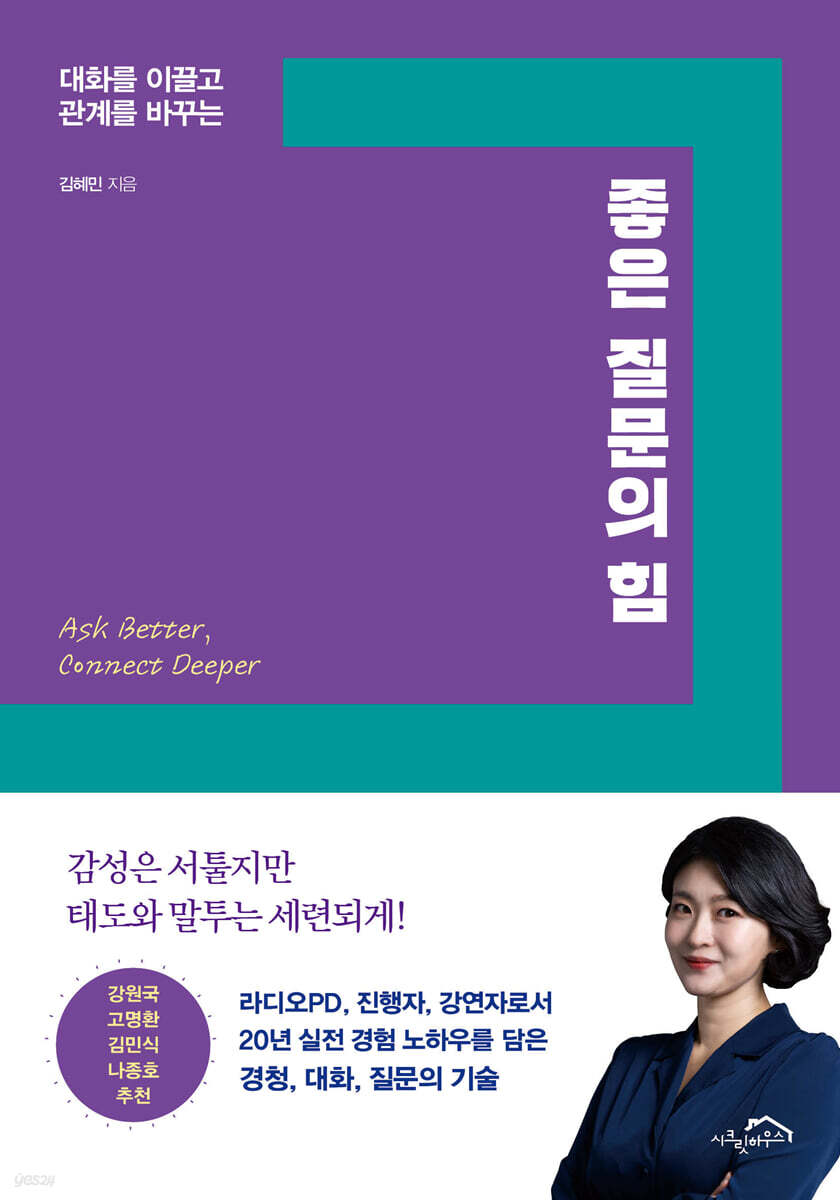
The power of good questions
 |
Description
Book Introduction
Ask Better, Connect Deeper!
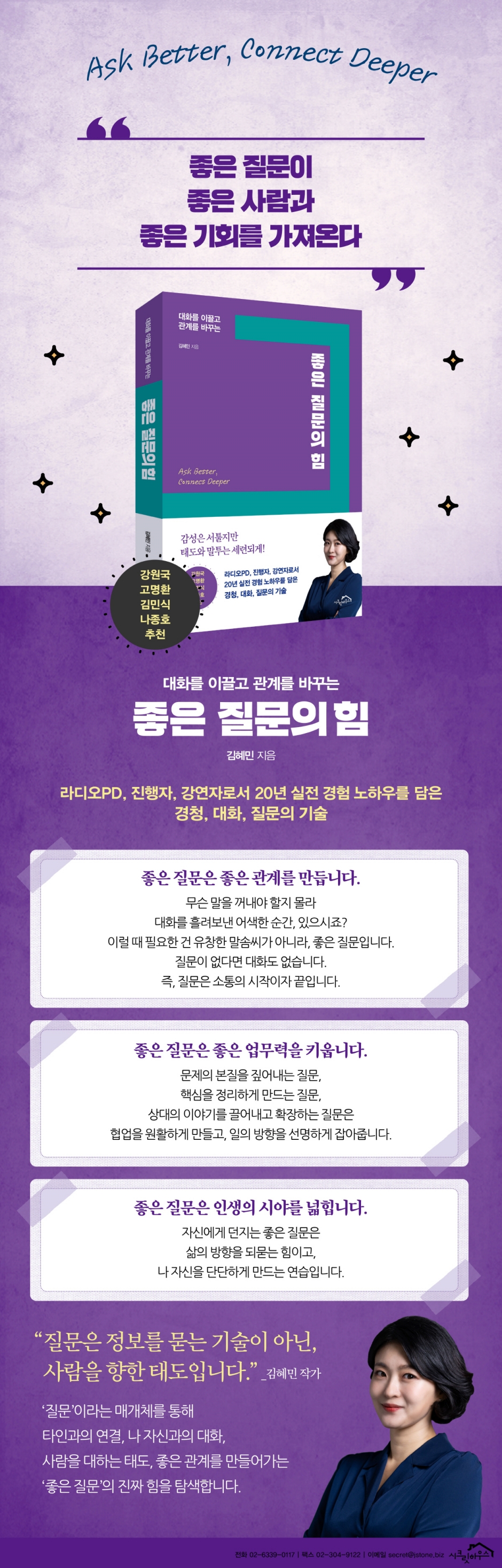
Good questions bring good people and good opportunities.
With 20 years of practical know-how as a radio PD, host, and lecturer
The skills of listening, conversation, and questioning
Recommended by Kang Won-guk, Go Myeong-hwan, Kim Min-sik, and Na Jong-ho!
Have you ever hesitated about how to start a conversation with someone you just met? We've all had that experience of wanting to strike up a conversation but feeling awkward or not knowing what to say, so we let the conversation flow.
I'm trying to make small talk, but I can't quite think of what to say first.
When you want to build a good relationship in an important meeting but are unsure of how to approach it, what you need is not a perfect self-introduction or fluent speaking skills, but a question that reflects your interest in the other person.
Author Kim Hye-min says:
They say good relationships start with good questions.
If there are no questions, there is no conversation.
In other words, questions are the beginning and the end of communication.
In the book “The Power of Good Questions,” the author says, “Questions are not a technique for asking for information, but an attitude toward people.”
A good question is the first step in a relationship, an attitude of trying to understand the other person, and a tool for self-reflection.
Author Kim Hye-min, who has worked as a radio producer, host, and lecturer for 20 years, has made asking and listening her profession, and has communicated with countless people through questions.
What the author discovered along the way was that one good question can change relationships, shift the direction of work, and even broaden one's perspective on life.
The book "The Power of Good Questions" is a guide to questions that contains the author's know-how gained from practical experience, but it is not a manual that simply contains speaking skills for speaking well.
Rather, it is a book that explores the true power of 'good questions' as a way to connect with others, have conversations with oneself, change one's attitude toward others, and build good relationships through the medium of 'questions'.
A question mark containing a question can develop into a question mark for another question, or it can become an exclamation point of enlightenment.
Sometimes it becomes a period at the end of a task, and sometimes it becomes a comma on the road of life that has been running without rest.
In this way, questions can become a cloud or a brake.
(…) Eventually, your attitude toward problems changes, your relationships change, and your life changes.
-From the text
Good questions bring good people and good opportunities.
With 20 years of practical know-how as a radio PD, host, and lecturer
The skills of listening, conversation, and questioning
Recommended by Kang Won-guk, Go Myeong-hwan, Kim Min-sik, and Na Jong-ho!
Have you ever hesitated about how to start a conversation with someone you just met? We've all had that experience of wanting to strike up a conversation but feeling awkward or not knowing what to say, so we let the conversation flow.
I'm trying to make small talk, but I can't quite think of what to say first.
When you want to build a good relationship in an important meeting but are unsure of how to approach it, what you need is not a perfect self-introduction or fluent speaking skills, but a question that reflects your interest in the other person.
Author Kim Hye-min says:
They say good relationships start with good questions.
If there are no questions, there is no conversation.
In other words, questions are the beginning and the end of communication.
In the book “The Power of Good Questions,” the author says, “Questions are not a technique for asking for information, but an attitude toward people.”
A good question is the first step in a relationship, an attitude of trying to understand the other person, and a tool for self-reflection.
Author Kim Hye-min, who has worked as a radio producer, host, and lecturer for 20 years, has made asking and listening her profession, and has communicated with countless people through questions.
What the author discovered along the way was that one good question can change relationships, shift the direction of work, and even broaden one's perspective on life.
The book "The Power of Good Questions" is a guide to questions that contains the author's know-how gained from practical experience, but it is not a manual that simply contains speaking skills for speaking well.
Rather, it is a book that explores the true power of 'good questions' as a way to connect with others, have conversations with oneself, change one's attitude toward others, and build good relationships through the medium of 'questions'.
A question mark containing a question can develop into a question mark for another question, or it can become an exclamation point of enlightenment.
Sometimes it becomes a period at the end of a task, and sometimes it becomes a comma on the road of life that has been running without rest.
In this way, questions can become a cloud or a brake.
(…) Eventually, your attitude toward problems changes, your relationships change, and your life changes.
-From the text
- You can preview some of the book's contents.
Preview
index
Recommendation
Prologue | Good Questions Bring Good People and Good Opportunities
Part 1.
The question is not about technology, but about attitude toward people.
Good questions grow in your ears.
A question that opens up conversation
Asking questions from the other person's perspective benefits everyone.
Form and content are also important
The Three Principles of Questioning
Practice making questions in everyday life
Surround yourself with people who ask good questions.
Part 2.
The power of good questions to change your life
The first question you should ask
Helps you grasp the core
Expand the story
Makes me think again
Make the world a better place
Seven Questions That Will Change Your Life
Part 3.
Good questions make good conversations.
Speaking and writing are fundamental
Writing Practice That Forms the Foundation for Good Questions
Choose a model of speaking you want to emulate.
How to Design Good Questions
How Successful Workers Use Questions
The Art of Asking Questions for Good Communication
Part 4.
Every relationship begins with a question.
One small question that opens a person's heart
A strong signal that I'm listening to you
Ask questions like Peter Drucker
Insights that capture the essence, the art of summarizing
Beware of bad questions that can destroy relationships.
Unexpected questions, seemingly meaningful conversations
Epilogue | A life of questioning is the most solid and profound life.
Prologue | Good Questions Bring Good People and Good Opportunities
Part 1.
The question is not about technology, but about attitude toward people.
Good questions grow in your ears.
A question that opens up conversation
Asking questions from the other person's perspective benefits everyone.
Form and content are also important
The Three Principles of Questioning
Practice making questions in everyday life
Surround yourself with people who ask good questions.
Part 2.
The power of good questions to change your life
The first question you should ask
Helps you grasp the core
Expand the story
Makes me think again
Make the world a better place
Seven Questions That Will Change Your Life
Part 3.
Good questions make good conversations.
Speaking and writing are fundamental
Writing Practice That Forms the Foundation for Good Questions
Choose a model of speaking you want to emulate.
How to Design Good Questions
How Successful Workers Use Questions
The Art of Asking Questions for Good Communication
Part 4.
Every relationship begins with a question.
One small question that opens a person's heart
A strong signal that I'm listening to you
Ask questions like Peter Drucker
Insights that capture the essence, the art of summarizing
Beware of bad questions that can destroy relationships.
Unexpected questions, seemingly meaningful conversations
Epilogue | A life of questioning is the most solid and profound life.
Detailed image
Into the book
When you decide to ask questions, nothing becomes obvious.
A passive attitude changes into a positive one.
Then the process of work changes and the results are different.
Ultimately, your attitude toward problems will change, your relationships will change, and your life will change.
In a world where ChatGPT can tell you everything, some readers might wonder why the questions humans ask are so important.
So, we need to look more deeply into what questions only humans, as humans, can ask, and what the nature of those questions is.
In the future, the ability to ask human questions will be the most important talent.
What is important at this time is the ‘ability to choose questions’ and the ‘ability to create questions.’
---「Prolog.
From “Good questions bring good people and good opportunities”
When I listen to someone's story, I consider myself a 'drummer'.
A gosu is a person who plays the drums in pansori.
A master must add appropriate exclamations according to the singer and the sound.
The sound of a famous singer changes depending on which expert he meets.
A suitable exclamation during a conversation is the mark of a master.
You can also replace exclamations with questions, such as “So what happened?” or “What did he do?”
---From "Good Questions Grow in Your Ears"
So, what kind of questions would make the person being asked say, "That's a good question"? When I'm asked a question after a lecture, if it allows me to get to the heart of what I consider important and valuable, I respond, "That's a good question."
This question, in other words, is a 'question containing the core'.
Because it is a question that can never be asked without clearly understanding what the other person is saying.
Asking such a question means that the lecturer delivered the lecture well, and that the questioner listened to the lecture with all his or her might.
---From "Getting to the Core"
The reason why specific questions are good is because it makes it easier to apply the other person's answer to my own life.
Rather than asking, “What should I do?”, it’s much more useful to ask specific questions like, “I only have 30 minutes a day. How do you think I should spend that time?”
Concrete questions ultimately open the way to immediate, real-world action.
To ask specific questions, use weapons like 'why, how, what if'.
The question 'why' is one you can ask when you want to know more deeply about a process or idea.
The question 'how' is a broader question that can be asked about the process or method.
Finally, the conditional question 'if ~' can expand the topic, so use it if you want to know more details about something.
---From "Questioning Skills for Good Communication"
Questions like these have the power to initiate and develop relationships with others.
But not just any question has this power.
You have to ask good questions.
In human relationships, questions should be asked in a way that buttons up one by one, not in a way that zips up the zipper.
Because the human heart is not easily opened by saying, “Open, sesame.”
Questions are the most effective tool for engaging in deep conversation with someone.
Asking questions is a powerful signal that you are willing to listen to what the other person is saying, not what you are saying.
Asking a question means you're curious about my story.
---From "A Powerful Signal That I Will Listen to You"
Questions are not just a verbal skill, they are an attitude and a personality.
The moment that most clearly reveals 'who this person is' is when you ask a question.
So, you could say that questions are a way of revealing to the world who I am.
I said earlier that there are no wrong questions, but there are bad questions.
The most common bad questions are those that contain unethical content.
In an age where diversity is valued and emphasized, there are questions that contain discrimination, hate speech, and views that absolutely cannot be included within the category of diverse opinions.
Of course, we all have prejudices and discriminatory perceptions about certain things, although to varying degrees.
But expressing this in words is entirely different.
A passive attitude changes into a positive one.
Then the process of work changes and the results are different.
Ultimately, your attitude toward problems will change, your relationships will change, and your life will change.
In a world where ChatGPT can tell you everything, some readers might wonder why the questions humans ask are so important.
So, we need to look more deeply into what questions only humans, as humans, can ask, and what the nature of those questions is.
In the future, the ability to ask human questions will be the most important talent.
What is important at this time is the ‘ability to choose questions’ and the ‘ability to create questions.’
---「Prolog.
From “Good questions bring good people and good opportunities”
When I listen to someone's story, I consider myself a 'drummer'.
A gosu is a person who plays the drums in pansori.
A master must add appropriate exclamations according to the singer and the sound.
The sound of a famous singer changes depending on which expert he meets.
A suitable exclamation during a conversation is the mark of a master.
You can also replace exclamations with questions, such as “So what happened?” or “What did he do?”
---From "Good Questions Grow in Your Ears"
So, what kind of questions would make the person being asked say, "That's a good question"? When I'm asked a question after a lecture, if it allows me to get to the heart of what I consider important and valuable, I respond, "That's a good question."
This question, in other words, is a 'question containing the core'.
Because it is a question that can never be asked without clearly understanding what the other person is saying.
Asking such a question means that the lecturer delivered the lecture well, and that the questioner listened to the lecture with all his or her might.
---From "Getting to the Core"
The reason why specific questions are good is because it makes it easier to apply the other person's answer to my own life.
Rather than asking, “What should I do?”, it’s much more useful to ask specific questions like, “I only have 30 minutes a day. How do you think I should spend that time?”
Concrete questions ultimately open the way to immediate, real-world action.
To ask specific questions, use weapons like 'why, how, what if'.
The question 'why' is one you can ask when you want to know more deeply about a process or idea.
The question 'how' is a broader question that can be asked about the process or method.
Finally, the conditional question 'if ~' can expand the topic, so use it if you want to know more details about something.
---From "Questioning Skills for Good Communication"
Questions like these have the power to initiate and develop relationships with others.
But not just any question has this power.
You have to ask good questions.
In human relationships, questions should be asked in a way that buttons up one by one, not in a way that zips up the zipper.
Because the human heart is not easily opened by saying, “Open, sesame.”
Questions are the most effective tool for engaging in deep conversation with someone.
Asking questions is a powerful signal that you are willing to listen to what the other person is saying, not what you are saying.
Asking a question means you're curious about my story.
---From "A Powerful Signal That I Will Listen to You"
Questions are not just a verbal skill, they are an attitude and a personality.
The moment that most clearly reveals 'who this person is' is when you ask a question.
So, you could say that questions are a way of revealing to the world who I am.
I said earlier that there are no wrong questions, but there are bad questions.
The most common bad questions are those that contain unethical content.
In an age where diversity is valued and emphasized, there are questions that contain discrimination, hate speech, and views that absolutely cannot be included within the category of diverse opinions.
Of course, we all have prejudices and discriminatory perceptions about certain things, although to varying degrees.
But expressing this in words is entirely different.
---From "Beware of Bad Questions That Destroy Relationships"
Publisher's Review
Although my emotions are clumsy,
Be stylish in your attitude and speech!
One question can change your relationship and your results.
People who are good at their jobs have something in common.
The point is to ask good questions.
Questions that get to the heart of the problem, clarify the core, and elicit and expand on the other person's story are crucial weapons that facilitate collaboration, enhance performance, and clearly define the direction of work in an organization.
But the ability to ask good questions isn't something you're born with.
It can be sufficiently developed with repeated training and small attempts.
In the book, “The Power of Good Questions,” the author introduces specific methods that can be applied to actual work and relationships, such as “The Three Principles of Questioning,” “The Questioning Method of Putting Yourself in Another Person’s Shoes,” “The Kokomu Questioning Method,” “Practice Your Speaking,” “How to Design Good Questions,” “How to Practice Creating Questions,” and “How to Be Aware of Bad Questions.”
Questions help us get to the heart of the problem and find solutions.
That's why people who ask questions often aren't stuck in their own preconceived notions, and their minds are open to finding answers to solve their problems.
So, working with someone who asks questions makes collaboration much easier.
-From the text
Especially for new employees who are worried about how to open up to their boss, office workers who are always concerned about what others think during meetings, and managers who have trouble maintaining an appropriate distance in their relationships with team members, the author's technique of asking "good questions" can lead to much better conversations than they do now.
Questions are not simply a tool for asking for information; they are a core part of communication that connects relationships and fosters growth.
Rather than being good at talking, those who know how to ask the right questions are ultimately trusted within an organization and go further.
If you're looking for answers about work, relationships, performance, and communication, you need to change your attitude toward asking questions.
However, the author does not view the power of questions simply as a tool for achievement or results.
Rather, I follow a journey of reaching out to others through questions, winning their hearts, and gaining a deeper understanding of myself.
Author Kim Hye-min's question structure, which moves from "listening" to "putting yourself in someone else's shoes" and then "connecting," will be effective in all aspects of human relationships, including work competency, leadership, and organizational culture.
The power of good questions to change your life
The first question you must ask is 'Who am I?'
Questions are a tool for conversation with others, but more than that, they are an inner language we ask ourselves.
Self-exploratory questions like, "Who am I?", "Are my current choices true to me?", and "Is this really what I want to do?" can change the direction of your life and redefine the meaning of work.
But we often live busy lives, missing the most important questions.
If we don't learn to stop and ask ourselves, we will only be swayed by other people's questions.
The author emphasizes that the most important and necessary question in life is the question we ask ourselves.
Because questions can be expanded infinitely, the questions I ask myself can transform and develop not only myself but also the communities I belong to.
The moment you ask a question, you take control of not only your life but also the world.
Because the questions we ask and receive in life don't always have correct answers.
So even if I don't find the answer, the question itself can help me grow in knowledge, wisdom, and inspiration.
The question itself may be the answer.
As an adult, you can't live just by answering questions.
Ultimately, the questions I ask prove and shape me.
-From the text
The author emphasizes the need to ask questions that expand the depth and direction of one's thinking.
Good questions clarify key points, expand stories, prompt rethinking, and make the world a better place.
I also recommend asking yourself these seven questions that will enrich your life often.
Because these questions are all tools to help you understand yourself more deeply and live your life proactively.
When the questions I ask myself change, my attitude toward relationships, my approach to work, and my approach to life change.
In other words, if your questions change, your life changes.
We always try to find the right answer, but the answer depends on the quality of the question.
Simply changing what I ask and where I focus can completely change the context of my life.
Ultimately, good questions are the power to question the direction of life and the practice that strengthens me.
What I need now may not be someone's advice, but a single, precise question.
The book, "The Power of Good Questions," will serve as a guide to what questions I should ask others, others should ask me, and I should ask myself, and how those questions can become a compass for my work and life.
Be stylish in your attitude and speech!
One question can change your relationship and your results.
People who are good at their jobs have something in common.
The point is to ask good questions.
Questions that get to the heart of the problem, clarify the core, and elicit and expand on the other person's story are crucial weapons that facilitate collaboration, enhance performance, and clearly define the direction of work in an organization.
But the ability to ask good questions isn't something you're born with.
It can be sufficiently developed with repeated training and small attempts.
In the book, “The Power of Good Questions,” the author introduces specific methods that can be applied to actual work and relationships, such as “The Three Principles of Questioning,” “The Questioning Method of Putting Yourself in Another Person’s Shoes,” “The Kokomu Questioning Method,” “Practice Your Speaking,” “How to Design Good Questions,” “How to Practice Creating Questions,” and “How to Be Aware of Bad Questions.”
Questions help us get to the heart of the problem and find solutions.
That's why people who ask questions often aren't stuck in their own preconceived notions, and their minds are open to finding answers to solve their problems.
So, working with someone who asks questions makes collaboration much easier.
-From the text
Especially for new employees who are worried about how to open up to their boss, office workers who are always concerned about what others think during meetings, and managers who have trouble maintaining an appropriate distance in their relationships with team members, the author's technique of asking "good questions" can lead to much better conversations than they do now.
Questions are not simply a tool for asking for information; they are a core part of communication that connects relationships and fosters growth.
Rather than being good at talking, those who know how to ask the right questions are ultimately trusted within an organization and go further.
If you're looking for answers about work, relationships, performance, and communication, you need to change your attitude toward asking questions.
However, the author does not view the power of questions simply as a tool for achievement or results.
Rather, I follow a journey of reaching out to others through questions, winning their hearts, and gaining a deeper understanding of myself.
Author Kim Hye-min's question structure, which moves from "listening" to "putting yourself in someone else's shoes" and then "connecting," will be effective in all aspects of human relationships, including work competency, leadership, and organizational culture.
The power of good questions to change your life
The first question you must ask is 'Who am I?'
Questions are a tool for conversation with others, but more than that, they are an inner language we ask ourselves.
Self-exploratory questions like, "Who am I?", "Are my current choices true to me?", and "Is this really what I want to do?" can change the direction of your life and redefine the meaning of work.
But we often live busy lives, missing the most important questions.
If we don't learn to stop and ask ourselves, we will only be swayed by other people's questions.
The author emphasizes that the most important and necessary question in life is the question we ask ourselves.
Because questions can be expanded infinitely, the questions I ask myself can transform and develop not only myself but also the communities I belong to.
The moment you ask a question, you take control of not only your life but also the world.
Because the questions we ask and receive in life don't always have correct answers.
So even if I don't find the answer, the question itself can help me grow in knowledge, wisdom, and inspiration.
The question itself may be the answer.
As an adult, you can't live just by answering questions.
Ultimately, the questions I ask prove and shape me.
-From the text
The author emphasizes the need to ask questions that expand the depth and direction of one's thinking.
Good questions clarify key points, expand stories, prompt rethinking, and make the world a better place.
I also recommend asking yourself these seven questions that will enrich your life often.
Because these questions are all tools to help you understand yourself more deeply and live your life proactively.
When the questions I ask myself change, my attitude toward relationships, my approach to work, and my approach to life change.
In other words, if your questions change, your life changes.
We always try to find the right answer, but the answer depends on the quality of the question.
Simply changing what I ask and where I focus can completely change the context of my life.
Ultimately, good questions are the power to question the direction of life and the practice that strengthens me.
What I need now may not be someone's advice, but a single, precise question.
The book, "The Power of Good Questions," will serve as a guide to what questions I should ask others, others should ask me, and I should ask myself, and how those questions can become a compass for my work and life.
GOODS SPECIFICS
- Date of issue: July 25, 2025
- Page count, weight, size: 254 pages | 378g | 140*200*17mm
- ISBN13: 9791194522195
- ISBN10: 119452219X
You may also like
카테고리
korean


korean

![GQ KOREA Mark (Monthly): December [2025]](http://librairie.coreenne.fr/cdn/shop/files/8ef265dbbfbf186523ed75ba7319009d.jpg?v=1765340328&width=3840)


