

Adults do not create equators or sides.
 |
Description
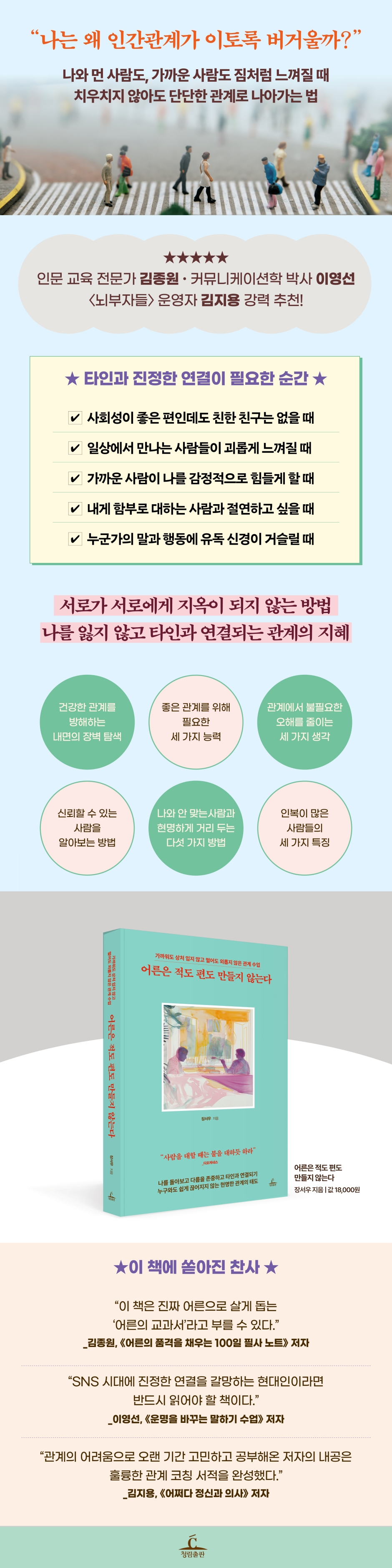
Book Introduction
Since we are born as humans, we must live our entire lives forming relationships with others, whether we like it or not.
But even though we've had many different relationships over the years as adults, we still find people difficult.
Most of the worries we have in life are related to human relationships, so building relationships is not easy.
So how can we overcome relationship difficulties?
In "I Decided Not to Prove Myself Anymore," author Jang Seo-woo, who conveyed the value of true growth to readers, talks about the interpersonal relationships of mature adults.
Drawing on a variety of everyday examples and research findings, we explore ways to avoid dichotomous thinking that divides others into allies and enemies, and to maintain balance in relationships.
By developing a flexible attitude toward diverse relationships with this book, you'll discover new possibilities in your relationships, even with people you've never been able to understand, or with people who sometimes seem too familiar to you.
But even though we've had many different relationships over the years as adults, we still find people difficult.
Most of the worries we have in life are related to human relationships, so building relationships is not easy.
So how can we overcome relationship difficulties?
In "I Decided Not to Prove Myself Anymore," author Jang Seo-woo, who conveyed the value of true growth to readers, talks about the interpersonal relationships of mature adults.
Drawing on a variety of everyday examples and research findings, we explore ways to avoid dichotomous thinking that divides others into allies and enemies, and to maintain balance in relationships.
By developing a flexible attitude toward diverse relationships with this book, you'll discover new possibilities in your relationships, even with people you've never been able to understand, or with people who sometimes seem too familiar to you.
- You can preview some of the book's contents.
Preview
index
Recommendation
On the paradox of relationships that becomes clearer as boundaries are broken down
Chapter 1: Time to observe my inner self and understand my relationship patterns
I'm not shy and I'm social, but why don't I have any close friends?
Even as an adult, human relationships are still difficult.
Discovering the inner barriers that block warm relationships
The art of breaking down and remodeling inner walls
How to Choose Happy Solitude Over Loneliness
Appearances aren't everything
Why You Can't Judge Emotions Based on Facial Expressions Alone
The desire to be recognized and the desire to be understood are different.
Three Skills Needed for Good Relationships
Chapter 2: The Formula for Communication That Avoids Misunderstandings
Healthy communication where truth and sincerity are in harmony
Three Tips for Reducing Unnecessary Misunderstandings in Relationships
Truthfulness and transparency are different
The paradox of a relationship where the more you try to get along, the more distant you become.
How to Know Who You Can Trust
Gossip: If you can't avoid it, respond wisely.
I have the right to judge those who judge me carelessly.
Why people around you leave even when you have good conditions
To get along well with people whose views you disagree with
Chapter 3: Adult Friendship, Not Too Far, Not Too Close
How much do I need friends?
A sense of connection in the online world
If you feel lonely because there are many people around you but you don't have any friends,
Why you can tell a person's identity by looking at their friends
Am I really someone's true friend?
The better you understand the minds of others, the more you can read their sincerity.
True empathy: understanding the feelings of others even when you can't relate to them.
If you're jealous, you can win in your own way.
How to attract good relationships
Chapter 4: How Different Worlds Connect
Why do we pursue our own uniqueness while having difficulty embracing the uniqueness of others?
Where does the fundamental strength to respect and trust me come from?
Those who 'believe' without deceiving themselves gain true trust.
To escape from the illusion of ‘being myself’
The necessity of the third person
Why You Should Surround Yourself with People Who Have Different Perspectives
Skills Matter More Than Connections? Misconceptions and Truths About Social Success
Introverts and extroverts have different spectrums of happiness.
Between quiet pleasure and joy
On the paradox of relationships that becomes clearer as boundaries are broken down
Chapter 1: Time to observe my inner self and understand my relationship patterns
I'm not shy and I'm social, but why don't I have any close friends?
Even as an adult, human relationships are still difficult.
Discovering the inner barriers that block warm relationships
The art of breaking down and remodeling inner walls
How to Choose Happy Solitude Over Loneliness
Appearances aren't everything
Why You Can't Judge Emotions Based on Facial Expressions Alone
The desire to be recognized and the desire to be understood are different.
Three Skills Needed for Good Relationships
Chapter 2: The Formula for Communication That Avoids Misunderstandings
Healthy communication where truth and sincerity are in harmony
Three Tips for Reducing Unnecessary Misunderstandings in Relationships
Truthfulness and transparency are different
The paradox of a relationship where the more you try to get along, the more distant you become.
How to Know Who You Can Trust
Gossip: If you can't avoid it, respond wisely.
I have the right to judge those who judge me carelessly.
Why people around you leave even when you have good conditions
To get along well with people whose views you disagree with
Chapter 3: Adult Friendship, Not Too Far, Not Too Close
How much do I need friends?
A sense of connection in the online world
If you feel lonely because there are many people around you but you don't have any friends,
Why you can tell a person's identity by looking at their friends
Am I really someone's true friend?
The better you understand the minds of others, the more you can read their sincerity.
True empathy: understanding the feelings of others even when you can't relate to them.
If you're jealous, you can win in your own way.
How to attract good relationships
Chapter 4: How Different Worlds Connect
Why do we pursue our own uniqueness while having difficulty embracing the uniqueness of others?
Where does the fundamental strength to respect and trust me come from?
Those who 'believe' without deceiving themselves gain true trust.
To escape from the illusion of ‘being myself’
The necessity of the third person
Why You Should Surround Yourself with People Who Have Different Perspectives
Skills Matter More Than Connections? Misconceptions and Truths About Social Success
Introverts and extroverts have different spectrums of happiness.
Between quiet pleasure and joy
Detailed image
Into the book
Chapter 1: Time to observe my inner self and understand my relationship patterns
Even as an adult, human relationships are still difficult.
The third reason why relationships don't go my way is because there is a 'barrier within me' that blocks warm relationships.
This invisible barrier can be called trauma, wound, shadow, defense mechanism, complex, inferiority complex, and many other names, and it has a negative impact not only on our relationships with others but also on our relationships with ourselves.
--- p.29
The art of breaking down and remodeling inner walls
People tend to live their lives ignoring their shadows, but there are still moments when they become indirectly aware of their shadows.
It's when you feel particularly uncomfortable when you see someone's appearance.
This is called 'shadow projection'.
It is the discomfort we feel when we see in others characteristics of ourselves that we do not recognize or find difficult to accept.
--- p.40
Chapter 2: The Formula for Communication That Avoids Misunderstandings
Three Tips for Reducing Unnecessary Misunderstandings in Relationships
We tend to believe that our view of the world is objective.
In psychology, this is called 'naive realism'.
The more strongly a person is dominated by naive realism, the more convinced he or she is that only his or her own perspective is correct, and that the perspectives of others who see the world differently from his or her own are wrong.
--- p.103
The paradox of a relationship where the more you try to get along, the more distant you become.
As time goes by when the principle of reciprocity is not properly observed in a relationship, a 'relationship paradox' can occur.
The more you try to get along with someone, the more distant you become.
This can be explained in relation to the psychological concept of 'reactance'.
Reactance refers to the psychological backlash that occurs when we feel that our freedom or choices are being restricted.
--- p.121
To get along well with people whose views you disagree with
Here, achieving objectivity also means not equating 'thought' with 'identity', but wisely separating them.
As long as you don't lose your objectivity, I can respect the existence of people who hold opinions that I find difficult to accept.
--- p.158
Chapter 3: Adult Friendship, Not Too Far, Not Too Close
Why you can tell a person's identity by looking at their friends
On the other hand, people who are low in agreeableness but high in openness may be good at exploring and accepting different perspectives, but may place relatively less importance on harmony with others.
These types of people tend to pursue relationships that are harmonious but not identical.
--- p.183
True empathy: understanding the feelings of others even when you can't relate to them.
We can easily find this problem of 'selective empathy' in our daily lives.
This is when you show excessive empathy towards those close to you, while ignoring the suffering of others who are not close to you.
Bloom suggests that moral judgment requires "thinking" based on rational reasoning rather than emotional empathy.
--- p.201
Chapter 4: How Different Worlds Connect
Why do we pursue our own uniqueness while having difficulty embracing the uniqueness of others?
In fact, the tendency to take sides and be wary of outsiders is not a matter of individual maturity, but rather stems from the nature of humans as social animals.
Research by social psychologists shows that people tend to divide themselves and others into "us" and "them" even when given very trivial criteria.
Even small differences, such as clothing, speech, or skin color, can create boundaries between people.
--- p.225
To escape from the illusion of ‘being myself’
In fact, the concept of ‘I’ is multifaceted.
From neuroscience and psychology to philosophy, religion and spirituality, each discipline has its own unique lens through which to view and understand the self.
(···) Although I have simplified it to make it easier to understand, the concept of ‘I’ can be defined in various ways, or is difficult to define, depending on the academic and ideological framework.
Perhaps the ‘real me’ is nothing more than an illusion of modern people.
--- p.246
Why You Should Surround Yourself with People Who Have Different Perspectives
If you always stick to the attitude of wanting to fit in with your group, you may miss out on unexpected opportunities like serendipity.
Sometimes, venturing into unfamiliar territory can be a catalyst for awakening hidden talents and passions within us.
Just as an ordinary science and engineering student finds new intellectual inspiration through a chance psychology lecture, or a philosophy major becomes captivated by music and embarks on an entirely different career path, unexpected encounters with unfamiliar fields can sometimes be life-changing.
Even as an adult, human relationships are still difficult.
The third reason why relationships don't go my way is because there is a 'barrier within me' that blocks warm relationships.
This invisible barrier can be called trauma, wound, shadow, defense mechanism, complex, inferiority complex, and many other names, and it has a negative impact not only on our relationships with others but also on our relationships with ourselves.
--- p.29
The art of breaking down and remodeling inner walls
People tend to live their lives ignoring their shadows, but there are still moments when they become indirectly aware of their shadows.
It's when you feel particularly uncomfortable when you see someone's appearance.
This is called 'shadow projection'.
It is the discomfort we feel when we see in others characteristics of ourselves that we do not recognize or find difficult to accept.
--- p.40
Chapter 2: The Formula for Communication That Avoids Misunderstandings
Three Tips for Reducing Unnecessary Misunderstandings in Relationships
We tend to believe that our view of the world is objective.
In psychology, this is called 'naive realism'.
The more strongly a person is dominated by naive realism, the more convinced he or she is that only his or her own perspective is correct, and that the perspectives of others who see the world differently from his or her own are wrong.
--- p.103
The paradox of a relationship where the more you try to get along, the more distant you become.
As time goes by when the principle of reciprocity is not properly observed in a relationship, a 'relationship paradox' can occur.
The more you try to get along with someone, the more distant you become.
This can be explained in relation to the psychological concept of 'reactance'.
Reactance refers to the psychological backlash that occurs when we feel that our freedom or choices are being restricted.
--- p.121
To get along well with people whose views you disagree with
Here, achieving objectivity also means not equating 'thought' with 'identity', but wisely separating them.
As long as you don't lose your objectivity, I can respect the existence of people who hold opinions that I find difficult to accept.
--- p.158
Chapter 3: Adult Friendship, Not Too Far, Not Too Close
Why you can tell a person's identity by looking at their friends
On the other hand, people who are low in agreeableness but high in openness may be good at exploring and accepting different perspectives, but may place relatively less importance on harmony with others.
These types of people tend to pursue relationships that are harmonious but not identical.
--- p.183
True empathy: understanding the feelings of others even when you can't relate to them.
We can easily find this problem of 'selective empathy' in our daily lives.
This is when you show excessive empathy towards those close to you, while ignoring the suffering of others who are not close to you.
Bloom suggests that moral judgment requires "thinking" based on rational reasoning rather than emotional empathy.
--- p.201
Chapter 4: How Different Worlds Connect
Why do we pursue our own uniqueness while having difficulty embracing the uniqueness of others?
In fact, the tendency to take sides and be wary of outsiders is not a matter of individual maturity, but rather stems from the nature of humans as social animals.
Research by social psychologists shows that people tend to divide themselves and others into "us" and "them" even when given very trivial criteria.
Even small differences, such as clothing, speech, or skin color, can create boundaries between people.
--- p.225
To escape from the illusion of ‘being myself’
In fact, the concept of ‘I’ is multifaceted.
From neuroscience and psychology to philosophy, religion and spirituality, each discipline has its own unique lens through which to view and understand the self.
(···) Although I have simplified it to make it easier to understand, the concept of ‘I’ can be defined in various ways, or is difficult to define, depending on the academic and ideological framework.
Perhaps the ‘real me’ is nothing more than an illusion of modern people.
--- p.246
Why You Should Surround Yourself with People Who Have Different Perspectives
If you always stick to the attitude of wanting to fit in with your group, you may miss out on unexpected opportunities like serendipity.
Sometimes, venturing into unfamiliar territory can be a catalyst for awakening hidden talents and passions within us.
Just as an ordinary science and engineering student finds new intellectual inspiration through a chance psychology lecture, or a philosophy major becomes captivated by music and embarks on an entirely different career path, unexpected encounters with unfamiliar fields can sometimes be life-changing.
--- p.261
Publisher's Review
Kim Jong-won, a humanities education expert? Lee Young-seon, a doctor of communication studies
Strongly recommended by Kim Ji-yong, the operator of "Brain Rich People"!
Adult friendships require a certain amount of distance.
The wisdom of relationships that connect with others without losing yourself
Today, our lives are more diverse than ever, yet an all-or-nothing attitude toward relationships has become prevalent.
There is an increasing number of people who categorize others as either their 'friend' or their 'enemy' or who easily cut off relationships with people who do not agree with them even slightly.
In a recent survey on interpersonal relationship stress, the highest percentage of respondents who were asked about the future direction of their relationships was 'I want to get rid of unnecessary interpersonal relationships.'
Why do these things happen? Should we view relationships based on needs or specific criteria?
In "I Decided Not to Prove Myself Anymore," author Jang Seo-woo, who taught readers the value of true growth, talks about how to build healthy relationships and positively influence others in her new book, "Adults Don't Make Enemies or Allies."
Drawing on over 40 classic works from the fields of philosophy, psychology, and literature, we examine ways to maintain balance in relationships, while cautioning against dichotomous thinking that divides others into allies and enemies.
If you want to recognize the inner barriers that hinder healthy relationships, if you want to connect well with people who are different from you, and if you want to socialize without losing yourself, this is a must-read.
“Even if you don’t fully understand, respect it as it is, me too.
And you too”
Acknowledging and accepting the three-dimensionality of myself and others
It's strange.
Even though we have developed various human relationships since childhood, within our families, at school, and among peer groups, we still find it difficult to relate to people.
Just by looking at the fact that most of the worries we have in life are related to interpersonal relationships, we can guess how difficult it is to form relationships.
So how can we overcome relationship difficulties? Author Jang Seo-woo suggests a method that begins with understanding yourself and then understanding your partner.
Chapter 1 begins by exploring the inner barriers that stand in the way of healthy relationships.
Trauma, defense mechanisms, complexes, and other barriers in our minds that we are not aware of have a negative impact not only on our relationships with others but also on our relationships with ourselves.
Barriers can be identified through the points at which each person reacts sensitively in the relationship.
In particular, this book tells us that the characteristics of others that we find particularly uncomfortable, such as boasting, lying, hypocrisy, and hypocrisy, are actually barriers within ourselves, and may even be characteristics of ourselves that we want to reject.
He also said that breaking down this barrier requires facing and understanding both your strengths and weaknesses.
Because understanding yourself must come first before you can build warm relationships with others.
It also talks about the importance of an attitude that accepts people's three-dimensionality.
It emphasizes that if we recognize that humans are multifaceted beings and try not to confine ourselves to a specific framework, we can have an objective perspective not only when looking at others but also when looking at ourselves.
Above all, the most important thing is respect for others.
It conveys the message that to build a good relationship, you must have an attitude of respect and love for the other person, even if you don't fully understand them.
“My negative feelings don’t mean the other person is wrong.”
Communication techniques to reduce common misunderstandings in everyday relationships
Even if you have a good understanding of others, it is not easy for different people to communicate, and many misunderstandings are bound to arise in the process.
Chapter 2 provides guidance on how to communicate wisely without causing misunderstandings.
First, let's talk about the harmony of truth and sincerity.
He cites examples of “untruthful sincerity” such as lip service and “untruthful truth” such as fact-checking, and says that a healthy conversation can only be achieved when sincerity and truth are balanced.
It also talks about misunderstandings that easily arise in everyday life and how to reduce them.
It offers practical tips, such as not equating lack of interest with intentional ignorance, not judging others based on your feelings, and not assuming they are bad people just because they don't fit in with you.
It also breaks the prejudice that a true relationship can only be achieved by revealing everything transparently, and tells people that not revealing everything hastily is the way to protect themselves and their relationships.
It also provides answers to common communication challenges we face in life, such as the need for appropriate distance in relationships, how to recognize trustworthy partners, and how to get along with people with whom we disagree.
"The more I respect the uniqueness of others, the more vivid my life becomes."
Adult friendship where each person's uniqueness blends harmoniously
So, can we cultivate genuine relationships even in our adult lives, entangled in complex webs of interests? Chapter 3 explores what mature adult friendships are.
From examining your relationship style and interaction style to attracting good connections, we share tips for developing strong adult friendships.
Rather than trying to judge whether the other person is a true friend, I urge you to be sincere first and, above all, to be interested in understanding the other person's feelings.
Chapter 4 describes techniques for harmoniously connecting people with different personalities, values, and ways of interacting with each other.
We explore why we pursue our own uniqueness while struggling to appreciate the uniqueness of others, and emphasize that the more we respect the uniqueness of others, the easier it is to live a life that is truly our own.
It is also said that interacting with people who are different from you can bring about unexpected opportunities.
In addition, it conveys the attitude necessary for forming relationships, such as accepting that I may be wrong and looking at myself in the third person.
By delving deeply into your inner self with this book and developing a flexible attitude toward diverse relationships, you will discover new possibilities in your relationships, even with people you never understood before or with people who sometimes felt burdened because they knew you so well.
Strongly recommended by Kim Ji-yong, the operator of "Brain Rich People"!
Adult friendships require a certain amount of distance.
The wisdom of relationships that connect with others without losing yourself
Today, our lives are more diverse than ever, yet an all-or-nothing attitude toward relationships has become prevalent.
There is an increasing number of people who categorize others as either their 'friend' or their 'enemy' or who easily cut off relationships with people who do not agree with them even slightly.
In a recent survey on interpersonal relationship stress, the highest percentage of respondents who were asked about the future direction of their relationships was 'I want to get rid of unnecessary interpersonal relationships.'
Why do these things happen? Should we view relationships based on needs or specific criteria?
In "I Decided Not to Prove Myself Anymore," author Jang Seo-woo, who taught readers the value of true growth, talks about how to build healthy relationships and positively influence others in her new book, "Adults Don't Make Enemies or Allies."
Drawing on over 40 classic works from the fields of philosophy, psychology, and literature, we examine ways to maintain balance in relationships, while cautioning against dichotomous thinking that divides others into allies and enemies.
If you want to recognize the inner barriers that hinder healthy relationships, if you want to connect well with people who are different from you, and if you want to socialize without losing yourself, this is a must-read.
“Even if you don’t fully understand, respect it as it is, me too.
And you too”
Acknowledging and accepting the three-dimensionality of myself and others
It's strange.
Even though we have developed various human relationships since childhood, within our families, at school, and among peer groups, we still find it difficult to relate to people.
Just by looking at the fact that most of the worries we have in life are related to interpersonal relationships, we can guess how difficult it is to form relationships.
So how can we overcome relationship difficulties? Author Jang Seo-woo suggests a method that begins with understanding yourself and then understanding your partner.
Chapter 1 begins by exploring the inner barriers that stand in the way of healthy relationships.
Trauma, defense mechanisms, complexes, and other barriers in our minds that we are not aware of have a negative impact not only on our relationships with others but also on our relationships with ourselves.
Barriers can be identified through the points at which each person reacts sensitively in the relationship.
In particular, this book tells us that the characteristics of others that we find particularly uncomfortable, such as boasting, lying, hypocrisy, and hypocrisy, are actually barriers within ourselves, and may even be characteristics of ourselves that we want to reject.
He also said that breaking down this barrier requires facing and understanding both your strengths and weaknesses.
Because understanding yourself must come first before you can build warm relationships with others.
It also talks about the importance of an attitude that accepts people's three-dimensionality.
It emphasizes that if we recognize that humans are multifaceted beings and try not to confine ourselves to a specific framework, we can have an objective perspective not only when looking at others but also when looking at ourselves.
Above all, the most important thing is respect for others.
It conveys the message that to build a good relationship, you must have an attitude of respect and love for the other person, even if you don't fully understand them.
“My negative feelings don’t mean the other person is wrong.”
Communication techniques to reduce common misunderstandings in everyday relationships
Even if you have a good understanding of others, it is not easy for different people to communicate, and many misunderstandings are bound to arise in the process.
Chapter 2 provides guidance on how to communicate wisely without causing misunderstandings.
First, let's talk about the harmony of truth and sincerity.
He cites examples of “untruthful sincerity” such as lip service and “untruthful truth” such as fact-checking, and says that a healthy conversation can only be achieved when sincerity and truth are balanced.
It also talks about misunderstandings that easily arise in everyday life and how to reduce them.
It offers practical tips, such as not equating lack of interest with intentional ignorance, not judging others based on your feelings, and not assuming they are bad people just because they don't fit in with you.
It also breaks the prejudice that a true relationship can only be achieved by revealing everything transparently, and tells people that not revealing everything hastily is the way to protect themselves and their relationships.
It also provides answers to common communication challenges we face in life, such as the need for appropriate distance in relationships, how to recognize trustworthy partners, and how to get along with people with whom we disagree.
"The more I respect the uniqueness of others, the more vivid my life becomes."
Adult friendship where each person's uniqueness blends harmoniously
So, can we cultivate genuine relationships even in our adult lives, entangled in complex webs of interests? Chapter 3 explores what mature adult friendships are.
From examining your relationship style and interaction style to attracting good connections, we share tips for developing strong adult friendships.
Rather than trying to judge whether the other person is a true friend, I urge you to be sincere first and, above all, to be interested in understanding the other person's feelings.
Chapter 4 describes techniques for harmoniously connecting people with different personalities, values, and ways of interacting with each other.
We explore why we pursue our own uniqueness while struggling to appreciate the uniqueness of others, and emphasize that the more we respect the uniqueness of others, the easier it is to live a life that is truly our own.
It is also said that interacting with people who are different from you can bring about unexpected opportunities.
In addition, it conveys the attitude necessary for forming relationships, such as accepting that I may be wrong and looking at myself in the third person.
By delving deeply into your inner self with this book and developing a flexible attitude toward diverse relationships, you will discover new possibilities in your relationships, even with people you never understood before or with people who sometimes felt burdened because they knew you so well.
GOODS SPECIFICS
- Date of issue: June 25, 2025
- Page count, weight, size: 292 pages | 478g | 140*210*20mm
- ISBN13: 9788935214778
- ISBN10: 8935214779
You may also like
카테고리
korean


korean

![GQ KOREA Mark (Monthly): December [2025]](http://librairie.coreenne.fr/cdn/shop/files/8ef265dbbfbf186523ed75ba7319009d.jpg?v=1765340328&width=3840)


