

Hundred Year Study Method
 |
Description
Book Introduction
'Why does everything I study quickly disappear from my memory?'
'What is the difference between a teaching expert and a learner?'
The answer lies in our brain's learning process!
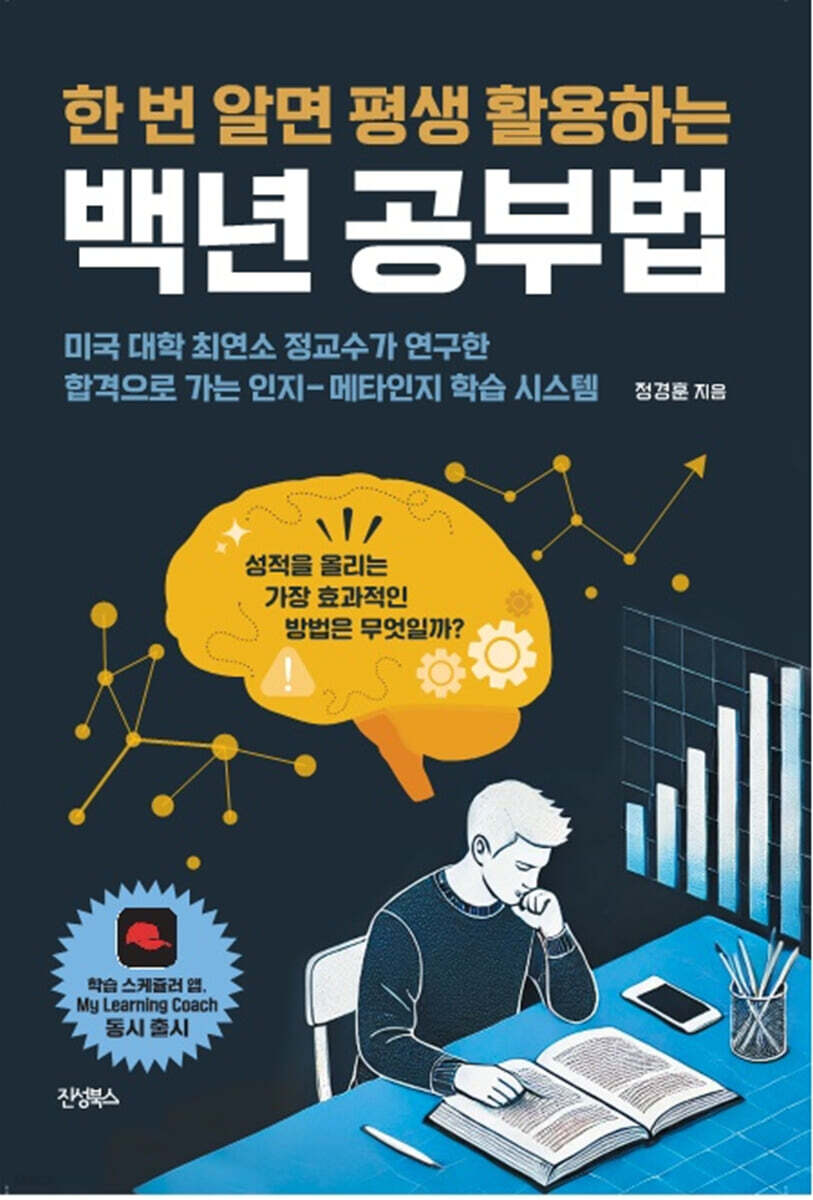
"The Hundred Year Study Method" is a book in which the author, a cognitive psychologist, presents complex academic concepts on "efficient study methods" in practical language that anyone can understand, based on fun experiments and 100 years of accumulated cognitive and brain science research. It is an innovative guide that goes beyond a simple textbook and changes the paradigm of knowledge acquisition throughout life.
This book has three attractive features for fostering creative and logical thinking skills.
First, 『The Hundred Year Study Method』 explains the principles of learning discovered by cognitive psychology in a way that anyone can easily understand and apply.
It is designed to be accessible to students, parents, and teachers alike by decomposing complex scientific concepts into simple logic.
Therefore, anyone can study effectively by understanding the essence of learning presented in 『The Hundred Year Study Method』 and applying it systematically.
Second, the learning strategies presented in 『The Hundred Year Study Method』 can be used throughout one's life (for 100 years).
"The Hundred Year Study Method" organizes key concepts concisely and systematically so that readers can see learning effects in a short period of time.
This learning method allows students, college students, and working professionals to grasp and master the core of a problem in a short period of time.
Third, 『The Hundred Year Study Method』 contains proven methods that the author personally used to guide students and achieve substantial academic improvement.
The theories presented in "The Hundred Year Study Method" are not simply theories derived from a laboratory; they are based on learning methods proven effective in actual educational settings.
In fact, many students across various grades have experienced improved grades and regained confidence in learning in a short period of time after applying the study methods presented in the book.
In this way, 『The Hundred Year Study Method』 is the most scientific study book available today, which teachers, whom the author cites as a "master of memory" and a model of learning methods, can read first and then give as a gift to their students.
Professor Jeong Gyeong-hun, author of "The Hundred Year Study Method," has released the "Hundred Year Study Method" app to make it easier to practice the cognitive-metacognitive learning system introduced in the book.
This app helps you systematically apply the learning principles introduced in the book to your daily life, and provides a comprehensive learning management system, from study plan creation to review reminders and memory reinforcement training.
You can search for 'My Learning Coach' and download it from the App Store and Google Play.
'What is the difference between a teaching expert and a learner?'
The answer lies in our brain's learning process!
"The Hundred Year Study Method" is a book in which the author, a cognitive psychologist, presents complex academic concepts on "efficient study methods" in practical language that anyone can understand, based on fun experiments and 100 years of accumulated cognitive and brain science research. It is an innovative guide that goes beyond a simple textbook and changes the paradigm of knowledge acquisition throughout life.
This book has three attractive features for fostering creative and logical thinking skills.
First, 『The Hundred Year Study Method』 explains the principles of learning discovered by cognitive psychology in a way that anyone can easily understand and apply.
It is designed to be accessible to students, parents, and teachers alike by decomposing complex scientific concepts into simple logic.
Therefore, anyone can study effectively by understanding the essence of learning presented in 『The Hundred Year Study Method』 and applying it systematically.
Second, the learning strategies presented in 『The Hundred Year Study Method』 can be used throughout one's life (for 100 years).
"The Hundred Year Study Method" organizes key concepts concisely and systematically so that readers can see learning effects in a short period of time.
This learning method allows students, college students, and working professionals to grasp and master the core of a problem in a short period of time.
Third, 『The Hundred Year Study Method』 contains proven methods that the author personally used to guide students and achieve substantial academic improvement.
The theories presented in "The Hundred Year Study Method" are not simply theories derived from a laboratory; they are based on learning methods proven effective in actual educational settings.
In fact, many students across various grades have experienced improved grades and regained confidence in learning in a short period of time after applying the study methods presented in the book.
In this way, 『The Hundred Year Study Method』 is the most scientific study book available today, which teachers, whom the author cites as a "master of memory" and a model of learning methods, can read first and then give as a gift to their students.
Professor Jeong Gyeong-hun, author of "The Hundred Year Study Method," has released the "Hundred Year Study Method" app to make it easier to practice the cognitive-metacognitive learning system introduced in the book.
This app helps you systematically apply the learning principles introduced in the book to your daily life, and provides a comprehensive learning management system, from study plan creation to review reminders and memory reinforcement training.
You can search for 'My Learning Coach' and download it from the App Store and Google Play.
- You can preview some of the book's contents.
Preview
index
introduction
Chapter 1: For those who only want to read the first part to judge the book's value
Chapter 2 Cognitive-Metacognitive Learning Systems
Chapter 3: Faith: The Right Attitude and Mindset toward Learning
Chapter 4: Understanding: Methods for Effective Knowledge Acquisition and Understanding
Chapter 5: Action - Execution: Systematic application and practice of learned knowledge.
Chapter 6: Evidence - Enlightenment: The Process of Completing True Learning and Growing into a Self-Directed Learner
In closing the book
concordance
Chapter 1: For those who only want to read the first part to judge the book's value
Chapter 2 Cognitive-Metacognitive Learning Systems
Chapter 3: Faith: The Right Attitude and Mindset toward Learning
Chapter 4: Understanding: Methods for Effective Knowledge Acquisition and Understanding
Chapter 5: Action - Execution: Systematic application and practice of learned knowledge.
Chapter 6: Evidence - Enlightenment: The Process of Completing True Learning and Growing into a Self-Directed Learner
In closing the book
concordance
Detailed image

Into the book
The most common method we use to move information from short-term memory to long-term memory is simple repetition.
For example, if you simply repeat a phone number, the information will eventually be transferred from short-term memory to long-term memory.
However, as we often experience, information transferred to long-term memory through simple repetition quickly becomes difficult to recall.
--- p.15
The reason you were able to understand the content so far, and even sympathize with some of it, to a greater or lesser extent, is because you had the appropriate background knowledge to accept it.
--- p.34
Human mental functions are broadly divided into two categories.
In everyday terms, we can divide it into thoughts and mind.
Thought refers to the process or result of processing information.
When we say “I’m thinking,” we mean that we have an object of thought and are making a decision or judgment about it.
Or if you say, “I remembered something,” it means that a solution or a memory from the past came to mind.
--- p.51
Moreover, the high memory effect brought about by retrieval was maintained even 8 months after learning.
Therefore, students who have to take a distant test like the CSAT should use the retrieval training study method, which involves regular retrieval training, rather than the reading study method, which involves repeatedly reading a book.
--- p.86
Experimental results showed that when this category information was not provided, people remembered less than about 40% of all words, but when the category information was provided, they were able to recall about 35% more words.
It was as if I had gone through each category of memory bins in my long-term memory and pulled out the words that remained.
--- p.122
But why did Ebbinghaus leave out these three elements of effective learning? In fact, Ebbinghaus wanted to study the human mental process of forgetting, free from the interference of other distracting factors.
That is, he intentionally excluded elements that could interfere with his forgetting.
--- p.173
What the above experiment suggests is the importance of a perspective that encompasses the entire learning content.
Sometimes, while listening to the teacher's class, I think, 'What on earth is he talking about?' or 'I don't understand a single thing he's saying.'
Just like when I first read the above text.
But perhaps what we needed at this time was just one picture, or one theme ('Serenade under the building').
--- p.201
This book is for students like me in the past.
The content in this book is not only a learning system that I have personally taught and come to trust as a practicing cognitive psychologist, but is also based on experiments conducted by numerous cognitive scientists.
So, please believe in this learning system, reflect on its principles, and practice it consistently.
Surely, you will be able to gain insight into your studies and enjoy the joy of improving your grades.
For example, if you simply repeat a phone number, the information will eventually be transferred from short-term memory to long-term memory.
However, as we often experience, information transferred to long-term memory through simple repetition quickly becomes difficult to recall.
--- p.15
The reason you were able to understand the content so far, and even sympathize with some of it, to a greater or lesser extent, is because you had the appropriate background knowledge to accept it.
--- p.34
Human mental functions are broadly divided into two categories.
In everyday terms, we can divide it into thoughts and mind.
Thought refers to the process or result of processing information.
When we say “I’m thinking,” we mean that we have an object of thought and are making a decision or judgment about it.
Or if you say, “I remembered something,” it means that a solution or a memory from the past came to mind.
--- p.51
Moreover, the high memory effect brought about by retrieval was maintained even 8 months after learning.
Therefore, students who have to take a distant test like the CSAT should use the retrieval training study method, which involves regular retrieval training, rather than the reading study method, which involves repeatedly reading a book.
--- p.86
Experimental results showed that when this category information was not provided, people remembered less than about 40% of all words, but when the category information was provided, they were able to recall about 35% more words.
It was as if I had gone through each category of memory bins in my long-term memory and pulled out the words that remained.
--- p.122
But why did Ebbinghaus leave out these three elements of effective learning? In fact, Ebbinghaus wanted to study the human mental process of forgetting, free from the interference of other distracting factors.
That is, he intentionally excluded elements that could interfere with his forgetting.
--- p.173
What the above experiment suggests is the importance of a perspective that encompasses the entire learning content.
Sometimes, while listening to the teacher's class, I think, 'What on earth is he talking about?' or 'I don't understand a single thing he's saying.'
Just like when I first read the above text.
But perhaps what we needed at this time was just one picture, or one theme ('Serenade under the building').
--- p.201
This book is for students like me in the past.
The content in this book is not only a learning system that I have personally taught and come to trust as a practicing cognitive psychologist, but is also based on experiments conducted by numerous cognitive scientists.
So, please believe in this learning system, reflect on its principles, and practice it consistently.
Surely, you will be able to gain insight into your studies and enjoy the joy of improving your grades.
--- p.291
Publisher's Review
"Is simple repetition and memorization really the best way to study?" - We must first understand the nature of learning.
In a German city in the 1880s, a man sits at his desk muttering something.
The man's name is Hermann Ebbinghaus, and he was one of the first cognitive psychologists and the first researcher to systematically study human memory through the 'Ebbinghaus forgetting curve'.
Through this experiment, Ebbinghaus discovered that when learning meaningless information by simply repeating it, 40% of what was remembered would be lost after just 20 minutes, 50% after an hour, and only 30% after a day.
Learning is the process of transferring information from short-term memory to long-term memory.
Information stored in long-term memory can be retained for a very long time, so every student wants to store a lot of information in this long-term memory.
However, most of the information that has just been transferred to long-term memory is easily scattered and lost, requiring special cognitive processing.
From short-term memory to long-term memory: a scientifically proven cognitive-metacognitive learning method.
Our memory is significantly impaired when similar information interferes with each other and new information lacks distinguishing features from existing knowledge.
For this reason, we need meaningful and effective learning methods that go beyond simple repetition and memorization.
The 'cognitive-metacognitive learning method' proposed by the author is an innovative approach to solving this problem.
Professor Jeong Gyeong-hun, a cognitive psychologist, has personally applied the 'cognitive-metacognitive learning method' he developed in various educational settings, from elementary schools to middle and high schools and universities.
As a result, students who studied this way showed significantly improved academic achievement compared to students who used simple repetition memorization techniques for the same amount of time.
This shows that the effectiveness of the 'cognitive-metacognitive learning method' has been clearly proven through scientific analysis and actual experiments.
The right study method creates an expert! "Shinhaehaengjeung" (信解行證): Believe, understand, act, and become enlightened!
In "The Hundred Year Study Method," the author introduces cognitive-metacognitive learning methods through four chapters based on the New Testament.
In 'God's Chapter', we tried to instill confidence in the learning method in readers through data obtained by actually applying the cognitive-metacognitive learning system to classes.
In the chapter 'The Sea', numerous research cases in cognitive psychology related to memory and learning are organized and introduced.
In the 'Chapter of the Year', we introduce a series of learning methods that summarize the numerous research results introduced in the previous chapters.
And in the final chapter, 'Chapter of Evidence,' we have provided a space for readers who have actually implemented this cognitive-metacognitive learning system to organize their own feelings and prepare for the next exam.
Numerous textbooks introduce various learning methods and boast about their effectiveness.
However, no matter how excellent or correct a learning method is, it can only change when we truly trust, understand, and act on it.
I sincerely hope that through this book, readers will believe in themselves, truly change, and achieve success.
In a German city in the 1880s, a man sits at his desk muttering something.
The man's name is Hermann Ebbinghaus, and he was one of the first cognitive psychologists and the first researcher to systematically study human memory through the 'Ebbinghaus forgetting curve'.
Through this experiment, Ebbinghaus discovered that when learning meaningless information by simply repeating it, 40% of what was remembered would be lost after just 20 minutes, 50% after an hour, and only 30% after a day.
Learning is the process of transferring information from short-term memory to long-term memory.
Information stored in long-term memory can be retained for a very long time, so every student wants to store a lot of information in this long-term memory.
However, most of the information that has just been transferred to long-term memory is easily scattered and lost, requiring special cognitive processing.
From short-term memory to long-term memory: a scientifically proven cognitive-metacognitive learning method.
Our memory is significantly impaired when similar information interferes with each other and new information lacks distinguishing features from existing knowledge.
For this reason, we need meaningful and effective learning methods that go beyond simple repetition and memorization.
The 'cognitive-metacognitive learning method' proposed by the author is an innovative approach to solving this problem.
Professor Jeong Gyeong-hun, a cognitive psychologist, has personally applied the 'cognitive-metacognitive learning method' he developed in various educational settings, from elementary schools to middle and high schools and universities.
As a result, students who studied this way showed significantly improved academic achievement compared to students who used simple repetition memorization techniques for the same amount of time.
This shows that the effectiveness of the 'cognitive-metacognitive learning method' has been clearly proven through scientific analysis and actual experiments.
The right study method creates an expert! "Shinhaehaengjeung" (信解行證): Believe, understand, act, and become enlightened!
In "The Hundred Year Study Method," the author introduces cognitive-metacognitive learning methods through four chapters based on the New Testament.
In 'God's Chapter', we tried to instill confidence in the learning method in readers through data obtained by actually applying the cognitive-metacognitive learning system to classes.
In the chapter 'The Sea', numerous research cases in cognitive psychology related to memory and learning are organized and introduced.
In the 'Chapter of the Year', we introduce a series of learning methods that summarize the numerous research results introduced in the previous chapters.
And in the final chapter, 'Chapter of Evidence,' we have provided a space for readers who have actually implemented this cognitive-metacognitive learning system to organize their own feelings and prepare for the next exam.
Numerous textbooks introduce various learning methods and boast about their effectiveness.
However, no matter how excellent or correct a learning method is, it can only change when we truly trust, understand, and act on it.
I sincerely hope that through this book, readers will believe in themselves, truly change, and achieve success.
GOODS SPECIFICS
- Date of issue: April 17, 2025
- Page count, weight, size: 312 pages | 574g | 152*225*20mm
- ISBN13: 9788997743698
- ISBN10: 8997743694
You may also like
카테고리
korean


korean

![GQ KOREA Mark (Monthly): December [2025]](http://librairie.coreenne.fr/cdn/shop/files/8ef265dbbfbf186523ed75ba7319009d.jpg?v=1765340328&width=3840)


