

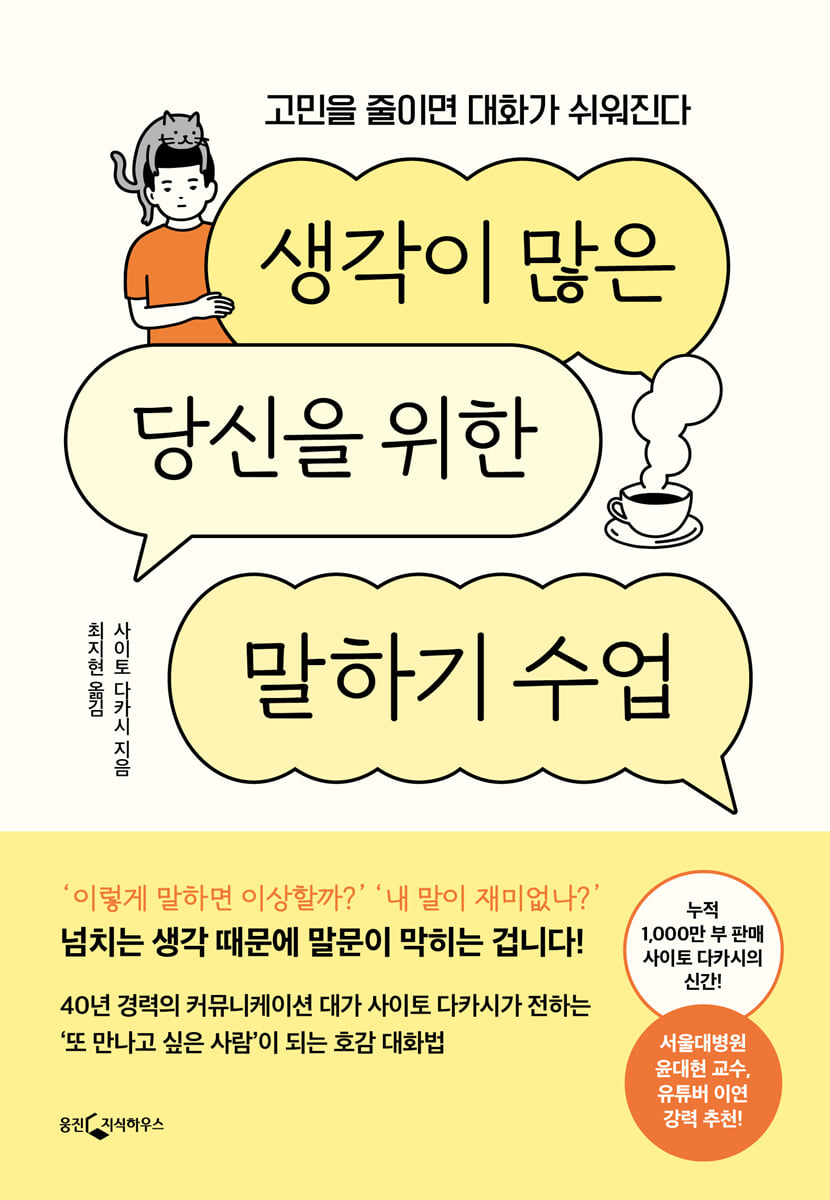
Speaking classes for those who think a lot
 |
Description
Book Introduction
★ Takashi Saito's new book, which has sold over 10 million copies!
★ Professor Daehyun Yoon of Seoul National University Hospital strongly recommends Lee Yeon, a YouTuber with 960,000 followers!
'Would it be weird to say this?' 'Are you not finding what I'm saying interesting?'
I'm speechless because my thoughts are overflowing!
Takashi Saito, a communications expert with 40 years of experience, shares his thoughts.
How to Have a Favorable Conversation That Makes You Want to See Someone Again
Takashi Saito, Japan's leading communication expert and bestselling author who has given communication lectures to tens of thousands of people for over 40 years, has published a new book, "Speaking Classes for Those Who Think a Lot."
Through extensive research, he points out that the common trait among people who have difficulty speaking is that they 'think a lot.'
They explain that they become speechless because they are concerned about what others might think, such as, "Can I say this?" or "Will they think this is weird?"
The author aims to impart communication skills that can be used in real-life conversations to those who think a lot.
This book provides concrete examples of everything from how to start a conversation in awkward situations to versatile conversational topics you can use anywhere, to how to make a good impression on others and develop relationships.
When having a conversation, you feel more comfortable when you have someone who listens well and reacts at the right time, rather than someone who just talks about themselves without hesitation.
The author defines these people as 'good speakers' who create a positive atmosphere.
You will discover a conversation technique that will help anyone easily win the other person's heart without having to liven up the mood with an interesting story or speak as fluently as an announcer.
★ Professor Daehyun Yoon of Seoul National University Hospital strongly recommends Lee Yeon, a YouTuber with 960,000 followers!
'Would it be weird to say this?' 'Are you not finding what I'm saying interesting?'
I'm speechless because my thoughts are overflowing!
Takashi Saito, a communications expert with 40 years of experience, shares his thoughts.
How to Have a Favorable Conversation That Makes You Want to See Someone Again
Takashi Saito, Japan's leading communication expert and bestselling author who has given communication lectures to tens of thousands of people for over 40 years, has published a new book, "Speaking Classes for Those Who Think a Lot."
Through extensive research, he points out that the common trait among people who have difficulty speaking is that they 'think a lot.'
They explain that they become speechless because they are concerned about what others might think, such as, "Can I say this?" or "Will they think this is weird?"
The author aims to impart communication skills that can be used in real-life conversations to those who think a lot.
This book provides concrete examples of everything from how to start a conversation in awkward situations to versatile conversational topics you can use anywhere, to how to make a good impression on others and develop relationships.
When having a conversation, you feel more comfortable when you have someone who listens well and reacts at the right time, rather than someone who just talks about themselves without hesitation.
The author defines these people as 'good speakers' who create a positive atmosphere.
You will discover a conversation technique that will help anyone easily win the other person's heart without having to liven up the mood with an interesting story or speak as fluently as an announcer.
- You can preview some of the book's contents.
Preview
index
Recommendation
To you who is speechless because of your overflowing thoughts at the beginning
Chapter 1: Not being able to speak is an illusion.
I have a conversation style that suits me.
If you only care about 'how it looks'
A person who cares for others more than himself
The Three Key Elements of Communication That Will Gain Your Opposite Party's Likeability
Conversation is like an instrument that must be learned and practiced.
Chapter 2: Conversational Skills for Those Who Think Too Much
The foundation of conversation is a 'prepared attitude'.
What should I say to “What did you do on your holiday?”
The word 'I don't know' is sometimes violent.
Finding common ground with the other person rather than talking about yourself
Psychological reasons for being speechless
The never-ending "I remembered" idiom
'10-Second Chat' and 'Casual Praise'
How to overcome age differences in conversation
Sometimes it's important to break it off properly
Chapter 3: I Want to Become Someone You Want to Talk to Again
The conversation is led by the 'listener'
Reaction skills that determine the quality of conversation
Good questions inspire the desire to speak.
You are a 'professional presenter'
Chapter 4: Good Relationships Begin with Comfortable Conversation
The Importance of Mid-Distance Relationships
The story should be at most 1 minute long, and there should be 3 interesting things.
Change the speed depending on the opponent
How to Take the Next Step in Your Relationship
A person who naturally creates the next opportunity
Chapter 5: How to Open Your Mind Easily Anytime, Anywhere
Meetings are a valuable opportunity to expand relationships.
How to talk to strangers
A way of speaking that leaves a good impression
How to Have Idea-Generating Business Conversations
In conclusion, if there is just one person with whom you can communicate
Appendix Communication Skills for Those Who Think a Lot
To you who is speechless because of your overflowing thoughts at the beginning
Chapter 1: Not being able to speak is an illusion.
I have a conversation style that suits me.
If you only care about 'how it looks'
A person who cares for others more than himself
The Three Key Elements of Communication That Will Gain Your Opposite Party's Likeability
Conversation is like an instrument that must be learned and practiced.
Chapter 2: Conversational Skills for Those Who Think Too Much
The foundation of conversation is a 'prepared attitude'.
What should I say to “What did you do on your holiday?”
The word 'I don't know' is sometimes violent.
Finding common ground with the other person rather than talking about yourself
Psychological reasons for being speechless
The never-ending "I remembered" idiom
'10-Second Chat' and 'Casual Praise'
How to overcome age differences in conversation
Sometimes it's important to break it off properly
Chapter 3: I Want to Become Someone You Want to Talk to Again
The conversation is led by the 'listener'
Reaction skills that determine the quality of conversation
Good questions inspire the desire to speak.
You are a 'professional presenter'
Chapter 4: Good Relationships Begin with Comfortable Conversation
The Importance of Mid-Distance Relationships
The story should be at most 1 minute long, and there should be 3 interesting things.
Change the speed depending on the opponent
How to Take the Next Step in Your Relationship
A person who naturally creates the next opportunity
Chapter 5: How to Open Your Mind Easily Anytime, Anywhere
Meetings are a valuable opportunity to expand relationships.
How to talk to strangers
A way of speaking that leaves a good impression
How to Have Idea-Generating Business Conversations
In conclusion, if there is just one person with whom you can communicate
Appendix Communication Skills for Those Who Think a Lot
Detailed image

Into the book
It's not your personality that makes you speechless, it's your overthinking.
It becomes easier to have a conversation if you reduce the number of thoughts that are overflowing in your head.
Even if you think, 'I wonder if they'll think it's weird if I say this,' or 'I guess I only said boring things,' the other person probably won't care much.
You may feel frustrated because you can't keep the conversation flowing smoothly due to such worries, saying, "I couldn't join in the conversation," or "I couldn't say much about myself." However, the other person may be grateful to you for brightening the mood and listening attentively to their story.
So there is absolutely no need to lose confidence due to baseless illusions.
--- From "Starting - To You Who Are Speechless Because of Overflowing Thoughts"
It's exhausting to worry about things like, 'Will they hate me if I say this?' or 'Will they laugh at me and say I'm stupid if I make this suggestion or ask this question?'
However, this can be said to be the same as 'talking while looking at myself across from the other person'.
Because I am only concerned about how others perceive me, my consciousness is directed towards myself rather than the other person.
If the other person feels the same way, they will not be talking to each other, but will only try to see 'the me that the other person is seeing'.
This way, communication will not be possible and you will only waste unnecessary energy.
--- From "Chapter 1 - Not being able to speak is an illusion"
It's common to be asked, "What do you usually do on holidays?"
(…) If you try to seriously answer this question by saying, ‘What do I usually do?’, you may not be able to think of anything right away or you may not be doing anything that would interest the other person, so you may have to think about it for a while.
In this case, the correct answer is 'say what you want to say'.
It's a good idea to talk about a hobby you're into now or something you were doing at the time, like, "I've been thinking about traveling abroad, so I've been looking into places to go."
The other person doesn't want to know about your holiday, they're just looking for a conversation starter to have a good time with you.
So, just give me a clue.
--- From "Chapter 2 - Conversation Methods for Those Who Think Too Much"
Remember that the principle of self-introduction is not 'talking about my history' but 'throwing out a story that can find common ground with the other person.'
For example, you can introduce yourself like this:
“I am currently working at this company and doing this kind of work.”
“I am a graduate of ○○ school and I am studying this.”
Although it's okay, let's introduce our resume at least and add a story that might interest the other person.
“I love ramen, so I’ve been to all the best ramen restaurants.
“If you want to eat delicious ramen, just tell me.”
“I recently started raising a cat.
“Thanks to that, I feel healed when I go home.”
When people find common ground in what they like and are interested in, that alone can liven up the conversation.
--- From "Chapter 2 - Conversation Methods for Those Who Think Too Much"
A great presenter has a sensor that reads 'what that person wants to talk about.'
The essence of a good question is to figure out, 'This is what that person wants to talk about,' or 'This is the essential story.'
(…) For example, let’s say a player who had been sitting on the bench all along is brought in at a crucial moment and leads the team to a comeback win.
If you ask, "You must have felt regretful for several years, how are you feeling today?", the player will answer by recalling difficult memories, and if it is a drama like that of a player, the fans will want to hear it too.
The ideal question is one that asks the other person something they would want to talk about.
--- From "Chapter 3 - I Want to Become Someone People Want to Talk to Again"
Surprisingly, it is not the speaker but the listener who drives communication.
A good speaker dominates the conversation, but never dominates the room.
In fact, it is the 'listener' who leads the atmosphere of the place by listening to the story and reacting appropriately so that it is easy to speak.
Who was the person you thought you 'wanted to meet again'?
Let's think about it based on each of our experiences.
Did that person smile at your story, respond positively, or even clap their hands and laugh cheerfully? Yes.
The reason I was able to talk comfortably was because the other person listened to my story as if it was interesting.
--- From "Chapter 3 - I Want to Become Someone People Want to Talk to Again"
There are people who have a pleasant conversation and a good time when they first meet, but then feel awkward the second time they meet.
But there's no need to worry.
Because you just need to review 'what we talked about last time'.
A Thank you for last time.
B Oh, it was fun back then.
A By the way, how is the dog you mentioned last time?
B Yes, he's still a prankster.
How have things been since then?
A I see.
Actually these days… .
If you can't think of anything to talk about, you can just ask directly, "What did we talk about last time?"
As the two of you reminisce together, you can relive the time you shared last time.
Even if you forget, say “I’m sorry.
You can just laugh it off by saying, “I guess it’s because I’m getting older, but my memory is…”
In addition to what we talked about last time, it would be better if you could talk about your recent situation for about 15 seconds.
--- From “Chapter 4 - Good Relationships Begin with Comfortable Conversation”
If you think, "If I just become close with one person, I'll achieve my goal," like I do, you can attend large parties without being discouraged.
Even if you become close with one person at a time, if you go to five gatherings, you will have five close friends.
Thinking this way motivates me and keeps me from getting nervous.
When you don't know anyone, just talk to someone who is similar to you.
If you know the participants in advance, why not try talking to someone you recognize by face but have never spoken to before, or someone you follow on social media but have never actually spoken to in person?
It becomes easier to have a conversation if you reduce the number of thoughts that are overflowing in your head.
Even if you think, 'I wonder if they'll think it's weird if I say this,' or 'I guess I only said boring things,' the other person probably won't care much.
You may feel frustrated because you can't keep the conversation flowing smoothly due to such worries, saying, "I couldn't join in the conversation," or "I couldn't say much about myself." However, the other person may be grateful to you for brightening the mood and listening attentively to their story.
So there is absolutely no need to lose confidence due to baseless illusions.
--- From "Starting - To You Who Are Speechless Because of Overflowing Thoughts"
It's exhausting to worry about things like, 'Will they hate me if I say this?' or 'Will they laugh at me and say I'm stupid if I make this suggestion or ask this question?'
However, this can be said to be the same as 'talking while looking at myself across from the other person'.
Because I am only concerned about how others perceive me, my consciousness is directed towards myself rather than the other person.
If the other person feels the same way, they will not be talking to each other, but will only try to see 'the me that the other person is seeing'.
This way, communication will not be possible and you will only waste unnecessary energy.
--- From "Chapter 1 - Not being able to speak is an illusion"
It's common to be asked, "What do you usually do on holidays?"
(…) If you try to seriously answer this question by saying, ‘What do I usually do?’, you may not be able to think of anything right away or you may not be doing anything that would interest the other person, so you may have to think about it for a while.
In this case, the correct answer is 'say what you want to say'.
It's a good idea to talk about a hobby you're into now or something you were doing at the time, like, "I've been thinking about traveling abroad, so I've been looking into places to go."
The other person doesn't want to know about your holiday, they're just looking for a conversation starter to have a good time with you.
So, just give me a clue.
--- From "Chapter 2 - Conversation Methods for Those Who Think Too Much"
Remember that the principle of self-introduction is not 'talking about my history' but 'throwing out a story that can find common ground with the other person.'
For example, you can introduce yourself like this:
“I am currently working at this company and doing this kind of work.”
“I am a graduate of ○○ school and I am studying this.”
Although it's okay, let's introduce our resume at least and add a story that might interest the other person.
“I love ramen, so I’ve been to all the best ramen restaurants.
“If you want to eat delicious ramen, just tell me.”
“I recently started raising a cat.
“Thanks to that, I feel healed when I go home.”
When people find common ground in what they like and are interested in, that alone can liven up the conversation.
--- From "Chapter 2 - Conversation Methods for Those Who Think Too Much"
A great presenter has a sensor that reads 'what that person wants to talk about.'
The essence of a good question is to figure out, 'This is what that person wants to talk about,' or 'This is the essential story.'
(…) For example, let’s say a player who had been sitting on the bench all along is brought in at a crucial moment and leads the team to a comeback win.
If you ask, "You must have felt regretful for several years, how are you feeling today?", the player will answer by recalling difficult memories, and if it is a drama like that of a player, the fans will want to hear it too.
The ideal question is one that asks the other person something they would want to talk about.
--- From "Chapter 3 - I Want to Become Someone People Want to Talk to Again"
Surprisingly, it is not the speaker but the listener who drives communication.
A good speaker dominates the conversation, but never dominates the room.
In fact, it is the 'listener' who leads the atmosphere of the place by listening to the story and reacting appropriately so that it is easy to speak.
Who was the person you thought you 'wanted to meet again'?
Let's think about it based on each of our experiences.
Did that person smile at your story, respond positively, or even clap their hands and laugh cheerfully? Yes.
The reason I was able to talk comfortably was because the other person listened to my story as if it was interesting.
--- From "Chapter 3 - I Want to Become Someone People Want to Talk to Again"
There are people who have a pleasant conversation and a good time when they first meet, but then feel awkward the second time they meet.
But there's no need to worry.
Because you just need to review 'what we talked about last time'.
A Thank you for last time.
B Oh, it was fun back then.
A By the way, how is the dog you mentioned last time?
B Yes, he's still a prankster.
How have things been since then?
A I see.
Actually these days… .
If you can't think of anything to talk about, you can just ask directly, "What did we talk about last time?"
As the two of you reminisce together, you can relive the time you shared last time.
Even if you forget, say “I’m sorry.
You can just laugh it off by saying, “I guess it’s because I’m getting older, but my memory is…”
In addition to what we talked about last time, it would be better if you could talk about your recent situation for about 15 seconds.
--- From “Chapter 4 - Good Relationships Begin with Comfortable Conversation”
If you think, "If I just become close with one person, I'll achieve my goal," like I do, you can attend large parties without being discouraged.
Even if you become close with one person at a time, if you go to five gatherings, you will have five close friends.
Thinking this way motivates me and keeps me from getting nervous.
When you don't know anyone, just talk to someone who is similar to you.
If you know the participants in advance, why not try talking to someone you recognize by face but have never spoken to before, or someone you follow on social media but have never actually spoken to in person?
--- From "Chapter 5 - How to Open Your Mouth Easily Anytime, Anywhere"
Publisher's Review
■ “Conversation becomes easier if you just let go of the thought, ‘I’m not good at speaking!’”
How to Become a "Good Speaker": A Guide to Thinking Through the Expertise of a 40-Year-Old Communication Expert
Recently, the phenomenon of 'call phobia', the fear of answering the phone, has been increasing.
According to a 2023 job search site survey, 35.6% of Generation MZ suffer from call phobia.
The main cause is fear of being unprepared for a situation and worry about making a slip of the tongue.
Since most people prefer text communication, such as messengers or emails, the level of tension increases even more when meeting in person and talking.
How can I reduce the psychological burden and have a natural conversation?
"Speaking Classes for Those Who Think a Lot," a compilation of popular communication lectures by Takashi Saito, a Japanese communication expert and professor of literature at Meiji University, is a book that offers a clear solution to this problem.
The author emphasizes that in order to speak well, one must first change one's perception, and emphasizes three mindsets.
First, you must get rid of the stereotype that you are 'unable to speak'.
In reality, it is not that they cannot speak, but rather that they do not know ‘how to converse’.
Since conversation is a skill, it is natural that it is difficult without practice and training.
We need to regain our confidence by thinking, 'I can do it if I learn and get used to it.'
Second, when talking, you and the other person must have a common topic of conversation.
If you don't bring up topics that you can share common opinions on, like the latest drama or movie, you'll end up revealing your personality or private area.
In this case, the moment the other person says 'but' or 'however', it feels like they are denying 'me', so it is easy to get hurt.
Third, conversation is about ‘finding a point of contact’ with the other person.
Rather than saying what I want to say, it is more appropriate to bring up topics that can lead to a conversation.
When asking questions, let's activate the sensor that reads 'what the other person wants to talk about'.
Finding ways to keep the conversation flowing naturally without being interrupted is also the core of this book.
■ “It’s not that I can’t speak, it’s that I don’t know how to speak!”
Small talk, the "I thought of that" technique, finding common ground... communication skills that make conversation easier.
“I thought I was bad at speaking, but surprisingly, I wasn’t.” This is the most common comment from students in the author’s communication classes.
What the author realized after lecturing on the topic of 'speaking' for over 40 years was that 'not being able to speak has little to do with personality or temperament.'
I have seen countless instances where even the most introverted person can speak fluently anytime, anywhere, once they learn how to open their mouths.
This book emphasizes that conversation is something to be learned and practiced like an instrument, and it provides a variety of communication skills that can be used in real-life conversations, such as small talk topics, the "I thought of you" technique that keeps conversations going, and tips for talking about recent events.
01 [Recent Talk Know-How] "I couldn't go this weekend, but I'm really into camping these days."
→ When asked about recent events, instead of saying “Nothing much is going on,” answer with something that will be a topic of conversation.
02 ['I remembered' speech] “I remembered it while I was on YouTube. Have you seen that channel?”
→ If you change the direction of the conversation little by little, the story will continue without interruption.
03 [Not denying] “I didn’t know, but that sounds fun.”
→ Be considerate of the other person by adding positive expressions to things you don't know.
04 [Small Talk Material] “This store has changed.
“What store was it before?”
→ When you have no topic for conversation, use the objects in front of you.
05 [Finding a connection] “I like tteokbokki.
If you know of a good tteokbokki restaurant nearby, please let me know.”
→ Conversation begins with ‘finding common ground’ with the other person.
■ “A person who is good at talking is someone you want to meet again”
A conversation is dominated by a good listener, not a talker.
What does it mean to be a good communicator? We often think of someone who actively leads conversations or speaks without hesitation.
However, in today's world where caution and consideration are emphasized in relationships with others, a person who creates an atmosphere where "everyone can talk comfortably" can be defined as a person who is good at speaking.
Rather than speaking out, a 'listener' who listens carefully to others and shows appropriate reactions is the one who truly leads the conversation.
“A person who creates a safe environment where the other person can feel comfortable talking, rather than speaking in a strong tone, leaves a good impression” (p. 12). Many people express regret after a conversation, saying, “I wasn’t able to join in the conversation,” or “I wasn’t able to tell an interesting story.”
But the other person may actually be grateful to you for livening up the atmosphere and listening attentively to their story.
Being good at speaking doesn't require any great ability or expertise.
Remember that listening and being considerate are the best ways to communicate well with others.
■ “Raise the temperature of your relationship with comfortable conversation.”
Meeting in person rather than social media, naturally creating "next opportunities," and the power of "10-second small talk."
Some people prefer to communicate through social media or avoid meeting people altogether because they find conversations with others tiring.
But meeting someone in person and having a conversation is a valuable experience that allows you to experience a new world you never knew existed.
The author emphasizes the positive influence we receive through 'people' and urges us to take a step further rather than avoid relationships.
Complimenting a colleague you might otherwise overlook by saying, “I liked what you said in the meeting earlier,” or talking about the weather by saying, “It’s really cold today,” is the secret to strengthening relationships.
Another trick is to naturally create opportunities for further communication by saying, "I like this video, don't you think? I'll send it to you via messenger."
“In the end, conversation is not about the fluency of words, but about the warmth between people.
As YouTube creator Lee Yeon recommends, “After reading this book, I look forward to the conversations we will have in the future,” I hope that through this book, you will learn how to converse comfortably and find your own way to maintain warm relationships with others.
How to Become a "Good Speaker": A Guide to Thinking Through the Expertise of a 40-Year-Old Communication Expert
Recently, the phenomenon of 'call phobia', the fear of answering the phone, has been increasing.
According to a 2023 job search site survey, 35.6% of Generation MZ suffer from call phobia.
The main cause is fear of being unprepared for a situation and worry about making a slip of the tongue.
Since most people prefer text communication, such as messengers or emails, the level of tension increases even more when meeting in person and talking.
How can I reduce the psychological burden and have a natural conversation?
"Speaking Classes for Those Who Think a Lot," a compilation of popular communication lectures by Takashi Saito, a Japanese communication expert and professor of literature at Meiji University, is a book that offers a clear solution to this problem.
The author emphasizes that in order to speak well, one must first change one's perception, and emphasizes three mindsets.
First, you must get rid of the stereotype that you are 'unable to speak'.
In reality, it is not that they cannot speak, but rather that they do not know ‘how to converse’.
Since conversation is a skill, it is natural that it is difficult without practice and training.
We need to regain our confidence by thinking, 'I can do it if I learn and get used to it.'
Second, when talking, you and the other person must have a common topic of conversation.
If you don't bring up topics that you can share common opinions on, like the latest drama or movie, you'll end up revealing your personality or private area.
In this case, the moment the other person says 'but' or 'however', it feels like they are denying 'me', so it is easy to get hurt.
Third, conversation is about ‘finding a point of contact’ with the other person.
Rather than saying what I want to say, it is more appropriate to bring up topics that can lead to a conversation.
When asking questions, let's activate the sensor that reads 'what the other person wants to talk about'.
Finding ways to keep the conversation flowing naturally without being interrupted is also the core of this book.
■ “It’s not that I can’t speak, it’s that I don’t know how to speak!”
Small talk, the "I thought of that" technique, finding common ground... communication skills that make conversation easier.
“I thought I was bad at speaking, but surprisingly, I wasn’t.” This is the most common comment from students in the author’s communication classes.
What the author realized after lecturing on the topic of 'speaking' for over 40 years was that 'not being able to speak has little to do with personality or temperament.'
I have seen countless instances where even the most introverted person can speak fluently anytime, anywhere, once they learn how to open their mouths.
This book emphasizes that conversation is something to be learned and practiced like an instrument, and it provides a variety of communication skills that can be used in real-life conversations, such as small talk topics, the "I thought of you" technique that keeps conversations going, and tips for talking about recent events.
01 [Recent Talk Know-How] "I couldn't go this weekend, but I'm really into camping these days."
→ When asked about recent events, instead of saying “Nothing much is going on,” answer with something that will be a topic of conversation.
02 ['I remembered' speech] “I remembered it while I was on YouTube. Have you seen that channel?”
→ If you change the direction of the conversation little by little, the story will continue without interruption.
03 [Not denying] “I didn’t know, but that sounds fun.”
→ Be considerate of the other person by adding positive expressions to things you don't know.
04 [Small Talk Material] “This store has changed.
“What store was it before?”
→ When you have no topic for conversation, use the objects in front of you.
05 [Finding a connection] “I like tteokbokki.
If you know of a good tteokbokki restaurant nearby, please let me know.”
→ Conversation begins with ‘finding common ground’ with the other person.
■ “A person who is good at talking is someone you want to meet again”
A conversation is dominated by a good listener, not a talker.
What does it mean to be a good communicator? We often think of someone who actively leads conversations or speaks without hesitation.
However, in today's world where caution and consideration are emphasized in relationships with others, a person who creates an atmosphere where "everyone can talk comfortably" can be defined as a person who is good at speaking.
Rather than speaking out, a 'listener' who listens carefully to others and shows appropriate reactions is the one who truly leads the conversation.
“A person who creates a safe environment where the other person can feel comfortable talking, rather than speaking in a strong tone, leaves a good impression” (p. 12). Many people express regret after a conversation, saying, “I wasn’t able to join in the conversation,” or “I wasn’t able to tell an interesting story.”
But the other person may actually be grateful to you for livening up the atmosphere and listening attentively to their story.
Being good at speaking doesn't require any great ability or expertise.
Remember that listening and being considerate are the best ways to communicate well with others.
■ “Raise the temperature of your relationship with comfortable conversation.”
Meeting in person rather than social media, naturally creating "next opportunities," and the power of "10-second small talk."
Some people prefer to communicate through social media or avoid meeting people altogether because they find conversations with others tiring.
But meeting someone in person and having a conversation is a valuable experience that allows you to experience a new world you never knew existed.
The author emphasizes the positive influence we receive through 'people' and urges us to take a step further rather than avoid relationships.
Complimenting a colleague you might otherwise overlook by saying, “I liked what you said in the meeting earlier,” or talking about the weather by saying, “It’s really cold today,” is the secret to strengthening relationships.
Another trick is to naturally create opportunities for further communication by saying, "I like this video, don't you think? I'll send it to you via messenger."
“In the end, conversation is not about the fluency of words, but about the warmth between people.
As YouTube creator Lee Yeon recommends, “After reading this book, I look forward to the conversations we will have in the future,” I hope that through this book, you will learn how to converse comfortably and find your own way to maintain warm relationships with others.
GOODS SPECIFICS
- Date of issue: March 28, 2025
- Page count, weight, size: 240 pages | 296g | 135*195*15mm
- ISBN13: 9788901293615
- ISBN10: 8901293617
You may also like
카테고리
korean


korean

![GQ KOREA Mark (Monthly): December [2025]](http://librairie.coreenne.fr/cdn/shop/files/8ef265dbbfbf186523ed75ba7319009d.jpg?v=1765340328&width=3840)


