

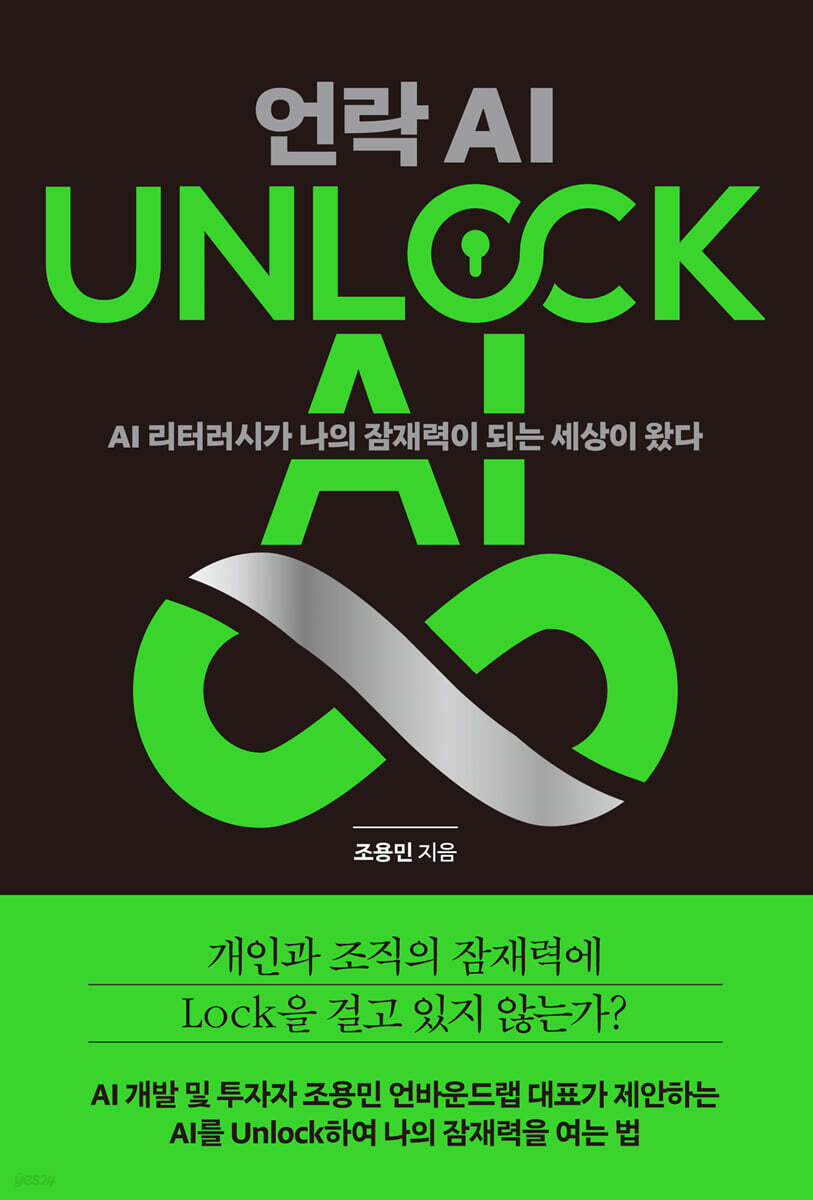
UNLOCK AI
 |
Description
Book Introduction
Former Google Korea Managing Director, AI Developer, and Investor
Proposed by Unbound Lab CEO Yongmin Cho
How to Unlock AI and Unlock Your Potential
New AI technologies are being released every day.
AI, which couldn't even tell the difference between a muffin and a puppy's face, can now joke around with users in real time, recognize their surroundings with the camera attached to their phone, remember them, and even help find lost glasses.
Because AI is an unknown entity whose development speed and limitations are difficult to predict, we cannot help but feel vague anxiety and fear about AI.
However, the wait-and-see attitude of ‘let’s see what kind of results AI produces’ can limit the potential of AI.
On the other hand, if we release the heavy lock of preconceptions and stereotypes that surround AI and embrace its potential and possibilities, more opportunities will unfold before us.
In that sense, author Cho Yong-min emphasizes the attitude of ‘unlocking AI.’
Unlocking AI means unlocking the potential of AI and embracing it as a collaborator. We must redefine AI as an extension of human potential, embracing it not as a "tool to be used," but as a "tool to collaborate with."
The final chapter of this book, titled "Growth is Nonlinear," was written in collaboration with Claude 3.5 Sonnet and Perplexity.
The author, who takes on the role of producer, demonstrates how AI can be used as a collaborative tool.
This book suggests that instead of worrying about "What if AI takes my job?", we should consider "How will I work with AI?" and, through unlocking AI, ask "How far can I expand my potential with AI?"
Proposed by Unbound Lab CEO Yongmin Cho
How to Unlock AI and Unlock Your Potential
New AI technologies are being released every day.
AI, which couldn't even tell the difference between a muffin and a puppy's face, can now joke around with users in real time, recognize their surroundings with the camera attached to their phone, remember them, and even help find lost glasses.
Because AI is an unknown entity whose development speed and limitations are difficult to predict, we cannot help but feel vague anxiety and fear about AI.
However, the wait-and-see attitude of ‘let’s see what kind of results AI produces’ can limit the potential of AI.
On the other hand, if we release the heavy lock of preconceptions and stereotypes that surround AI and embrace its potential and possibilities, more opportunities will unfold before us.
In that sense, author Cho Yong-min emphasizes the attitude of ‘unlocking AI.’
Unlocking AI means unlocking the potential of AI and embracing it as a collaborator. We must redefine AI as an extension of human potential, embracing it not as a "tool to be used," but as a "tool to collaborate with."
The final chapter of this book, titled "Growth is Nonlinear," was written in collaboration with Claude 3.5 Sonnet and Perplexity.
The author, who takes on the role of producer, demonstrates how AI can be used as a collaborative tool.
This book suggests that instead of worrying about "What if AI takes my job?", we should consider "How will I work with AI?" and, through unlocking AI, ask "How far can I expand my potential with AI?"
index
Prologue_Unlock AI: Rediscover Creativity with a Persistent Mindset
PART 1: AI is a tool that expands human potential.
1 The future has already arrived
Humanity has long imagined AI.
What kind of future will AI technology take us to?
If you ask me what I should do right now,
2 Unlock AI to make AI's potential your own
AI with the strength of weak ties
People who don't use AI will be replaced by people who do.
AI: The most powerful double-edged sword we've ever encountered
PART 2 Unlocking Your Mindset to Unleash 200% of Your Abilities
3 Open Minds to Tools: Unlock's First Mindset
Human attitude toward AI
Are you someone who gets excited or anxious about new tools?
Collaborating with AI is now inevitable, no matter what you do.
4. Persistent Problem Awareness: Unlock's Second Mindset
I worry about my problems first
If you have a keen sense of problem, you will eventually reach AI, no matter how many times you wander.
AI experts are now becoming top experts in their respective fields.
5 Redefining Creativity: Unlock's Third Mindset
AI Becomes a Muse for Writers
Columbus in the AI Age: Changing the Concept of Creativity
Creativity is connecting AI's potential with my own.
PART 3: The Plus One Law to Unlock Your Potential
6. Beyond being number one in your field, be a "boundary plus one."
You have to step out of your comfort zone to expand it.
There is no such thing as 'the original me'
Expand boundaries and overcome limits with Boundary Plus One.
What we need now is the courage to take a step out of our comfort zone.
7. "Question Plus One" Beyond "90 Myeongdong Citizens' Thoughts"
Useful ideas come after asking and thinking again.
If you don't ask questions, you can't unlock your potential.
The difference between someone who just works hard and someone who asks one more question
8. Not 'One Against a Hundred' but 'Level Plus One'
Redefine your work from a higher perspective.
Who will be Level Plus One?
Level Plus One is ultimately about kindness.
PART 4 Success Opportunities Come in Changed Forms
9 The Trap of the Advice Paradox
The paradox of the formula for success
It's not 'motivation' that gets me going, it's 'the puppy inside me'
All you need is one clear and simple principle.
My own principles that will serve as a solid standard for all other choices
10 Setting Your Organization's KPIs: If Your Goal Is to Win a Gold Medal, You Can't Become a Gold Medalist
A gold medal is not a goal, it's a result.
People who aim for the finish line vs.
A person who wants to go 2-3 meters further from the finish line
The difference in performance made by resetting KPIs
Redefining Your Goals: How Much Willpower Do You Have?
11 People who can't control their strength can do anything well.
An attitude of exerting one's best abilities without any effort
The moment you let go of your strength, someone is watching you.
Why Masters of Power Control Fail
Energy comes out as you use it.
12 Growth is nonlinear
There is no growth if you only look for perfect conditions and shortcuts.
The next two years will usher in a golden age for unlocking AI.
PART 1: AI is a tool that expands human potential.
1 The future has already arrived
Humanity has long imagined AI.
What kind of future will AI technology take us to?
If you ask me what I should do right now,
2 Unlock AI to make AI's potential your own
AI with the strength of weak ties
People who don't use AI will be replaced by people who do.
AI: The most powerful double-edged sword we've ever encountered
PART 2 Unlocking Your Mindset to Unleash 200% of Your Abilities
3 Open Minds to Tools: Unlock's First Mindset
Human attitude toward AI
Are you someone who gets excited or anxious about new tools?
Collaborating with AI is now inevitable, no matter what you do.
4. Persistent Problem Awareness: Unlock's Second Mindset
I worry about my problems first
If you have a keen sense of problem, you will eventually reach AI, no matter how many times you wander.
AI experts are now becoming top experts in their respective fields.
5 Redefining Creativity: Unlock's Third Mindset
AI Becomes a Muse for Writers
Columbus in the AI Age: Changing the Concept of Creativity
Creativity is connecting AI's potential with my own.
PART 3: The Plus One Law to Unlock Your Potential
6. Beyond being number one in your field, be a "boundary plus one."
You have to step out of your comfort zone to expand it.
There is no such thing as 'the original me'
Expand boundaries and overcome limits with Boundary Plus One.
What we need now is the courage to take a step out of our comfort zone.
7. "Question Plus One" Beyond "90 Myeongdong Citizens' Thoughts"
Useful ideas come after asking and thinking again.
If you don't ask questions, you can't unlock your potential.
The difference between someone who just works hard and someone who asks one more question
8. Not 'One Against a Hundred' but 'Level Plus One'
Redefine your work from a higher perspective.
Who will be Level Plus One?
Level Plus One is ultimately about kindness.
PART 4 Success Opportunities Come in Changed Forms
9 The Trap of the Advice Paradox
The paradox of the formula for success
It's not 'motivation' that gets me going, it's 'the puppy inside me'
All you need is one clear and simple principle.
My own principles that will serve as a solid standard for all other choices
10 Setting Your Organization's KPIs: If Your Goal Is to Win a Gold Medal, You Can't Become a Gold Medalist
A gold medal is not a goal, it's a result.
People who aim for the finish line vs.
A person who wants to go 2-3 meters further from the finish line
The difference in performance made by resetting KPIs
Redefining Your Goals: How Much Willpower Do You Have?
11 People who can't control their strength can do anything well.
An attitude of exerting one's best abilities without any effort
The moment you let go of your strength, someone is watching you.
Why Masters of Power Control Fail
Energy comes out as you use it.
12 Growth is nonlinear
There is no growth if you only look for perfect conditions and shortcuts.
The next two years will usher in a golden age for unlocking AI.
Detailed image

Into the book
The real concern we should be having is not, "What if AI takes my job?"
Now is the time to consider how we will collaborate with AI, with coexistence, not competition, as the fundamental premise.
Professor Andrew Ng argued that AI will not replace humans, but rather that those who use AI will replace those who don't. He argued that effectively leveraging AI to enhance one's work capabilities is the only new competitive edge suited to the AI era.
This doesn't just mean technical proficiency in handling AI tools. The ability to verify AI-generated results, creatively reinterpret them, and combine them with uniquely human insights to create greater value is becoming increasingly important.
--- From "PART 1? People who do not use AI will be replaced by people who use AI"
It has become much easier for everyone to access and utilize AI.
The emergence of generative AI has brought about an era in which even non-coding experts can utilize AI through natural language.
But why are there differences in the output of AI?
Why is AI a magic wand for some, but nothing more than a rumored feast for others?
People often say that to use AI well, you need to be good at prompting or asking good questions, but that's just half-assed and meaningless.
First, I have to worry about my own problems.
Anyone who wants to use AI to solve their problems will have to be more aggressive in their prompting and ask sharper, more pointed questions.
As the old saying goes, "Even beads need to be strung to become a treasure." No matter how diligently you learn and master AI tools, if you can't weave their functions into solving your own problems, AI is no longer a treasure, but merely a bunch of scattered, floating beads.
--- From "PART 2 | Worrying about my own problems comes first"
Ultimately, the thoughts and perspectives of the average person will be replaced by AI.
In this day and age, who can break away from the average and rise to the top?
He is not just a hard worker, he is also a person who asks questions one more time.
In games where people quickly come up with flat, near-average answers, they are no match for AI.
So, as AI delves deeper into our daily lives, the ability to quickly give the right answer becomes less important.
The story is that if we don't internalize Q+1, we will soon not be able to achieve the same level of competitiveness as AI.
So how can we internalize Q+1?
You must ask yourself “Why?” at every moment.
There are no set limits.
If you asked two questions yesterday, you should promise to ask three questions today, and four questions tomorrow.
The moment when you shout “Eureka” may seem to come suddenly, but it is actually the result of Q+1 being repeated over and over again.
--- From "PART 3 | The Difference Between People Who Just Work Hard and People Who Ask One More Question"
In the women's 10,000-meter final at the 2015 Beijing World Championships, American Molly Hurdle was confident of victory and slowed down at the 9,999-meter mark, but was overtaken by Emily Infield and lost the bronze medal.
Why did the world's best athletes, who had trained hard and sweated blood for years, make such a ridiculous mistake?
Because the only goal was to win a gold medal or medal.
A gold medal is not a goal, it's a result.
Because I confused the goal with the result, I unconsciously slowed down or cheered prematurely when the gold medal was certain.
What if they had other goals in mind than the gold medal itself?
What if the goal was to not slow down until 2-3 meters after the finish line?
In the process of achieving your own goals, wouldn't you have naturally ended up winning a gold medal?
Now is the time to consider how we will collaborate with AI, with coexistence, not competition, as the fundamental premise.
Professor Andrew Ng argued that AI will not replace humans, but rather that those who use AI will replace those who don't. He argued that effectively leveraging AI to enhance one's work capabilities is the only new competitive edge suited to the AI era.
This doesn't just mean technical proficiency in handling AI tools. The ability to verify AI-generated results, creatively reinterpret them, and combine them with uniquely human insights to create greater value is becoming increasingly important.
--- From "PART 1? People who do not use AI will be replaced by people who use AI"
It has become much easier for everyone to access and utilize AI.
The emergence of generative AI has brought about an era in which even non-coding experts can utilize AI through natural language.
But why are there differences in the output of AI?
Why is AI a magic wand for some, but nothing more than a rumored feast for others?
People often say that to use AI well, you need to be good at prompting or asking good questions, but that's just half-assed and meaningless.
First, I have to worry about my own problems.
Anyone who wants to use AI to solve their problems will have to be more aggressive in their prompting and ask sharper, more pointed questions.
As the old saying goes, "Even beads need to be strung to become a treasure." No matter how diligently you learn and master AI tools, if you can't weave their functions into solving your own problems, AI is no longer a treasure, but merely a bunch of scattered, floating beads.
--- From "PART 2 | Worrying about my own problems comes first"
Ultimately, the thoughts and perspectives of the average person will be replaced by AI.
In this day and age, who can break away from the average and rise to the top?
He is not just a hard worker, he is also a person who asks questions one more time.
In games where people quickly come up with flat, near-average answers, they are no match for AI.
So, as AI delves deeper into our daily lives, the ability to quickly give the right answer becomes less important.
The story is that if we don't internalize Q+1, we will soon not be able to achieve the same level of competitiveness as AI.
So how can we internalize Q+1?
You must ask yourself “Why?” at every moment.
There are no set limits.
If you asked two questions yesterday, you should promise to ask three questions today, and four questions tomorrow.
The moment when you shout “Eureka” may seem to come suddenly, but it is actually the result of Q+1 being repeated over and over again.
--- From "PART 3 | The Difference Between People Who Just Work Hard and People Who Ask One More Question"
In the women's 10,000-meter final at the 2015 Beijing World Championships, American Molly Hurdle was confident of victory and slowed down at the 9,999-meter mark, but was overtaken by Emily Infield and lost the bronze medal.
Why did the world's best athletes, who had trained hard and sweated blood for years, make such a ridiculous mistake?
Because the only goal was to win a gold medal or medal.
A gold medal is not a goal, it's a result.
Because I confused the goal with the result, I unconsciously slowed down or cheered prematurely when the gold medal was certain.
What if they had other goals in mind than the gold medal itself?
What if the goal was to not slow down until 2-3 meters after the finish line?
In the process of achieving your own goals, wouldn't you have naturally ended up winning a gold medal?
--- From "PART 4 | A gold medal is not a goal, it's a result"
Publisher's Review
To the potential of individuals and organizations
Isn't it locked?
If you look at the syllabus of a famous Chinese university that became a hot topic due to the shock of Deepseek, the expression 'Object Oriented' is said to be particularly noticeable.
This means that we focus on cultivating developers who redefine and actively solve problems, rather than operators who passively solve given problems.
This is why DeepSeek was able to develop LLM at a level similar to GPT-4o using a low-spec chip.
What DeepSeek has proven is that how you perceive and define a problem and how much determination you put into solving it are still relevant skills in the AI era.
The core of the 'unlock AI' discussed in this book is also a persistent sense of problem.
Unlocking AI is about unlocking the potential of AI and embracing it as a collaborative tool rather than a "tool to be used." AI is already creating innovations in the real world that surpass our expectations.
Therefore, we must recognize the potential of AI and devote all our creativity to maximizing its potential.
Author Yongmin Cho draws on his experience successfully establishing a company by leveraging AI to create a brand name, website, and logo in a single day, as well as his diverse projects. He offers insights into how to redefine problems and cultivate creative thinking and problem-solving skills in the AI era.
Through this, you will realize that more important than the technical skills to master AI tools is the ability to validate AI-generated results, creatively reinterpret them, and combine them with new insights to create greater value.
Unlocking the Mindset to Unlock AI's Potential
An open mind to tools determines whether AI can be unlocked.
Google DeepMind's 'Mobile Aloha' robot can learn a new task after watching a human demonstration about 50 times.
People's reactions to this are divided into two groups: disappointment, "It's not that bad to have to teach it 50 times," and possibility, "Can we reduce the number of learning times?"
In this way, how you approach all tools, including AI, determines whether you can unlock AI or not.
Tools may change across eras and fields, but those who approach them with an open mind and strive to stay connected will achieve results regardless of their current position.
Successful use of AI technology begins with a constant awareness of the problem.
The true application of AI technology begins with an individual's urgent awareness of the problem.
The expert case of AI-based analysis of semiconductor roller replacement timing, Carrot Market's use of LLM, and the digital illusion marketing of American fashion brand Alexander Wang and global beauty brand Maybelline are all examples of how intense thinking to solve specific problems led to successful AI utilization.
This book advises that AI should not be adopted simply to keep up with the times, but rather used as a tool to solve practical problems.
Creativity is connecting AI's potential with my own.
In 2022, a novel written by Kamome Ashizawa using ChatGPT was selected and became a hot topic.
Kamome completed 100 novels in three weeks by collaborating with AI, and his method was as easy for anyone to copy as Columbus's egg.
Author Jo Yong-min says that the very concept of creativity is changing in response to these changes.
More than half of the creativity required for any task will be spent thinking about how to collaborate with AI to achieve the best results.
The Plus One Law to Unlock Your Potential
As times change rapidly, we must not rest on our laurels in our own expertise but strive to transcend boundaries.
'Boundary plus one (Bd+1)' means going one step further than your comfort zone.
Representative examples of this Bd+1 spirit include the animators of Frozen 2, who were inspired by modern dance, the production team of Inside Out, who collaborated with neuroscientists, and the Ameca Robotics development team, which was passionate about not only robotics but also medical research.
Especially in the AI era, where it's easy for anyone to achieve average perfection, we need to go beyond simply working hard and have a "question plus one (Q+1)" attitude of constantly asking questions.
It becomes important not to settle for the first thought, but to repeatedly ask “why?” and find a better solution.
'Level Plus One (Lv+1)' refers to a mindset that redefines work from a perspective one level higher than the current position.
If one-man-for-one-hundred is quickly handling the work of two or three people, Lv+1 is looking at and executing one's work at a higher level.
For example, in the event of a platform failure, Lv+1's attitude is not to simply report the problem, but to prepare an estimate of the damage and a specific solution.
Ultimately, Lv+1 comes down to a 'kind heart' that thinks from the perspective of the people you work with and considers them so that they can work more efficiently.
The author of this book emphasizes that if you strive to improve your abilities by looking at them from a higher perspective than you are, there will come a time when you will actually reach that level.
Recommendations written with rave reviews by actual famous AIs
In an era where AI goes beyond mere technology and redefines our lives and work, how should we utilize AI? This book presents ways to embrace AI as a collaborator that expands our potential.
In particular, it emphasizes the 'Unlock AI' mindset, which makes AI's potential your own.
_ChatGPT4o
This book offers a fresh perspective on AI as a partner that expands our potential. Drawing on the author's experience in establishing a company and successfully implementing various projects using AI, it provides guidance on how to cultivate the creative thinking and problem-solving skills necessary for the AI era.
_Gemini 1.5 Pro
In an era where AI technology has become a matter of survival, this book teaches us how to transform AI into our potential, rather than fear it.
With a new mindset called "Unlock AI," you can learn how to lead the AI era by being open to tools, persistently challenging yourself, and redefining creativity.
_Claude 3.5 Sonnet
This book presents a practical methodology for viewing AI not as a mere tool, but as a collaborator that expands human potential.
_Perplexity AI
Isn't it locked?
If you look at the syllabus of a famous Chinese university that became a hot topic due to the shock of Deepseek, the expression 'Object Oriented' is said to be particularly noticeable.
This means that we focus on cultivating developers who redefine and actively solve problems, rather than operators who passively solve given problems.
This is why DeepSeek was able to develop LLM at a level similar to GPT-4o using a low-spec chip.
What DeepSeek has proven is that how you perceive and define a problem and how much determination you put into solving it are still relevant skills in the AI era.
The core of the 'unlock AI' discussed in this book is also a persistent sense of problem.
Unlocking AI is about unlocking the potential of AI and embracing it as a collaborative tool rather than a "tool to be used." AI is already creating innovations in the real world that surpass our expectations.
Therefore, we must recognize the potential of AI and devote all our creativity to maximizing its potential.
Author Yongmin Cho draws on his experience successfully establishing a company by leveraging AI to create a brand name, website, and logo in a single day, as well as his diverse projects. He offers insights into how to redefine problems and cultivate creative thinking and problem-solving skills in the AI era.
Through this, you will realize that more important than the technical skills to master AI tools is the ability to validate AI-generated results, creatively reinterpret them, and combine them with new insights to create greater value.
Unlocking the Mindset to Unlock AI's Potential
An open mind to tools determines whether AI can be unlocked.
Google DeepMind's 'Mobile Aloha' robot can learn a new task after watching a human demonstration about 50 times.
People's reactions to this are divided into two groups: disappointment, "It's not that bad to have to teach it 50 times," and possibility, "Can we reduce the number of learning times?"
In this way, how you approach all tools, including AI, determines whether you can unlock AI or not.
Tools may change across eras and fields, but those who approach them with an open mind and strive to stay connected will achieve results regardless of their current position.
Successful use of AI technology begins with a constant awareness of the problem.
The true application of AI technology begins with an individual's urgent awareness of the problem.
The expert case of AI-based analysis of semiconductor roller replacement timing, Carrot Market's use of LLM, and the digital illusion marketing of American fashion brand Alexander Wang and global beauty brand Maybelline are all examples of how intense thinking to solve specific problems led to successful AI utilization.
This book advises that AI should not be adopted simply to keep up with the times, but rather used as a tool to solve practical problems.
Creativity is connecting AI's potential with my own.
In 2022, a novel written by Kamome Ashizawa using ChatGPT was selected and became a hot topic.
Kamome completed 100 novels in three weeks by collaborating with AI, and his method was as easy for anyone to copy as Columbus's egg.
Author Jo Yong-min says that the very concept of creativity is changing in response to these changes.
More than half of the creativity required for any task will be spent thinking about how to collaborate with AI to achieve the best results.
The Plus One Law to Unlock Your Potential
As times change rapidly, we must not rest on our laurels in our own expertise but strive to transcend boundaries.
'Boundary plus one (Bd+1)' means going one step further than your comfort zone.
Representative examples of this Bd+1 spirit include the animators of Frozen 2, who were inspired by modern dance, the production team of Inside Out, who collaborated with neuroscientists, and the Ameca Robotics development team, which was passionate about not only robotics but also medical research.
Especially in the AI era, where it's easy for anyone to achieve average perfection, we need to go beyond simply working hard and have a "question plus one (Q+1)" attitude of constantly asking questions.
It becomes important not to settle for the first thought, but to repeatedly ask “why?” and find a better solution.
'Level Plus One (Lv+1)' refers to a mindset that redefines work from a perspective one level higher than the current position.
If one-man-for-one-hundred is quickly handling the work of two or three people, Lv+1 is looking at and executing one's work at a higher level.
For example, in the event of a platform failure, Lv+1's attitude is not to simply report the problem, but to prepare an estimate of the damage and a specific solution.
Ultimately, Lv+1 comes down to a 'kind heart' that thinks from the perspective of the people you work with and considers them so that they can work more efficiently.
The author of this book emphasizes that if you strive to improve your abilities by looking at them from a higher perspective than you are, there will come a time when you will actually reach that level.
Recommendations written with rave reviews by actual famous AIs
In an era where AI goes beyond mere technology and redefines our lives and work, how should we utilize AI? This book presents ways to embrace AI as a collaborator that expands our potential.
In particular, it emphasizes the 'Unlock AI' mindset, which makes AI's potential your own.
_ChatGPT4o
This book offers a fresh perspective on AI as a partner that expands our potential. Drawing on the author's experience in establishing a company and successfully implementing various projects using AI, it provides guidance on how to cultivate the creative thinking and problem-solving skills necessary for the AI era.
_Gemini 1.5 Pro
In an era where AI technology has become a matter of survival, this book teaches us how to transform AI into our potential, rather than fear it.
With a new mindset called "Unlock AI," you can learn how to lead the AI era by being open to tools, persistently challenging yourself, and redefining creativity.
_Claude 3.5 Sonnet
This book presents a practical methodology for viewing AI not as a mere tool, but as a collaborator that expands human potential.
_Perplexity AI
GOODS SPECIFICS
- Date of issue: March 31, 2025
- Page count, weight, size: 260 pages | 368g | 135*200*17mm
- ISBN13: 9791193540299
- ISBN10: 1193540291
You may also like
카테고리
korean


korean

![GQ KOREA Mark (Monthly): December [2025]](http://librairie.coreenne.fr/cdn/shop/files/8ef265dbbfbf186523ed75ba7319009d.jpg?v=1765340328&width=3840)


