

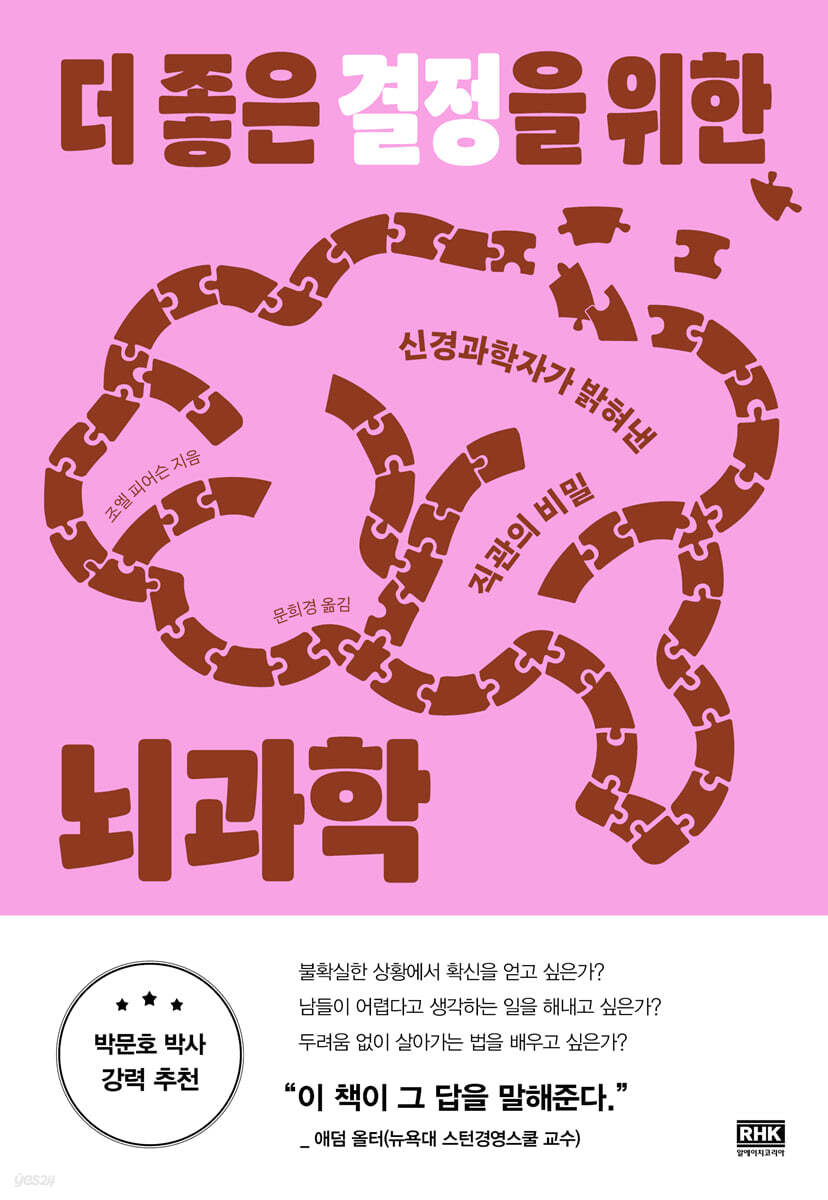
Brain Science for Better Decisions
 |
Description
Book Introduction
In the data collected by the unconscious
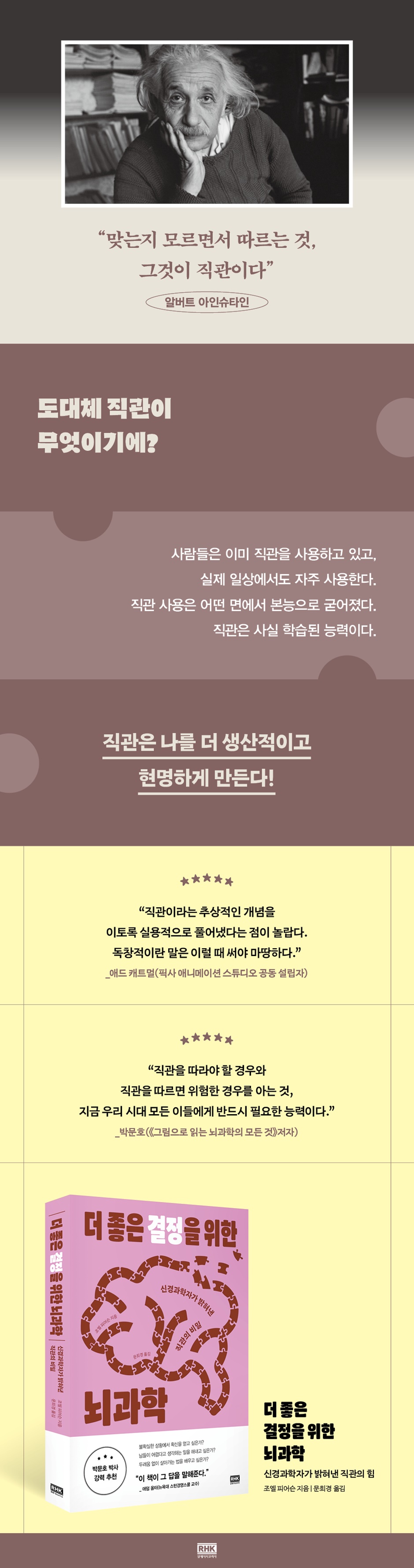
The power of intuition to draw the best conclusions
“It’s amazing how the abstract concept of intuition can be explained in such a practical way.
“This is where the word ‘original’ comes into play.” _Ed Catmull (co-founder of Pixar Animation Studios)
Neuroscientist Joel Pearson's first popular science book.
This book, which serves as a user manual for intuition, reveals for the first time the boundless world of intuition, hidden like a side branch within the larger topic of brain science.
Over the past decade, the author has collected and studied cases from around the world where intuition worked at crucial moments, realizing the usefulness of intuition and devising ways to help more people actively utilize it.
From life-or-death moments to choosing the right date, our daily lives are inextricably linked to our intuition.
In other words, if you can detect and make decisions based on the signals your intuition sends, you can reduce your risk.
So what happened to those who ignored their intuition? Climbers who trained for years to climb Everest were able to halt their progress and safely descend without a moment's discomfort, but those who attempted the ascent were swept away by a blizzard.
The formation pilot who insisted on following the manual instead of following the experienced pilot's decision to pull the control stick and deviate from the course without listening to the instructions of the lead pilot lost his life.
It's difficult to achieve success with a brilliant idea, but it's even more difficult to wisely escape an unexpected disaster.
If you want to be confident and find answers before others in this uncertain situation, you can start practicing your intuition.
The power of intuition to draw the best conclusions
“It’s amazing how the abstract concept of intuition can be explained in such a practical way.
“This is where the word ‘original’ comes into play.” _Ed Catmull (co-founder of Pixar Animation Studios)
Neuroscientist Joel Pearson's first popular science book.
This book, which serves as a user manual for intuition, reveals for the first time the boundless world of intuition, hidden like a side branch within the larger topic of brain science.
Over the past decade, the author has collected and studied cases from around the world where intuition worked at crucial moments, realizing the usefulness of intuition and devising ways to help more people actively utilize it.
From life-or-death moments to choosing the right date, our daily lives are inextricably linked to our intuition.
In other words, if you can detect and make decisions based on the signals your intuition sends, you can reduce your risk.
So what happened to those who ignored their intuition? Climbers who trained for years to climb Everest were able to halt their progress and safely descend without a moment's discomfort, but those who attempted the ascent were swept away by a blizzard.
The formation pilot who insisted on following the manual instead of following the experienced pilot's decision to pull the control stick and deviate from the course without listening to the instructions of the lead pilot lost his life.
It's difficult to achieve success with a brilliant idea, but it's even more difficult to wisely escape an unexpected disaster.
If you want to be confident and find answers before others in this uncertain situation, you can start practicing your intuition.
- You can preview some of the book's contents.
Preview
index
As we go in, how did he avoid disaster?
Part 1 Background
Chapter 1: The Power of Intuition
Chapter 2: Measuring Intuition
Part 2: Five Rules of Intuition, SMILE
Chapter 1 Self-Awareness
Chapter 2 Proficiency
Chapter 3: Impulses and Addictions
Chapter 4 Low Probability
Chapter 5 Environment
Part 3: Intuition Exercises
Acknowledgements
Part 1 Background
Chapter 1: The Power of Intuition
Chapter 2: Measuring Intuition
Part 2: Five Rules of Intuition, SMILE
Chapter 1 Self-Awareness
Chapter 2 Proficiency
Chapter 3: Impulses and Addictions
Chapter 4 Low Probability
Chapter 5 Environment
Part 3: Intuition Exercises
Acknowledgements
Detailed image
Into the book
We've all heard the saying, "Follow your gut."
Or maybe someone has asked you, “What does your intuition say?” when trying to make a difficult decision.
You've probably had the experience of acting on your intuition without logically or consciously considering the situation.
In this book, we will explore the many layers of this intuitive process.
We'll break down and analyze what actually happens in our brains when we rely on our intuition to make decisions or take actions.
And by integrating neuroscience and psychology, we aim to decipher the mysteries of intuition and present five rules of safe and reliable guidance that can be applied to everyday decisions.
--- p.13
While intuition and conscious thought often work together, the unconscious often takes the lead.
For example, you might be sitting in a restaurant and have an uneasy feeling that something is wrong.
Paying attention to this feeling can help you avoid unpleasant things, but ignoring it can lead to stomach upset or worse.
At this time, our mind does not consider pros and cons on a conscious level.
Rather, as John experienced on the summit of Mount Everest, our brains unconsciously and rapidly process numerous signals from the surrounding environment.
These signals include the smells inside the restaurant, untidy tablecloths, the atmosphere, the temperature, the attitude of the staff, and countless other subtle factors.
As this information swirls around, is instantly integrated, and associations are stimulated, interoception kicks in, transforming these signals into intuition.
The subtle yet powerful power of this amazing process is what demonstrates the remarkable capabilities of the human brain.
This is what is commonly called intuition.
--- p.35~36
Failure and mistakes send shock signals to our brains, telling us that things aren't going as planned and that change is needed.
Then the brain enters a state of plasticity, a state in which it can change.
It is an ideal state for learning something new as the brain prepares itself to change.
There are times when this phenomenon becomes even more interesting.
It's when you make a lot of mistakes while learning something and then learn something else.
Because our brains are already capable of change, mistakes made in the first learning process make the next learning process easier.
But people usually don't enjoy failure.
Who enjoys making mistakes like throwing a dart out of bounds or falling off a bike? Failure reminds us of our shortcomings and the immense effort required to improve.
No one wants to fail 100 percent.
This is also not effective for learning.
However, there is an advantage to a failure rate of around 20 percent.
The trick is to make failure more enjoyable, to make it a kind of game.
This is actually exactly how video games work.
Video games help users find reward in failure by providing positive reinforcement and rewards while also boosting dopamine levels.
The reason we expect failure is so we can learn how to move on to the next step.
In short, once the pain of failure subsides, learning can advance by leaps and bounds.
--- p.122~123
The brain sometimes works in funny ways.
When we look at reactions to positive and negative emotions, reactions to negative ones are generally stronger than reactions to positive ones.
This is how the brain works.
Over time, we have evolved to react more strongly to negative and potentially dangerous situations.
Because that way, your chances of survival increase.
For example, not being able to pick a flower or pet a puppy might be a little sad, but not seeing an approaching poisonous snake could cost you your life.
Therefore, in intuition, the positive and negative aspects are not balanced.
Because more learning occurs from negative events, you may feel negative things more often and more strongly as part of your intuition.
--- p.152
The human brain doesn't really understand probability, so if you dream about a plane crash and it actually happens the next day, you won't believe it's just a coincidence and will think there must be a better explanation.
Our brains try to find other reasons, and in doing so, we may end up believing that we are special and that we had a precognitive dream.
Or maybe someone has asked you, “What does your intuition say?” when trying to make a difficult decision.
You've probably had the experience of acting on your intuition without logically or consciously considering the situation.
In this book, we will explore the many layers of this intuitive process.
We'll break down and analyze what actually happens in our brains when we rely on our intuition to make decisions or take actions.
And by integrating neuroscience and psychology, we aim to decipher the mysteries of intuition and present five rules of safe and reliable guidance that can be applied to everyday decisions.
--- p.13
While intuition and conscious thought often work together, the unconscious often takes the lead.
For example, you might be sitting in a restaurant and have an uneasy feeling that something is wrong.
Paying attention to this feeling can help you avoid unpleasant things, but ignoring it can lead to stomach upset or worse.
At this time, our mind does not consider pros and cons on a conscious level.
Rather, as John experienced on the summit of Mount Everest, our brains unconsciously and rapidly process numerous signals from the surrounding environment.
These signals include the smells inside the restaurant, untidy tablecloths, the atmosphere, the temperature, the attitude of the staff, and countless other subtle factors.
As this information swirls around, is instantly integrated, and associations are stimulated, interoception kicks in, transforming these signals into intuition.
The subtle yet powerful power of this amazing process is what demonstrates the remarkable capabilities of the human brain.
This is what is commonly called intuition.
--- p.35~36
Failure and mistakes send shock signals to our brains, telling us that things aren't going as planned and that change is needed.
Then the brain enters a state of plasticity, a state in which it can change.
It is an ideal state for learning something new as the brain prepares itself to change.
There are times when this phenomenon becomes even more interesting.
It's when you make a lot of mistakes while learning something and then learn something else.
Because our brains are already capable of change, mistakes made in the first learning process make the next learning process easier.
But people usually don't enjoy failure.
Who enjoys making mistakes like throwing a dart out of bounds or falling off a bike? Failure reminds us of our shortcomings and the immense effort required to improve.
No one wants to fail 100 percent.
This is also not effective for learning.
However, there is an advantage to a failure rate of around 20 percent.
The trick is to make failure more enjoyable, to make it a kind of game.
This is actually exactly how video games work.
Video games help users find reward in failure by providing positive reinforcement and rewards while also boosting dopamine levels.
The reason we expect failure is so we can learn how to move on to the next step.
In short, once the pain of failure subsides, learning can advance by leaps and bounds.
--- p.122~123
The brain sometimes works in funny ways.
When we look at reactions to positive and negative emotions, reactions to negative ones are generally stronger than reactions to positive ones.
This is how the brain works.
Over time, we have evolved to react more strongly to negative and potentially dangerous situations.
Because that way, your chances of survival increase.
For example, not being able to pick a flower or pet a puppy might be a little sad, but not seeing an approaching poisonous snake could cost you your life.
Therefore, in intuition, the positive and negative aspects are not balanced.
Because more learning occurs from negative events, you may feel negative things more often and more strongly as part of your intuition.
--- p.152
The human brain doesn't really understand probability, so if you dream about a plane crash and it actually happens the next day, you won't believe it's just a coincidence and will think there must be a better explanation.
Our brains try to find other reasons, and in doing so, we may end up believing that we are special and that we had a precognitive dream.
--- p.183~184
Publisher's Review
“The brain already knows the answer.”
How Intuition Works at Crucial Moments
Let's say you're driving on the road.
As you follow a familiar path, you suddenly sense something unusual.
I can't explain why, but I have a feeling that if I go any further, something will definitely happen.
Depending on this feeling, I changed lanes or took a detour to find another route, and ended up encountering a broken-down vehicle or an accident on the way.
Haven't you ever experienced something like this? We've avoided traffic jams thanks to our experience of the area, which we've acquired while driving, and by adapting to subtle changes in traffic pattern data, vehicle movement, or driver behavior.
In this way, we make countless decisions, big and small, every day without even thinking about it consciously.
It was at this point that intuition kicked in.
So what exactly is intuition? Intuition is the ability to make decisions or assess situations instantly, without conscious analysis or logical thinking.
According to Joel Pearson's research, intuition occurs when the brain rapidly processes information, even when we are not aware of it, and makes decisions based on previous experiences and patterns stored in memory.
In other words, it is the brain's ability to make optimal decisions unconsciously.
This ability is often described as a 'feel' or 'intuition', and it shines especially brightly when geniuses make groundbreaking discoveries.
Steve Jobs, who devised the optimal design tailored to the user's perspective, developed the iPhone, which captivated people around the world, with ideas that he 'intuitively' brought about. The same was true when Einstein, who brought about a revolutionary change in physics, derived the theory of relativity, or when world-renowned artists created their own unique worldviews through musical and cinematic intuition.
In this way, intuition has played a crucial role in tasks that require a high degree of creativity and insight.
“Train and be alert.”
Five Rules for Drawing the Best Conclusions
All activities that make humans human are controlled by the brain.
Within the countless connections between neurons in the brain, humans can expand their capabilities beyond their natural abilities through training, or they can weaken those capabilities through adverse reactions like addiction.
Among the various studies on neuroplasticity by brain scientists around the world, Joel Pearson focused on the moment when intuition intervenes.
Intuition is not yet a central research area in neuroscience, but it is a topic that has only recently begun to receive attention, yet it is closely related to human daily life.
When we use our intuition correctly, we can solve problems quickly and accurately, but when we use it incorrectly, we can make big mistakes.
This is also the reason why investors took excessive risks when making decisions based on market intuition, which led to the financial crisis.
Therefore, we must be wary of allowing our intuition to follow incomplete information or incorrect patterns at the moment of decision-making.
Pearson's SMILE law helps prevent failures based on intuition.
First, when using intuition, you should prioritize intuition based on experience.
Intuition relies on pattern recognition derived from experience, so it can produce better results in areas where you have a lot of experience, i.e., environments where you are skilled.
Second, we need to reinforce our intuition by collecting as much information and data as possible.
Human experience is limited, so information to support it is needed.
Third, when using intuition, you must always go through a process of verifying that intuition.
The accuracy of intuition must be checked after the fact through 'follow-up analysis'.
Fourth, if your intuition leads to a wrong judgment, you must acknowledge it and improve it.
Finally, when using intuition, it is necessary to recognize the emotions or biases you sense and make an effort to look at the situation objectively.
The difference between good and bad intuition comes down to experience and perception.
This book will help you transform your intuition from mere gut feeling into a trustworthy and insightful, uniquely human ability, enabling you to make more accurate and confident decisions while minimizing the risk of personal error.
How Intuition Works at Crucial Moments
Let's say you're driving on the road.
As you follow a familiar path, you suddenly sense something unusual.
I can't explain why, but I have a feeling that if I go any further, something will definitely happen.
Depending on this feeling, I changed lanes or took a detour to find another route, and ended up encountering a broken-down vehicle or an accident on the way.
Haven't you ever experienced something like this? We've avoided traffic jams thanks to our experience of the area, which we've acquired while driving, and by adapting to subtle changes in traffic pattern data, vehicle movement, or driver behavior.
In this way, we make countless decisions, big and small, every day without even thinking about it consciously.
It was at this point that intuition kicked in.
So what exactly is intuition? Intuition is the ability to make decisions or assess situations instantly, without conscious analysis or logical thinking.
According to Joel Pearson's research, intuition occurs when the brain rapidly processes information, even when we are not aware of it, and makes decisions based on previous experiences and patterns stored in memory.
In other words, it is the brain's ability to make optimal decisions unconsciously.
This ability is often described as a 'feel' or 'intuition', and it shines especially brightly when geniuses make groundbreaking discoveries.
Steve Jobs, who devised the optimal design tailored to the user's perspective, developed the iPhone, which captivated people around the world, with ideas that he 'intuitively' brought about. The same was true when Einstein, who brought about a revolutionary change in physics, derived the theory of relativity, or when world-renowned artists created their own unique worldviews through musical and cinematic intuition.
In this way, intuition has played a crucial role in tasks that require a high degree of creativity and insight.
“Train and be alert.”
Five Rules for Drawing the Best Conclusions
All activities that make humans human are controlled by the brain.
Within the countless connections between neurons in the brain, humans can expand their capabilities beyond their natural abilities through training, or they can weaken those capabilities through adverse reactions like addiction.
Among the various studies on neuroplasticity by brain scientists around the world, Joel Pearson focused on the moment when intuition intervenes.
Intuition is not yet a central research area in neuroscience, but it is a topic that has only recently begun to receive attention, yet it is closely related to human daily life.
When we use our intuition correctly, we can solve problems quickly and accurately, but when we use it incorrectly, we can make big mistakes.
This is also the reason why investors took excessive risks when making decisions based on market intuition, which led to the financial crisis.
Therefore, we must be wary of allowing our intuition to follow incomplete information or incorrect patterns at the moment of decision-making.
Pearson's SMILE law helps prevent failures based on intuition.
First, when using intuition, you should prioritize intuition based on experience.
Intuition relies on pattern recognition derived from experience, so it can produce better results in areas where you have a lot of experience, i.e., environments where you are skilled.
Second, we need to reinforce our intuition by collecting as much information and data as possible.
Human experience is limited, so information to support it is needed.
Third, when using intuition, you must always go through a process of verifying that intuition.
The accuracy of intuition must be checked after the fact through 'follow-up analysis'.
Fourth, if your intuition leads to a wrong judgment, you must acknowledge it and improve it.
Finally, when using intuition, it is necessary to recognize the emotions or biases you sense and make an effort to look at the situation objectively.
The difference between good and bad intuition comes down to experience and perception.
This book will help you transform your intuition from mere gut feeling into a trustworthy and insightful, uniquely human ability, enabling you to make more accurate and confident decisions while minimizing the risk of personal error.
GOODS SPECIFICS
- Date of issue: March 24, 2025
- Format: Hardcover book binding method guide
- Page count, weight, size: 240 pages | 480g | 145*210*20mm
- ISBN13: 9788925573885
- ISBN10: 8925573881
You may also like
카테고리
korean


korean

![GQ KOREA Mark (Monthly): December [2025]](http://librairie.coreenne.fr/cdn/shop/files/8ef265dbbfbf186523ed75ba7319009d.jpg?v=1765340328&width=3840)


