

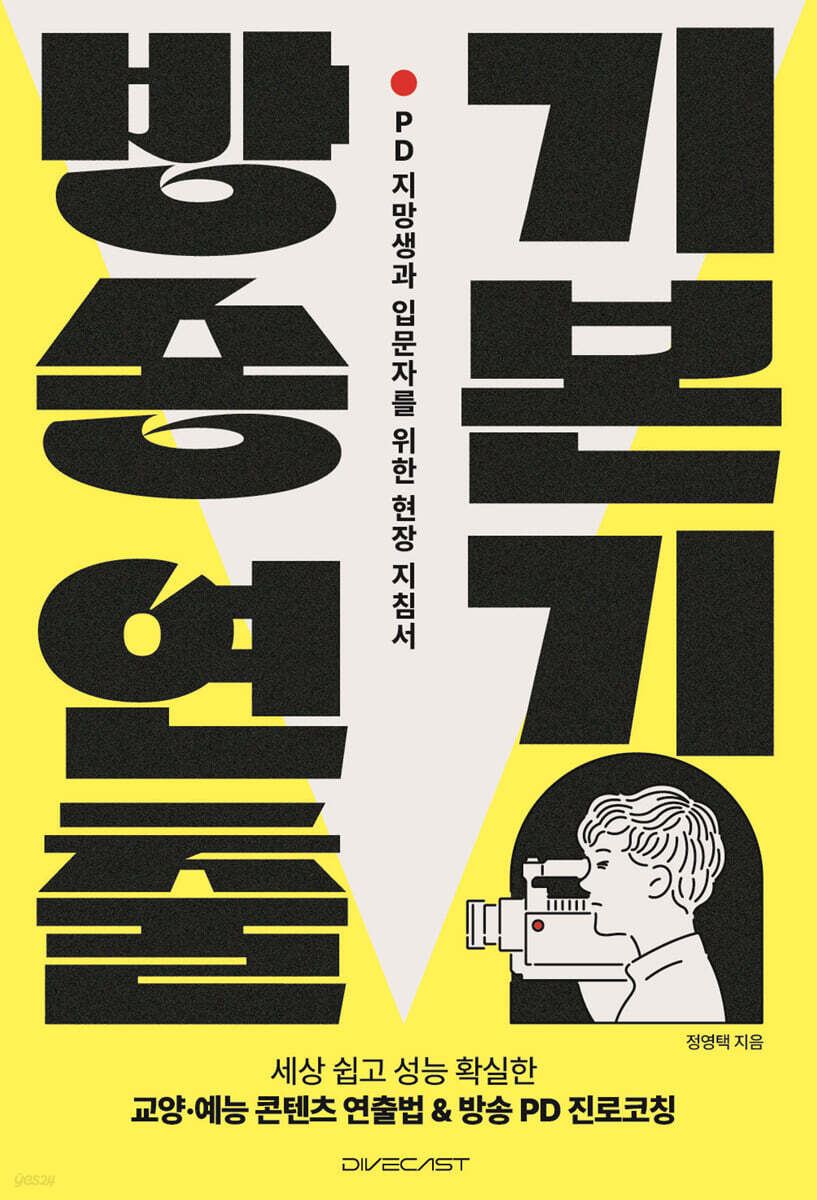
Broadcast directing basics
 |
Description
Book Introduction
The world's easiest and most effective way to produce cultural and entertainment content & career coaching for broadcast PDs
This book is a problem-solving guide that addresses the most common concerns of those who dream of becoming a broadcast director or are just starting out in the field regarding broadcast directing and their career path.
The author, who has been directing educational and entertainment content for 20 years as a producer, selects only the core of video content directing and production based on his actual field experience and organizes the principles.
It also contains the most realistic methods to become a broadcast PD, as seen from the perspective of a current PD.
But unlike stiff college textbooks, it is explained in an easy-to-understand way with various examples and analogies.
If you read it smoothly as if you were reading an essay, you will soon grasp the basics of broadcast directing.
This book is a problem-solving guide that addresses the most common concerns of those who dream of becoming a broadcast director or are just starting out in the field regarding broadcast directing and their career path.
The author, who has been directing educational and entertainment content for 20 years as a producer, selects only the core of video content directing and production based on his actual field experience and organizes the principles.
It also contains the most realistic methods to become a broadcast PD, as seen from the perspective of a current PD.
But unlike stiff college textbooks, it is explained in an easy-to-understand way with various examples and analogies.
If you read it smoothly as if you were reading an essay, you will soon grasp the basics of broadcast directing.
- You can preview some of the book's contents.
Preview
index
Prologue | Author's Note · 005
CHAPTER 1.
How will you live?
1.
Unhappy Full-Time PD · 012
2.
Unhappy Irregular PD · 018
3.
Life Goes On · 025
4.
Book 028
5.
Unbreakable · 038
CHAPTER 2.
Broadcast Editing Basics
1.
Before we begin · 044
2.
The Beginning and End of Directing · 046
3.
How to Achieve Your Intention | The Purpose of Directing · 050
4.
How to Immerse | The Art of Directing · 055
5.
How to Speak with Action | Actions for Engagement · 061
6.
How to Reduce Revisions | Unifying Planning Intent · 066
7.
How to Avoid Burnout 1 | Shooting Log · 073
8.
How to Avoid Burnout 2 | Outline · 077
9.
Let's Memorize This | Video Storytelling 1 · 085
10.
Make Me Human | Video Storytelling 2 · 090
11.
Don't Let Smoke Out of the Chimney When There's No Fire | Video Storytelling 3 · 098
12.
Life Has Too Many Obstacles | Video Storytelling 4 · 106
13.
Pasting a single cut is daunting | Selecting and Composing Cuts · 113
14.
Editing Practice | Reality Show Editing Case Studies · 125
15.
Hidden Cameras and Hitchcock | Editing and Composition Techniques · 133
16.
What should I fly? | Edited version of the original · 141
17.
How to Create a Faster Sense of Speed | Editing Rhythm 1 · 147
18.
How to Create Tension | Editing Rhythm 2 · 154
19.
How to Engage Your Audience in a Conversation | Editing Dialogue Scenes · 160
20.
How to Make Everyone Expect | The Art of Opening and Ending · 165
21.
How to Write Sound | Audio and Sound Technology · 169
CHAPTER 3.
Collaboration Fundamentals
1.
Group Project | Planning · 178
2.
Final Image | Photographed · 185
3.
Rapport | Cast · 190
4.
Reference | Post-production · 196
5.
Staff | Career Path · 198
Epilogue | Good Luck · 201
Acknowledgments · 205
CHAPTER 1.
How will you live?
1.
Unhappy Full-Time PD · 012
2.
Unhappy Irregular PD · 018
3.
Life Goes On · 025
4.
Book 028
5.
Unbreakable · 038
CHAPTER 2.
Broadcast Editing Basics
1.
Before we begin · 044
2.
The Beginning and End of Directing · 046
3.
How to Achieve Your Intention | The Purpose of Directing · 050
4.
How to Immerse | The Art of Directing · 055
5.
How to Speak with Action | Actions for Engagement · 061
6.
How to Reduce Revisions | Unifying Planning Intent · 066
7.
How to Avoid Burnout 1 | Shooting Log · 073
8.
How to Avoid Burnout 2 | Outline · 077
9.
Let's Memorize This | Video Storytelling 1 · 085
10.
Make Me Human | Video Storytelling 2 · 090
11.
Don't Let Smoke Out of the Chimney When There's No Fire | Video Storytelling 3 · 098
12.
Life Has Too Many Obstacles | Video Storytelling 4 · 106
13.
Pasting a single cut is daunting | Selecting and Composing Cuts · 113
14.
Editing Practice | Reality Show Editing Case Studies · 125
15.
Hidden Cameras and Hitchcock | Editing and Composition Techniques · 133
16.
What should I fly? | Edited version of the original · 141
17.
How to Create a Faster Sense of Speed | Editing Rhythm 1 · 147
18.
How to Create Tension | Editing Rhythm 2 · 154
19.
How to Engage Your Audience in a Conversation | Editing Dialogue Scenes · 160
20.
How to Make Everyone Expect | The Art of Opening and Ending · 165
21.
How to Write Sound | Audio and Sound Technology · 169
CHAPTER 3.
Collaboration Fundamentals
1.
Group Project | Planning · 178
2.
Final Image | Photographed · 185
3.
Rapport | Cast · 190
4.
Reference | Post-production · 196
5.
Staff | Career Path · 198
Epilogue | Good Luck · 201
Acknowledgments · 205
Detailed image

Into the book
Whether it's a relationship or a job, even if you start something out of love, there's only one reason why you quit.
Because it doesn't fit 'me'.
Whether it's a money issue, a people issue, or an environmental issue, if I simplify anything, it ends up not being right for me.
To avoid making bad choices, you must first understand yourself. There are many paths to becoming a PD, and if you don't understand yourself, you'll end up taking the wrong path.
Once you enter that path, the time you miss will pile up and you will come to a day when you no longer love each other, and eventually you will quit your job as if you were breaking up or continue to work without love or meaning.
This process is painful, and if the pain is prolonged, it becomes unfortunate.
Misfortune can teach us something about our true selves, but we don't need to put our hands in the fire to know it's hot.
All I have to do is reflect on what I want and what is important to me.
Since others don't live my life for me, I have no shame in giving worldly answers like, "Am I a materialistic person?", whether it's money or fame.
The more unconventional the situation, the more honest you have to be with yourself.
To avoid misfortune and achieve a happy ending of 'I survived and worked for a long time,' the best option is to choose the path of becoming a PD based on the answer.
---From "Life Goes On"
They say there are two sides to a coin, but there are too many bright articles that inject dreams and hope into the PD profession, and too few dark articles.
In summary, it's 'I'm so tired that I have so much work to do that I'm up all night for days.'
Not only in writing but also in the media, PDs are depicted as exhausted and tired, so everyone knows that being a PD is a difficult job.
But I don't know exactly why it's difficult.
So, there are so many people who take on challenges with the determination, "I can overcome the difficulties of having a lot of work! I'll overcome it with my mental strength!" and then give up, saying, "I never dreamed this would be this hard."
This is all due to information imbalance.
So, even if it was a little dark, I had to first include the stories that aspiring PDs and beginners were looking for, the stories that were absolutely necessary.
That's the only possible way for a senior to act.
---From "Unbreakable"
To become a good director, it is important to watch a lot of good works, but the fastest and most reliable way is to try editing yourself.
When you edit, you will learn what parts are full of intention and immersion, what parts are lacking, and what parts are needed.
So, people with a lot of editing experience create a solid composition and format from the planning stage, and they capture the necessary parts without missing anything during the filming process.
As such, editing skills aren't just for sitting in front of a computer in the editing room cutting and pasting.
This is the most essential skill throughout the entire production process.
That's why those who are good at editing on set are also good at directing.
---From "The Beginning and End of Directing"
There are rules to becoming a professional director who receives money for directing.
To achieve the directing purpose.
As mentioned earlier, the purpose of directing is to achieve the intention, so the purpose of video directing is to achieve the intention through the video.
But unfortunately, there are many videos that do not achieve their intended purpose.
A movie that is so full of violent and sexual scenes that you can't remember the content even after watching it all the way through, or an advertisement that is so full of flashy and sensual scenes that you can't remember the product name even after watching it all the way through.
It's not that everyone doesn't know the director's rules.
But why do these videos keep getting made? Most of the time, it's because the creators are just obsessed with them.
'I can't believe I made this!' Even though I initially cared about my intentions, I gradually became self-absorbed and the story went off the rails.
This is like a person who is so absorbed in pleasure that he forgets to eat and sleep.
But as we all know, eating and sleeping are the iron rules of human life.
Videos like this that ignore the rules are just the director's self-consolation.
It's just a failed production that wasted production costs.
If it's broadcasting, it's just a crime that adds to the waste of airwaves.
Let us not live in sin.
To become a professional director, you must live a purpose-driven life.
The purpose of directing is to achieve the intention, so the intention of the video should be achieved as the purpose leads.
---From "How to Achieve Your Intentions"
Montage, mise-en-scène, charades, the 180-degree rule, the imagistic line, all these things have to be followed, and I feel suffocated and like I'm going up against a wall.
A bigger side effect is that your head becomes stiff.
There are many beginners in the field who refuse to even consider other methods, saying, “This is the rule,” because they memorized the video grammar without understanding it.
The roles have been reversed.
New ways to engage viewers are now appearing more frequently on YouTube, which is no longer bound by video grammar.
Any method is fine as long as the viewer starts thinking after watching the video.
That's why they say there is no right answer in directing.
The joy of directing comes from thinking without limits about how to immerse the viewer, and that joy opens your mind.
Shouldn't those who tell stories to viewers be more closed off than the viewers themselves?
---From "How to Immerse"
Let's think about the classic novel, "Heungbu and Nolbu."
When Heungbu begs his sister-in-law for food, his sister-in-law hits him in the face with the spatula she used to serve him food.
And Heungbu takes off the rice stuck to his cheek and eats it.
Viewers focus on the 'actions' of slapping with a spatula or eating rice cake rather than the dialogue.
And I think.
"What the hell is going on? How can someone slap someone with a spatula? Why isn't that guy even angry? He's just eating rice cake soup. Is that even possible? What's their relationship? Let's just wait and see." Look.
Even though you only show actions, people reflexively question and make assumptions.
---From "How to Speak with Action"
To properly capture a character, you must first be clear about what the actor wants.
Only then can you catch the characteristics of the behavior that leads to what you want.
Catching the characteristics of behavior means finding 'what makes them different from ordinary people.'
If you find it, you need to attach that behavior 'consistently'.
For example, in tvN's [Grandpas Over Flowers], Lee Soon-jae wants to have a fun trip, and for him, a fun trip means going to and seeing more places.
For this reason, they walk much faster than other people (unlike most people).
If you want to characterize this trait as 'straightforward Sunjae', look for scenes where he walks quickly and is active and enthusiastic about traveling.
If you have a passive and unmotivated appearance, you should get rid of it.
'What on earth is Grandpa Lee Soon-jae? Is he going straight or backwards?' The viewers are confused.
However, it is okay to attach it if the appearance is necessary to achieve the planning intent.
If your lack of motivation is due to a cold, it could be because you're dealing with the realities of old age.
The planning intent always comes first.
---From "Don't let smoke come out of the chimney when there's no smoke"
There is something Kwon Ji-yong said about ‘creation.’
If you pursue perfection, you will never achieve it.
For something to be completed, it must be perfect at least by my standards.' This is why PDs force themselves to stay up all night.
A PD who pursues perfection cannot finish editing, and to finish editing, it must at least meet the PD's own standards, and those standards are high.
Why? Because they're all people who decided to become producers to create something to show someone.
I understand.
I did.
That's why it's so heartbreaking.
I hope this book will be helpful to those PDs.
Even if you read this book, you'll probably choose to stay up all night, but when you're alone in the empty editing room, wrestling with the footage, feeling frustrated and lost as to what to do, when it's so late at night that you can't ask anyone, I hope you have this book by your side.
I hope that you have an older senior by your side whom you can ask about direction, even if you don't know their face, so that even mornings spent alone won't be lonely.
Because it doesn't fit 'me'.
Whether it's a money issue, a people issue, or an environmental issue, if I simplify anything, it ends up not being right for me.
To avoid making bad choices, you must first understand yourself. There are many paths to becoming a PD, and if you don't understand yourself, you'll end up taking the wrong path.
Once you enter that path, the time you miss will pile up and you will come to a day when you no longer love each other, and eventually you will quit your job as if you were breaking up or continue to work without love or meaning.
This process is painful, and if the pain is prolonged, it becomes unfortunate.
Misfortune can teach us something about our true selves, but we don't need to put our hands in the fire to know it's hot.
All I have to do is reflect on what I want and what is important to me.
Since others don't live my life for me, I have no shame in giving worldly answers like, "Am I a materialistic person?", whether it's money or fame.
The more unconventional the situation, the more honest you have to be with yourself.
To avoid misfortune and achieve a happy ending of 'I survived and worked for a long time,' the best option is to choose the path of becoming a PD based on the answer.
---From "Life Goes On"
They say there are two sides to a coin, but there are too many bright articles that inject dreams and hope into the PD profession, and too few dark articles.
In summary, it's 'I'm so tired that I have so much work to do that I'm up all night for days.'
Not only in writing but also in the media, PDs are depicted as exhausted and tired, so everyone knows that being a PD is a difficult job.
But I don't know exactly why it's difficult.
So, there are so many people who take on challenges with the determination, "I can overcome the difficulties of having a lot of work! I'll overcome it with my mental strength!" and then give up, saying, "I never dreamed this would be this hard."
This is all due to information imbalance.
So, even if it was a little dark, I had to first include the stories that aspiring PDs and beginners were looking for, the stories that were absolutely necessary.
That's the only possible way for a senior to act.
---From "Unbreakable"
To become a good director, it is important to watch a lot of good works, but the fastest and most reliable way is to try editing yourself.
When you edit, you will learn what parts are full of intention and immersion, what parts are lacking, and what parts are needed.
So, people with a lot of editing experience create a solid composition and format from the planning stage, and they capture the necessary parts without missing anything during the filming process.
As such, editing skills aren't just for sitting in front of a computer in the editing room cutting and pasting.
This is the most essential skill throughout the entire production process.
That's why those who are good at editing on set are also good at directing.
---From "The Beginning and End of Directing"
There are rules to becoming a professional director who receives money for directing.
To achieve the directing purpose.
As mentioned earlier, the purpose of directing is to achieve the intention, so the purpose of video directing is to achieve the intention through the video.
But unfortunately, there are many videos that do not achieve their intended purpose.
A movie that is so full of violent and sexual scenes that you can't remember the content even after watching it all the way through, or an advertisement that is so full of flashy and sensual scenes that you can't remember the product name even after watching it all the way through.
It's not that everyone doesn't know the director's rules.
But why do these videos keep getting made? Most of the time, it's because the creators are just obsessed with them.
'I can't believe I made this!' Even though I initially cared about my intentions, I gradually became self-absorbed and the story went off the rails.
This is like a person who is so absorbed in pleasure that he forgets to eat and sleep.
But as we all know, eating and sleeping are the iron rules of human life.
Videos like this that ignore the rules are just the director's self-consolation.
It's just a failed production that wasted production costs.
If it's broadcasting, it's just a crime that adds to the waste of airwaves.
Let us not live in sin.
To become a professional director, you must live a purpose-driven life.
The purpose of directing is to achieve the intention, so the intention of the video should be achieved as the purpose leads.
---From "How to Achieve Your Intentions"
Montage, mise-en-scène, charades, the 180-degree rule, the imagistic line, all these things have to be followed, and I feel suffocated and like I'm going up against a wall.
A bigger side effect is that your head becomes stiff.
There are many beginners in the field who refuse to even consider other methods, saying, “This is the rule,” because they memorized the video grammar without understanding it.
The roles have been reversed.
New ways to engage viewers are now appearing more frequently on YouTube, which is no longer bound by video grammar.
Any method is fine as long as the viewer starts thinking after watching the video.
That's why they say there is no right answer in directing.
The joy of directing comes from thinking without limits about how to immerse the viewer, and that joy opens your mind.
Shouldn't those who tell stories to viewers be more closed off than the viewers themselves?
---From "How to Immerse"
Let's think about the classic novel, "Heungbu and Nolbu."
When Heungbu begs his sister-in-law for food, his sister-in-law hits him in the face with the spatula she used to serve him food.
And Heungbu takes off the rice stuck to his cheek and eats it.
Viewers focus on the 'actions' of slapping with a spatula or eating rice cake rather than the dialogue.
And I think.
"What the hell is going on? How can someone slap someone with a spatula? Why isn't that guy even angry? He's just eating rice cake soup. Is that even possible? What's their relationship? Let's just wait and see." Look.
Even though you only show actions, people reflexively question and make assumptions.
---From "How to Speak with Action"
To properly capture a character, you must first be clear about what the actor wants.
Only then can you catch the characteristics of the behavior that leads to what you want.
Catching the characteristics of behavior means finding 'what makes them different from ordinary people.'
If you find it, you need to attach that behavior 'consistently'.
For example, in tvN's [Grandpas Over Flowers], Lee Soon-jae wants to have a fun trip, and for him, a fun trip means going to and seeing more places.
For this reason, they walk much faster than other people (unlike most people).
If you want to characterize this trait as 'straightforward Sunjae', look for scenes where he walks quickly and is active and enthusiastic about traveling.
If you have a passive and unmotivated appearance, you should get rid of it.
'What on earth is Grandpa Lee Soon-jae? Is he going straight or backwards?' The viewers are confused.
However, it is okay to attach it if the appearance is necessary to achieve the planning intent.
If your lack of motivation is due to a cold, it could be because you're dealing with the realities of old age.
The planning intent always comes first.
---From "Don't let smoke come out of the chimney when there's no smoke"
There is something Kwon Ji-yong said about ‘creation.’
If you pursue perfection, you will never achieve it.
For something to be completed, it must be perfect at least by my standards.' This is why PDs force themselves to stay up all night.
A PD who pursues perfection cannot finish editing, and to finish editing, it must at least meet the PD's own standards, and those standards are high.
Why? Because they're all people who decided to become producers to create something to show someone.
I understand.
I did.
That's why it's so heartbreaking.
I hope this book will be helpful to those PDs.
Even if you read this book, you'll probably choose to stay up all night, but when you're alone in the empty editing room, wrestling with the footage, feeling frustrated and lost as to what to do, when it's so late at night that you can't ask anyone, I hope you have this book by your side.
I hope that you have an older senior by your side whom you can ask about direction, even if you don't know their face, so that even mornings spent alone won't be lonely.
---From "Epilogue _ Good Luck"
GOODS SPECIFICS
- Date of issue: February 14, 2025
- Page count, weight, size: 208 pages | 284g | 128*188*19mm
- ISBN13: 9791199063907
- ISBN10: 1199063908
You may also like
카테고리
korean


korean

![GQ KOREA Mark (Monthly): December [2025]](http://librairie.coreenne.fr/cdn/shop/files/8ef265dbbfbf186523ed75ba7319009d.jpg?v=1765340328&width=3840)


