

What Makes Coaching and Mentoring Complete?
 |
Description
Book Introduction
From traditional coaching to cutting-edge information, Clutterbuck's gift of theory and experience!
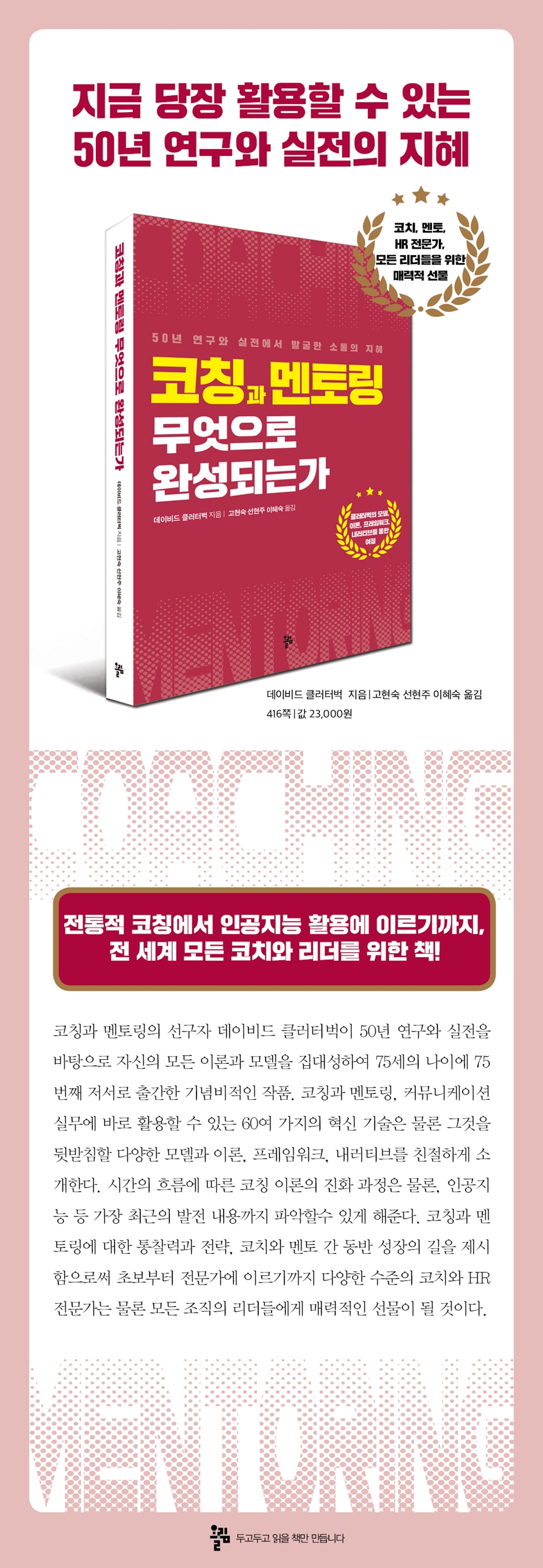
A monumental work by David Clutterbuck, a pioneer in coaching and mentoring, published at the age of 75 as his 75th book, compiling all of his theories and models based on 50 years of research and practice.
This book introduces over 60 innovative techniques that can be immediately applied in coaching, mentoring, and communication practices, as well as the various models, theories, frameworks, and narratives that support them.
It allows you to understand the evolution of coaching theory over time, as well as the most recent developments, such as artificial intelligence.
By offering insights and strategies for coaching and mentoring, and by offering a path for shared growth between coaches and mentors, this book will be an engaging gift for coaches and HR professionals of all levels, from beginners to experts, as well as leaders in all organizations.
The author's writing, which is equipped with not only rich field experience and extensive theory, but also philosophy, science, humanities, and even humor, provides the pleasure of reading a high-quality essay.
A monumental work by David Clutterbuck, a pioneer in coaching and mentoring, published at the age of 75 as his 75th book, compiling all of his theories and models based on 50 years of research and practice.
This book introduces over 60 innovative techniques that can be immediately applied in coaching, mentoring, and communication practices, as well as the various models, theories, frameworks, and narratives that support them.
It allows you to understand the evolution of coaching theory over time, as well as the most recent developments, such as artificial intelligence.
By offering insights and strategies for coaching and mentoring, and by offering a path for shared growth between coaches and mentors, this book will be an engaging gift for coaches and HR professionals of all levels, from beginners to experts, as well as leaders in all organizations.
The author's writing, which is equipped with not only rich field experience and extensive theory, but also philosophy, science, humanities, and even humor, provides the pleasure of reading a high-quality essay.
- You can preview some of the book's contents.
Preview
index
Dedication words
Translator's Preface
Introduction
1 The Importance of an Evidence-Based Approach
2 Communication
The Complexity of Listening / The Power of Blood-Drying Hard Questions (BDQs)
/ Questioning Perspectives / Conversations Are Not Enough / The Impact of Context on How People Communicate / A Didactic Story (or Two) to Illustrate a Concept / Communication Styles / Learning Conversations / Four Questions to Improve the Quality of Meetings / Seven Conversations in Leadership / Four Conversations in Systematic Talent Management / How Communication Creates Value in Organizations / Words That Create Ideas
3 Corporate Leadership and Governance
The Role of a Leader / Core Qualities of a Leader in a VUCA World /
Assessing a Leader's Growth Potential / Effective Boards /
High-Performance Board / Role of the Board
4 Mentoring
Defining Learning Conversations /
Mentoring lies on a spectrum of support styles.
Problems in Mentoring Research / Stages of the Mentoring Relationship /
Structure of a Mentoring Conversation / Key Unresolved Issues (SUI) /
Personal Reflective Space (PRS) /
Mentoring Square / Executive Mentoring Framework /
Executive Mentoring Process Model / Mentoring Outcomes /
Mentor as a role model
5 Human Connections
Reflection / Connecting with Oneself /
M&A Worry Index / Psychological Contract
6 Coaching and Mentoring Culture
The Evolution of Direct Manager Coaching / The 7 Stages of Traditional Coaching /
A Situational Model of Direct Manager Coaching / The Coaching Question Cycle / Direct Manager Coaching Styles / Providing Up-to-Date Information / Coaching Culture / Coaching Energy Fields / Stages of Coaching Culture Development / Creating a Coaching Culture / Components of a Coaching Culture Strategy / Building a Coaching Culture within Your Team / Changing the System Requires Changing the Entire System / Coach Assessment and Development Center / The Role of the Coaching and Mentoring Program Manager
7 Coach Implementation and Development
Coach Maturity / Why Coach Maturity Matters / The Troublesome Goal Problem / Supervision / A Systematic Coaching Supervision Model
8 Team Coaching
Team Types and Roles / Seven Golden Rules for Team Learning Conversations / From Systems to Complex Adaptive Systems / Teams of Teams / Building New Teams / Agile Processes for Stable Teams
9 Ethics, Coaching, and the Coming Presence of Artificial Intelligence
Ethical Mentor / Democratizing Coaching / Decolonizing Coaching /
Raising Customer Awareness of Ethical Issues / The Challenges of AI / Coach-AI Partnerships / Leveraging Coach-AI Partnerships
That's all for my story...
Conclusion
supplement
Appendix 1 Clutterbuck's Books, Co-Authors, and Co-Editors
Appendix 2: April Fool's Day Blog Traditions
Appendix 3 How Fair is the Psychological Contract Between You and the Organization?
Appendix 4 Coaching Culture Questionnaire
Appendix 5 You and Your Six Life Strands
Translator's Preface
Introduction
1 The Importance of an Evidence-Based Approach
2 Communication
The Complexity of Listening / The Power of Blood-Drying Hard Questions (BDQs)
/ Questioning Perspectives / Conversations Are Not Enough / The Impact of Context on How People Communicate / A Didactic Story (or Two) to Illustrate a Concept / Communication Styles / Learning Conversations / Four Questions to Improve the Quality of Meetings / Seven Conversations in Leadership / Four Conversations in Systematic Talent Management / How Communication Creates Value in Organizations / Words That Create Ideas
3 Corporate Leadership and Governance
The Role of a Leader / Core Qualities of a Leader in a VUCA World /
Assessing a Leader's Growth Potential / Effective Boards /
High-Performance Board / Role of the Board
4 Mentoring
Defining Learning Conversations /
Mentoring lies on a spectrum of support styles.
Problems in Mentoring Research / Stages of the Mentoring Relationship /
Structure of a Mentoring Conversation / Key Unresolved Issues (SUI) /
Personal Reflective Space (PRS) /
Mentoring Square / Executive Mentoring Framework /
Executive Mentoring Process Model / Mentoring Outcomes /
Mentor as a role model
5 Human Connections
Reflection / Connecting with Oneself /
M&A Worry Index / Psychological Contract
6 Coaching and Mentoring Culture
The Evolution of Direct Manager Coaching / The 7 Stages of Traditional Coaching /
A Situational Model of Direct Manager Coaching / The Coaching Question Cycle / Direct Manager Coaching Styles / Providing Up-to-Date Information / Coaching Culture / Coaching Energy Fields / Stages of Coaching Culture Development / Creating a Coaching Culture / Components of a Coaching Culture Strategy / Building a Coaching Culture within Your Team / Changing the System Requires Changing the Entire System / Coach Assessment and Development Center / The Role of the Coaching and Mentoring Program Manager
7 Coach Implementation and Development
Coach Maturity / Why Coach Maturity Matters / The Troublesome Goal Problem / Supervision / A Systematic Coaching Supervision Model
8 Team Coaching
Team Types and Roles / Seven Golden Rules for Team Learning Conversations / From Systems to Complex Adaptive Systems / Teams of Teams / Building New Teams / Agile Processes for Stable Teams
9 Ethics, Coaching, and the Coming Presence of Artificial Intelligence
Ethical Mentor / Democratizing Coaching / Decolonizing Coaching /
Raising Customer Awareness of Ethical Issues / The Challenges of AI / Coach-AI Partnerships / Leveraging Coach-AI Partnerships
That's all for my story...
Conclusion
supplement
Appendix 1 Clutterbuck's Books, Co-Authors, and Co-Editors
Appendix 2: April Fool's Day Blog Traditions
Appendix 3 How Fair is the Psychological Contract Between You and the Organization?
Appendix 4 Coaching Culture Questionnaire
Appendix 5 You and Your Six Life Strands
Detailed image
Into the book
The book also includes stories from Clutterbuck's personal life and family, including how he grew up and what his journey as a professional was like.
That kind of passage is fun to read like an autobiographical essay.
Furthermore, by following the topics in each chapter, you will be able to better understand how the theories and models introduced in the author's various books are connected.
It provides context for the topics he has explored, from coaching and mentoring to communication and team coaching, and is rich in useful tools and models that can be put to immediate use.
--- p.6
The first question I asked myself when I came up with the idea for this book was, 'Is this just the vanity of an old man?'
I have a deep-seated and long-standing aversion to self-promotion, to the point where I avoid putting myself on lists of top gurus.
I only occasionally bring my book to lectures or workshops.
To answer this question, I thought of three more questions.
ㆍ What do readers find useful to learn?
ㆍ What can you learn from this book?
ㆍ What will Wilf say?
--- pp.12-13
We also explored how HR can function more effectively by combining the worlds of marketing and HR to authentically market itself within an organization.
Then, around the turn of the century, my interest shifted to four intertwined topics that still captivate me today: coaching culture, coach maturity, systematic talent management, and team coaching.
Along the way, I became interested in how artificial intelligence could enhance (or threaten) coaching, and more recently, the potential of coaching in virtual reality.
--- p.15
The models and frameworks presented in this book are those that have had the greatest impact, those that I particularly like, or those that I believe will stimulate new thinking in readers.
Whether you read from beginning to end, skim through the main points, or skim occasionally, it's worth keeping in mind the value of a mixed approach.
Having too many disconnected pieces of knowledge reduces its usefulness.
What matters is how you connect.
Look for connections between the ideas in this book and your existing knowledge bank.
And if you can point me to some connections between ideas in this book that I hadn't thought of, I'd be very grateful!
--- p.18
As a business journalist, I've come across many interesting ideas.
One of them is what we know today as 360-degree feedback.
The concept originated in a heavy industry plant in St. Petersburg, then Leningrad.
I first experimented with this concept in the West, designed by communist unions to keep their direct managers from becoming complacent.
I underestimated how much of an impact it would have to give top executives at a large financial firm feedback they had never received before.
But after recovering from the shock, all executives wanted to try this again a year later.
One lesson learned here is to avoid the trap of using 360-degree feedback as a monitoring tool.
Unfortunately, 360-degree feedback is a classic example of a good idea that was distorted by money-seeking consultants.
They simply used them for commercial purposes without doing any research to understand the context of tool use.
--- p.21
If you ask people how good of a listener they are, most will say they are above average.
In my observations, introverts tend to rate themselves lower as listeners than extroverts, but they are generally better listeners.
To make things more complicated, just because someone isn't talking doesn't mean they're listening.
Their attention may be far away.
It's also surprising how defensive we become when someone accuses us of not listening.
“I’m listening! You’re not listening to me!”
--- pp.34-35
A maxim I've found useful in developing listening skills in myself and others is, "Just when you think you understand, that's when you need to listen twice as hard."
--- p.36
Before starting the discussion, everyone shares their answers to three questions.
As a result, discussions become more focused, respectful of others' opinions, and generally much shorter! Once it's clear that consensus is being reached, the person facilitating the meeting can ask everyone the following questions:
ㆍ Have you said everything you wanted to say?
ㆍ Did you hear the story you wanted to hear?
ㆍ Have you achieved your goal?
But there's one final step that adds value to the discussion: the question, "What should have been said but wasn't?"
This allows us to bring to light any concerns that may not have been raised during the conversation.
--- p.59
Another area with tremendous potential to transform society is mentoring in schools.
Typically, a mentor is a teacher or other adult volunteer.
But experiments conducted around the world show that students themselves can be very effective coaches and mentors to their peers.
The educational materials, developed around the Every Kid Needs a Mentor project, include a chapter on how to mentor parents.
--- p.122
One recent study I came across (Kardas et al.)1 asked people to approach strangers and either engage in casual conversation or engage in deeper conversation out of curiosity about the other person.
We predicted that most study participants would be more satisfied with light conversations and more fearful of deep conversations.
But the result was just the opposite.
Once participants got over their initial hesitation, they felt significantly happier engaging in deep conversations than in casual conversations, and the more they learned about the other person, the more they liked him.
--- p.155
I was blessed to have a son with a learning disability.
Jonathan, the youngest of four sons, has both autism and Down syndrome.
I learned a lot from my son.
I have become more patient, more aware, and more exposed to a wider range of diversity.
I am proud of my son's accomplishments.
Her achievements, especially as a skater competing in the Special Olympics Invitational, demonstrate how courage and the right support can overcome tremendous odds.
--- pp.159-160
A question came to mind as I tried to define systematic talent management.
"Why would truly talented people want to work here?" Amidst the wave of mass resignations following the pandemic, one of the reasons people are considering changing jobs is to find a work environment where they feel valued, have a sense of purpose, and feel fulfilled.
I believe that creating a coaching culture is one of the most effective, and potentially least expensive, ways to achieve that goal!
That kind of passage is fun to read like an autobiographical essay.
Furthermore, by following the topics in each chapter, you will be able to better understand how the theories and models introduced in the author's various books are connected.
It provides context for the topics he has explored, from coaching and mentoring to communication and team coaching, and is rich in useful tools and models that can be put to immediate use.
--- p.6
The first question I asked myself when I came up with the idea for this book was, 'Is this just the vanity of an old man?'
I have a deep-seated and long-standing aversion to self-promotion, to the point where I avoid putting myself on lists of top gurus.
I only occasionally bring my book to lectures or workshops.
To answer this question, I thought of three more questions.
ㆍ What do readers find useful to learn?
ㆍ What can you learn from this book?
ㆍ What will Wilf say?
--- pp.12-13
We also explored how HR can function more effectively by combining the worlds of marketing and HR to authentically market itself within an organization.
Then, around the turn of the century, my interest shifted to four intertwined topics that still captivate me today: coaching culture, coach maturity, systematic talent management, and team coaching.
Along the way, I became interested in how artificial intelligence could enhance (or threaten) coaching, and more recently, the potential of coaching in virtual reality.
--- p.15
The models and frameworks presented in this book are those that have had the greatest impact, those that I particularly like, or those that I believe will stimulate new thinking in readers.
Whether you read from beginning to end, skim through the main points, or skim occasionally, it's worth keeping in mind the value of a mixed approach.
Having too many disconnected pieces of knowledge reduces its usefulness.
What matters is how you connect.
Look for connections between the ideas in this book and your existing knowledge bank.
And if you can point me to some connections between ideas in this book that I hadn't thought of, I'd be very grateful!
--- p.18
As a business journalist, I've come across many interesting ideas.
One of them is what we know today as 360-degree feedback.
The concept originated in a heavy industry plant in St. Petersburg, then Leningrad.
I first experimented with this concept in the West, designed by communist unions to keep their direct managers from becoming complacent.
I underestimated how much of an impact it would have to give top executives at a large financial firm feedback they had never received before.
But after recovering from the shock, all executives wanted to try this again a year later.
One lesson learned here is to avoid the trap of using 360-degree feedback as a monitoring tool.
Unfortunately, 360-degree feedback is a classic example of a good idea that was distorted by money-seeking consultants.
They simply used them for commercial purposes without doing any research to understand the context of tool use.
--- p.21
If you ask people how good of a listener they are, most will say they are above average.
In my observations, introverts tend to rate themselves lower as listeners than extroverts, but they are generally better listeners.
To make things more complicated, just because someone isn't talking doesn't mean they're listening.
Their attention may be far away.
It's also surprising how defensive we become when someone accuses us of not listening.
“I’m listening! You’re not listening to me!”
--- pp.34-35
A maxim I've found useful in developing listening skills in myself and others is, "Just when you think you understand, that's when you need to listen twice as hard."
--- p.36
Before starting the discussion, everyone shares their answers to three questions.
As a result, discussions become more focused, respectful of others' opinions, and generally much shorter! Once it's clear that consensus is being reached, the person facilitating the meeting can ask everyone the following questions:
ㆍ Have you said everything you wanted to say?
ㆍ Did you hear the story you wanted to hear?
ㆍ Have you achieved your goal?
But there's one final step that adds value to the discussion: the question, "What should have been said but wasn't?"
This allows us to bring to light any concerns that may not have been raised during the conversation.
--- p.59
Another area with tremendous potential to transform society is mentoring in schools.
Typically, a mentor is a teacher or other adult volunteer.
But experiments conducted around the world show that students themselves can be very effective coaches and mentors to their peers.
The educational materials, developed around the Every Kid Needs a Mentor project, include a chapter on how to mentor parents.
--- p.122
One recent study I came across (Kardas et al.)1 asked people to approach strangers and either engage in casual conversation or engage in deeper conversation out of curiosity about the other person.
We predicted that most study participants would be more satisfied with light conversations and more fearful of deep conversations.
But the result was just the opposite.
Once participants got over their initial hesitation, they felt significantly happier engaging in deep conversations than in casual conversations, and the more they learned about the other person, the more they liked him.
--- p.155
I was blessed to have a son with a learning disability.
Jonathan, the youngest of four sons, has both autism and Down syndrome.
I learned a lot from my son.
I have become more patient, more aware, and more exposed to a wider range of diversity.
I am proud of my son's accomplishments.
Her achievements, especially as a skater competing in the Special Olympics Invitational, demonstrate how courage and the right support can overcome tremendous odds.
--- pp.159-160
A question came to mind as I tried to define systematic talent management.
"Why would truly talented people want to work here?" Amidst the wave of mass resignations following the pandemic, one of the reasons people are considering changing jobs is to find a work environment where they feel valued, have a sense of purpose, and feel fulfilled.
I believe that creating a coaching culture is one of the most effective, and potentially least expensive, ways to achieve that goal!
--- p.248
GOODS SPECIFICS
- Date of issue: December 20, 2024
- Page count, weight, size: 416 pages | 152*225*30mm
- ISBN13: 9791162620632
- ISBN10: 1162620633
You may also like
카테고리
korean


korean

![GQ KOREA Mark (Monthly): December [2025]](http://librairie.coreenne.fr/cdn/shop/files/8ef265dbbfbf186523ed75ba7319009d.jpg?v=1765340328&width=3840)


