

Adult greetings
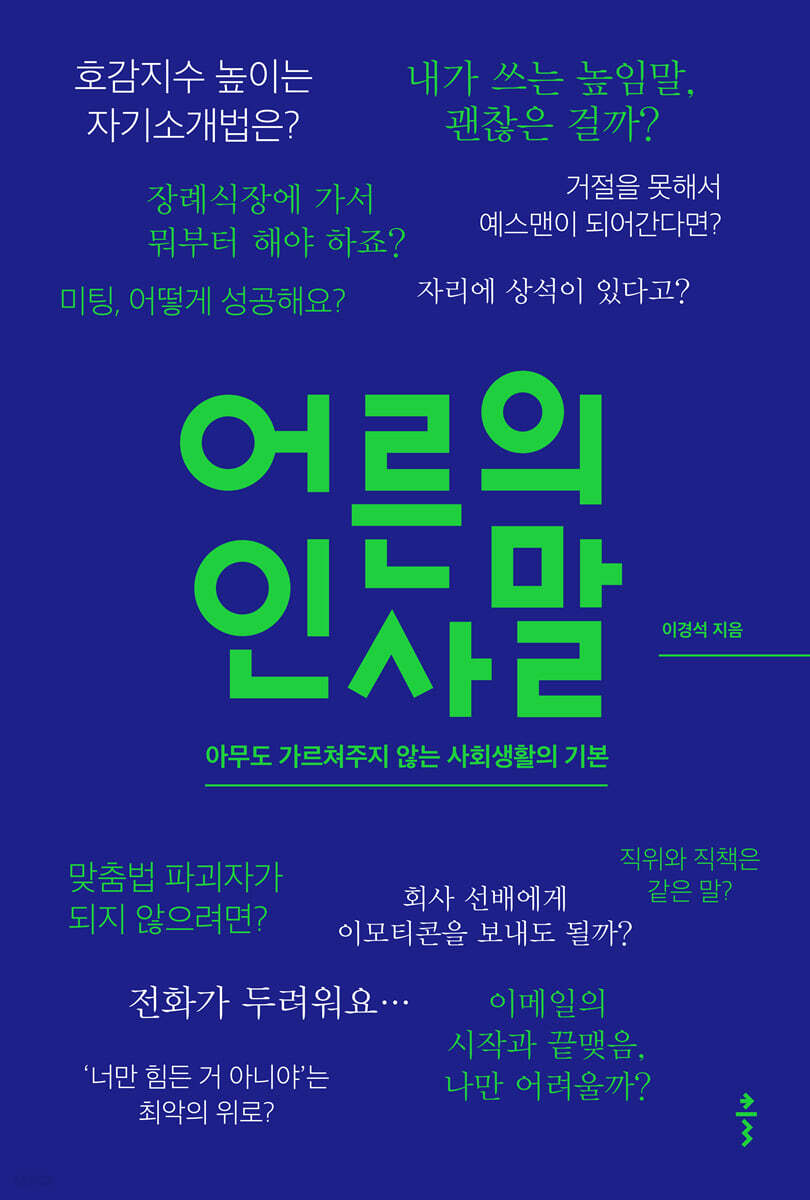 |
Description
Book Introduction
Speaking x Listening x Conversation x Condolences x Etiquette x Work life tips,
Contains everything about social life that no one tells you about
Encyclopedia of Adults with Internal Energy
As you leave your student status and begin your social life, you take your first steps into the adult world.
They say that an adult is someone who can take responsibility for their own actions, but the world of adults is more difficult than you think.
From everyday life to work life, there are countless things to know and keep in mind.
In order to avoid being rude, you must be mindful of your speech and attitude, and take care of various condolence events such as funerals, weddings, and visiting the sick.
Not to mention at work.
You must develop the ability to adapt to new tasks and deal with unexpected situations.
This is a moment when we need the words, actions, attitude, and mindset necessary for every situation we encounter in life, that is, the 'adult greeting'.
But no one tells us what kind of adult greeting to use in this situation.
Most of us learn by living and encountering things.
It is only after repeated trial and error and failure that one learns something.
This book was planned with the hope that everyone will experience a little less bitterness in society and learn the basics of social life with ease.
From those just starting out in the workforce to adults seeking to grow both internally and externally, we have completed the 'Encyclopedia of Adults with Inner Strength', which contains everything about social life that no one teaches.
Part 1 lays the foundation for character through small but diverse greetings and self-introductions, and Part 2 helps smooth interpersonal relationships by providing sensible conversation techniques that allow you to flexibly deal with any moment of silence.
The etiquette for congratulatory messages taught in Part 3 is useful knowledge that will be useful for a lifetime once you learn it.
Finally, Part 4 contains essential work knowledge and tips that will help you reduce the time it takes to adapt to society by half.
A greeting from an adult that will make you remembered as a person who is strong yet delicate, and a person who is liked wherever you go, will be the easiest way to elevate your character and personality, and it will become a life skill.
Contains everything about social life that no one tells you about
Encyclopedia of Adults with Internal Energy
As you leave your student status and begin your social life, you take your first steps into the adult world.
They say that an adult is someone who can take responsibility for their own actions, but the world of adults is more difficult than you think.
From everyday life to work life, there are countless things to know and keep in mind.
In order to avoid being rude, you must be mindful of your speech and attitude, and take care of various condolence events such as funerals, weddings, and visiting the sick.
Not to mention at work.
You must develop the ability to adapt to new tasks and deal with unexpected situations.
This is a moment when we need the words, actions, attitude, and mindset necessary for every situation we encounter in life, that is, the 'adult greeting'.
But no one tells us what kind of adult greeting to use in this situation.
Most of us learn by living and encountering things.
It is only after repeated trial and error and failure that one learns something.
This book was planned with the hope that everyone will experience a little less bitterness in society and learn the basics of social life with ease.
From those just starting out in the workforce to adults seeking to grow both internally and externally, we have completed the 'Encyclopedia of Adults with Inner Strength', which contains everything about social life that no one teaches.
Part 1 lays the foundation for character through small but diverse greetings and self-introductions, and Part 2 helps smooth interpersonal relationships by providing sensible conversation techniques that allow you to flexibly deal with any moment of silence.
The etiquette for congratulatory messages taught in Part 3 is useful knowledge that will be useful for a lifetime once you learn it.
Finally, Part 4 contains essential work knowledge and tips that will help you reduce the time it takes to adapt to society by half.
A greeting from an adult that will make you remembered as a person who is strong yet delicate, and a person who is liked wherever you go, will be the easiest way to elevate your character and personality, and it will become a life skill.
- You can preview some of the book's contents.
Preview
index
prolog
Part 1.
Every word has its own attitude
- The importance of greetings that enhance my value
[ greeting ]
The Many Uses of Greetings | All Etiquette Begins with a Greeting | Basic Greetings Worth Reviewing | Greetings After a Long Time or While Passing by
[ Self-introduction ]
The art of self-introduction that influences first impressions | What will the listener be curious about? | Self-introductions also need to be adapted to the situation | Keep self-introductions simple for business purposes
[ Greetings ]
If you haven't seen each other in a while, ask how they're doing | Sometimes even ask about family | Say hello to someone who isn't here
[ Ending remarks ]
Enough now, a greeting that ends the greeting
[Parents' names]
When saying your parents' names | Full name vs. given name vs. honorific vs. honorific | How to say your parents' names correctly | Kimhae Kim? Kim family of Kimhae?
[ Honorifics ]
Honorifics: Where to Elevate and Where to Deprecate? | Is "Father is at home" wrong? | Still, let's not elevate objects.
[ Note ]
The Perfection of a Greeting Comes from Attitude and Sense | Commenting on Appearance Isn't a Greeting
Part 2.
A sense of everyday language that attracts favor
-Conversation skills that make relationships flexible
[ Listen ]
A 'conversation master' listens well and empathizes well.
[ Response ]
The Art of Responding to Keep People Talking | Various Reaction Methods
[ Speaking ]
The Power of Positive Language to Improve Relationships | Does Negative Language Lead to Negative Consequences? | Positive Language and Positive Thinking for Life
[ question ]
The Art of Asking Questions That Create Unwanted Favor | Good Questions Make Good Conversations | Sometimes, "Pretending" Is Necessary | Become a "Pro Questioner" with Open-ended and Follow-up Questions | The Art of Asking Questions That "Assume" and "Compare" | Don't Tell Your "Personal" Past
[Expression of gratitude]
Expressing gratitude is a fundamental social skill | Expressing gratitude generously | Sincere thanks that will make you want to give more | Find something to be thankful for
[ apologize ]
The Language of Apologies That Turn Hearts Around | If You're Going to Apologize, Acknowledge It 'Coolly' | The Recipient Holds the Sword | Timing is Everything in Apologies
[Rejection]
To you who are swayed by your inability to say no | The art of refusing with consideration and respect | Before refusing, put empathy and alternatives before and after
[ consolation ]
Comforting Language to Heal Wounded Hearts | Advice is a No-No, Start by Listening | "You're Not the Only One Having a Hard Time" is the Worst Comfort | Using the Comforting Self as the Subject
[ Online Communication ]
Dignified Adult Online Communication | Greetings Matter Online | The Best Cure for Spilled Milk is Prevention | Apologize Immediately if You Make a Mistake | Emoticons Are Pretty, But Put Them Away | Do You Think You're Angry Without Haha and ㅋㅋ?
[ Spelling ]
What's the use of being polite when your spelling is terrible? | Why you need to study spelling | Confusing spelling
Part 3.
Everything You Need to Know About Lifelong Useful Congratulatory Phrases
- The right knowledge at the right time and place to avoid confusion anytime, anywhere
[ Funeral home ]
The bereaved family is not well at all | How to reply to an obituary text? | Words to know before going to a funeral | Things to prepare before going to a funeral | How much should I give as a condolence gift? | What should I write on the condolence gift envelope? | Should I burn incense or offer flowers? | How to bow to the deceased | How to greet the chief mourner | Other funeral etiquette to know | If a funeral has been held | The chief mourner may not have much to say either | The funeral is not over even after it is over
[Wedding Hall]
How to politely congratulate a good event | The right attitude toward wedding invitations | There are 'national rules' for each era even for congratulatory money | Greetings are basic even if you are not attending | You could easily become a 'nuisance guest' | No supporting actor should stand out more than the main character | No tardiness, greet elders before friends | Give congratulatory money at the right time | Be sensible at the wedding venue
[ Visit ]
Language of comfort and hope for patients | It's rude to visit without a plan | Keep visits short and sweet, and choose your words carefully | What should I give my patients?
[ invite ]
How to Enter Private Spaces Like an Adult | If You've Been Invited to a Housewarming | A Thoughtful Guest Starts with a Different Greeting | Saying Goodbye Even When Leaving | The Basics of a Successful Invitation | Things to Consider When Greeting Guests
Part 4.
The first step to becoming a 'hard worker'
-The foundation of social life is learning the language of work.
[ Title ]
Respectful social addressing | Useful uses of '-nim' in social life | If the addressing title is ambiguous, use 'teacher'
[ Position and Title ]
Difference between position and title
[Business card]
Exchanging business cards determines first impressions | Get a business card holder | Courtesy and respect in fleeting moments | Business card management also requires rules | What if you lose a business card?
[ Introducing the other person ]
When introducing two people who don't know each other
[ Handshake ]
Handshakes are a fundamental part of business etiquette. | There are rules for shaking hands. | How to actually shake hands. | Handshakes are also done with the mouth.
[ Seating arrangement ]
Even if you can't see it, there are seats everywhere.
[ Meeting ]
Timing is important in meetings too | Be polite from the beginning to the end of the meeting
[ email ]
Emails are letters, too | No one writes a letter carelessly | A letter naturally begins with a greeting | The language of email | Clarifying rather than direct, positive rather than negative language | Polite closing remarks | Using a neat subject line | How to write an email body that conveys the message accurately | Examples of accurate emails
[ phone call ]
There are etiquette rules for phone calls, too. | Phone calls are invisible meetings. | When to answer the phone. | When to transfer the call to someone else.
[ message ]
A text message for politely declining calls | The endless ringing of the phone is annoying.
Epilogue
Part 1.
Every word has its own attitude
- The importance of greetings that enhance my value
[ greeting ]
The Many Uses of Greetings | All Etiquette Begins with a Greeting | Basic Greetings Worth Reviewing | Greetings After a Long Time or While Passing by
[ Self-introduction ]
The art of self-introduction that influences first impressions | What will the listener be curious about? | Self-introductions also need to be adapted to the situation | Keep self-introductions simple for business purposes
[ Greetings ]
If you haven't seen each other in a while, ask how they're doing | Sometimes even ask about family | Say hello to someone who isn't here
[ Ending remarks ]
Enough now, a greeting that ends the greeting
[Parents' names]
When saying your parents' names | Full name vs. given name vs. honorific vs. honorific | How to say your parents' names correctly | Kimhae Kim? Kim family of Kimhae?
[ Honorifics ]
Honorifics: Where to Elevate and Where to Deprecate? | Is "Father is at home" wrong? | Still, let's not elevate objects.
[ Note ]
The Perfection of a Greeting Comes from Attitude and Sense | Commenting on Appearance Isn't a Greeting
Part 2.
A sense of everyday language that attracts favor
-Conversation skills that make relationships flexible
[ Listen ]
A 'conversation master' listens well and empathizes well.
[ Response ]
The Art of Responding to Keep People Talking | Various Reaction Methods
[ Speaking ]
The Power of Positive Language to Improve Relationships | Does Negative Language Lead to Negative Consequences? | Positive Language and Positive Thinking for Life
[ question ]
The Art of Asking Questions That Create Unwanted Favor | Good Questions Make Good Conversations | Sometimes, "Pretending" Is Necessary | Become a "Pro Questioner" with Open-ended and Follow-up Questions | The Art of Asking Questions That "Assume" and "Compare" | Don't Tell Your "Personal" Past
[Expression of gratitude]
Expressing gratitude is a fundamental social skill | Expressing gratitude generously | Sincere thanks that will make you want to give more | Find something to be thankful for
[ apologize ]
The Language of Apologies That Turn Hearts Around | If You're Going to Apologize, Acknowledge It 'Coolly' | The Recipient Holds the Sword | Timing is Everything in Apologies
[Rejection]
To you who are swayed by your inability to say no | The art of refusing with consideration and respect | Before refusing, put empathy and alternatives before and after
[ consolation ]
Comforting Language to Heal Wounded Hearts | Advice is a No-No, Start by Listening | "You're Not the Only One Having a Hard Time" is the Worst Comfort | Using the Comforting Self as the Subject
[ Online Communication ]
Dignified Adult Online Communication | Greetings Matter Online | The Best Cure for Spilled Milk is Prevention | Apologize Immediately if You Make a Mistake | Emoticons Are Pretty, But Put Them Away | Do You Think You're Angry Without Haha and ㅋㅋ?
[ Spelling ]
What's the use of being polite when your spelling is terrible? | Why you need to study spelling | Confusing spelling
Part 3.
Everything You Need to Know About Lifelong Useful Congratulatory Phrases
- The right knowledge at the right time and place to avoid confusion anytime, anywhere
[ Funeral home ]
The bereaved family is not well at all | How to reply to an obituary text? | Words to know before going to a funeral | Things to prepare before going to a funeral | How much should I give as a condolence gift? | What should I write on the condolence gift envelope? | Should I burn incense or offer flowers? | How to bow to the deceased | How to greet the chief mourner | Other funeral etiquette to know | If a funeral has been held | The chief mourner may not have much to say either | The funeral is not over even after it is over
[Wedding Hall]
How to politely congratulate a good event | The right attitude toward wedding invitations | There are 'national rules' for each era even for congratulatory money | Greetings are basic even if you are not attending | You could easily become a 'nuisance guest' | No supporting actor should stand out more than the main character | No tardiness, greet elders before friends | Give congratulatory money at the right time | Be sensible at the wedding venue
[ Visit ]
Language of comfort and hope for patients | It's rude to visit without a plan | Keep visits short and sweet, and choose your words carefully | What should I give my patients?
[ invite ]
How to Enter Private Spaces Like an Adult | If You've Been Invited to a Housewarming | A Thoughtful Guest Starts with a Different Greeting | Saying Goodbye Even When Leaving | The Basics of a Successful Invitation | Things to Consider When Greeting Guests
Part 4.
The first step to becoming a 'hard worker'
-The foundation of social life is learning the language of work.
[ Title ]
Respectful social addressing | Useful uses of '-nim' in social life | If the addressing title is ambiguous, use 'teacher'
[ Position and Title ]
Difference between position and title
[Business card]
Exchanging business cards determines first impressions | Get a business card holder | Courtesy and respect in fleeting moments | Business card management also requires rules | What if you lose a business card?
[ Introducing the other person ]
When introducing two people who don't know each other
[ Handshake ]
Handshakes are a fundamental part of business etiquette. | There are rules for shaking hands. | How to actually shake hands. | Handshakes are also done with the mouth.
[ Seating arrangement ]
Even if you can't see it, there are seats everywhere.
[ Meeting ]
Timing is important in meetings too | Be polite from the beginning to the end of the meeting
[ email ]
Emails are letters, too | No one writes a letter carelessly | A letter naturally begins with a greeting | The language of email | Clarifying rather than direct, positive rather than negative language | Polite closing remarks | Using a neat subject line | How to write an email body that conveys the message accurately | Examples of accurate emails
[ phone call ]
There are etiquette rules for phone calls, too. | Phone calls are invisible meetings. | When to answer the phone. | When to transfer the call to someone else.
[ message ]
A text message for politely declining calls | The endless ringing of the phone is annoying.
Epilogue
Detailed image

Into the book
Greetings are not just a few words.
As we will discuss in detail in the book, it is a concept that encompasses the words, actions, attitudes, and mindsets necessary in all situations where we relate to, interact with, and communicate with others in life.
It is no exaggeration to say that these are essential behavioral tips for surviving in a harsh world.
This book contains greetings for everyday life that no one has ever taught in detail, etiquette needed for various situations encountered in social life, the sense of language needed to build smooth relationships, and the language of work that is essential for office workers.
Of course, this book is not a panacea that will solve all situations.
However, I believe it will be quite useful in equipping you with the minimum basic skills needed to survive in the adult world.
Building on that solid foundation, you can build experience and skills to create your own life skills.
--- From the "Prologue"
When telling someone your parents' names, say 'last name', 'first letter of first name + child', 'second letter of first name + child'.
If your father's name is 'Kim Gyeong-tae', it is standard to say, "Kim, Gyeong-ja, Tae-ja" or "Kim, Gyeong-ja, Tae-ja."
There are cases where 'ja' is added to the end of a surname, such as "Kim Ja, Gyeong Ja, and Tae Ja." However, the National Institute of the Korean Language's standard language etiquette guideline states that 'ja' is only added to given names.
--- From "How to Properly Say Your Parents' Names"
There are certainly times when it's difficult to refuse honestly and firmly.
In such cases, you should politely decline with an appropriate reason.
It takes some skill to refuse someone while being as considerate and non-offensive as possible.
Positive expressions, empathy, and the suggestion of alternatives, along with the 'cushion language' that acts as a kind of buffer like a soft cushion, are considered effective methods for rejection.
Rather than just saying no, adding something like, “Thank you for asking,” “I’m really sorry,” or “I really want to help you,” can make the other person feel a little more considerate and respectful, even if it’s the same rejection.
--- From "Rejection: The Art of Considerate and Respectful Refusal"
The most commonly used and standardized sentence is “May the deceased rest in peace.”
'Samga' means 'to be humble and careful, with respect', and 'myeongbok' means 'the blessings received in the afterlife after death'.
If you are very close, like a close friend, you can convey your condolences in a more casual way, but if not, the sentence above is appropriate.
“I offer my deepest condolences and pray for the repose of the soul of the deceased.” is also a commonly used phrase.
Here, being bored does not mean being boring or not fun, but it means being very deep and earnest.
Even when you cannot attend the funeral due to unavoidable circumstances and only send condolences, it is a good idea to leave a message of condolence.
You can add “I apologize for not being able to visit you in person to offer my condolences” to the above example.
--- From "Funeral Home: How to Respond to an Obituary"
Usually, the envelope is provided in the place where the congratulatory money is given, and the affiliation and name are written vertically on the lower left corner of the back of the envelope.
If you know each other well, you can often just write down the first three letters of the name. However, if there are people with the same name, or if the groom and bride's families are calculating the congratulatory money after the wedding, it may be difficult to determine who the guest is, so it is better to write down the relationship as follows.
Write in one line on the left side of the envelope or write your name on the left side and paste it, then write your affiliation on the right side.
--- From "Wedding Hall: Give a Gift at the Right Time"
There is an order to exchanging business cards.
It is common for the subordinate to give first, and for the person visiting to give first.
If you are meeting with your boss at work, it is polite to exchange business cards with your boss first before handing over your own.
When exchanging business cards, if possible, stand up and hand them over so that the printed letters are clearly visible to the recipient.
Hand over the card politely with both hands, or with the other hand supporting the hand holding the business card, and hold the end of the business card so as not to obscure the text.
It is also basic procedure to state your affiliation, name, and position at the same time as handing over your business card.
If you already know each other's affiliations, it is okay to briefly state your name and position, such as, "I am Kang Joo-young, an employee." or "I am Yoo Jin-seon, an assistant manager."
After receiving the business card, hold it with both hands and look at it for a moment to check the affiliation, name, and position again.
--- From "Business Cards: A Brief Exchange of Respect"
The body of the email should be written in parentheses whenever possible.
This is a method of presenting the most important matter first and then writing down the details.
There is no need to use artifice in business correspondence.
Clear and concise sentences, not literary sentences, are the standard for email.
If the content is inevitably long, it is a good idea to divide it into paragraphs and emphasize important parts by using boldface, color changes, or underlining.
If there are additional attachments other than the main text, clearly indicate the file names.
It is good to have a file name that allows the other party to know at a glance what kind of data it is.
Another way is to number files in an order, such as '1-1' or '1-2'.
If the file you are attaching is a Hangul or Word file, it is a good idea to create a PDF file and attach it as well.
This can prevent situations where the other party cannot open the document because they do not have the program.
Even if you write in the body of the email what file you have attached, the recipient will open the attachment.
It's a great way to make sure you don't forget.
As we will discuss in detail in the book, it is a concept that encompasses the words, actions, attitudes, and mindsets necessary in all situations where we relate to, interact with, and communicate with others in life.
It is no exaggeration to say that these are essential behavioral tips for surviving in a harsh world.
This book contains greetings for everyday life that no one has ever taught in detail, etiquette needed for various situations encountered in social life, the sense of language needed to build smooth relationships, and the language of work that is essential for office workers.
Of course, this book is not a panacea that will solve all situations.
However, I believe it will be quite useful in equipping you with the minimum basic skills needed to survive in the adult world.
Building on that solid foundation, you can build experience and skills to create your own life skills.
--- From the "Prologue"
When telling someone your parents' names, say 'last name', 'first letter of first name + child', 'second letter of first name + child'.
If your father's name is 'Kim Gyeong-tae', it is standard to say, "Kim, Gyeong-ja, Tae-ja" or "Kim, Gyeong-ja, Tae-ja."
There are cases where 'ja' is added to the end of a surname, such as "Kim Ja, Gyeong Ja, and Tae Ja." However, the National Institute of the Korean Language's standard language etiquette guideline states that 'ja' is only added to given names.
--- From "How to Properly Say Your Parents' Names"
There are certainly times when it's difficult to refuse honestly and firmly.
In such cases, you should politely decline with an appropriate reason.
It takes some skill to refuse someone while being as considerate and non-offensive as possible.
Positive expressions, empathy, and the suggestion of alternatives, along with the 'cushion language' that acts as a kind of buffer like a soft cushion, are considered effective methods for rejection.
Rather than just saying no, adding something like, “Thank you for asking,” “I’m really sorry,” or “I really want to help you,” can make the other person feel a little more considerate and respectful, even if it’s the same rejection.
--- From "Rejection: The Art of Considerate and Respectful Refusal"
The most commonly used and standardized sentence is “May the deceased rest in peace.”
'Samga' means 'to be humble and careful, with respect', and 'myeongbok' means 'the blessings received in the afterlife after death'.
If you are very close, like a close friend, you can convey your condolences in a more casual way, but if not, the sentence above is appropriate.
“I offer my deepest condolences and pray for the repose of the soul of the deceased.” is also a commonly used phrase.
Here, being bored does not mean being boring or not fun, but it means being very deep and earnest.
Even when you cannot attend the funeral due to unavoidable circumstances and only send condolences, it is a good idea to leave a message of condolence.
You can add “I apologize for not being able to visit you in person to offer my condolences” to the above example.
--- From "Funeral Home: How to Respond to an Obituary"
Usually, the envelope is provided in the place where the congratulatory money is given, and the affiliation and name are written vertically on the lower left corner of the back of the envelope.
If you know each other well, you can often just write down the first three letters of the name. However, if there are people with the same name, or if the groom and bride's families are calculating the congratulatory money after the wedding, it may be difficult to determine who the guest is, so it is better to write down the relationship as follows.
Write in one line on the left side of the envelope or write your name on the left side and paste it, then write your affiliation on the right side.
--- From "Wedding Hall: Give a Gift at the Right Time"
There is an order to exchanging business cards.
It is common for the subordinate to give first, and for the person visiting to give first.
If you are meeting with your boss at work, it is polite to exchange business cards with your boss first before handing over your own.
When exchanging business cards, if possible, stand up and hand them over so that the printed letters are clearly visible to the recipient.
Hand over the card politely with both hands, or with the other hand supporting the hand holding the business card, and hold the end of the business card so as not to obscure the text.
It is also basic procedure to state your affiliation, name, and position at the same time as handing over your business card.
If you already know each other's affiliations, it is okay to briefly state your name and position, such as, "I am Kang Joo-young, an employee." or "I am Yoo Jin-seon, an assistant manager."
After receiving the business card, hold it with both hands and look at it for a moment to check the affiliation, name, and position again.
--- From "Business Cards: A Brief Exchange of Respect"
The body of the email should be written in parentheses whenever possible.
This is a method of presenting the most important matter first and then writing down the details.
There is no need to use artifice in business correspondence.
Clear and concise sentences, not literary sentences, are the standard for email.
If the content is inevitably long, it is a good idea to divide it into paragraphs and emphasize important parts by using boldface, color changes, or underlining.
If there are additional attachments other than the main text, clearly indicate the file names.
It is good to have a file name that allows the other party to know at a glance what kind of data it is.
Another way is to number files in an order, such as '1-1' or '1-2'.
If the file you are attaching is a Hangul or Word file, it is a good idea to create a PDF file and attach it as well.
This can prevent situations where the other party cannot open the document because they do not have the program.
Even if you write in the body of the email what file you have attached, the recipient will open the attachment.
It's a great way to make sure you don't forget.
--- From "Email: How to Write an Email Body That Delivers Accurately"
Publisher's Review
“The greeting I use becomes my character.”
The secret to speaking and acting like a strong and sensitive person
“I’m using honorifics, so I’m even using honorifics to honor ‘things.’ Is that correct?”
“Is ‘You’re not the only one having a hard time’ the worst consolation?”
“I’m having trouble because the spelling is so confusing.”
How do I speak and converse on a daily basis? Even as an adult, won't I still use the same vocabulary and tone of voice as I did as a student? As we enter the broader world of adulthood, we meet many people and encounter a wide variety of situations.
At times like this, the only things that reveal me are my words and attitude.
So, when you start your social life, you need to go through a process of checking and upgrading your words and attitude.
This book contains indicators to help you review and improve your speech and attitude.
It is a variety of ways to use language, from basic vocabulary that forms the basis of character to conversational skills that create a favorable impression.
Even though I seem to know everything, such as simple greetings, asking how they are doing, answering questions about my parents' names, and using honorifics and spelling to honor others, there are parts that I tend to make mistakes in, so it's enough to reflect on my own knowledge of language.
New information starts now.
Conversational skills that create a favorable impression, such as listening and reacting, asking and expressing questions, refusing and apologizing, and comforting others, are the key to building flexible relationships and personal growth.
As you apply the various greetings and examples in the conversation techniques in the book, you will feel your language skills gradually improving.
"A must-read for adults who don't know what to say or how to act."
From the ever-confusing manners of daily life to the etiquette of condolence, knowledge at the right time and place.
“What should I do first when I go to the funeral?”
“How much should I pay for condolence money?”
“If I wear this to a wedding, will it be considered a nuisance?”
There are quite a few events that adults have to attend, such as funerals, weddings, visiting sick people, housewarmings, and invitations.
When you're young, it's not a big deal to make mistakes because you don't know what to do, but as an adult, it's easy to become rude and impolite with just one mistake.
Furthermore, it can also cause problems for an individual's reputation.
Even though I've experienced it many times, I still get confused about the etiquette of congratulatory messages.
So I organized it in an easy-to-understand way.
It contains essential etiquette, things to watch out for, and greetings to know for each location and situation, along with examples that can be applied in various ways to real life.
In particular, life-related information such as words of comfort given at a funeral, how to write a name on a condolence envelope, wedding guest attire, and choosing the right gift for the other person becomes lifelong knowledge that can be used for a long time.
Everything you need for work life, including answering emails, phone calls, and preparing for meetings!
Work tips to work efficiently and error-free, and become a well-prepared talent.
“How do you exchange business cards and shake hands?”
“How do you begin and end an email?”
“Are title and position the same thing?”
There are processes that you can only learn by going to work.
I have to understand the organizational structure and often have to introduce myself to superiors, business partners, etc.
Email is also a big deal.
How you send your emails can make or break your work.
Besides that, there are a lot of things you wouldn't know unless you experienced them, such as phone calls and meetings.
It's hard to adapt to an organization, and you're bound to make mistakes at least once while working.
To prevent such mistakes and complete tasks efficiently, the author introduces various work tips learned through personal experience and failure.
Just by learning the basics of office life—how to write concise and accurate emails, how to answer the phone in different situations, how to exchange business cards, and what to prepare before a meeting—you'll experience the moment when you go from a fresh graduate to a "successful worker."
Speaking and acting the same everywhere
Encyclopedia of Adults with Internal Energy
For adults, greetings are like first impressions.
It is a small but important element that reveals a person's character.
A simple “hello” exchange is not a greeting; it is the beginning of a relationship by asking about the other person’s well-being and opening up a conversation.
Greetings are more important.
It encompasses the words, actions, attitudes, and mindsets necessary in all situations where we relate to, interact with, and communicate with others in life.
This is the 'adult greeting' and the minimum basic skill required for social life.
Having worked as a journalist for 20 years, the author has come to appreciate the importance of greetings through meeting countless people.
I've been through a lot over the years, getting flustered, making mistakes, getting yelled at, and feeling upset when encountering new tasks and relationships, until I became an adult who was comfortable with social life.
So, for those just starting out in society and adults who want to grow, we have compiled everything they need for social life into a book.
This book is a warm greeting, written with the hope that many people will prepare for the trials and errors they will face in society and easily overcome the hurdles of social life.
Although this book may not point you to a bright destination, I hope it will serve as a compass to help you find your way, and be of some help in navigating the dense undergrowth of social life.
The secret to speaking and acting like a strong and sensitive person
“I’m using honorifics, so I’m even using honorifics to honor ‘things.’ Is that correct?”
“Is ‘You’re not the only one having a hard time’ the worst consolation?”
“I’m having trouble because the spelling is so confusing.”
How do I speak and converse on a daily basis? Even as an adult, won't I still use the same vocabulary and tone of voice as I did as a student? As we enter the broader world of adulthood, we meet many people and encounter a wide variety of situations.
At times like this, the only things that reveal me are my words and attitude.
So, when you start your social life, you need to go through a process of checking and upgrading your words and attitude.
This book contains indicators to help you review and improve your speech and attitude.
It is a variety of ways to use language, from basic vocabulary that forms the basis of character to conversational skills that create a favorable impression.
Even though I seem to know everything, such as simple greetings, asking how they are doing, answering questions about my parents' names, and using honorifics and spelling to honor others, there are parts that I tend to make mistakes in, so it's enough to reflect on my own knowledge of language.
New information starts now.
Conversational skills that create a favorable impression, such as listening and reacting, asking and expressing questions, refusing and apologizing, and comforting others, are the key to building flexible relationships and personal growth.
As you apply the various greetings and examples in the conversation techniques in the book, you will feel your language skills gradually improving.
"A must-read for adults who don't know what to say or how to act."
From the ever-confusing manners of daily life to the etiquette of condolence, knowledge at the right time and place.
“What should I do first when I go to the funeral?”
“How much should I pay for condolence money?”
“If I wear this to a wedding, will it be considered a nuisance?”
There are quite a few events that adults have to attend, such as funerals, weddings, visiting sick people, housewarmings, and invitations.
When you're young, it's not a big deal to make mistakes because you don't know what to do, but as an adult, it's easy to become rude and impolite with just one mistake.
Furthermore, it can also cause problems for an individual's reputation.
Even though I've experienced it many times, I still get confused about the etiquette of congratulatory messages.
So I organized it in an easy-to-understand way.
It contains essential etiquette, things to watch out for, and greetings to know for each location and situation, along with examples that can be applied in various ways to real life.
In particular, life-related information such as words of comfort given at a funeral, how to write a name on a condolence envelope, wedding guest attire, and choosing the right gift for the other person becomes lifelong knowledge that can be used for a long time.
Everything you need for work life, including answering emails, phone calls, and preparing for meetings!
Work tips to work efficiently and error-free, and become a well-prepared talent.
“How do you exchange business cards and shake hands?”
“How do you begin and end an email?”
“Are title and position the same thing?”
There are processes that you can only learn by going to work.
I have to understand the organizational structure and often have to introduce myself to superiors, business partners, etc.
Email is also a big deal.
How you send your emails can make or break your work.
Besides that, there are a lot of things you wouldn't know unless you experienced them, such as phone calls and meetings.
It's hard to adapt to an organization, and you're bound to make mistakes at least once while working.
To prevent such mistakes and complete tasks efficiently, the author introduces various work tips learned through personal experience and failure.
Just by learning the basics of office life—how to write concise and accurate emails, how to answer the phone in different situations, how to exchange business cards, and what to prepare before a meeting—you'll experience the moment when you go from a fresh graduate to a "successful worker."
Speaking and acting the same everywhere
Encyclopedia of Adults with Internal Energy
For adults, greetings are like first impressions.
It is a small but important element that reveals a person's character.
A simple “hello” exchange is not a greeting; it is the beginning of a relationship by asking about the other person’s well-being and opening up a conversation.
Greetings are more important.
It encompasses the words, actions, attitudes, and mindsets necessary in all situations where we relate to, interact with, and communicate with others in life.
This is the 'adult greeting' and the minimum basic skill required for social life.
Having worked as a journalist for 20 years, the author has come to appreciate the importance of greetings through meeting countless people.
I've been through a lot over the years, getting flustered, making mistakes, getting yelled at, and feeling upset when encountering new tasks and relationships, until I became an adult who was comfortable with social life.
So, for those just starting out in society and adults who want to grow, we have compiled everything they need for social life into a book.
This book is a warm greeting, written with the hope that many people will prepare for the trials and errors they will face in society and easily overcome the hurdles of social life.
Although this book may not point you to a bright destination, I hope it will serve as a compass to help you find your way, and be of some help in navigating the dense undergrowth of social life.
GOODS SPECIFICS
- Date of issue: December 5, 2024
- Page count, weight, size: 232 pages | 442g | 135*200*20mm
- ISBN13: 9791194374107
- ISBN10: 1194374107
You may also like
카테고리
korean


korean

![GQ KOREA Mark (Monthly): December [2025]](http://librairie.coreenne.fr/cdn/shop/files/8ef265dbbfbf186523ed75ba7319009d.jpg?v=1765340328&width=3840)


