![Le Monde Diplomatique (Monthly): November [2025]](http://librairie.coreenne.fr/cdn/shop/files/c8ee7d7d45bb83640dab937bfe9d9d35.jpg?v=1765298886&width=3840)

Le Monde Diplomatique (Monthly): November [2025]
 |
Description
index
[index]
■ Column of the Month
Benoit Breville | The Criminals of Destruction and Violence and Their Accomplices
Seong Il-kwon | Young Koreans Deceived by the Aspiration of Ten Million Won a Month
■ Focus
Florence Iadaden | A Generation of Youth Deceived by the State
■ Global Village
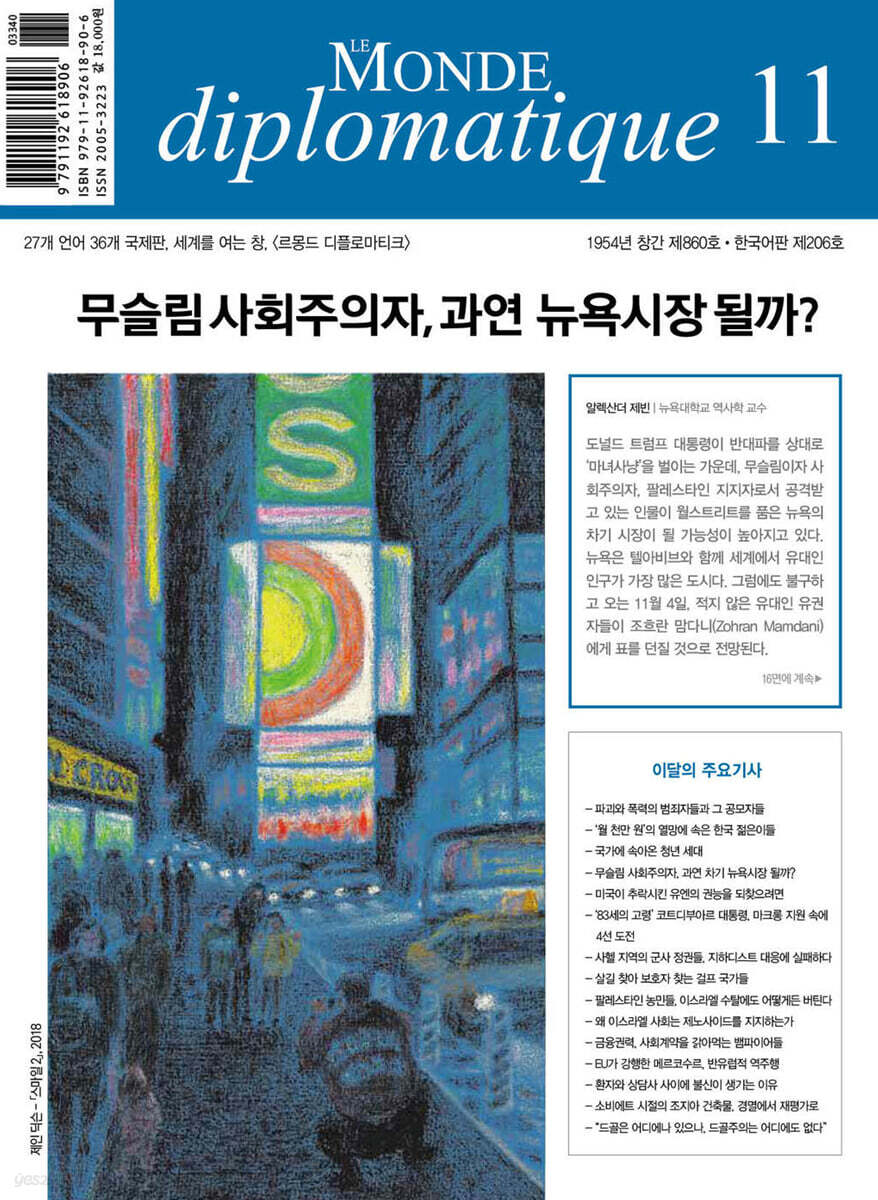
Alexander Zevin | A Muslim and a Socialist: Could He Be the Next Mayor of New York City?
Christophe Ventura | How to Reclaim the Power of the United Nations That the US Has Undermined
Fanny Pizzo | At 83, Ivorian President Seeks Fourth Term with Macron Support
Nina Vilen | Sahel military regimes fail to counter jihadists
Akram Belkaid | Gulf States Seeking a Way to Survive and a Protector
■ Israel & Palestine
Leonor Ashmann et al. | Palestinian Farmers Survive Israeli Exploitation
Gideon Levy | Why Israeli Society Supports Genocide
Philippe Descamps | Israel's genocide to compensate for its own population decline
■ Economy
Frédéric Lordon | Financial Power: Vampires Eating the Social Contract
Morvan Burrell | The EU's push for Mercosur: An anti-European backlash
■ Society
Evelyn Pieyet | Why Mistrust Occurs Between Patients and Counselor
■ History
Jens Maling | From Contempt to Reevaluation of Soviet-Era Georgian Architecture
Aurélien Bernier | "De Gaulle is everywhere, but Gaullism is nowhere."
■ Culture
Alexia Blanc | Why Socialist Consumption Was a Celebration
Peter Beinart | The Hypocritical 'Jewish Exceptionalism'
Xavier Lapreille | The War That Turns Humans into Beasts
Nicolas Mellant | Take the Moon? The World and Its Opposite
Ellen Richard | In the Name of Revolution
■ Korean Peninsula
Mok Su-jeong | Why did BlackRock join hands with Korea?
Park Jeong-eun | Countless threats and intimidation: What does the US mean to us?
Kim Young-geun | The launch of the far-right Liberal Coalition government: What impact will it have on Korea-Japan relations?
Lim Hyung-jin | How Theater People Are Resisting the New Far Right
Song A-reum | Can we now speak of the existence of Korean cinema?
Kang Eun-young & Kang Hye-young: The Great Country Boy's Search for Happiness - Francis Cabrel
[About the Author]
Benoit Breville
French publisher, PhD in history.
He served as a professor at the University of Quebec, a researcher at the Institute of 20th Century Social History at the University of Paris 1, and editor-in-chief of the French edition.
It critically analyzes urban poverty, social policy, press freedom and censorship, global economics, and technological power.
His major works include 『Les mondes insurges.
Altermanuel d'histoire contemporaine The world of rebellion.
His publications include 『Alternative Handbook of Modern History』(co-authored, 2014), 『Manuel d'histoire critique Handbook of Critical History』(2014), etc.
■ Column of the Month
Benoit Breville | The Criminals of Destruction and Violence and Their Accomplices
Seong Il-kwon | Young Koreans Deceived by the Aspiration of Ten Million Won a Month
■ Focus
Florence Iadaden | A Generation of Youth Deceived by the State
■ Global Village
Alexander Zevin | A Muslim and a Socialist: Could He Be the Next Mayor of New York City?
Christophe Ventura | How to Reclaim the Power of the United Nations That the US Has Undermined
Fanny Pizzo | At 83, Ivorian President Seeks Fourth Term with Macron Support
Nina Vilen | Sahel military regimes fail to counter jihadists
Akram Belkaid | Gulf States Seeking a Way to Survive and a Protector
■ Israel & Palestine
Leonor Ashmann et al. | Palestinian Farmers Survive Israeli Exploitation
Gideon Levy | Why Israeli Society Supports Genocide
Philippe Descamps | Israel's genocide to compensate for its own population decline
■ Economy
Frédéric Lordon | Financial Power: Vampires Eating the Social Contract
Morvan Burrell | The EU's push for Mercosur: An anti-European backlash
■ Society
Evelyn Pieyet | Why Mistrust Occurs Between Patients and Counselor
■ History
Jens Maling | From Contempt to Reevaluation of Soviet-Era Georgian Architecture
Aurélien Bernier | "De Gaulle is everywhere, but Gaullism is nowhere."
■ Culture
Alexia Blanc | Why Socialist Consumption Was a Celebration
Peter Beinart | The Hypocritical 'Jewish Exceptionalism'
Xavier Lapreille | The War That Turns Humans into Beasts
Nicolas Mellant | Take the Moon? The World and Its Opposite
Ellen Richard | In the Name of Revolution
■ Korean Peninsula
Mok Su-jeong | Why did BlackRock join hands with Korea?
Park Jeong-eun | Countless threats and intimidation: What does the US mean to us?
Kim Young-geun | The launch of the far-right Liberal Coalition government: What impact will it have on Korea-Japan relations?
Lim Hyung-jin | How Theater People Are Resisting the New Far Right
Song A-reum | Can we now speak of the existence of Korean cinema?
Kang Eun-young & Kang Hye-young: The Great Country Boy's Search for Happiness - Francis Cabrel
[About the Author]
Benoit Breville
French publisher, PhD in history.
He served as a professor at the University of Quebec, a researcher at the Institute of 20th Century Social History at the University of Paris 1, and editor-in-chief of the French edition.
It critically analyzes urban poverty, social policy, press freedom and censorship, global economics, and technological power.
His major works include 『Les mondes insurges.
Altermanuel d'histoire contemporaine The world of rebellion.
His publications include 『Alternative Handbook of Modern History』(co-authored, 2014), 『Manuel d'histoire critique Handbook of Critical History』(2014), etc.
The perpetrators of destruction and their accomplices
French edition publisher
President Manuel Macron said he would wait for the “right moment” to recognize a Palestinian state.
But even in May 2024, when Spain, Ireland and Norway had already made their decisions, he still judged it premature.
The situation at that time was already serious enough.
The bombing of the Gaza Strip has been going on for eight months.
It had been ten years since Sweden had recognized Palestine, 36 years since the declaration of Palestinian independence, and three-quarters of the world's nations had already recognized it.
Nevertheless, the French president thought he could wait a few more months.
Young Koreans Deceived by the Aspiration of Ten Million Won a Month
Korean edition publisher
“A young Korean man was lured to Cambodia by a 10 million won monthly part-time job offer, and worked like a slave under the guise of a development company.”
At first, it seemed like a victim of an overseas voice phishing organization.
However, as the investigation narrows in, it is shocking to discover that the organization's operator, recruiter, and manager are all Korean.
This incident is not simply a foreign crime.
The moral collapse within Korean society is a 'human export' structure that has spread beyond the borders.
Could a Muslim Socialist Be the Next Mayor of New York City?
Alexander Zevin, Professor of History, New York University
As President Donald Trump wages a witch hunt against his opponents, a man under attack as a Muslim, a socialist and a Palestinian supporter is increasingly likely to become the next mayor of New York City, the city that embraces Wall Street.
New York, along with Tel Aviv, has the largest Jewish population in the world.
Nonetheless, it is expected that a significant number of Jewish voters will vote for Zohran Mamdani on November 4th.
To restore the power of the United Nations that the United States has undermined
Ancécile Robert | International Editor-in-Chief of the French Edition
Christophe Ventura, Research Director, Institute for International and Strategic Relations (IRIS)
The United Nations (UN), which is celebrating its 80th anniversary, appears even weaker.
On September 22, former US President Donald Trump said in his speech to the UN General Assembly, “The UN does not solve problems.
Rather, it creates new problems that we have to solve,” he criticized.
In the face of American disengagement and an increasingly threatening world order, the organization now faces the challenge of reinventing itself.
Military regimes in the Sahel fail to respond to jihadists.
Nina Villén | Africa Program Director, Egmont Institute, Brussels
In just ten years, the landscape of the Sahel has changed completely.
The successive coups in Mali, Burkina Faso, and Niger were initially seen as temporary measures to address security crises.
But now it is solidifying into a trend that solidifies an authoritarian regime.
The common denominator among the three countries is a strong aversion to the presence of French troops.
But the new military regimes have failed to present a clear political vision beyond this.
Above all, it is failing to stop the ever-spreading jihadist offensive.
The perpetrators of destruction and their accomplices
French edition publisher
President Manuel Macron said he would wait for the “right moment” to recognize a Palestinian state.
But even in May 2024, when Spain, Ireland and Norway had already made their decisions, he still judged it premature.
The situation at that time was already serious enough.
The bombing of the Gaza Strip has been going on for eight months.
It had been ten years since Sweden had recognized Palestine, 36 years since the declaration of Palestinian independence, and three-quarters of the world's nations had already recognized it.
Nevertheless, the French president thought he could wait a few more months.
Young Koreans Deceived by the Aspiration of Ten Million Won a Month
Korean edition publisher
“A young Korean man was lured to Cambodia by a 10 million won monthly part-time job offer, and worked like a slave under the guise of a development company.”
At first, it seemed like a victim of an overseas voice phishing organization.
However, as the investigation narrows in, it is shocking to discover that the organization's operator, recruiter, and manager are all Korean.
This incident is not simply a foreign crime.
The moral collapse within Korean society is a 'human export' structure that has spread beyond the borders.
Could a Muslim Socialist Be the Next Mayor of New York City?
Alexander Zevin, Professor of History, New York University
As President Donald Trump wages a witch hunt against his opponents, a man under attack as a Muslim, a socialist and a Palestinian supporter is increasingly likely to become the next mayor of New York City, the city that embraces Wall Street.
New York, along with Tel Aviv, has the largest Jewish population in the world.
Nonetheless, it is expected that a significant number of Jewish voters will vote for Zohran Mamdani on November 4th.
To restore the power of the United Nations that the United States has undermined
Ancécile Robert | International Editor-in-Chief of the French Edition
Christophe Ventura, Research Director, Institute for International and Strategic Relations (IRIS)
The United Nations (UN), which is celebrating its 80th anniversary, appears even weaker.
On September 22, former US President Donald Trump said in his speech to the UN General Assembly, “The UN does not solve problems.
Rather, it creates new problems that we have to solve,” he criticized.
In the face of American disengagement and an increasingly threatening world order, the organization now faces the challenge of reinventing itself.
Military regimes in the Sahel fail to respond to jihadists.
Nina Villén | Africa Program Director, Egmont Institute, Brussels
In just ten years, the landscape of the Sahel has changed completely.
The successive coups in Mali, Burkina Faso, and Niger were initially seen as temporary measures to address security crises.
But now it is solidifying into a trend that solidifies an authoritarian regime.
The common denominator among the three countries is a strong aversion to the presence of French troops.
But the new military regimes have failed to present a clear political vision beyond this.
Above all, it is failing to stop the ever-spreading jihadist offensive.
Detailed image

Publisher's Review
[Publisher's Review]
“Could a Muslim Socialist Be the Next Mayor of New York City?”
The November 2025 issue of the Korean edition is a special issue calling for "rebuilding the world" amid ethical bankruptcy and democratic regression.
The cover story, “Will a Muslim Socialist Be the Next Mayor of New York?” (Alexander Zevin), illuminates the potential for a moral politics re-emerging at the heart of American politics.
The challenge from New York City's Muslim socialist Congressman Zohran Mamdani is a portrait of a politician who, despite being attacked for his support of Palestinians, has not abandoned the language of justice and ethics.
The question posed throughout this issue—"Where does human dignity begin again after the collapse of ethics?"—originates from this cover story.
In "The Criminals of Destruction and Their Complicities," French publisher Benoit Breville denounces the moral bankruptcy of Western nations that aided and abetted the massacre in Gaza.
He pointed out that “the European Union, which imposed 19 sanctions on Russia, did not take a single action against Israel,” and asserted that “Europe was not a bystander, but an accomplice in the massacre.”
Breville's column exposes the hypocrisy of European democracy and the empty pronouncements of a West that has lost the "language of human rights."
His writing serves as the moral rudder for this entire issue.
In "Young Koreans Deceived by the Desire of Ten Million Won a Month," Korean edition publisher Seong Il-kwon exposes the reality of the "digital slave trade" in Cambodia, Myanmar, and the Philippines.
He diagnoses this not as a simple crime, but as “a human export structure that extends beyond the borders of the moral collapse within Korea.”
He interprets past international adoption as “an era of exporting lives in the name of welfare,” and today’s digital labor exploitation as “repeated human transactions in the name of labor.”
“In a society where money has taken precedence over humanity and efficiency has replaced ethics, we must now embark on a rebuilding of ethics.” This article expands the moral crisis in Korean society to a world-historical dimension.
In the following Focus section, French sociologist Florence Iardaden analyzes the reality in which the state has turned young people into “debtors” rather than objects of protection, through “The Generation of Youth Deceived by the State.”
She confronts the inequality and precarious labor within the youth generation, saying, “Youth is just a word,” borrowing Bourdieu’s words.
Youth unemployment is approaching 20%, and only a third of people under 30 have stable jobs.
“It’s not that young people are turning away from jobs, it’s that jobs are rejecting young people,” she says, criticizing the state’s “politics of management” for eroding the dignity of young people.
The Global Village section focuses on the cracks and restructuring of the world order.
In "Reclaiming the Power of the UN That the US Has Destroyed," Christophe Ventura highlights the diplomatic efforts of the Global South to restore the UN system that the US has weakened since the Cold War. In "83-Year-Old President of the Ivory Coast Runs for a Fourth Term with Macron's Support," Fanny Pizzo criticizes the reality that France's "patronage democracy" still holds sway over African politics. In "Military Regimes in the Sahel Fail to Respond to Jihadists," Nina Villenne examines the failure of West African military rule and the residual influence of France. In "Gulf States Wandering in Search of Protectors," Akram Belkaid focuses on the dilemma of the Gulf states, which have lost their autonomy within a structure of oil and security dependence.
The Global Village section highlights Le Diplo's core concerns: the absence of moral leadership amidst the chaos of world politics and the search for alternatives.
The Korean Peninsula section then highlights the conflicting intersections of global capital and democracy.
Mok Su-jeong's "Why Did BlackRock Join Hands with Korea?" interprets the entry of BlackRock, the world's largest asset management company, into Korea as "a new test for Korean democracy." The articles by Park Jeong-eun, Kim Young-geun, Lim Hyeong-jin, and Song A-reum
It explores structural inequality and cultural resistance in Korean society, covering the intersection of Korea-US relations, far-right coalitions, and art and politics.
“Could a Muslim Socialist Be the Next Mayor of New York City?”
The November 2025 issue of the Korean edition is a special issue calling for "rebuilding the world" amid ethical bankruptcy and democratic regression.
The cover story, “Will a Muslim Socialist Be the Next Mayor of New York?” (Alexander Zevin), illuminates the potential for a moral politics re-emerging at the heart of American politics.
The challenge from New York City's Muslim socialist Congressman Zohran Mamdani is a portrait of a politician who, despite being attacked for his support of Palestinians, has not abandoned the language of justice and ethics.
The question posed throughout this issue—"Where does human dignity begin again after the collapse of ethics?"—originates from this cover story.
In "The Criminals of Destruction and Their Complicities," French publisher Benoit Breville denounces the moral bankruptcy of Western nations that aided and abetted the massacre in Gaza.
He pointed out that “the European Union, which imposed 19 sanctions on Russia, did not take a single action against Israel,” and asserted that “Europe was not a bystander, but an accomplice in the massacre.”
Breville's column exposes the hypocrisy of European democracy and the empty pronouncements of a West that has lost the "language of human rights."
His writing serves as the moral rudder for this entire issue.
In "Young Koreans Deceived by the Desire of Ten Million Won a Month," Korean edition publisher Seong Il-kwon exposes the reality of the "digital slave trade" in Cambodia, Myanmar, and the Philippines.
He diagnoses this not as a simple crime, but as “a human export structure that extends beyond the borders of the moral collapse within Korea.”
He interprets past international adoption as “an era of exporting lives in the name of welfare,” and today’s digital labor exploitation as “repeated human transactions in the name of labor.”
“In a society where money has taken precedence over humanity and efficiency has replaced ethics, we must now embark on a rebuilding of ethics.” This article expands the moral crisis in Korean society to a world-historical dimension.
In the following Focus section, French sociologist Florence Iardaden analyzes the reality in which the state has turned young people into “debtors” rather than objects of protection, through “The Generation of Youth Deceived by the State.”
She confronts the inequality and precarious labor within the youth generation, saying, “Youth is just a word,” borrowing Bourdieu’s words.
Youth unemployment is approaching 20%, and only a third of people under 30 have stable jobs.
“It’s not that young people are turning away from jobs, it’s that jobs are rejecting young people,” she says, criticizing the state’s “politics of management” for eroding the dignity of young people.
The Global Village section focuses on the cracks and restructuring of the world order.
In "Reclaiming the Power of the UN That the US Has Destroyed," Christophe Ventura highlights the diplomatic efforts of the Global South to restore the UN system that the US has weakened since the Cold War. In "83-Year-Old President of the Ivory Coast Runs for a Fourth Term with Macron's Support," Fanny Pizzo criticizes the reality that France's "patronage democracy" still holds sway over African politics. In "Military Regimes in the Sahel Fail to Respond to Jihadists," Nina Villenne examines the failure of West African military rule and the residual influence of France. In "Gulf States Wandering in Search of Protectors," Akram Belkaid focuses on the dilemma of the Gulf states, which have lost their autonomy within a structure of oil and security dependence.
The Global Village section highlights Le Diplo's core concerns: the absence of moral leadership amidst the chaos of world politics and the search for alternatives.
The Korean Peninsula section then highlights the conflicting intersections of global capital and democracy.
Mok Su-jeong's "Why Did BlackRock Join Hands with Korea?" interprets the entry of BlackRock, the world's largest asset management company, into Korea as "a new test for Korean democracy." The articles by Park Jeong-eun, Kim Young-geun, Lim Hyeong-jin, and Song A-reum
It explores structural inequality and cultural resistance in Korean society, covering the intersection of Korea-US relations, far-right coalitions, and art and politics.
GOODS SPECIFICS
- Date of issue: October 30, 2025
- Page count, weight, size: 128 pages | 205*285*6mm
- ISBN13: 9791192618906
- ISBN10: 1192618904
You may also like
카테고리
korean


korean

![GQ KOREA Mark (Monthly): December [2025]](http://librairie.coreenne.fr/cdn/shop/files/8ef265dbbfbf186523ed75ba7319009d.jpg?v=1765340328&width=3840)


