![NewPhilosopher (Quarterly): Vol. 30 [2025]](http://librairie.coreenne.fr/cdn/shop/files/f69a9f73afd7ba7cccb3b43c3ede8eac.jpg?v=1765275198&width=3840)

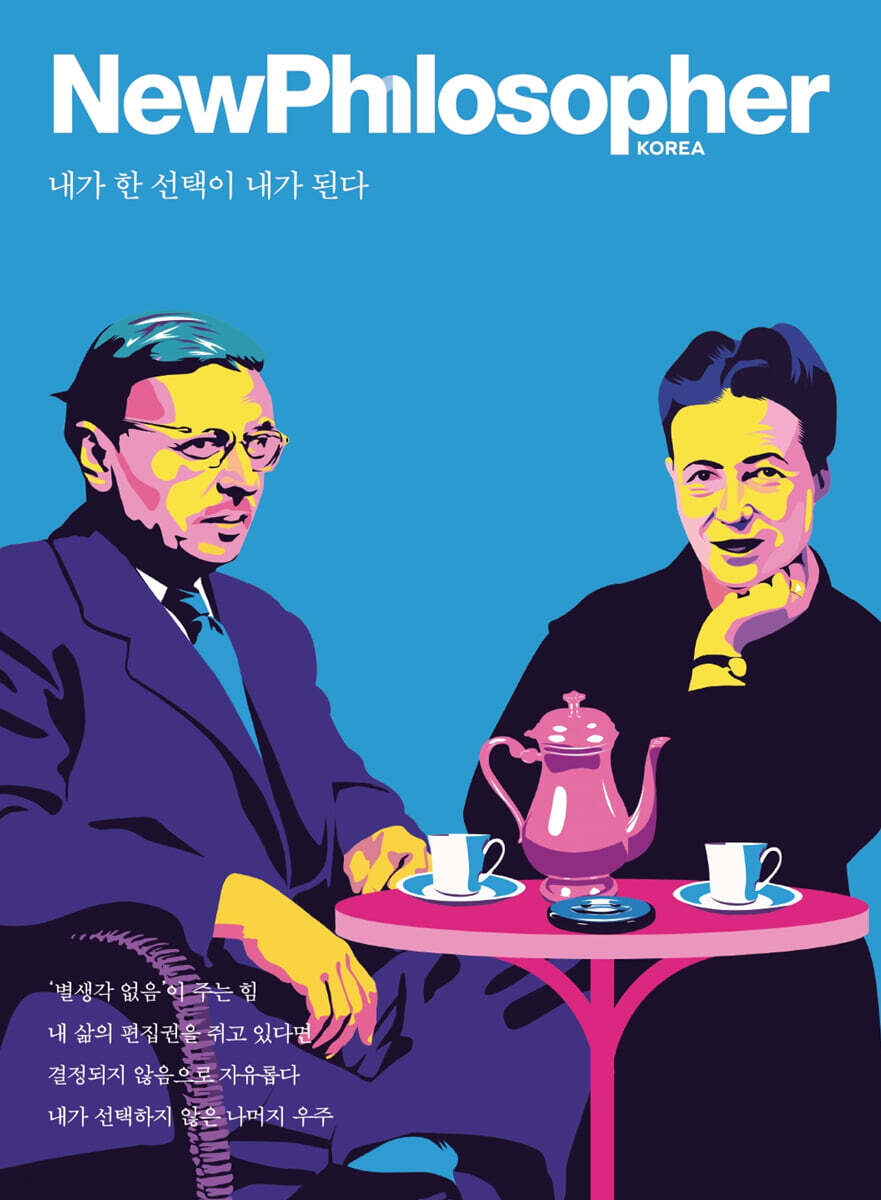
NewPhilosopher (Quarterly): Vol. 30 [2025]
 |
Description
Book Introduction
Kierkegaard said, 'Life is a series of choices.'
He said that this principle is the 'core of all philosophy' because humans are bound to regret whatever they choose or don't choose.
Jean-Paul Sartre said, "What I choose becomes my reality," and Simone de Beauvoir said, "Women must have the right to self-determination, that is, freedom, to choose for themselves."
In this way, 'choice' is a fundamental right and duty of life that many philosophers have focused on.
In "New Philosopher," we will examine how we should exercise the freedom of choice, the meaning of the conflict between free will and determinism, which is often discussed in conjunction with choice, and even the wandering of modern people who cannot readily make a decision amidst an infinite array of choices, through various perspectives on choice.
He said that this principle is the 'core of all philosophy' because humans are bound to regret whatever they choose or don't choose.
Jean-Paul Sartre said, "What I choose becomes my reality," and Simone de Beauvoir said, "Women must have the right to self-determination, that is, freedom, to choose for themselves."
In this way, 'choice' is a fundamental right and duty of life that many philosophers have focused on.
In "New Philosopher," we will examine how we should exercise the freedom of choice, the meaning of the conflict between free will and determinism, which is often discussed in conjunction with choice, and even the wandering of modern people who cannot readily make a decision amidst an infinite array of choices, through various perspectives on choice.
- You can preview some of the book's contents.
Preview
index
[New Philosopher (2025 Vol.
31) Table of Contents]
If it's just unavoidable luck anyway
Before talking about genetic fatalism
Luck composed of positive and negative particles
Do you want to become a slave to routine?
A life indebted to chance
31) Table of Contents]
If it's just unavoidable luck anyway
Before talking about genetic fatalism
Luck composed of positive and negative particles
Do you want to become a slave to routine?
A life indebted to chance
Detailed image
Publisher's Review
A choice that requires giving up everything but one
_ Thinking of the rest of the universe I didn't choose
The criteria for choosing something will probably vary depending on the situation, but it will generally be based on this idea.
'Which one do I like more?', 'Which one is more beneficial to me?', and 'Which one is the safer choice?', etc.
But there comes a point where we are in a critical conflict when it comes to making choices that meet these conditions.
'Perhaps it would have been better if I hadn't chosen it?'
Patrick Stokes, a professor of philosophy at Deakin University in Australia, uses marriage as an example, saying that marriage is not about choosing one person, but rather, as the traditional wedding vows say, "forsaking all others."
If you choose one, you don't know if the other one you didn't choose would be a better person, a better thing, or a better situation.
Ultimately, choices are always accompanied by feelings of regret, but fortunately, there are many people who are not overwhelmed by regret and live according to their choices.
Professor Stokes then proposes a solution.
This is a way of looking at choice as 'evaluating various possible worlds'.
The possible world here refers to the world closest to reality. For example, rather than choosing between A and B, it is choosing between ‘the possible world A’ and ‘the possible world B’.
This possible worlds theory, which is in line with the controversial 'modal realism' of philosopher David Lewis, believes that even if 'possible world A' is actually chosen, 'possible world B' exists very close by.
What this means is that when you choose one option, the other options you had to give up don't simply disappear.
In the realm of philosophy, this hypothesis tells us that the many paths we are given when faced with the countless choices in life are innumerable possibilities themselves.
Of course, it's hard to know what to regret, since we can never know what our lives would have been like if we had chosen differently.
But if Lewis is right, there are always universes in which I made different choices.
In at least one of those universes, I'm a rock star.
(Page 25)
Is there such a thing as a best choice?
_ In a world where decision paralysis is commonplace,
When discussing choice, 'determinism' and 'free will' are topics that many philosophers never leave out.
In particular, Jean-Paul Sartre asserted that "humans are beings sentenced to freedom" and that "our fate is not predetermined, but we choose it ourselves at every moment."
However, determinists, who stood at the opposite end of the spectrum, defended determinism, which held that there was no such thing as human choice and that the conclusion of choice was already decided.
Even if a person makes a choice after much deliberation, it means that his brain, or the universe, already knows his choice.
Are the decisions we make in life truly our own independent free will, or are we simply following the predetermined decisions of a superior being with a far superior intelligence?
I also agree with the analysis that the countless choices paralyze the autonomy to make choices.
After displaying several picture posters, one group was asked to immediately select the one they liked, while another group was asked to examine them closely, analyze the pros and cons of each poster, and finally select one.
A few days later, when they were asked whether they still liked the posters they had chosen, quite a few people in the first group said yes, but more people in the second group said they did not like them.
Social psychologist Barry Schwartz has argued that too many choices can actually hinder freedom, and that excessive worry and focus can actually lead to more errors.
Compared to the past, the present world is a world where too many choices are spread out like mushrooms.
How much focus can we have on the various texts and images displayed on our phone screens as we endlessly scroll down?
Dr. Schwartz hints that while we can't reduce the range of choices, we can reduce the number of options we have to consider.
But it seems unlikely that humanity will have fewer choices when the capitalist world meets cutting-edge technology.
Just someone who wants to make the best choice and is satisfied with the choice they made.
I conclude that among these two types of people, the latter attitude is by far the one that brings us closer to happiness.
It's no surprise that many young people struggle with decision paralysis, as the younger you are, the more you struggle to find the best solution.
I think as people get older, they come to the realization that moderation is enough.
(Page 57)
“If I had editorial control over my life”
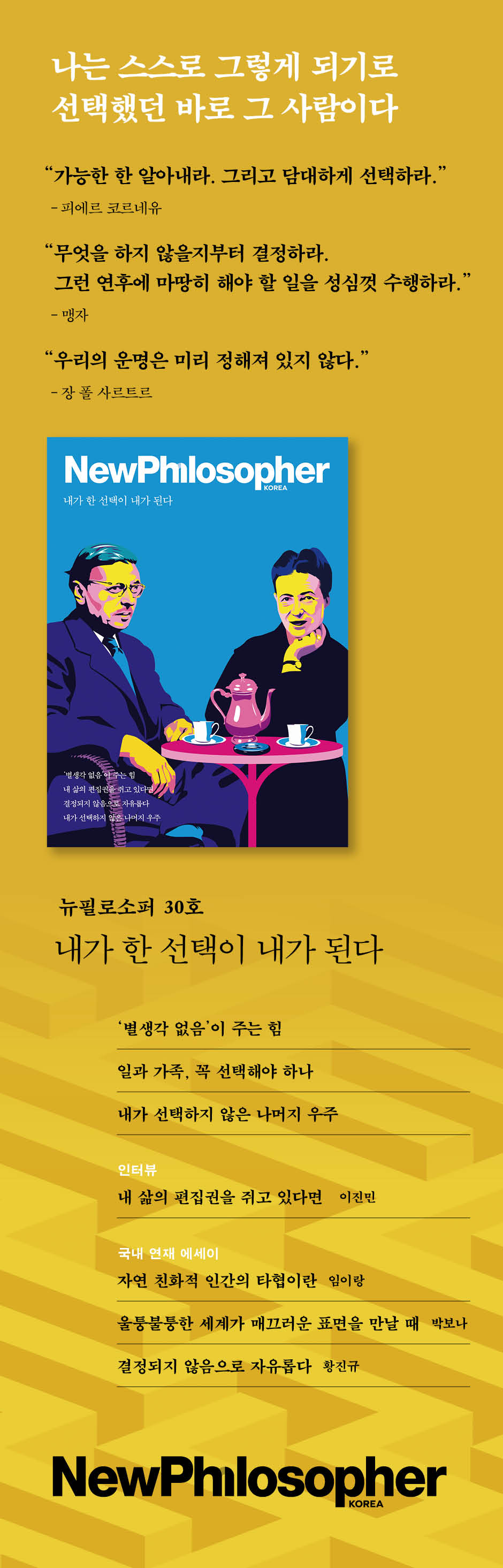
- Interview with Lee Jin-min, a philosophical mother, and philosophical essays by Korean writers.
We meet author Jinmin Lee, who lives near Munich, Germany, through an email interview.
Jinmin Lee, who earned a doctorate in philosophy at the same time as giving birth, is a philosophy writer with a lot of energy who consistently publishes more than one book a year, despite his quiet appearance living abroad.
Raising two children in a foreign country with no one to turn to, his only supporters were the philosophers he found lying in his books.
When looking at a child with separation anxiety, he thought of Hobbes, who said, "We must make the anxious future predictable," and when setting boundaries for children's freedom, he was helped by Mill, who taught him the "principle of no harm," and Shukla's advice to "start by eliminating the bad rather than the good" became the pillar of his parenting philosophy.
This issue also includes philosophical essays written by Korean authors, freely exploring their own fields.
Writers Im and Lee Rang talk about the space of a travel destination's accommodation where one can entrust one's tired body and soul, artist Park Bo-na talks about a young painter who creates smooth pictures with an airbrush, and philosopher Hwang Jin-gyu explains the infinite potential and indeterminacy of human freedom based on Henri Bergson's theory of nervous system development.
“Even if a certain choice seems to completely change the direction of my life, I think it’s a matter of which side I focus on and which side I defocus while having the editorial control over my life.
We can usually go back in that direction over time.” (p. 152)
_ Thinking of the rest of the universe I didn't choose
The criteria for choosing something will probably vary depending on the situation, but it will generally be based on this idea.
'Which one do I like more?', 'Which one is more beneficial to me?', and 'Which one is the safer choice?', etc.
But there comes a point where we are in a critical conflict when it comes to making choices that meet these conditions.
'Perhaps it would have been better if I hadn't chosen it?'
Patrick Stokes, a professor of philosophy at Deakin University in Australia, uses marriage as an example, saying that marriage is not about choosing one person, but rather, as the traditional wedding vows say, "forsaking all others."
If you choose one, you don't know if the other one you didn't choose would be a better person, a better thing, or a better situation.
Ultimately, choices are always accompanied by feelings of regret, but fortunately, there are many people who are not overwhelmed by regret and live according to their choices.
Professor Stokes then proposes a solution.
This is a way of looking at choice as 'evaluating various possible worlds'.
The possible world here refers to the world closest to reality. For example, rather than choosing between A and B, it is choosing between ‘the possible world A’ and ‘the possible world B’.
This possible worlds theory, which is in line with the controversial 'modal realism' of philosopher David Lewis, believes that even if 'possible world A' is actually chosen, 'possible world B' exists very close by.
What this means is that when you choose one option, the other options you had to give up don't simply disappear.
In the realm of philosophy, this hypothesis tells us that the many paths we are given when faced with the countless choices in life are innumerable possibilities themselves.
Of course, it's hard to know what to regret, since we can never know what our lives would have been like if we had chosen differently.
But if Lewis is right, there are always universes in which I made different choices.
In at least one of those universes, I'm a rock star.
(Page 25)
Is there such a thing as a best choice?
_ In a world where decision paralysis is commonplace,
When discussing choice, 'determinism' and 'free will' are topics that many philosophers never leave out.
In particular, Jean-Paul Sartre asserted that "humans are beings sentenced to freedom" and that "our fate is not predetermined, but we choose it ourselves at every moment."
However, determinists, who stood at the opposite end of the spectrum, defended determinism, which held that there was no such thing as human choice and that the conclusion of choice was already decided.
Even if a person makes a choice after much deliberation, it means that his brain, or the universe, already knows his choice.
Are the decisions we make in life truly our own independent free will, or are we simply following the predetermined decisions of a superior being with a far superior intelligence?
I also agree with the analysis that the countless choices paralyze the autonomy to make choices.
After displaying several picture posters, one group was asked to immediately select the one they liked, while another group was asked to examine them closely, analyze the pros and cons of each poster, and finally select one.
A few days later, when they were asked whether they still liked the posters they had chosen, quite a few people in the first group said yes, but more people in the second group said they did not like them.
Social psychologist Barry Schwartz has argued that too many choices can actually hinder freedom, and that excessive worry and focus can actually lead to more errors.
Compared to the past, the present world is a world where too many choices are spread out like mushrooms.
How much focus can we have on the various texts and images displayed on our phone screens as we endlessly scroll down?
Dr. Schwartz hints that while we can't reduce the range of choices, we can reduce the number of options we have to consider.
But it seems unlikely that humanity will have fewer choices when the capitalist world meets cutting-edge technology.
Just someone who wants to make the best choice and is satisfied with the choice they made.
I conclude that among these two types of people, the latter attitude is by far the one that brings us closer to happiness.
It's no surprise that many young people struggle with decision paralysis, as the younger you are, the more you struggle to find the best solution.
I think as people get older, they come to the realization that moderation is enough.
(Page 57)
“If I had editorial control over my life”
- Interview with Lee Jin-min, a philosophical mother, and philosophical essays by Korean writers.
We meet author Jinmin Lee, who lives near Munich, Germany, through an email interview.
Jinmin Lee, who earned a doctorate in philosophy at the same time as giving birth, is a philosophy writer with a lot of energy who consistently publishes more than one book a year, despite his quiet appearance living abroad.
Raising two children in a foreign country with no one to turn to, his only supporters were the philosophers he found lying in his books.
When looking at a child with separation anxiety, he thought of Hobbes, who said, "We must make the anxious future predictable," and when setting boundaries for children's freedom, he was helped by Mill, who taught him the "principle of no harm," and Shukla's advice to "start by eliminating the bad rather than the good" became the pillar of his parenting philosophy.
This issue also includes philosophical essays written by Korean authors, freely exploring their own fields.
Writers Im and Lee Rang talk about the space of a travel destination's accommodation where one can entrust one's tired body and soul, artist Park Bo-na talks about a young painter who creates smooth pictures with an airbrush, and philosopher Hwang Jin-gyu explains the infinite potential and indeterminacy of human freedom based on Henri Bergson's theory of nervous system development.
“Even if a certain choice seems to completely change the direction of my life, I think it’s a matter of which side I focus on and which side I defocus while having the editorial control over my life.
We can usually go back in that direction over time.” (p. 152)
GOODS SPECIFICS
- Date of issue: April 3, 2025
- Page count, weight, size: 184 pages | 180*245*20mm
- ISBN13: 9772586476005
- ISBN10: 25864769
You may also like
카테고리
korean


korean

![GQ KOREA Mark (Monthly): December [2025]](http://librairie.coreenne.fr/cdn/shop/files/8ef265dbbfbf186523ed75ba7319009d.jpg?v=1765340328&width=3840)


