

Maze 3: OMA
 |
Description
Book Introduction
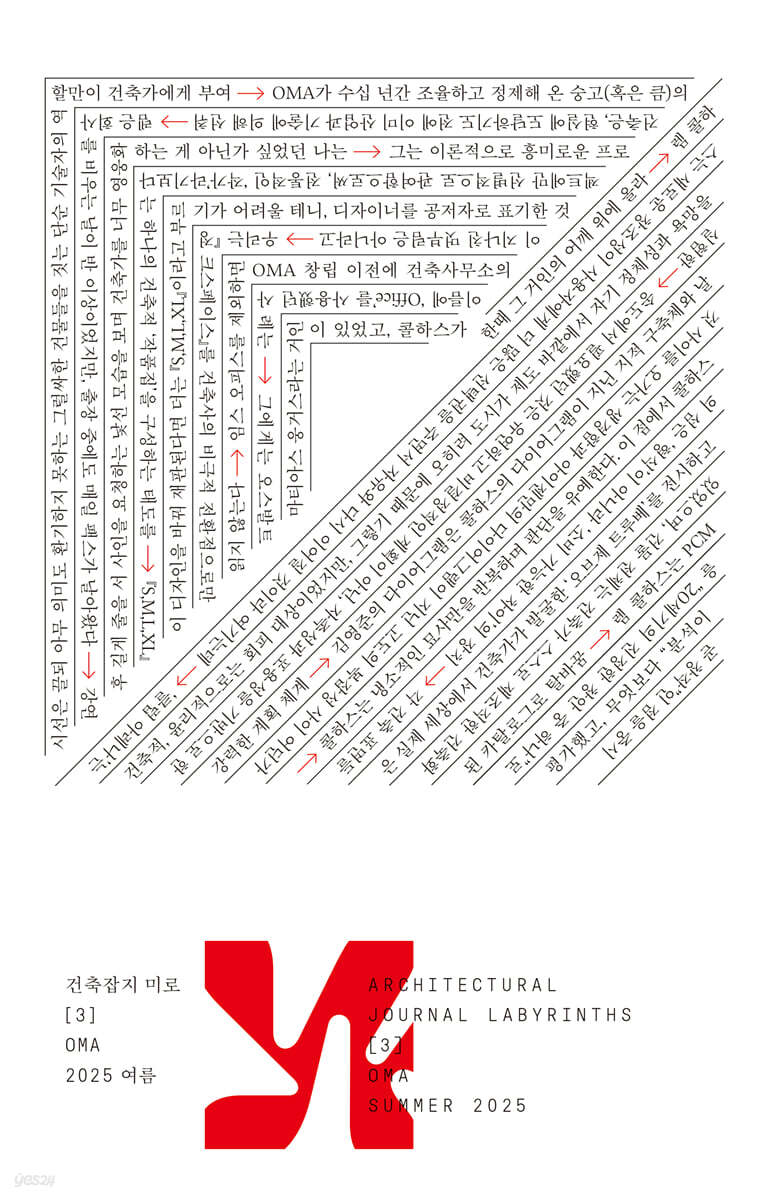
The architectural magazine 『Miro』, published three times a year, aims to discover and record the discourse of modern Korean architecture.
It is a text-based magazine consisting only of articles focusing on a selected topic each issue, and the theme of the third issue is “OMA.”
It is a text-based magazine consisting only of articles focusing on a selected topic each issue, and the theme of the third issue is “OMA.”
- You can preview some of the book's contents.
Preview
index
Weaving together "Labyrinth" _ Park Jeong-hyeon
A Society of Unconscious Collaborators _ Jeong Dae-in
Oh, My Sublime!_Kang Hyun-seok
A conversation between Rem and Jo Min-seok in the mid-1990s _ Jo Min-seok, Park Jeong-hyeon, Choi Won-jun, and Bae Yoon-kyung
A Retrospective Year Later on Koolhaas as Seen Through the Eyes of a Late 20th-Century Korean Architecture Student _ Wonjun Choi
OMA Asia, the Beginning _ Vincent Feu Duvalon
How much would all the tens of thousands of copies of "S,M,L,ML" in the world weigh? (Unrelated to the article) _ Choi Seong-min
Junkspace Kids™ _ Jeon Jae-woo
History of Group Names _ Lee Hee-jun
OMU+OMA _ Kim Geon-ho
Freedom and Creation: The Case of Paul Frankl and Rem Koolhaas _ Lim Seong-hun
Seoul in Delirium _ Choi Na-wook
Between Planned and Unplanned: The Ideals and Limitations of the OMA Songdo Experiment _ Oh Do-young
Diagrams: The Complex, the Raw, and the Opaque _ Hyun Myung-seok
From Mega-Architecture to Absolute Architecture: OMA's New Hongik Campus and Seoul's Urban Politics _ Lee Jang-hee
Rem Koolhaas and Heterogeneous Accumulation _ Nam Seong-taek
Rem Koolhaas's Experiments in Architecture _ Jeong Man-young
A Society of Unconscious Collaborators _ Jeong Dae-in
Oh, My Sublime!_Kang Hyun-seok
A conversation between Rem and Jo Min-seok in the mid-1990s _ Jo Min-seok, Park Jeong-hyeon, Choi Won-jun, and Bae Yoon-kyung
A Retrospective Year Later on Koolhaas as Seen Through the Eyes of a Late 20th-Century Korean Architecture Student _ Wonjun Choi
OMA Asia, the Beginning _ Vincent Feu Duvalon
How much would all the tens of thousands of copies of "S,M,L,ML" in the world weigh? (Unrelated to the article) _ Choi Seong-min
Junkspace Kids™ _ Jeon Jae-woo
History of Group Names _ Lee Hee-jun
OMU+OMA _ Kim Geon-ho
Freedom and Creation: The Case of Paul Frankl and Rem Koolhaas _ Lim Seong-hun
Seoul in Delirium _ Choi Na-wook
Between Planned and Unplanned: The Ideals and Limitations of the OMA Songdo Experiment _ Oh Do-young
Diagrams: The Complex, the Raw, and the Opaque _ Hyun Myung-seok
From Mega-Architecture to Absolute Architecture: OMA's New Hongik Campus and Seoul's Urban Politics _ Lee Jang-hee
Rem Koolhaas and Heterogeneous Accumulation _ Nam Seong-taek
Rem Koolhaas's Experiments in Architecture _ Jeong Man-young
Publisher's Review
While compiling 『Labyrinth 3: OMA』
In 1974, Rem Koolhaas, then just thirty, wrote a short article in Oppositions No. 3 about a masquerade ball for architects held by the American Academy of Beaux-Arts in 1931.
It was an event where architects who had built buildings that competed in the New York sky at the time, such as the Chrysler Building, attended a banquet wearing clothes that resembled their buildings.
Rem Koolhaas diagnoses that although they are essentially the same, they are showing off their individuality without any meaning due to competition.
This article was aimed at the exhibition “Five Architects” held two years earlier in 1972 by five New York-based architects (Peter Eisenman, Michael Graves, Charles Guasmi, John Hejduk, and Richard Meier, who were also the leading members of “Opositions”).
Two events that occurred 40 years apart, in 1931 and 1972, are parallel.
In 1931, when European modernism was at its peak or at its demise, a masquerade ball was held in New York at the Beaux-Arts Academy (the very thing that modernism was trying to overcome).
In 1972, young architects in New York were following the lead of European high-modernist architecture (which had been the subject of harsh criticism only a few years earlier).
New York was adoring a Europe of the past, and Rem Koolhaas was obsessively searching for the overlooked features of New York.
Manfredo Tafuri described this period of Rem Koolhaas's career as a 'joke'.
Fifty years later, Rem Koolhaas's language has become the most serious of words, a joke that exerts real power.
Whether the joke still retains its timeliness, wit, and sharpness is another matter.
In 1996, more than 20 years later, New York architects posed for Vanity Fair in costumes modeled after their buildings, and Rem Koolhaas was wandering the globe like the legendary Flying Dutchman.
Asia has emerged as a prime opportunity to test the theories honed in New York.
From this very point on, Korea also becomes entangled in it.
In all aspects, including human exchanges, Korean projects, and discourse, Korea is a party to the OMA era.
This is a different situation from the incident where Kim Jung-up rang the doorbell of Le Corbusier's Parisian studio only after a difficult string of exceptions and coincidences, or the incident where Kim Jong-seong, who was able to enjoy exceptional luck, was able to become Miss's disciple.
If the relationship between modernist masters and Korean architecture was previously one-sided and operated within a time gap, since the late 1990s, the relationship between the global architectural world and Korea has been two-way and contemporary.
Even though the intensity and density of the relationship were not equal, and misunderstandings and speculations arose within the contemporaneity.
If there had been no economic growth in Asia, including Korea, the coined word "starchitect" would certainly have a very different nuance than it does today.
In this context, the goal of this issue is to examine Rem Koolhaas and OMA in Korea. We've attempted to view OMA through the lens of Korea and Seoul.
In 1974, Rem Koolhaas, then just thirty, wrote a short article in Oppositions No. 3 about a masquerade ball for architects held by the American Academy of Beaux-Arts in 1931.
It was an event where architects who had built buildings that competed in the New York sky at the time, such as the Chrysler Building, attended a banquet wearing clothes that resembled their buildings.
Rem Koolhaas diagnoses that although they are essentially the same, they are showing off their individuality without any meaning due to competition.
This article was aimed at the exhibition “Five Architects” held two years earlier in 1972 by five New York-based architects (Peter Eisenman, Michael Graves, Charles Guasmi, John Hejduk, and Richard Meier, who were also the leading members of “Opositions”).
Two events that occurred 40 years apart, in 1931 and 1972, are parallel.
In 1931, when European modernism was at its peak or at its demise, a masquerade ball was held in New York at the Beaux-Arts Academy (the very thing that modernism was trying to overcome).
In 1972, young architects in New York were following the lead of European high-modernist architecture (which had been the subject of harsh criticism only a few years earlier).
New York was adoring a Europe of the past, and Rem Koolhaas was obsessively searching for the overlooked features of New York.
Manfredo Tafuri described this period of Rem Koolhaas's career as a 'joke'.
Fifty years later, Rem Koolhaas's language has become the most serious of words, a joke that exerts real power.
Whether the joke still retains its timeliness, wit, and sharpness is another matter.
In 1996, more than 20 years later, New York architects posed for Vanity Fair in costumes modeled after their buildings, and Rem Koolhaas was wandering the globe like the legendary Flying Dutchman.
Asia has emerged as a prime opportunity to test the theories honed in New York.
From this very point on, Korea also becomes entangled in it.
In all aspects, including human exchanges, Korean projects, and discourse, Korea is a party to the OMA era.
This is a different situation from the incident where Kim Jung-up rang the doorbell of Le Corbusier's Parisian studio only after a difficult string of exceptions and coincidences, or the incident where Kim Jong-seong, who was able to enjoy exceptional luck, was able to become Miss's disciple.
If the relationship between modernist masters and Korean architecture was previously one-sided and operated within a time gap, since the late 1990s, the relationship between the global architectural world and Korea has been two-way and contemporary.
Even though the intensity and density of the relationship were not equal, and misunderstandings and speculations arose within the contemporaneity.
If there had been no economic growth in Asia, including Korea, the coined word "starchitect" would certainly have a very different nuance than it does today.
In this context, the goal of this issue is to examine Rem Koolhaas and OMA in Korea. We've attempted to view OMA through the lens of Korea and Seoul.
GOODS SPECIFICS
- Date of issue: August 30, 2025
- Page count, weight, size: 248 pages | 142*225*20mm
- ISBN13: 9791190853699
- ISBN10: 1190853698
You may also like
카테고리
korean


korean

![GQ KOREA Mark (Monthly): December [2025]](http://librairie.coreenne.fr/cdn/shop/files/8ef265dbbfbf186523ed75ba7319009d.jpg?v=1765340328&width=3840)


