

SKEPTIC Korea (quarterly): Issue 42
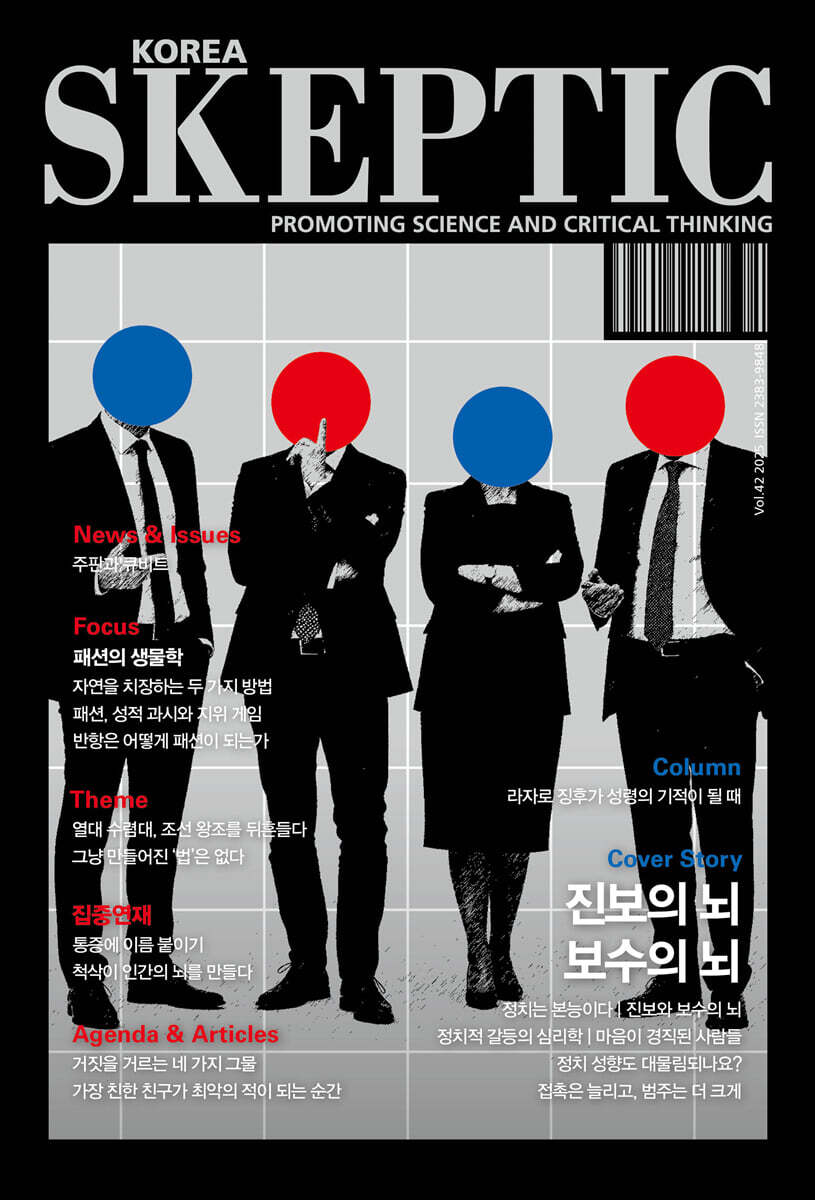 |
Description
Book Introduction
Where do the roots of political conflicts that are reaching extremes lie?
From the differences in the brains of progressives and conservatives to the inheritance of political leanings, a path to broadening the radius of empathy beyond the psychological foundations and echo chambers of ideology.
Is fashion entirely a product of culture? The biology of fashion as a game of sexual display and status, from natural beauty strategies to the mechanisms by which rebellion becomes style.
Understanding the calculation principles of quantum computers with an abacus, the secrets of climate history that changed the fate of the Joseon Dynasty due to the Intertropical Convergence Zone, naming pain and escaping meaningless pain, the story of the evolution of the human brain that began in chordates.
From the thinking tools that filter out lies to the trap of perception that gives meaning to coincidences through the Lazarus Sign, Skeptic Issue #42 is filled with fascinating articles.
From the differences in the brains of progressives and conservatives to the inheritance of political leanings, a path to broadening the radius of empathy beyond the psychological foundations and echo chambers of ideology.
Is fashion entirely a product of culture? The biology of fashion as a game of sexual display and status, from natural beauty strategies to the mechanisms by which rebellion becomes style.
Understanding the calculation principles of quantum computers with an abacus, the secrets of climate history that changed the fate of the Joseon Dynasty due to the Intertropical Convergence Zone, naming pain and escaping meaningless pain, the story of the evolution of the human brain that began in chordates.
From the thinking tools that filter out lies to the trap of perception that gives meaning to coincidences through the Lazarus Sign, Skeptic Issue #42 is filled with fascinating articles.
- You can preview some of the book's contents.
Preview
index
News & Issues
Abacus and Qubit - Kim Ki-duk
Column
When the Sign of Lazarus Becomes a Miracle of the Holy Spirit - John D.
Van Dijk
Cover Story: The Progressive Brain, the Conservative Brain
Politics is an instinct - Manos Tsakiris
The Brain of Progressives and Conservatives - Kwon Jun-su
The Psychology of Political Conflict - Kim Hak-jin
People with Stiff Hearts - Leor Zmigrod
Are political leanings inherited? - Choi Jeong-gyun
Increase contact, expand categories - Jeong Tae-yeon
Theme
The Tropical Convergence Zone Shakes the Joseon Dynasty - Park Jeong-jae
There is no such thing as a 'law' that is just created - PM
Intensive series
Naming Pain - Woo Chung-wan
The Chorda Forms the Human Brain - Lee Dae-han
Focus on the Biology of Fashion
Two Ways to Decorate Nature - David P.
Barash
Fashion, Sexual Display, and the Status Game - Catherine Salmon and Rebecca L.
Birch
How Rebellion Becomes Fashion - W.
David Marks
Agenda &Articles
Four Nets to Filter Out Lies - Baek Woo-jin
When Your Best Friend Becomes Your Worst Enemy - Lawrence Newport
Abacus and Qubit - Kim Ki-duk
Column
When the Sign of Lazarus Becomes a Miracle of the Holy Spirit - John D.
Van Dijk
Cover Story: The Progressive Brain, the Conservative Brain
Politics is an instinct - Manos Tsakiris
The Brain of Progressives and Conservatives - Kwon Jun-su
The Psychology of Political Conflict - Kim Hak-jin
People with Stiff Hearts - Leor Zmigrod
Are political leanings inherited? - Choi Jeong-gyun
Increase contact, expand categories - Jeong Tae-yeon
Theme
The Tropical Convergence Zone Shakes the Joseon Dynasty - Park Jeong-jae
There is no such thing as a 'law' that is just created - PM
Intensive series
Naming Pain - Woo Chung-wan
The Chorda Forms the Human Brain - Lee Dae-han
Focus on the Biology of Fashion
Two Ways to Decorate Nature - David P.
Barash
Fashion, Sexual Display, and the Status Game - Catherine Salmon and Rebecca L.
Birch
How Rebellion Becomes Fashion - W.
David Marks
Agenda &Articles
Four Nets to Filter Out Lies - Baek Woo-jin
When Your Best Friend Becomes Your Worst Enemy - Lawrence Newport
Detailed image

Publisher's Review
Korean Skeptic SKEPTIC No. 42
▶ Politics is an instinct
▶ The brains of progressives and conservatives
▶ People with rigid minds
▶ Are political tendencies also inherited?
▶ Increase contact and expand the category
▶ Fashion, sexual flaunting, and status games
▶ How Rebellion Becomes Fashion
▶ Four nets to filter out lies
▶ Abacus and Qubit
▼ Cover Story: The Progressive Brain, the Conservative Brain
We explore the causes and solutions to extreme political conflicts within our brains.
Are progressives and conservatives simply different beliefs, or do they differ fundamentally in brain structure? The latest brain science, genetics, and psychology suggest that our political beliefs have a biological basis.
This issue's cover story features six in-depth articles that scientifically analyze the roots of political conflict and explore ways to move beyond extreme confrontation.
In “Politics is an Instinct,” political psychologist Manos Tsakaris analyzes why 21st-century politics operates on an instinctual level.
In times of uncertainty, our bodies struggle to maintain homeostasis, and in this process, emotions influence political decision-making.
He presents a new concept of 'instinct politics' at the intersection of physical physiology and political behavior, showing how emotions overwhelm reason and drive political action.
In 'The Brain of Progressives and Conservatives,' psychiatrist Kwon Jun-su explores differences in brain structure according to political orientation.
From early research showing that conservatives have larger amygdalae and liberals have more active anterior cingulate cortexes to more recent reexaminations, we illuminate the neurological basis of political beliefs.
A study specifically targeting Koreans presents interesting results showing that conservatives are more vulnerable to stress but also exhibit greater psychological resilience.
In “The Psychology of Political Conflict,” biopsychologist Kim Hak-jin analyzes the neuroscientific mechanisms of political conflict.
Choice blindness experiments show that we tend to rationalize our choices even when we are not fully aware of them, and 'argument theory' suggests that reason may have evolved to win arguments rather than to pursue truth.
We propose that emotional recognition may be key to resolving political conflict, focusing on the role of the medial prefrontal cortex.
In "The Rigid Mind," neuroscientist Leo Zmigrod explores the link between cognitive flexibility and political extremism.
Our research on Brexit reveals that cognitively rigid people are more likely to hold nationalist beliefs, empirically testing the 'horseshoe theory' that the far left and far right are cognitively similar.
It shows that political extremism is not simply a right-wing problem, but a characteristic of both extremes on the left and right.
Geneticist Jeong-gyun Choi explores the genetic basis of political beliefs in "Are Political Tendencies Inherited?"
We introduce studies showing that serotonin is related to conservative tendencies, dopamine to progressive tendencies, and genes such as MAOA and 5-HTT influence political tendencies through interactions with the environment.
Genes can explain up to 65% of political leanings, but the study highlights that environment also plays a significant role.
Finally, social psychologist Taeyeon Jeong suggests practical ways to reduce ideological pressure in “Increase contact, expand categories.”
It points out the problems of dogmatism and emphasizes the importance of intergroup contact to overcome in-group favoritism and out-group discrimination.
It seeks to alleviate political conflict by uniting conflicting groups into a higher category and setting common goals.
This issue's cover story shows that political conflict is not simply a matter of differing opinions, but a complex intertwining of brain structure, genes, and evolutionary mechanisms.
At the same time, based on this scientific understanding, it offers hope that we can move beyond extreme confrontation and toward a society where constructive dialogue and cooperation are possible.
▼ Focus: The Biology of Fashion
Why do peacocks sport inconvenient and dangerous tails? Why do poison dart frogs have bright colors that attract predators? And why do humans wear high heels, get tattoos, and spend millions on ripped jeans? Seeing fashion as merely a cultural phenomenon only reveals half the truth.
Millions of years of evolution have engraved in us the instinct for decoration and display.
The signaling systems that animals have developed for mating and survival are amazingly sophisticated, and human fashion is also a magnificent cultural edifice built on this biological foundation.
In this Focus, we look at fashion through the lens of evolutionary biology.
From nature's fashion show shaped by sexual selection to how subcultures become the hallmarks of luxury brands, it traces the evolutionary motivations and sociocultural variations behind everything we wear and adorn.
Evolutionary biologist David P.
In 'Two Ways Nature Adorns', Barash gives a short but essential lecture on the ways nature adorn animals: sexual selection and warning coloration.
This article clearly explains how two evolutionary strategies—a display of beauty for mating competition and a color language as a warning to avoid predators—have complemented and coexisted.
Using the peacock feathers and the colors of the poison dart frog as examples, Barash concisely unravels the subtle connections between evolution, reproduction, and beauty, reminding us that fashion's roots are not mere decoration.
In "Fashion, Sexual Display, and the Status Game," evolutionary psychologists Catherine Salmon and Rebecca Burch analyze how human clothing and accessories function as "cost signals."
Applying sexual selection and the Hardy-Zampetti handicap principle, we show that expensive luxury handbags and bold clothing choices are ways to display an individual's resource-holding capacity and reproductive fitness.
In particular, through case studies and experimental results from various cultures, we show that fashion is not simply a trend, but a strategic act directly linked to social status and reproductive success.
Cultural historian W.
In "How Rebellion Became Fashion," David Marks provides a wealth of historical examples of how working-class subcultures like the Teddy Boys, punk, and reggae were appropriated as signs of upper culture.
He dissects, from a cultural-historical perspective, how the code of subculture's "rebellion" has been reconstructed and symbolized within the context of power and capital, emphasizing that fashion is not only an evolutionary instinct but also the result of constant reinterpretation within a socio-cultural context.
▼ The Tropical Convergence Zone Shakes the Joseon Dynasty
Did the Intertropical Convergence Zone (ICZ) determine the fate of the Korean Peninsula during the late Joseon Dynasty? Professor Park Jeong-jae, a geographer at Seoul National University, traces the relationship between the 70-year cycle of climate anomalies in the late Joseon Dynasty and the ICTZ.
The Intertropical Convergence Zone is a low-pressure belt that rises near the equator where trade winds meet. It moves north and south throughout the year and determines the strength of the East Asian monsoon.
Professor Park Jeong-jae analyzes that five factors—precession, solar activity, Atlantic circulation, volcanic eruptions, and the increase in modern greenhouse gases—have moved the Inter-Tropical Convergence Zone in cycles of 60 to 80 years, and that this cycle has led to the repeated droughts and civil unrest of the late Joseon Dynasty.
By comparing drought records in the Annals of the Joseon Dynasty with proxy data from Cuban stalagmites and Venezuelan plankton, this book clearly and fascinatingly explains how invisible atmospheric currents influenced the rise and fall of late Joseon society.
▼ Abacus and qubit
Dr. Kim Ki-duk, team leader of the Max Planck Thin Film Technology Team, clearly explains the actual operating principles hidden beneath the fancy term “quantum computer.”
Quantum computers are often mentioned, but few people actually know how they calculate.
Dr. Kim Ki-duk starts with the abacus beads that his mother, a bank teller, flicked on her fingertips, and then looks at the principle of bits implemented with transistor switches so that classical computers only understand 0 and 1. He then shows at a glance the process of moving on to qubits that simultaneously maintain a mixed state of 0 and 1 by utilizing the superposition phenomenon of quantum mechanics.
▼ When the sign of Lazarus becomes a miracle of the Holy Spirit
The author of this article, John D.
During his college days, Van Dyke witnessed a 'miracle' when a brain-dead friend died, and his limbs began to move on their own.
He long regarded this impossible 'miracle' as a revelation from heaven.
But in reality, this phenomenon was neither a miracle nor a revelation.
This seemingly impossible phenomenon was simply a spinal reflex.
Through his own case, the author explores how the 'Lazarus Sign' was mistaken for a religious miracle.
Through historical episodes such as the coincidence comparison between the Lincoln and Kennedy assassinations, the author keenly analyzes the psychological mechanisms and statistical pitfalls that lead us to place excessive significance on coincidence.
▼ The notochord creates the human brain
The origins of the human brain, with its hundreds of billions of interconnected neurons, are one of the intriguing mysteries of evolution.
Professor Lee Dae-han, an evolutionary geneticist at Sungkyunkwan University, compares the vertebrate brain developmental pathway from single cells to blastula, gastrula, and neural embryo formation, as well as the invagination pathway of the neuroectoderm of arthropods such as fruit flies and the direct differentiation pathway of the neural ectoderm of octopuses and cephalopods. He also provides a fascinating account of how the emergence of the notochord and spine, which played a key role in the evolution of the human brain, led to the emergence of the complex neural tube, covering everything from the Cambrian fossil 'Pikaia' from 500 million years ago to modern genome evolution.
▼ Four nets to filter out lies
As generative AI permeates every corner of our lives, the most essential skill is 'accurate thinking.'
Author and translator Baek Woo-jin proposes a method for filtering out errors and capturing true meaning from the vast amount of information produced by AI through the "four nets" of category-case alignment, internal consistency, factual relevance, and completeness.
Distinguishing between hallucinations and real information in the seemingly plausible responses of ChatGPT is the ability needed to make AI not just a tool but a "partner for advancement."
This three-part series will teach you practical critical thinking skills for the AI era.
Also, Skeptic No. 42
- In 'Naming Pain,' Professor Woo Chung-wan, a neuroscientist at Sungkyunkwan University, looks back at the meaning of pain and examines how pain without a cause distorts life and why naming pain is important.
▶ Politics is an instinct
▶ The brains of progressives and conservatives
▶ People with rigid minds
▶ Are political tendencies also inherited?
▶ Increase contact and expand the category
▶ Fashion, sexual flaunting, and status games
▶ How Rebellion Becomes Fashion
▶ Four nets to filter out lies
▶ Abacus and Qubit
▼ Cover Story: The Progressive Brain, the Conservative Brain
We explore the causes and solutions to extreme political conflicts within our brains.
Are progressives and conservatives simply different beliefs, or do they differ fundamentally in brain structure? The latest brain science, genetics, and psychology suggest that our political beliefs have a biological basis.
This issue's cover story features six in-depth articles that scientifically analyze the roots of political conflict and explore ways to move beyond extreme confrontation.
In “Politics is an Instinct,” political psychologist Manos Tsakaris analyzes why 21st-century politics operates on an instinctual level.
In times of uncertainty, our bodies struggle to maintain homeostasis, and in this process, emotions influence political decision-making.
He presents a new concept of 'instinct politics' at the intersection of physical physiology and political behavior, showing how emotions overwhelm reason and drive political action.
In 'The Brain of Progressives and Conservatives,' psychiatrist Kwon Jun-su explores differences in brain structure according to political orientation.
From early research showing that conservatives have larger amygdalae and liberals have more active anterior cingulate cortexes to more recent reexaminations, we illuminate the neurological basis of political beliefs.
A study specifically targeting Koreans presents interesting results showing that conservatives are more vulnerable to stress but also exhibit greater psychological resilience.
In “The Psychology of Political Conflict,” biopsychologist Kim Hak-jin analyzes the neuroscientific mechanisms of political conflict.
Choice blindness experiments show that we tend to rationalize our choices even when we are not fully aware of them, and 'argument theory' suggests that reason may have evolved to win arguments rather than to pursue truth.
We propose that emotional recognition may be key to resolving political conflict, focusing on the role of the medial prefrontal cortex.
In "The Rigid Mind," neuroscientist Leo Zmigrod explores the link between cognitive flexibility and political extremism.
Our research on Brexit reveals that cognitively rigid people are more likely to hold nationalist beliefs, empirically testing the 'horseshoe theory' that the far left and far right are cognitively similar.
It shows that political extremism is not simply a right-wing problem, but a characteristic of both extremes on the left and right.
Geneticist Jeong-gyun Choi explores the genetic basis of political beliefs in "Are Political Tendencies Inherited?"
We introduce studies showing that serotonin is related to conservative tendencies, dopamine to progressive tendencies, and genes such as MAOA and 5-HTT influence political tendencies through interactions with the environment.
Genes can explain up to 65% of political leanings, but the study highlights that environment also plays a significant role.
Finally, social psychologist Taeyeon Jeong suggests practical ways to reduce ideological pressure in “Increase contact, expand categories.”
It points out the problems of dogmatism and emphasizes the importance of intergroup contact to overcome in-group favoritism and out-group discrimination.
It seeks to alleviate political conflict by uniting conflicting groups into a higher category and setting common goals.
This issue's cover story shows that political conflict is not simply a matter of differing opinions, but a complex intertwining of brain structure, genes, and evolutionary mechanisms.
At the same time, based on this scientific understanding, it offers hope that we can move beyond extreme confrontation and toward a society where constructive dialogue and cooperation are possible.
▼ Focus: The Biology of Fashion
Why do peacocks sport inconvenient and dangerous tails? Why do poison dart frogs have bright colors that attract predators? And why do humans wear high heels, get tattoos, and spend millions on ripped jeans? Seeing fashion as merely a cultural phenomenon only reveals half the truth.
Millions of years of evolution have engraved in us the instinct for decoration and display.
The signaling systems that animals have developed for mating and survival are amazingly sophisticated, and human fashion is also a magnificent cultural edifice built on this biological foundation.
In this Focus, we look at fashion through the lens of evolutionary biology.
From nature's fashion show shaped by sexual selection to how subcultures become the hallmarks of luxury brands, it traces the evolutionary motivations and sociocultural variations behind everything we wear and adorn.
Evolutionary biologist David P.
In 'Two Ways Nature Adorns', Barash gives a short but essential lecture on the ways nature adorn animals: sexual selection and warning coloration.
This article clearly explains how two evolutionary strategies—a display of beauty for mating competition and a color language as a warning to avoid predators—have complemented and coexisted.
Using the peacock feathers and the colors of the poison dart frog as examples, Barash concisely unravels the subtle connections between evolution, reproduction, and beauty, reminding us that fashion's roots are not mere decoration.
In "Fashion, Sexual Display, and the Status Game," evolutionary psychologists Catherine Salmon and Rebecca Burch analyze how human clothing and accessories function as "cost signals."
Applying sexual selection and the Hardy-Zampetti handicap principle, we show that expensive luxury handbags and bold clothing choices are ways to display an individual's resource-holding capacity and reproductive fitness.
In particular, through case studies and experimental results from various cultures, we show that fashion is not simply a trend, but a strategic act directly linked to social status and reproductive success.
Cultural historian W.
In "How Rebellion Became Fashion," David Marks provides a wealth of historical examples of how working-class subcultures like the Teddy Boys, punk, and reggae were appropriated as signs of upper culture.
He dissects, from a cultural-historical perspective, how the code of subculture's "rebellion" has been reconstructed and symbolized within the context of power and capital, emphasizing that fashion is not only an evolutionary instinct but also the result of constant reinterpretation within a socio-cultural context.
▼ The Tropical Convergence Zone Shakes the Joseon Dynasty
Did the Intertropical Convergence Zone (ICZ) determine the fate of the Korean Peninsula during the late Joseon Dynasty? Professor Park Jeong-jae, a geographer at Seoul National University, traces the relationship between the 70-year cycle of climate anomalies in the late Joseon Dynasty and the ICTZ.
The Intertropical Convergence Zone is a low-pressure belt that rises near the equator where trade winds meet. It moves north and south throughout the year and determines the strength of the East Asian monsoon.
Professor Park Jeong-jae analyzes that five factors—precession, solar activity, Atlantic circulation, volcanic eruptions, and the increase in modern greenhouse gases—have moved the Inter-Tropical Convergence Zone in cycles of 60 to 80 years, and that this cycle has led to the repeated droughts and civil unrest of the late Joseon Dynasty.
By comparing drought records in the Annals of the Joseon Dynasty with proxy data from Cuban stalagmites and Venezuelan plankton, this book clearly and fascinatingly explains how invisible atmospheric currents influenced the rise and fall of late Joseon society.
▼ Abacus and qubit
Dr. Kim Ki-duk, team leader of the Max Planck Thin Film Technology Team, clearly explains the actual operating principles hidden beneath the fancy term “quantum computer.”
Quantum computers are often mentioned, but few people actually know how they calculate.
Dr. Kim Ki-duk starts with the abacus beads that his mother, a bank teller, flicked on her fingertips, and then looks at the principle of bits implemented with transistor switches so that classical computers only understand 0 and 1. He then shows at a glance the process of moving on to qubits that simultaneously maintain a mixed state of 0 and 1 by utilizing the superposition phenomenon of quantum mechanics.
▼ When the sign of Lazarus becomes a miracle of the Holy Spirit
The author of this article, John D.
During his college days, Van Dyke witnessed a 'miracle' when a brain-dead friend died, and his limbs began to move on their own.
He long regarded this impossible 'miracle' as a revelation from heaven.
But in reality, this phenomenon was neither a miracle nor a revelation.
This seemingly impossible phenomenon was simply a spinal reflex.
Through his own case, the author explores how the 'Lazarus Sign' was mistaken for a religious miracle.
Through historical episodes such as the coincidence comparison between the Lincoln and Kennedy assassinations, the author keenly analyzes the psychological mechanisms and statistical pitfalls that lead us to place excessive significance on coincidence.
▼ The notochord creates the human brain
The origins of the human brain, with its hundreds of billions of interconnected neurons, are one of the intriguing mysteries of evolution.
Professor Lee Dae-han, an evolutionary geneticist at Sungkyunkwan University, compares the vertebrate brain developmental pathway from single cells to blastula, gastrula, and neural embryo formation, as well as the invagination pathway of the neuroectoderm of arthropods such as fruit flies and the direct differentiation pathway of the neural ectoderm of octopuses and cephalopods. He also provides a fascinating account of how the emergence of the notochord and spine, which played a key role in the evolution of the human brain, led to the emergence of the complex neural tube, covering everything from the Cambrian fossil 'Pikaia' from 500 million years ago to modern genome evolution.
▼ Four nets to filter out lies
As generative AI permeates every corner of our lives, the most essential skill is 'accurate thinking.'
Author and translator Baek Woo-jin proposes a method for filtering out errors and capturing true meaning from the vast amount of information produced by AI through the "four nets" of category-case alignment, internal consistency, factual relevance, and completeness.
Distinguishing between hallucinations and real information in the seemingly plausible responses of ChatGPT is the ability needed to make AI not just a tool but a "partner for advancement."
This three-part series will teach you practical critical thinking skills for the AI era.
Also, Skeptic No. 42
- In 'Naming Pain,' Professor Woo Chung-wan, a neuroscientist at Sungkyunkwan University, looks back at the meaning of pain and examines how pain without a cause distorts life and why naming pain is important.
GOODS SPECIFICS
- Date of issue: June 3, 2025
- Page count, weight, size: 280 pages | 522g | 170*250*16mm
- ISBN13: 9772383984000
- ISBN10: 23839848
You may also like
카테고리
korean


korean

![GQ KOREA Mark (Monthly): December [2025]](http://librairie.coreenne.fr/cdn/shop/files/8ef265dbbfbf186523ed75ba7319009d.jpg?v=1765340328&width=3840)


