

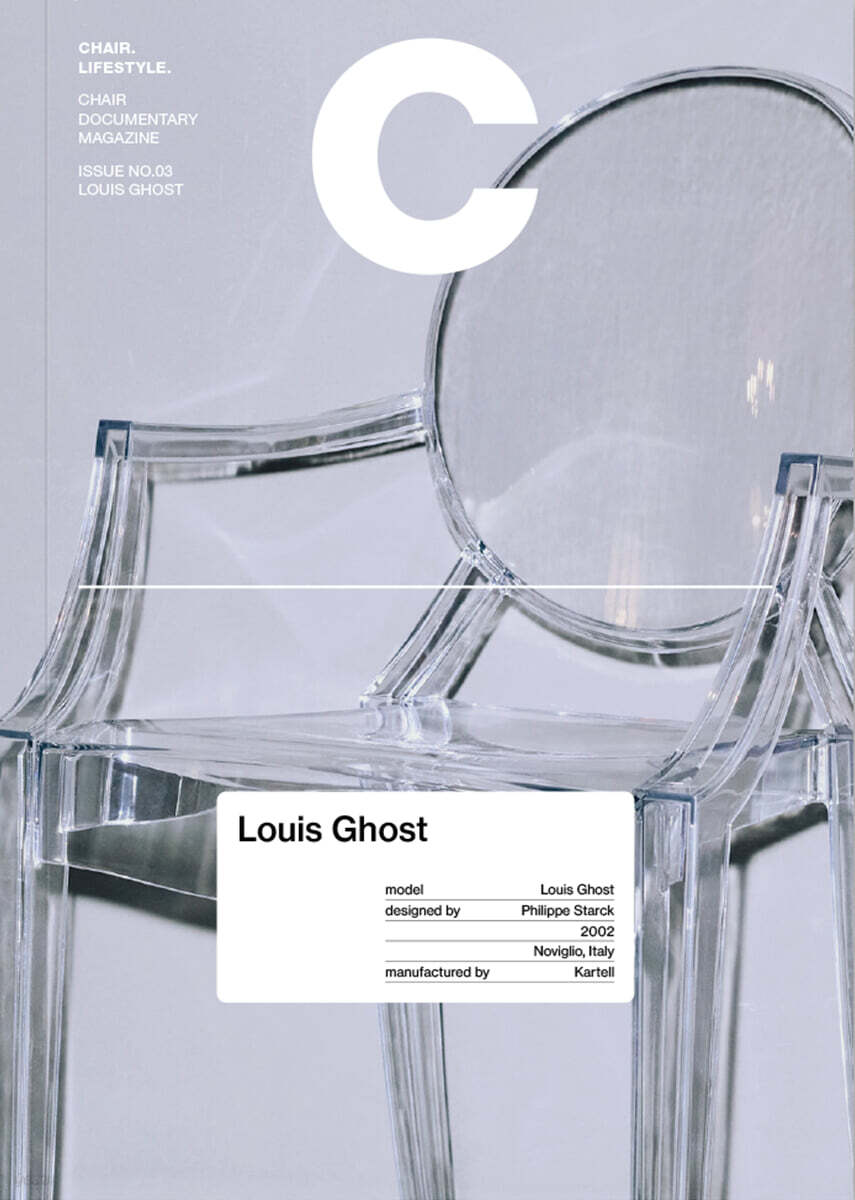
Magazine C: Louis Ghost No. 3
 |
Description
Book Introduction
Designed by Philippe Starck and produced by Kartell in 2002, the Louis Ghost chair has become a worldwide hit and is synonymous with a beautiful, sturdy, lightweight and transparent chair.
The classic design, inspired by 18th-century Baroque chairs, and the innovation of a single-piece chair made of polycarbonate create an iconic chair of the century that is transparent yet has a distinct presence.
The reputation of high-quality plastic chairs, which quietly create space with a quiet beauty rather than eye-catching flashiness, and which fit well anywhere and can be used in any way anyone wants, continues to this day.
In this issue, magazine C introduces the homes and lifestyles of people who use Louis Ghost in cities around the world, and also interviews Philippe Starck, the world-renowned designer who designed Louis Ghost.
From his design philosophy that has been consistent for over 50 years to the story of his life in his remote home in Cascais, Portugal.
Discover everything about Philippe Starck in one book, including his masterpieces.
You can also find various information such as interviews with Kartell CEO Claudio Luti, who created the Louis Ghost, and representative French designer Matali Crasset, as well as hotels and restaurants designed by Philippe Starck in Paris.
The classic design, inspired by 18th-century Baroque chairs, and the innovation of a single-piece chair made of polycarbonate create an iconic chair of the century that is transparent yet has a distinct presence.
The reputation of high-quality plastic chairs, which quietly create space with a quiet beauty rather than eye-catching flashiness, and which fit well anywhere and can be used in any way anyone wants, continues to this day.
In this issue, magazine C introduces the homes and lifestyles of people who use Louis Ghost in cities around the world, and also interviews Philippe Starck, the world-renowned designer who designed Louis Ghost.
From his design philosophy that has been consistent for over 50 years to the story of his life in his remote home in Cascais, Portugal.
Discover everything about Philippe Starck in one book, including his masterpieces.
You can also find various information such as interviews with Kartell CEO Claudio Luti, who created the Louis Ghost, and representative French designer Matali Crasset, as well as hotels and restaurants designed by Philippe Starck in Paris.
index
Intro
Letter From C
Publisher's Note
Quotes
Philippe Starck's words that penetrate the essence of things and phenomena
4 Cities 4 Homes
From classic to modern, urban to natural, luxury to rustic.
A landscape with a Louis Ghost that fits any lifestyle.
Salento Uli Weber Photographer
Paris design journalist Sylvie Adigard
Surrey artists Karen Nichol & Peter Clark
Seoul Yang Ji-woo Architect
Creator Interview, Philippe Starck
From dematerialization to collaborations with AI, a peek inside Philippe Starck's mind.
Designer: Philippe Starck
The life and design of Philippe Starck, who started out as a star designer and has continued to enjoy his heyday with the title of 'design emperor'.
Iconic Chair: Louis Ghost
Louis Ghost, a perfect trinity of design, technology, and materials.
Starck network
Philippe Starck's masterpieces manufactured by leading furniture brands around the world, including Dryade, Cassina, Kartell, B&B Italia, and Emeco.
About Kartell
Kartel, which ushered in the era of plastic furniture by creating a plastic syndrome with advanced technology and insight.
Special Interview
Claudio Luti, CEO of Kartell, led Kartell's heyday by attempting to turn high-quality plastic furniture into a luxury brand.
Kartell Mission
Three core values within Kartell's flagship products, encompassing production, design, and materials.
Digest
Kartell's design heritage and its activities as a manufacturer representing 'Made in Italy'
Opinion: Matali Crasset
An interview with French designer Matali Crasset, who embodies freedom, equality, and fraternity alongside Philippe Starck.
Starckpedia
From dental floss to the crew cabin module of the International Space Station.
A comprehensive encyclopedia of Philippe Starck's designs
Opinion: Philippe & Matthias Jousse, Guillaume de Casson
An interview with the director and curator of Jus Entreprise Gallery, who defined Philippe Starck's early designs as monuments to the times through the exhibition "Philippe Starck: 80's"
Starck Collectors
A 1980s design by Philippe Starck, housed in a collector's living room and gallery exhibition space.
Opinion: Charlotte & Peter Fiell
Charlotte & Peter Peel, who have explored the important context of design history through books such as 〈1000 Chairs〉 and 〈Plastic Dreams〉, talk about Louis Ghost.
Starck in Paris
From small cafes to grand hotels, a Parisian design journey following in the footsteps of Philippe Starck.
New Wave
From spaces where stories flow like a scene from a movie to chairs where experiments with various materials create narratives.
Uchronia and Nice Workshop, design studios that connect with the design world of Philippe Starck.
Chairpunk
Designer Yang Seung-bin's Louis Ghost Twist
Chair Index
my favorite chair
Outro
Letter From C
Publisher's Note
Quotes
Philippe Starck's words that penetrate the essence of things and phenomena
4 Cities 4 Homes
From classic to modern, urban to natural, luxury to rustic.
A landscape with a Louis Ghost that fits any lifestyle.
Salento Uli Weber Photographer
Paris design journalist Sylvie Adigard
Surrey artists Karen Nichol & Peter Clark
Seoul Yang Ji-woo Architect
Creator Interview, Philippe Starck
From dematerialization to collaborations with AI, a peek inside Philippe Starck's mind.
Designer: Philippe Starck
The life and design of Philippe Starck, who started out as a star designer and has continued to enjoy his heyday with the title of 'design emperor'.
Iconic Chair: Louis Ghost
Louis Ghost, a perfect trinity of design, technology, and materials.
Starck network
Philippe Starck's masterpieces manufactured by leading furniture brands around the world, including Dryade, Cassina, Kartell, B&B Italia, and Emeco.
About Kartell
Kartel, which ushered in the era of plastic furniture by creating a plastic syndrome with advanced technology and insight.
Special Interview
Claudio Luti, CEO of Kartell, led Kartell's heyday by attempting to turn high-quality plastic furniture into a luxury brand.
Kartell Mission
Three core values within Kartell's flagship products, encompassing production, design, and materials.
Digest
Kartell's design heritage and its activities as a manufacturer representing 'Made in Italy'
Opinion: Matali Crasset
An interview with French designer Matali Crasset, who embodies freedom, equality, and fraternity alongside Philippe Starck.
Starckpedia
From dental floss to the crew cabin module of the International Space Station.
A comprehensive encyclopedia of Philippe Starck's designs
Opinion: Philippe & Matthias Jousse, Guillaume de Casson
An interview with the director and curator of Jus Entreprise Gallery, who defined Philippe Starck's early designs as monuments to the times through the exhibition "Philippe Starck: 80's"
Starck Collectors
A 1980s design by Philippe Starck, housed in a collector's living room and gallery exhibition space.
Opinion: Charlotte & Peter Fiell
Charlotte & Peter Peel, who have explored the important context of design history through books such as 〈1000 Chairs〉 and 〈Plastic Dreams〉, talk about Louis Ghost.
Starck in Paris
From small cafes to grand hotels, a Parisian design journey following in the footsteps of Philippe Starck.
New Wave
From spaces where stories flow like a scene from a movie to chairs where experiments with various materials create narratives.
Uchronia and Nice Workshop, design studios that connect with the design world of Philippe Starck.
Chairpunk
Designer Yang Seung-bin's Louis Ghost Twist
Chair Index
my favorite chair
Outro
Detailed image

Publisher's Review
Magazine 《C》
Magazine <C> is a chair documentary magazine that introduces design and lifestyle centered around an iconic chair selected by Grande Clip and Magazine <B> each issue.
Covering everything from famous chairs that have had a profound impact on related industries and public life to street chairs, it illuminates the designers, brands, manufacturers, collectors, and the lifestyles of those who sit in them, as well as their contemporary influence.
Grande Clip, which publishes the magazine “C,” is a new startup launched by Kim Bong-jin, founder of Woowa Brothers (Baedal Minjok). With the motto of “making small things great,” the company aims to find value in small and ordinary things like clips and make them meaningful and great.
-
The Louis Ghost is a design that reflects Philippe Starck's humor and wit.
Unfortunately, I think I first encountered this chair as a counterfeit.
I knew it was an important piece of design history, but when I first saw it as a fake, I remember feeling uneasy because it seemed structurally unstable and didn't feel sturdy when I sat on it.
The Louis Ghost is known as one of the most copied chairs of all time, and this personal experience speaks volumes about its popularity.
It may have been possible to replicate the form, but it would have been difficult to replicate the quality.
When I met the 'real' Louis Ghost in another place after some time, I thought it was really pretty and suited the atmosphere of the place.
I'm reminded of how important it is for any design to find its place.
The transparent Louis Ghost fits well into many spaces, but seems especially suited to elegant spaces.
Although it is made of transparent plastic, it looks like a sparkling jewel, so unlike its name, 'Ghost', it seems to be a prominent character wherever it goes.
Having designed over 10,000 products to date, Philippe Starck is arguably one of the world's most renowned designers.
Even people who aren't interested in design probably know his name and at least one of his works.
Outside of the fashion industry, it's rare to find a designer who's been working under their own name for this long. It's truly remarkable that, at the age of 75, they've been active for over 50 years. Some designers imbue their designs with profound and profound meaning, but as time passes, the zeitgeist shifts, and new trends emerge, they can easily fade away.
It is important for designers to establish their own philosophy and design, but they must also understand the spirit of the times, breathe with it, and know how to lead or sometimes follow it.
Artists must stubbornly insist on making their works understood by the world, but designers must be able to communicate with the times.
The designs that the times demand are bound to change constantly, and as a junior designer, I admire the way you naturally surf the waves and move forward with the times.
Philippe Starck is a rare case where the name itself has become a brand.
It's still rare to find products with a designer's name on them, and I think this is an important aspect to consider, as it's because the designers themselves aren't branded.
The Louis Ghost chair was introduced at a time when the aesthetics of transparency were gaining attention with Jonathan Ive's semi-transparent iMac.
The seamless transparency was an expression of confidence in that it intuitively showed the structural logic and technological prowess of the product, which was the result of using polycarbonate, a type of synthetic plastic with durability and flexibility that was cutting-edge at the time. (Currently, it is produced with polycarbonate 2.0, which has been developed to be more suitable for recycling.) In an era where sustainability issues have become important, ESG is an excellent evaluation standard for products being made today, but it is cautious to apply the same standards to works of the past.
If you look at or evaluate the past from the standards of the present, everything will be wrong.
Released in 2002, this chair reflects the zeitgeist and technological prowess of the time. The key takeaways are its innovativeness, combining the traditional design of the 18th-century Baroque era with the modern material of plastic, and its rebellion against established authority and order.
As a result, Louis Ghost became a worldwide sensation as soon as it was released in 2002.
I see Louis Ghost as a product of that zeitgeist.
Publisher Kim Bong-jin
Magazine <C> is a chair documentary magazine that introduces design and lifestyle centered around an iconic chair selected by Grande Clip and Magazine <B> each issue.
Covering everything from famous chairs that have had a profound impact on related industries and public life to street chairs, it illuminates the designers, brands, manufacturers, collectors, and the lifestyles of those who sit in them, as well as their contemporary influence.
Grande Clip, which publishes the magazine “C,” is a new startup launched by Kim Bong-jin, founder of Woowa Brothers (Baedal Minjok). With the motto of “making small things great,” the company aims to find value in small and ordinary things like clips and make them meaningful and great.
-
The Louis Ghost is a design that reflects Philippe Starck's humor and wit.
Unfortunately, I think I first encountered this chair as a counterfeit.
I knew it was an important piece of design history, but when I first saw it as a fake, I remember feeling uneasy because it seemed structurally unstable and didn't feel sturdy when I sat on it.
The Louis Ghost is known as one of the most copied chairs of all time, and this personal experience speaks volumes about its popularity.
It may have been possible to replicate the form, but it would have been difficult to replicate the quality.
When I met the 'real' Louis Ghost in another place after some time, I thought it was really pretty and suited the atmosphere of the place.
I'm reminded of how important it is for any design to find its place.
The transparent Louis Ghost fits well into many spaces, but seems especially suited to elegant spaces.
Although it is made of transparent plastic, it looks like a sparkling jewel, so unlike its name, 'Ghost', it seems to be a prominent character wherever it goes.
Having designed over 10,000 products to date, Philippe Starck is arguably one of the world's most renowned designers.
Even people who aren't interested in design probably know his name and at least one of his works.
Outside of the fashion industry, it's rare to find a designer who's been working under their own name for this long. It's truly remarkable that, at the age of 75, they've been active for over 50 years. Some designers imbue their designs with profound and profound meaning, but as time passes, the zeitgeist shifts, and new trends emerge, they can easily fade away.
It is important for designers to establish their own philosophy and design, but they must also understand the spirit of the times, breathe with it, and know how to lead or sometimes follow it.
Artists must stubbornly insist on making their works understood by the world, but designers must be able to communicate with the times.
The designs that the times demand are bound to change constantly, and as a junior designer, I admire the way you naturally surf the waves and move forward with the times.
Philippe Starck is a rare case where the name itself has become a brand.
It's still rare to find products with a designer's name on them, and I think this is an important aspect to consider, as it's because the designers themselves aren't branded.
The Louis Ghost chair was introduced at a time when the aesthetics of transparency were gaining attention with Jonathan Ive's semi-transparent iMac.
The seamless transparency was an expression of confidence in that it intuitively showed the structural logic and technological prowess of the product, which was the result of using polycarbonate, a type of synthetic plastic with durability and flexibility that was cutting-edge at the time. (Currently, it is produced with polycarbonate 2.0, which has been developed to be more suitable for recycling.) In an era where sustainability issues have become important, ESG is an excellent evaluation standard for products being made today, but it is cautious to apply the same standards to works of the past.
If you look at or evaluate the past from the standards of the present, everything will be wrong.
Released in 2002, this chair reflects the zeitgeist and technological prowess of the time. The key takeaways are its innovativeness, combining the traditional design of the 18th-century Baroque era with the modern material of plastic, and its rebellion against established authority and order.
As a result, Louis Ghost became a worldwide sensation as soon as it was released in 2002.
I see Louis Ghost as a product of that zeitgeist.
Publisher Kim Bong-jin
GOODS SPECIFICS
- Date of issue: December 27, 2024
- Page count, weight, size: 184 pages | 170*240*20mm
- ISBN13: 9791198807038
- ISBN10: 1198807032
You may also like
카테고리
korean


korean

![GQ KOREA Mark (Monthly): December [2025]](http://librairie.coreenne.fr/cdn/shop/files/8ef265dbbfbf186523ed75ba7319009d.jpg?v=1765340328&width=3840)


