

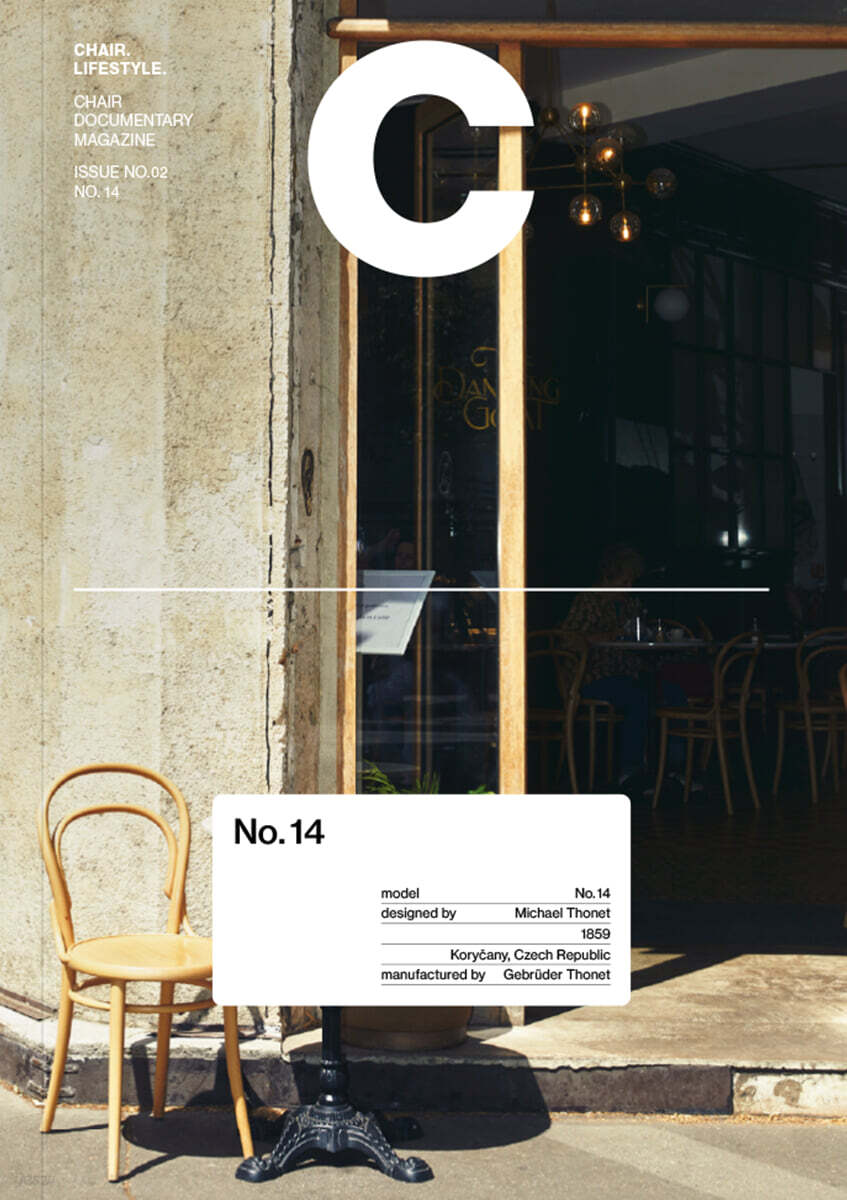
Magazine C: No. 14 (Chair 14) Issue 2
 |
Description
Book Introduction
Magazine <C> is a chair documentary magazine that introduces design and lifestyle centered around an iconic chair selected by Grande Clip and Magazine <B> each issue.
Covering everything from famous chairs that have had a profound impact on related industries and public life to street chairs, it illuminates the designers, brands, manufacturers, collectors, and the lifestyles of those who sit in them, as well as their contemporary influence.
Grande Clip, which publishes the magazine “C,” is a new startup launched by Kim Bong-jin, founder of Woowa Brothers (Baedal Minjok). With the motto of “making small things great,” the company aims to find value in small and ordinary things like clips and make them meaningful and great.
Covering everything from famous chairs that have had a profound impact on related industries and public life to street chairs, it illuminates the designers, brands, manufacturers, collectors, and the lifestyles of those who sit in them, as well as their contemporary influence.
Grande Clip, which publishes the magazine “C,” is a new startup launched by Kim Bong-jin, founder of Woowa Brothers (Baedal Minjok). With the motto of “making small things great,” the company aims to find value in small and ordinary things like clips and make them meaningful and great.
index
Intro
Letter From C
Publisher's Note
Quotes
Michael Thonet, as told by renowned architects and designers
5 Cities, 5 Cafes
Five cafes in five cities: Paris, Vienna, Milan, Paju, and Melbourne, featuring Thonet chairs.
The Dancing Goat, a Parisian cafe that bans laptop use
Café Central, the majesty of a coffee house that opened in Vienna in 1876
Milano Jamaica Bar, a place of reflection for 20th-century artists
Thames Coffee, a cafe owned by Paju Thonet Vintage Collector
Bentwood Fitzroy, a community of local residents steeped in Melbourne's Bentwood history
Designer: Michael Thonet
Michael Thonet, the designer who transformed himself into an engineer, inventor, producer, and manager, and who brought mass production of chairs to fruition.
Iconic Chair: No.14
Chair 14, a modern chair embodying the values of technological innovation, efficiency, and popularization.
Thonet Best Sellers
A best-selling collection of Thonet chairs, which have filled coffeehouses around the world.
About Ton
Ton, a brand that carries on the history and technology of the Bystrzycepothostynem factory founded by Michael Tonette in 1861.
The Bentwood Vision
Interview with Milan Dostalik, CEO of Tone
Image Documentary
The site where bestselling and iconic chairs that transcend centuries are created.
Ton of the 21st Century
A modernization strategy based on a long history and symbolic heritage
Digest
A collection of classic wood furniture inspired by Michael Thonet's ideas.
Opinion: Jasper Morrison
Jasper Morrison, a designer who designs simple, useful, and long-lasting things.
By Thonet
10 modern chair designs inspired by Michael Thonet's designs.
Opinion: Alexander von Vegesack
Alexander von Wegesak, researcher and collector of Thonet chairs and founder of Boisbouché
Viewing Rooms
Four scenes with Chair 14, including a tea room, a showroom, a study, and a dining room.
Opinion: Markman Ellis
Markman Ellis, who studies the history and culture of coffeehouses.
Cafe by Cafe
Cafes in major cities around the world have expanded into diverse functions, such as offices for work, performance venues for music, restaurants for gourmet dining, showrooms for brand identity, and communities for various events.
Cafe for Work Berlin, St. Oberholz
Cafe for Music Seoul, Ferments
Cafe for Brand New York, Saturdays NYC
Cafe for Gourmet Tokyo, Coffee Mameya Kakeru
Cafe for Community Copenhagen, Amator
Cafe by brand
The identities of global brand cafe chairs, including Starbucks, Blue Bottle Coffee, Arket, Muji, Maison Kitsuné, and % Arabica.
New Wave
A classic design with simple and elegant curves, economical design with minimal production and transportation, and widespread use in cafes and restaurants.
Three teams of designers summoned with keywords that define Chair 14.
Moon Seung-ji, Alessandro Stabile Studio, Studio Pesci
Chairpunk
Zero Lab Jang Tae-hoon's 14th Chair Twist
Chair Index
my favorite chair
Outro
Letter From C
Publisher's Note
Quotes
Michael Thonet, as told by renowned architects and designers
5 Cities, 5 Cafes
Five cafes in five cities: Paris, Vienna, Milan, Paju, and Melbourne, featuring Thonet chairs.
The Dancing Goat, a Parisian cafe that bans laptop use
Café Central, the majesty of a coffee house that opened in Vienna in 1876
Milano Jamaica Bar, a place of reflection for 20th-century artists
Thames Coffee, a cafe owned by Paju Thonet Vintage Collector
Bentwood Fitzroy, a community of local residents steeped in Melbourne's Bentwood history
Designer: Michael Thonet
Michael Thonet, the designer who transformed himself into an engineer, inventor, producer, and manager, and who brought mass production of chairs to fruition.
Iconic Chair: No.14
Chair 14, a modern chair embodying the values of technological innovation, efficiency, and popularization.
Thonet Best Sellers
A best-selling collection of Thonet chairs, which have filled coffeehouses around the world.
About Ton
Ton, a brand that carries on the history and technology of the Bystrzycepothostynem factory founded by Michael Tonette in 1861.
The Bentwood Vision
Interview with Milan Dostalik, CEO of Tone
Image Documentary
The site where bestselling and iconic chairs that transcend centuries are created.
Ton of the 21st Century
A modernization strategy based on a long history and symbolic heritage
Digest
A collection of classic wood furniture inspired by Michael Thonet's ideas.
Opinion: Jasper Morrison
Jasper Morrison, a designer who designs simple, useful, and long-lasting things.
By Thonet
10 modern chair designs inspired by Michael Thonet's designs.
Opinion: Alexander von Vegesack
Alexander von Wegesak, researcher and collector of Thonet chairs and founder of Boisbouché
Viewing Rooms
Four scenes with Chair 14, including a tea room, a showroom, a study, and a dining room.
Opinion: Markman Ellis
Markman Ellis, who studies the history and culture of coffeehouses.
Cafe by Cafe
Cafes in major cities around the world have expanded into diverse functions, such as offices for work, performance venues for music, restaurants for gourmet dining, showrooms for brand identity, and communities for various events.
Cafe for Work Berlin, St. Oberholz
Cafe for Music Seoul, Ferments
Cafe for Brand New York, Saturdays NYC
Cafe for Gourmet Tokyo, Coffee Mameya Kakeru
Cafe for Community Copenhagen, Amator
Cafe by brand
The identities of global brand cafe chairs, including Starbucks, Blue Bottle Coffee, Arket, Muji, Maison Kitsuné, and % Arabica.
New Wave
A classic design with simple and elegant curves, economical design with minimal production and transportation, and widespread use in cafes and restaurants.
Three teams of designers summoned with keywords that define Chair 14.
Moon Seung-ji, Alessandro Stabile Studio, Studio Pesci
Chairpunk
Zero Lab Jang Tae-hoon's 14th Chair Twist
Chair Index
my favorite chair
Outro
Detailed image

Publisher's Review
Chair No. 14, introduced by Michael Thonet in 1859, is widely known to us as the 'Café Chair'.
In fact, this chair has existed in cafes, restaurants, bars, and other spaces where people gather, transcending time and country, from the 19th century to the present day.
Michael Thonet realized the values of technological innovation, efficiency, and popularization through the Chair No. 14, devising a composition and assembly method that enabled factory-style mass production, realizing overseas distribution through flat-pack packaging, and promoting it through catalogs.
The starting point of the 'modern chair', which allows anyone to purchase and use a product of consistent quality at a reasonable price, is Chair No. 14, which boasts a classic design and elegant beauty.
In this issue, C magazine introduces cafés around the world that feature Thonet chairs, and visits the Thonet factory where the No. 14 chair is still produced in the same way it was made over 160 years ago.
Experience the process of creating a single chair through vivid image documentary, from wood drying to bending and assembly.
In addition, designer Jasper Morrison and Alexander von Wegesak, former director of the Vitra Design Museum, discuss the design of Michael Thonet and the No. 14 chair, as well as the expanded functions of the café today and detailed information about the global brand café chair.
Various stories about 'cafe' and 'chairs' unfold, centering around Michael Thonet's Chair No. 14.
Michael Thonet's Chair No. 14 is a representative chair that has always been around us, but we don't really recognize it.
You can see it often in cafes and bakeries in Europe, the US, and even in Korea these days. Seeing it being used so widely, I think it's a very successful design.
Today, when we think of iconic chairs, we often think of the steel-based pieces that emerged in the post-Bauhaus, mid-century modern era, but the 14 chair, decades earlier, realized the ideal of the modern chair by bending a wooden bar.
This was 165 years ago, when furniture was more like a craft.
So how many No. 14 chairs have been made so far? It's said that over 80 million have been produced, but if you include other series like the No. 18, which was just as popular as the No. 14 and had a slightly modified backrest, the number is likely much higher.
Chair No. 14 was a practical, beautiful, and affordable product that enriched people's lives before the advent of IKEA.
It is also a chair that bears the name of the designer himself, Michael Thonet.
Even now, it is sold at a reasonable price compared to other design icons.
I can't help but say that it has all the virtues of good design.
Chair No. 14 was widely known as the symbol of cafes as it was most commonly used in coffee houses that flourished mainly in Europe in the mid-19th century.
Even today, people visit cafes not only to drink tea or coffee, but also to work and have personal meetings.
There's so much happening in cafes, you wonder how we'd live in a city without them.
I once read about the connection between a period of rapid advancement in human wisdom and a period of flourishing tea culture.
In Europe, the water quality was poor, so when people gathered, they mostly drank beer. When they started a discussion, they got excited because of the alcohol and started fighting, so it was difficult to continue a conversation for more than 30 minutes.
On the other hand, it is said that the salon culture began to sprout thanks to tea, which allowed people to sit quietly and have conversations, and this sounds quite credible.
Cafes are now a symbol of sophisticated urban culture, and also serve as welcome "restroom signs" for travelers. (Laughs) They are truly an essential space in the city.
Meanwhile, coffee has become a popular beverage, often associated with the local culture.
Many countries, including the United States, Vietnam, and Singapore, have their own unique coffee cultures.
In Korea, it's called coffee mix.
While researching how to make black coffee taste better, I mixed cream and sugar to make it sweeter while also removing the bitterness.
To introduce Korea's unique coffee culture, we recently launched a brand called Newmix.
If you think about it, not only coffee, but everything else is mixed to create something new.
It's a mix of everything in the world. (Laughs)
Many people are curious about what kind of chairs will be featured in the magazine <C>, which introduces iconic chairs.
Some people think of expensive luxury goods or art furniture, but it makes me think about what good design has had a profound and significant impact on our lives.
In that respect, it feels very meaningful to be working on Chair No. 14, following Jean Prouvé's Standard Chair, which was designed with use in public spaces such as schools in mind.
Art can be said to solve problems between people, while design can be said to deal with problems between people and objects.
When a design successfully solves a problem between people and things, people will naturally start using the product.
In capitalism, a product that is unpopular or unsold means it is uncompetitive, so the fact that Chair 14 was produced in such large quantities and has survived to this day is proof that its value has been recognized by the world.
For example, the LC series can be seen as a tribute to the master Le Corbusier while also embracing the value of design.
In contrast, I thought that Chair 14 was a good design that everyone loved because it solved problems related to people, objects, and life.
We would like to express our gratitude to designer Michael Thonet and all those who have continued to create the Chair No. 14.
Enjoy a fun read about the people who cherish and love Chair 14, and the cafe culture it has created.
Ultimately, I hope this will be an opportunity to think about what good design is together with the magazine <C>.
Publisher Kim Bong-jin
In fact, this chair has existed in cafes, restaurants, bars, and other spaces where people gather, transcending time and country, from the 19th century to the present day.
Michael Thonet realized the values of technological innovation, efficiency, and popularization through the Chair No. 14, devising a composition and assembly method that enabled factory-style mass production, realizing overseas distribution through flat-pack packaging, and promoting it through catalogs.
The starting point of the 'modern chair', which allows anyone to purchase and use a product of consistent quality at a reasonable price, is Chair No. 14, which boasts a classic design and elegant beauty.
In this issue, C magazine introduces cafés around the world that feature Thonet chairs, and visits the Thonet factory where the No. 14 chair is still produced in the same way it was made over 160 years ago.
Experience the process of creating a single chair through vivid image documentary, from wood drying to bending and assembly.
In addition, designer Jasper Morrison and Alexander von Wegesak, former director of the Vitra Design Museum, discuss the design of Michael Thonet and the No. 14 chair, as well as the expanded functions of the café today and detailed information about the global brand café chair.
Various stories about 'cafe' and 'chairs' unfold, centering around Michael Thonet's Chair No. 14.
Michael Thonet's Chair No. 14 is a representative chair that has always been around us, but we don't really recognize it.
You can see it often in cafes and bakeries in Europe, the US, and even in Korea these days. Seeing it being used so widely, I think it's a very successful design.
Today, when we think of iconic chairs, we often think of the steel-based pieces that emerged in the post-Bauhaus, mid-century modern era, but the 14 chair, decades earlier, realized the ideal of the modern chair by bending a wooden bar.
This was 165 years ago, when furniture was more like a craft.
So how many No. 14 chairs have been made so far? It's said that over 80 million have been produced, but if you include other series like the No. 18, which was just as popular as the No. 14 and had a slightly modified backrest, the number is likely much higher.
Chair No. 14 was a practical, beautiful, and affordable product that enriched people's lives before the advent of IKEA.
It is also a chair that bears the name of the designer himself, Michael Thonet.
Even now, it is sold at a reasonable price compared to other design icons.
I can't help but say that it has all the virtues of good design.
Chair No. 14 was widely known as the symbol of cafes as it was most commonly used in coffee houses that flourished mainly in Europe in the mid-19th century.
Even today, people visit cafes not only to drink tea or coffee, but also to work and have personal meetings.
There's so much happening in cafes, you wonder how we'd live in a city without them.
I once read about the connection between a period of rapid advancement in human wisdom and a period of flourishing tea culture.
In Europe, the water quality was poor, so when people gathered, they mostly drank beer. When they started a discussion, they got excited because of the alcohol and started fighting, so it was difficult to continue a conversation for more than 30 minutes.
On the other hand, it is said that the salon culture began to sprout thanks to tea, which allowed people to sit quietly and have conversations, and this sounds quite credible.
Cafes are now a symbol of sophisticated urban culture, and also serve as welcome "restroom signs" for travelers. (Laughs) They are truly an essential space in the city.
Meanwhile, coffee has become a popular beverage, often associated with the local culture.
Many countries, including the United States, Vietnam, and Singapore, have their own unique coffee cultures.
In Korea, it's called coffee mix.
While researching how to make black coffee taste better, I mixed cream and sugar to make it sweeter while also removing the bitterness.
To introduce Korea's unique coffee culture, we recently launched a brand called Newmix.
If you think about it, not only coffee, but everything else is mixed to create something new.
It's a mix of everything in the world. (Laughs)
Many people are curious about what kind of chairs will be featured in the magazine <C>, which introduces iconic chairs.
Some people think of expensive luxury goods or art furniture, but it makes me think about what good design has had a profound and significant impact on our lives.
In that respect, it feels very meaningful to be working on Chair No. 14, following Jean Prouvé's Standard Chair, which was designed with use in public spaces such as schools in mind.
Art can be said to solve problems between people, while design can be said to deal with problems between people and objects.
When a design successfully solves a problem between people and things, people will naturally start using the product.
In capitalism, a product that is unpopular or unsold means it is uncompetitive, so the fact that Chair 14 was produced in such large quantities and has survived to this day is proof that its value has been recognized by the world.
For example, the LC series can be seen as a tribute to the master Le Corbusier while also embracing the value of design.
In contrast, I thought that Chair 14 was a good design that everyone loved because it solved problems related to people, objects, and life.
We would like to express our gratitude to designer Michael Thonet and all those who have continued to create the Chair No. 14.
Enjoy a fun read about the people who cherish and love Chair 14, and the cafe culture it has created.
Ultimately, I hope this will be an opportunity to think about what good design is together with the magazine <C>.
Publisher Kim Bong-jin
GOODS SPECIFICS
- Date of issue: September 30, 2024
- Page count, weight, size: 186 pages | 170*240*20mm
- ISBN13: 9791198807014
- ISBN10: 1198807016
You may also like
카테고리
korean


korean

![GQ KOREA Mark (Monthly): December [2025]](http://librairie.coreenne.fr/cdn/shop/files/8ef265dbbfbf186523ed75ba7319009d.jpg?v=1765340328&width=3840)


