

Top 100 Korean Films: From "Crossroads of Youth" to "Decision to Leave"
 |
Description
Book Introduction
Over the past 10 years, how have Korean society, Korean films, and the thoughts, perspectives, and tastes of those who view Korean films changed?
This is the third Korean Films Top 100 list, returning after 10 years, following the first list in 2006 and the second in 2014.
Here is the ultimate list for Korean film lovers.
The "100 Best Korean Films," announced in May 2024, received great attention from film fans as a valuable resource that allows readers to understand the flow of Korean film history at a glance.
Based on these results, the recently published [100 Korean Films: From 'Crossroads of Youth' to 'Decision to Leave'] was produced as the optimal list-up book for readers who want to enjoy Korean films more deeply, more broadly, and more interestingly.
The collection's value has been enhanced by a variety of elements, including statistics and commentary that clearly organize the changes in the selected works over time, reviews that reaffirm the film historical value of the 100 selected works, special mentions and high-quality series that we should pay attention to, and a chronology that allows us to see the history of Korean cinema at a glance.
This is the third Korean Films Top 100 list, returning after 10 years, following the first list in 2006 and the second in 2014.
Here is the ultimate list for Korean film lovers.
The "100 Best Korean Films," announced in May 2024, received great attention from film fans as a valuable resource that allows readers to understand the flow of Korean film history at a glance.
Based on these results, the recently published [100 Korean Films: From 'Crossroads of Youth' to 'Decision to Leave'] was produced as the optimal list-up book for readers who want to enjoy Korean films more deeply, more broadly, and more interestingly.
The collection's value has been enhanced by a variety of elements, including statistics and commentary that clearly organize the changes in the selected works over time, reviews that reaffirm the film historical value of the 100 selected works, special mentions and high-quality series that we should pay attention to, and a chronology that allows us to see the history of Korean cinema at a glance.
- You can preview some of the book's contents.
Preview
index
In publishing the book
Announcing the top 100 Korean films
A look at the top 100 Korean films
Statistics on the Top 100 Korean Films
100 Korean Films to Preview in Comments
Rewatching 100 Korean Films
A broader look at the top 100 Korean films
A work that unfortunately did not make it into the top 100
Special Mention
A series we must remember
Rediscovering Korean Films, Korean Films You Need to See
Korean Film History Chronology
Introduction of the selected candidates
People I am grateful to
About the writers
Announcing the top 100 Korean films
A look at the top 100 Korean films
Statistics on the Top 100 Korean Films
100 Korean Films to Preview in Comments
Rewatching 100 Korean Films
A broader look at the top 100 Korean films
A work that unfortunately did not make it into the top 100
Special Mention
A series we must remember
Rediscovering Korean Films, Korean Films You Need to See
Korean Film History Chronology
Introduction of the selected candidates
People I am grateful to
About the writers
Into the book
What was really important in The Housemaid (1960)?
Stop hanging around and get inside the movie.
Then you will be able to hear Kim Ki-young's laughter.
Jeong Seong-il
--- p.42
Why did the military regime ban the screening of "Aimless Bullet" (1961)? It's because the film possesses a subversive quality that transcends its time, a subtext that could be recalled at any time when Korean society faces a darkening.
Jo Jun-hyung
--- p.44
If you were to pick just one representative Korean film from the 1970s, it would have to be March of Fools (1975).
The film was completed at 117 minutes, but after government censorship, nearly 18 minutes were cut and released at 99 minutes.
But the young audience paid no attention and filled in the gaps themselves, showing enthusiastic support.
Jeong Jong-hwa
--- p.58
The two large trees standing at the three-way intersection in front of the Grassland Photo Studio naturally show the change of seasons from early summer to winter and the change of light between day and night.
The same goes for the garden house.
〈Christmas in August〉(1998) succeeds in finding one's own emotions by showing how important it is to express the 'texture of air' that space possesses.
Hwang In-jun
--- p.95
Memories of Murder (2003) is the prototype of Bong Joon-ho's style: long takes that constantly move while following the space and characters, fast-paced editing that matches the rapid development, color strategies that create nostalgia and sorrow, and acting that makes you empathize with the moment of awakening that comes to the detectives whose emotions are at their peak.
Jeong Min-ah
--- p.114
In 2004, the Cannes International Film Festival awarded the Grand Prix to Park Chan-wook's Oldboy (2003).
'K-movie' begins from this point.
Of course, there were pioneers before.
But Oldboy was different.
If the films of his predecessors were within the magnetic field of Orientalism, Oldboy was the first Korean film that resonated with young audiences and fans around the world.
Kim Hyung-seok
--- p.116
Although poetry writing is a key motif and actual poets appear in the film, the driving force behind Poetry (2010)'s immersion is not words and writing.
It makes us feel the pain caused by violence through images that are restrained, not clichéd or excessive.
Oh Young-sook
--- p.132
The cinematic vision that Bong Joon-ho presents in Parasite (2019) is the cruel reality that “the world is a dizzying hell.”
It's funny, but tragic.
The cynicism about hopeless capitalism goes beyond the simple experience of watching an entertaining movie; it makes you constantly ponder the absurdity of how the world works.
Jeong Min-ah
--- p.145
It is understandable to try to view "Decision to Leave" (2022), which was invited to the competition section of the 75th Cannes International Film Festival and won the Best Director Award, within the Hitchcockian framework, but it is rather lazy.
Rather, it is much more helpful to ponder the lyrics of the theme song 'Fog', which can be read more accurately as a 'logline'.
Park Hye-eun
Stop hanging around and get inside the movie.
Then you will be able to hear Kim Ki-young's laughter.
Jeong Seong-il
--- p.42
Why did the military regime ban the screening of "Aimless Bullet" (1961)? It's because the film possesses a subversive quality that transcends its time, a subtext that could be recalled at any time when Korean society faces a darkening.
Jo Jun-hyung
--- p.44
If you were to pick just one representative Korean film from the 1970s, it would have to be March of Fools (1975).
The film was completed at 117 minutes, but after government censorship, nearly 18 minutes were cut and released at 99 minutes.
But the young audience paid no attention and filled in the gaps themselves, showing enthusiastic support.
Jeong Jong-hwa
--- p.58
The two large trees standing at the three-way intersection in front of the Grassland Photo Studio naturally show the change of seasons from early summer to winter and the change of light between day and night.
The same goes for the garden house.
〈Christmas in August〉(1998) succeeds in finding one's own emotions by showing how important it is to express the 'texture of air' that space possesses.
Hwang In-jun
--- p.95
Memories of Murder (2003) is the prototype of Bong Joon-ho's style: long takes that constantly move while following the space and characters, fast-paced editing that matches the rapid development, color strategies that create nostalgia and sorrow, and acting that makes you empathize with the moment of awakening that comes to the detectives whose emotions are at their peak.
Jeong Min-ah
--- p.114
In 2004, the Cannes International Film Festival awarded the Grand Prix to Park Chan-wook's Oldboy (2003).
'K-movie' begins from this point.
Of course, there were pioneers before.
But Oldboy was different.
If the films of his predecessors were within the magnetic field of Orientalism, Oldboy was the first Korean film that resonated with young audiences and fans around the world.
Kim Hyung-seok
--- p.116
Although poetry writing is a key motif and actual poets appear in the film, the driving force behind Poetry (2010)'s immersion is not words and writing.
It makes us feel the pain caused by violence through images that are restrained, not clichéd or excessive.
Oh Young-sook
--- p.132
The cinematic vision that Bong Joon-ho presents in Parasite (2019) is the cruel reality that “the world is a dizzying hell.”
It's funny, but tragic.
The cynicism about hopeless capitalism goes beyond the simple experience of watching an entertaining movie; it makes you constantly ponder the absurdity of how the world works.
Jeong Min-ah
--- p.145
It is understandable to try to view "Decision to Leave" (2022), which was invited to the competition section of the 75th Cannes International Film Festival and won the Best Director Award, within the Hitchcockian framework, but it is rather lazy.
Rather, it is much more helpful to ponder the lyrics of the theme song 'Fog', which can be read more accurately as a 'logline'.
Park Hye-eun
--- p.149
Publisher's Review
Once every decade, we'll see 100 films that illuminated Korean film history.
The Best List for You: [100 Korean Films]
Over the past 10 years, how have Korean society, Korean films, and the thoughts, perspectives, and tastes of those who view Korean films changed?
This is the third Korean Films Top 100 list, returning after 10 years, following the first list in 2006 and the second in 2014.
Here is the ultimate list for Korean film lovers.
From the oldest existing feature film, [Crossroads of Youth] (1934) to [Until the Decision to Leave] (2022).
The "100 Best Korean Films," announced in May 2024, received great attention from film fans as a valuable resource that allows readers to understand the flow of Korean film history at a glance.
Based on these results, the recently published [100 Korean Films: From [Crossroads of Youth] to [Decision to Leave]] was produced as the optimal list-up book for readers who want to enjoy Korean films more deeply, more broadly, and more interestingly.
The collection's value has been enhanced by a variety of elements, including statistics and commentary that clearly organize the changes in the selected works over time, reviews that reaffirm the film historical value of the 100 selected works, special mentions and high-quality series that we should pay attention to, and a chronology that allows us to see the history of Korean cinema at a glance.
From Kim Ki-young to Park Chan-wook and Bong Joon-ho
Why are their works revered as masterpieces in Korean film history?
Why did director Bong Joon-ho, who swept Cannes and the Academy Awards, and actress Youn Yuh-jung, who won the Academy Award for Best Supporting Actress, show such deep respect for director Kim Ki-young?
Why did director Park Chan-wook emphasize that “if you want to make a good movie, you have to watch classic movies”?
You can find the answer in this book.
This book is written by a large team of experts, including Korean film researchers, domestic and international film professors, and film journalists. It presents the surprisingly novel and bold challenges and values of 100 films that have shaped the history of Korean cinema, from the 1934 film [Crossroads of Youth] to the latest [Decision to Leave].
These articles, which go beyond simple synopsis introductions and include notable phenomena surrounding contemporary cinema, both internally and externally, and poignant reflections on the works themselves, will offer new discoveries to Korean film lovers.
Discover the roots and zeitgeist of Korean cinema, which is attracting global attention.
This book is particularly significant and profound in that it revisits the roots and zeitgeist of Korean cinema, which is attracting keen attention from around the world.
When we talk about masterpieces and classics in film history, the reason we often think of foreign works is partly due to the difference in the amount of information.
If the UK has the BFI's '100 Ultimate Films' and Hollywood has the AFI Collection, Korea has the Korean Film Archive's '100 Korean Films'.
Through this book, readers can encounter 100 shining works of Korean film history that must be reinterpreted by modern audiences, such as the "noisiness of silent films" in the 1934 film "Crossroads of Youth," the fighting spirit of the "modern filmmakers" who struggled to create "Joseon films" during the colonial era, and the poignant lines in "The Widow" by Korea's first female director Park Nam-ok from 1955.
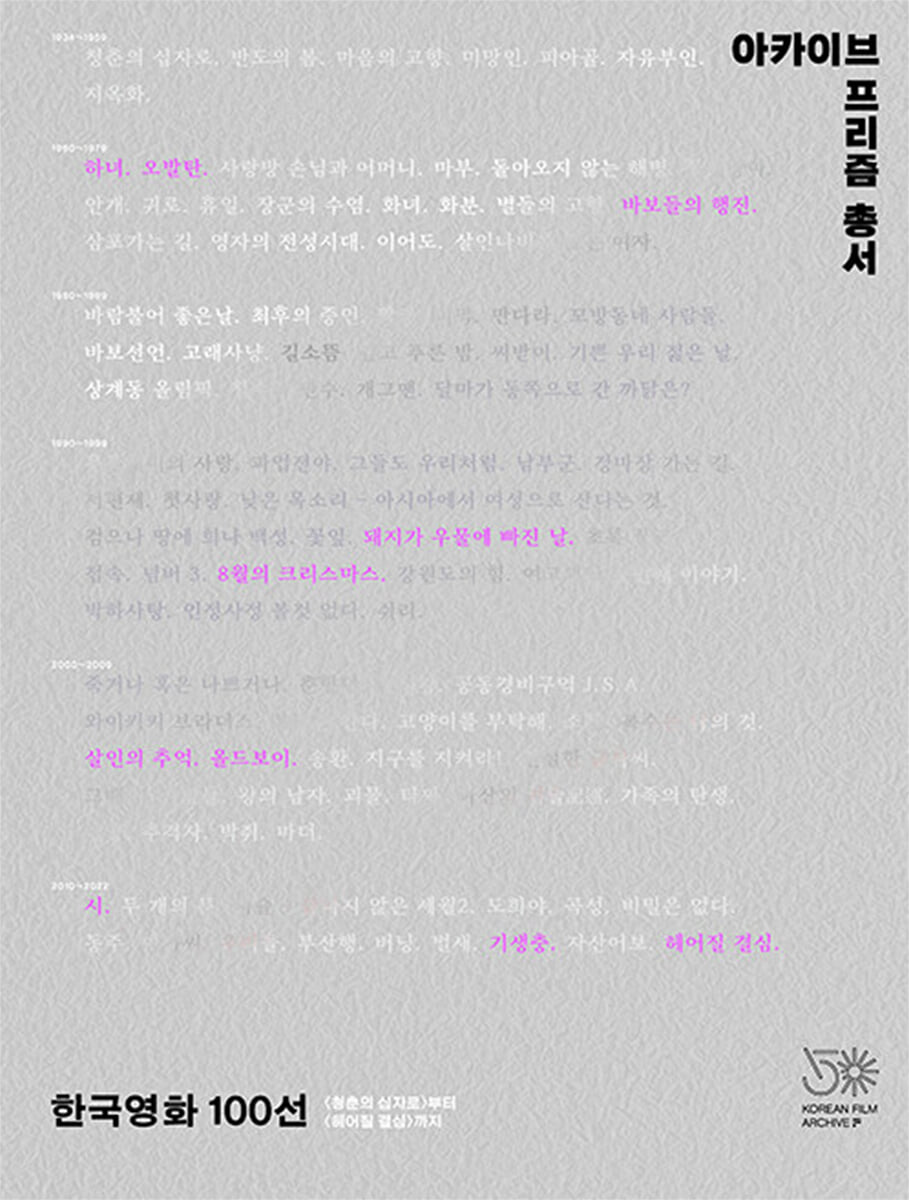
A shining cover engraved with 100 Korean films
A design you'll want to own, completed with energetic colors.
A special gift: a checklist bookmark of the '100 Best Korean Films'
The first book in the Archive Prism Series, which will be published for the first time in 2024, [100 Korean Films] is published once every ten years, and is characterized by its design and special process that enhance its collection value.
We aimed to create a book that you would want to keep for a long time, with a unique cover featuring the titles of 100 shining films in Korean film history in hologram and special color printing, a back cover engraved with recommendations from the top 10 films, and an interior design using energetic colors.
We also produced a '100 Best Korean Films' checklist bookmark as a special gift to our Korean film enthusiast readers as a token of our appreciation.
We are giving this book as a gift to all readers who purchase it.
The Best List for You: [100 Korean Films]
Over the past 10 years, how have Korean society, Korean films, and the thoughts, perspectives, and tastes of those who view Korean films changed?
This is the third Korean Films Top 100 list, returning after 10 years, following the first list in 2006 and the second in 2014.
Here is the ultimate list for Korean film lovers.
From the oldest existing feature film, [Crossroads of Youth] (1934) to [Until the Decision to Leave] (2022).
The "100 Best Korean Films," announced in May 2024, received great attention from film fans as a valuable resource that allows readers to understand the flow of Korean film history at a glance.
Based on these results, the recently published [100 Korean Films: From [Crossroads of Youth] to [Decision to Leave]] was produced as the optimal list-up book for readers who want to enjoy Korean films more deeply, more broadly, and more interestingly.
The collection's value has been enhanced by a variety of elements, including statistics and commentary that clearly organize the changes in the selected works over time, reviews that reaffirm the film historical value of the 100 selected works, special mentions and high-quality series that we should pay attention to, and a chronology that allows us to see the history of Korean cinema at a glance.
From Kim Ki-young to Park Chan-wook and Bong Joon-ho
Why are their works revered as masterpieces in Korean film history?
Why did director Bong Joon-ho, who swept Cannes and the Academy Awards, and actress Youn Yuh-jung, who won the Academy Award for Best Supporting Actress, show such deep respect for director Kim Ki-young?
Why did director Park Chan-wook emphasize that “if you want to make a good movie, you have to watch classic movies”?
You can find the answer in this book.
This book is written by a large team of experts, including Korean film researchers, domestic and international film professors, and film journalists. It presents the surprisingly novel and bold challenges and values of 100 films that have shaped the history of Korean cinema, from the 1934 film [Crossroads of Youth] to the latest [Decision to Leave].
These articles, which go beyond simple synopsis introductions and include notable phenomena surrounding contemporary cinema, both internally and externally, and poignant reflections on the works themselves, will offer new discoveries to Korean film lovers.
Discover the roots and zeitgeist of Korean cinema, which is attracting global attention.
This book is particularly significant and profound in that it revisits the roots and zeitgeist of Korean cinema, which is attracting keen attention from around the world.
When we talk about masterpieces and classics in film history, the reason we often think of foreign works is partly due to the difference in the amount of information.
If the UK has the BFI's '100 Ultimate Films' and Hollywood has the AFI Collection, Korea has the Korean Film Archive's '100 Korean Films'.
Through this book, readers can encounter 100 shining works of Korean film history that must be reinterpreted by modern audiences, such as the "noisiness of silent films" in the 1934 film "Crossroads of Youth," the fighting spirit of the "modern filmmakers" who struggled to create "Joseon films" during the colonial era, and the poignant lines in "The Widow" by Korea's first female director Park Nam-ok from 1955.
A shining cover engraved with 100 Korean films
A design you'll want to own, completed with energetic colors.
A special gift: a checklist bookmark of the '100 Best Korean Films'
The first book in the Archive Prism Series, which will be published for the first time in 2024, [100 Korean Films] is published once every ten years, and is characterized by its design and special process that enhance its collection value.
We aimed to create a book that you would want to keep for a long time, with a unique cover featuring the titles of 100 shining films in Korean film history in hologram and special color printing, a back cover engraved with recommendations from the top 10 films, and an interior design using energetic colors.
We also produced a '100 Best Korean Films' checklist bookmark as a special gift to our Korean film enthusiast readers as a token of our appreciation.
We are giving this book as a gift to all readers who purchase it.
GOODS SPECIFICS
- Date of issue: July 19, 2024
- Page count, weight, size: 196 pages | 740g | 225*297*13mm
- ISBN13: 9788993056662
- ISBN10: 8993056668
You may also like
카테고리
korean


korean

![GQ KOREA Mark (Monthly): December [2025]](http://librairie.coreenne.fr/cdn/shop/files/8ef265dbbfbf186523ed75ba7319009d.jpg?v=1765340328&width=3840)


