

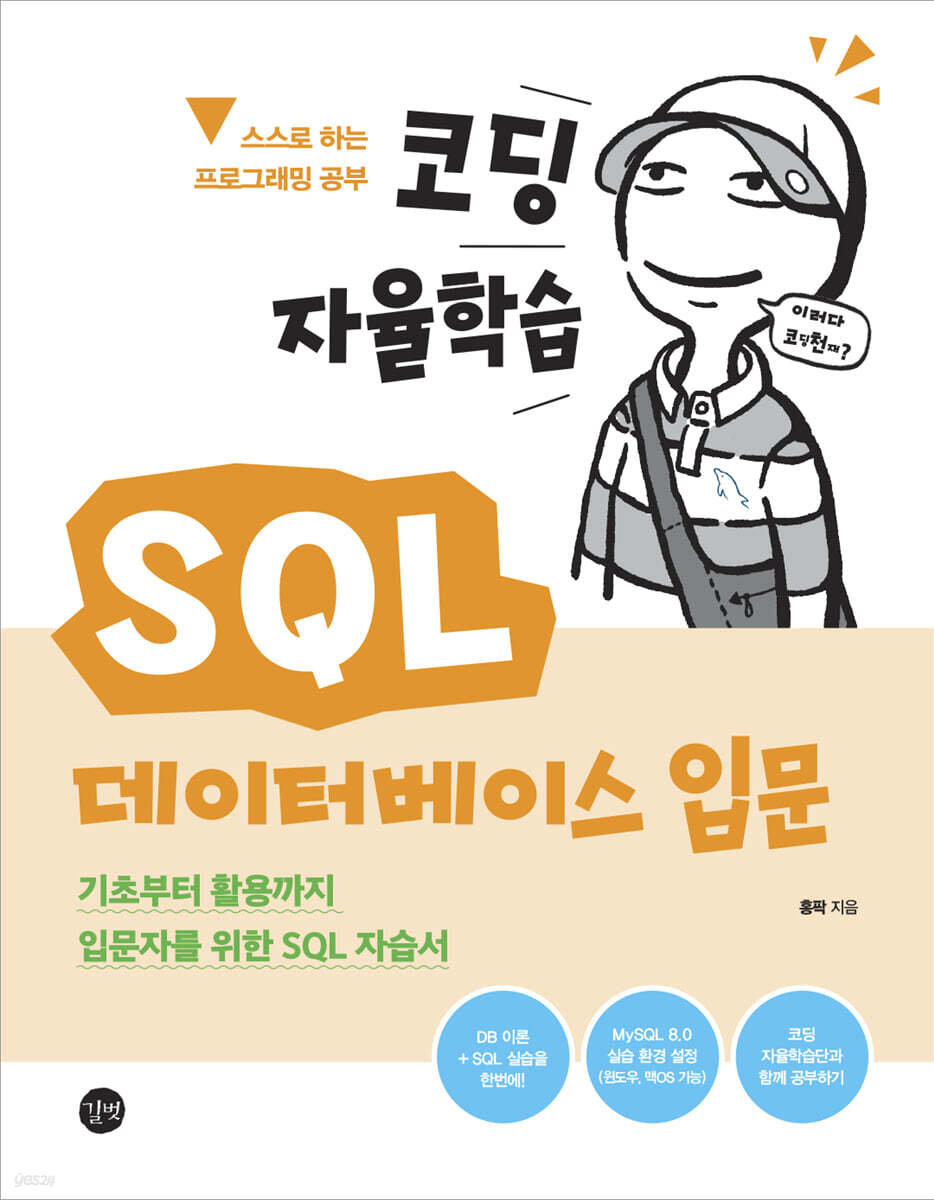
Introduction to SQL Database Coding Self-Study
 |
Description
Book Introduction
With practice-oriented, repetitive learning
From SQL Beginner to Expert
Understand the overall concepts and operating principles of databases and learn how to write SQL queries.
The training will be conducted using MySQL, which is available for free, and is available for both Windows and macOS users.
By utilizing the author's unique, clear explanation style, you can understand basic concepts and operating principles and immediately practice them, allowing you to study without getting bored.
After reading the book, you will understand the basic concepts and principles of databases and be able to extract and analyze the desired data using SQL.
From SQL Beginner to Expert
Understand the overall concepts and operating principles of databases and learn how to write SQL queries.
The training will be conducted using MySQL, which is available for free, and is available for both Windows and macOS users.
By utilizing the author's unique, clear explanation style, you can understand basic concepts and operating principles and immediately practice them, allowing you to study without getting bored.
After reading the book, you will understand the basic concepts and principles of databases and be able to extract and analyze the desired data using SQL.
- You can preview some of the book's contents.
Preview
index
Part 1 Overview of the Database
Chapter 1: Getting Started with the Database
1.1 What is a database?
1.2 Data storage format
1.3 Setting up the MySQL practice environment
Part 2 SQL Basics
Chapter 2: Creating, Retrieving, Modifying, and Deleting Data
2.1 What is Data CRUD?
2.2 Creating a Database
2.3 Inserting and Retrieving Data
2.4 Modifying and Deleting Data
Chapter 3 Filtering Data
3.1 What is data filtering?
3.2 Data Filtering Practice: University DB
Chapter 4 Aggregating Data
4.1 What is an aggregate function?
4.2 Aggregate Function Practice: Bank DB
Chapter 5: Using Various Data Types
5.1 What is a data type?
5.2 Filtering Practice by Data Type: Store DB
Part 3 Using SQL
Chapter 6: Building Relationships
6.1 Relationship
6.2 Creating Diverse Relationships
6.3 Relationship Creation Practice: Starstagram DB
Chapter 7 Joining Tables
7.1 What is a join?
7.2 Types of Joins
7.3 Join Practice: Stargram DB
Chapter 8: Grouping Analysis
8.1 Grouping
8.2 Grouping, Filtering, Sorting, and Retrieval Limits
8.3 Grouping Analysis Practice: Market DB
Chapter 9: Using Subqueries
9.1 What is a subquery?
9.2 Subqueries in various locations
9.3 IN, ANY, ALL, EXISTS
Part 4 Data Modeling
Chapter 10: Data Modeling and Normalization
10.1 What is data modeling?
10.2 Components of the Data Model
10.3 Data Modeling Practice: Shopping Mall DB
10.4 Normalization
Chapter 1: Getting Started with the Database
1.1 What is a database?
1.2 Data storage format
1.3 Setting up the MySQL practice environment
Part 2 SQL Basics
Chapter 2: Creating, Retrieving, Modifying, and Deleting Data
2.1 What is Data CRUD?
2.2 Creating a Database
2.3 Inserting and Retrieving Data
2.4 Modifying and Deleting Data
Chapter 3 Filtering Data
3.1 What is data filtering?
3.2 Data Filtering Practice: University DB
Chapter 4 Aggregating Data
4.1 What is an aggregate function?
4.2 Aggregate Function Practice: Bank DB
Chapter 5: Using Various Data Types
5.1 What is a data type?
5.2 Filtering Practice by Data Type: Store DB
Part 3 Using SQL
Chapter 6: Building Relationships
6.1 Relationship
6.2 Creating Diverse Relationships
6.3 Relationship Creation Practice: Starstagram DB
Chapter 7 Joining Tables
7.1 What is a join?
7.2 Types of Joins
7.3 Join Practice: Stargram DB
Chapter 8: Grouping Analysis
8.1 Grouping
8.2 Grouping, Filtering, Sorting, and Retrieval Limits
8.3 Grouping Analysis Practice: Market DB
Chapter 9: Using Subqueries
9.1 What is a subquery?
9.2 Subqueries in various locations
9.3 IN, ANY, ALL, EXISTS
Part 4 Data Modeling
Chapter 10: Data Modeling and Normalization
10.1 What is data modeling?
10.2 Components of the Data Model
10.3 Data Modeling Practice: Shopping Mall DB
10.4 Normalization
Detailed image

Publisher's Review
"Contents Covered"
1.
Database Overview | DB Concepts, Data Storage Formats, MySQL Practice Environment Setup (Windows, macOS)
2. SQL Basics | Data Creation, Retrieval, Modification, and Deletion, Data Filtering, Data Aggregation, Data Types
3. Using SQL | Creating Relationships, Joining Tables, Grouping Analysis, Subqueries
4.
Data Modeling | Data Modeling Process, Key Terms, Normalization
Recommended Readers
- Those who need to study individually before or after taking a database class
- Those studying front-end or back-end development
- I'm learning data analysis at work, but I'm not sure where to start.
- Those who are preparing for SQL certification but have not yet established the basics
- Those who know SQL bit by bit and want to organize it systematically
- Those who prefer to learn with a focus on practice rather than concepts
Recommended Reviews
Above all, the greatest advantage is that it is explained concisely and without unnecessary details.
The program installation process is also easy to understand and provides step-by-step guidance. Rather than simply listing theories, it provides a balanced mix of theory and practice so you can create and utilize your own database.
_Lee Seon-hwa
Having previously studied programming languages like Python and Java, I finally learned SQL for the first time. It was easy to follow and understand, and it really helped me build a solid foundation. As I gained experience working with databases using SQL, I naturally came to understand how it works.
_Kim Se-yoon
At first, the concept of databases was unfamiliar to me and I wasn't sure if I understood it correctly, but after about halfway through, I felt like I was getting used to it and the unfamiliar feeling gradually decreased.
I hope that more introductory books like this one, focusing on practical exercises, will be published in the future.
_Kim Ri-yeon
It's easy to follow because it guides you through every step, from program installation to file saving, in detail, and the content in the book matches the screens I used on my practice, so there's no major difficulty.
Instead of explaining things in lengthy sentences, we provide appropriate comments and concise examples to keep you immersed even during long study sessions.
_Choi Jin-han
I felt my SQL skills improving significantly through the process of typing queries and checking the answers myself, which made learning enjoyable and rewarding.
The book's explanations are very friendly and the concepts are organized very well, so it will be useful not only for SQL beginners but also for those who want to review.
_Lee Seung-hyun
1.
Database Overview | DB Concepts, Data Storage Formats, MySQL Practice Environment Setup (Windows, macOS)
2. SQL Basics | Data Creation, Retrieval, Modification, and Deletion, Data Filtering, Data Aggregation, Data Types
3. Using SQL | Creating Relationships, Joining Tables, Grouping Analysis, Subqueries
4.
Data Modeling | Data Modeling Process, Key Terms, Normalization
Recommended Readers
- Those who need to study individually before or after taking a database class
- Those studying front-end or back-end development
- I'm learning data analysis at work, but I'm not sure where to start.
- Those who are preparing for SQL certification but have not yet established the basics
- Those who know SQL bit by bit and want to organize it systematically
- Those who prefer to learn with a focus on practice rather than concepts
Recommended Reviews
Above all, the greatest advantage is that it is explained concisely and without unnecessary details.
The program installation process is also easy to understand and provides step-by-step guidance. Rather than simply listing theories, it provides a balanced mix of theory and practice so you can create and utilize your own database.
_Lee Seon-hwa
Having previously studied programming languages like Python and Java, I finally learned SQL for the first time. It was easy to follow and understand, and it really helped me build a solid foundation. As I gained experience working with databases using SQL, I naturally came to understand how it works.
_Kim Se-yoon
At first, the concept of databases was unfamiliar to me and I wasn't sure if I understood it correctly, but after about halfway through, I felt like I was getting used to it and the unfamiliar feeling gradually decreased.
I hope that more introductory books like this one, focusing on practical exercises, will be published in the future.
_Kim Ri-yeon
It's easy to follow because it guides you through every step, from program installation to file saving, in detail, and the content in the book matches the screens I used on my practice, so there's no major difficulty.
Instead of explaining things in lengthy sentences, we provide appropriate comments and concise examples to keep you immersed even during long study sessions.
_Choi Jin-han
I felt my SQL skills improving significantly through the process of typing queries and checking the answers myself, which made learning enjoyable and rewarding.
The book's explanations are very friendly and the concepts are organized very well, so it will be useful not only for SQL beginners but also for those who want to review.
_Lee Seung-hyun
GOODS SPECIFICS
- Date of issue: February 5, 2025
- Page count, weight, size: 352 pages | 183*235*14mm
- ISBN13: 9791140712526
You may also like
카테고리
korean


korean

![GQ KOREA Mark (Monthly): December [2025]](http://librairie.coreenne.fr/cdn/shop/files/8ef265dbbfbf186523ed75ba7319009d.jpg?v=1765340328&width=3840)


