

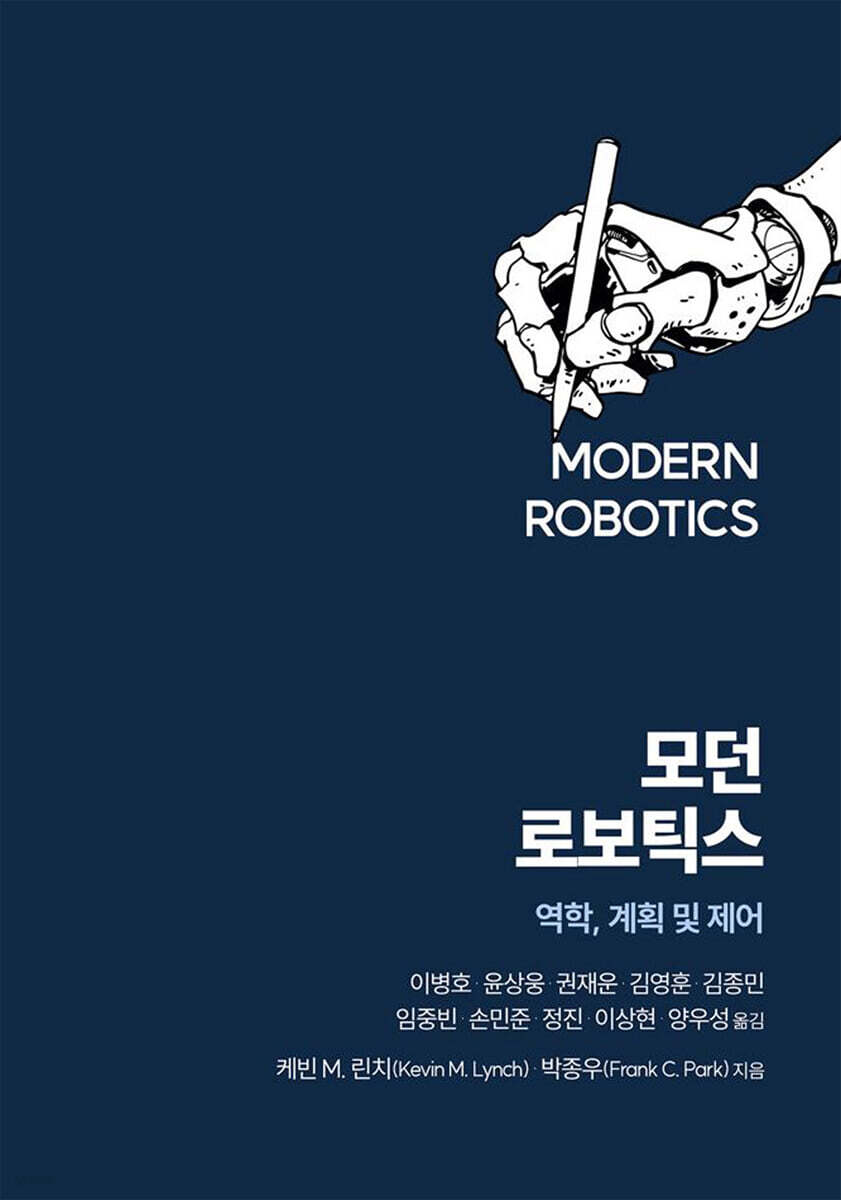
Modern Robotics
 |
Description
Book Introduction
This book provides a comprehensive introduction to the field of robotics, encompassing both theoretical concepts and practical applications.
It covers topics such as kinematics, dynamics, motion planning, and control, as well as modern techniques such as optimization and machine learning.
The book includes a variety of examples and practice problems, and even provides a code library and simulation environment to help readers gain practical robotics experience.
This book will be helpful to undergraduate and graduate students, as well as researchers and practitioners in the field of robotics. The author's free video lectures are available on Coursera (https://www.coursera.org/specializations/modernrobotics).
It covers topics such as kinematics, dynamics, motion planning, and control, as well as modern techniques such as optimization and machine learning.
The book includes a variety of examples and practice problems, and even provides a code library and simulation environment to help readers gain practical robotics experience.
This book will be helpful to undergraduate and graduate students, as well as researchers and practitioners in the field of robotics. The author's free video lectures are available on Coursera (https://www.coursera.org/specializations/modernrobotics).
- You can preview some of the book's contents.
Preview
index
Chapter 1.
Preview
Chapter 2.
state space
2.1 Degrees of freedom of rigid bodies
2.2 Degrees of freedom of the robot
2.2.1 Robot joints
2.2.2 Grübler's formula
2.3 State Space: Topology and Representation
2.3.1 State space topology
2.3.2 State space representation
2.4 Configuration and Speed Constraints
2.5 Task Space and Workspace
2.6 Summary
2.7 Notes and References
2.8 Practice Problems
Chapter 3.
Rigid body motion
3.1 Rigid body motion on a plane
3.2 Rotation and angular velocity
3.2.1 Rotation matrix
3.2.2 Angular velocity
3.2.3 Exponential Coordinate Representation of Rotation
3.3 Rigid body motion and twist
3.3.1 Homogeneous transformation matrix
3.3.2 Twist
3.3.3 Exponential Coordinate Representation of Rigid Body Motion
3.4 wrench
3.5 Summary
3.6 Software
3.7 Notes and References
3.8 Practice Problems
Chapter 4.
Regular mechanics
4.1 Exponential product formula
4.1.1 First formulation: Screw axis in the base coordinate system
4.1.2 Example
4.1.3 Second formulation: Screw axis in the end effector coordinate system
4.2 Unified Format for Robotics
4.3 Summary
4.4 Software
4.5 Notes and References
4.6 Practice Problems
Chapter 5.
Velocity kinematics and statics
5.1 Manipulator Jacobian
5.1.1 Spatial Jacobian
5.1.2 Object Jacobian
5.1.3 Visualizing the Spatial and Object Jacobians
5.1.4 Relationship between spatial and body Jacobians
5.1.5 Other expressions of Jacobian
5.1.6 Preview of reverse velocity kinematics
5.2 Statics of the chain
5.3 Singularity Analysis
5.4 Operability
5.5 Summary
5.6 Software
5.7 Notes and References
5.8 Practice Problems
Chapter 6.
Inverse kinematics
6.1 Analytical inverse kinematics
6.1.1 6R Puma-type robotic arm
6.1.2 Stanford-type robotic arm
6.2 Numerical inverse kinematics
6.2.1 Newton-Raphson method
6.2.2 Numerical inverse kinematics algorithm
6.3 Velocity inverse kinematics
6.4 Comments on closed loops
6.5 Summary
6.6 Software
6.7 Notes and References
6.8 Practice Problems
Chapter 7.
Kinematics of closed chains
7.1 Inverse kinematics and forward kinematics
7.1.1 3×RPR Planar Parallel Mechanism
7.1.2 Stewart-Gough Platform
7.1.3 General parallel mechanisms
7.2 Differential Kinematics
7.2.1 Stewart-Gough Platform
7.2.2 General parallel mechanisms
7.3 Singularity
7.4 Summary
7.5 Notes and References
7.6 Practice Problems
Chapter 8.
Dynamics of the chain
8.1 Lagrangian form
8.1.1 Basic Concepts and Examples
8.1.2 Generalized formulas
8.1.3 Understanding the Mass Matrix
8.1.4 Lagrangian dynamics versus Newton-Euler dynamics
8.2 Dynamics of a single rigid body
8.2.1 Classical formula
8.2.2 Twist-wrench formula
8.2.3 Dynamics in other coordinate systems
8.3 Inverse Newton-Euler dynamics
8.3.1 Induction
8.3.2 Newton-Euler dynamics algorithm
8.4 Closed-form dynamic equations
8.5 Dynamics of the chain
8.6 Dynamics in the workspace
8.7 Dynamics under constrained conditions
8.8 Robot Dynamics in URDF
8.9 Drive, Gearing, Friction
8.9.1 DC Motors and Gearing
8.9.2 Detected Rotational Inertia
8.9.3 Newton-Euler dynamics algorithm considering the effects of motor rotational inertia and gearing
8.9.4 Friction
8.9.5 Flexibility of joints and links
8.10 Plot
8.11 Software
8.12 Notes and References
8.13 Example
Chapter 9.
Trajectory generation
9.1 Definition of Terms
9.2 Point-to-point trajectory
9.2.1 Straight path
9.2.2 Time Scaling and Straight Paths
9.3 Polynomial waypoint trajectories
9.4 hours optimal time scaling
9.4.1 (s, s˙) phase plane
9.4.2 Time Scaling Algorithm
9.4.3 Variations of the Time Scaling Algorithm
9.4.4 Assumptions and Precautions
9.5 Summary
9.6 Software
9.7 Notes and References
9.8 Practice Problems
Chapter 10.
motion plan
10.1 Overview of the motion plan
10.1.1 Various motion planning problems
10.1.2 Characteristics of the motion planner
10.1.3 Motion Planning Method
10.2 Basics
10.2.1 State Space Obstacles
10.2.2 Distance measurement to obstacles and collision detection
10.2.3 Graphs and Trees
10.2.4 Graph Navigation
10.3 Full Motion Planner
10.4 Grid Planner
10.4.1 Multi-resolution grid representation
10.4.2 Grid representation when motion constraints exist
10.5 Sampling Techniques
10.5.1 RRT Algorithm
10.5.2 PRM
10.6 Virtual potential field
10.6.1 Points in state space
10.6.2 Navigation functions
10.6.3 Workspace Potential
10.6.4 Wheeled Mobile Robots
10.6.5 Applications in the Motion Scheme of Potential Fields
10.7 Nonlinear Optimization
10.8 Curved
10.9 Summary
10.10 References and Others
10.11 Practice Problems
Chapter 11.
Robot control
11.1 Control System Overview
11.2 Error dynamics
11.2.1 Error Response
11.2.2 Linear error dynamics
11.3 Motion control based on speed input
11.3.1 Motion control of a single joint
11.3.2 Motion control of multi-joint robots
11.3.3 Motion Control in Task Space
11.4 Motion control based on torque and force input
11.4.1 Motion Control for a Single Joint
11.4.2 Motion control of multi-joint robots
11.4.3 Motion Control in Task Space
11.5 Force Control
11.6 Hybrid Exercises - Force Control
11.6.1 Natural and artificial constraints
11.6.2 Hybrid Motion - Force Controller
11.7 Impedance Control
11.7.1 Impedance Control Algorithm
11.7.2 Admittance Control Algorithm
11.8 Low-level joint force-torque control
11.9 Other topics
11.10 Summary
11.11 Software
11.12 Notes and References
11.13 Practice Problems
Chapter 12.
Phage and manipulation
12.1 Contact kinematics
12.1.1 Primary Analysis for a Single Contact Point
12.1.2 Types of contact: rolling, sliding, and sliding
12.1.3 Multiple Contacts
12.1.4 Set of objects
12.1.5 Other types of contact points
12.1.6 Schematic method on a plane
12.1.7 Form closure
12.2 Contact Force and Friction
12.2.1 Friction
12.2.2 Planar schematic method
12.2.3 Force Closure
12.2.4 Duality of Force and Motion Degrees of Freedom
12.3 Operation
12.4 Summary
12.5 Notes and References
12.6 Practice Problems
Chapter 13.
wheeled mobile robot
13.1 Types of wheeled mobile robots
13.2 Omnidirectional wheeled mobile robot
13.2.1 Modeling
13.2.2 Motion Planning
13.2.3 Feedback Control
13.3 Nonholonomic wheeled mobile robots
13.3.1 Modeling
13.3.2 Controllability
13.3.3 Motion Plan
13.3.4 Feedback Control
13.4 Odometry
13.5 Movement Controls
13.6 Summary
13.7 Notes and References
13.8 Practice Problems
A Summary of Useful Formulas
Various expressions of B rotation
B.1 Euler angles
B.1.1 Algorithm for Computing ZYX Euler Angles
Euler angle representations other than B.1.2
B.2 Roll-pitch-yaw angles
B.3 Unit number of employees
B.4 Cayley-Rodriguez parameters
C Denavit-Hartenberg parameter
C.1 Denavit-Hartenberg expression
C.2 Determining the Link Coordinate System
C.3 Why 4 parameters are sufficient
C.4 Regular kinematics of manipulators
C.5 Practice Problems
C.6 Relationship between PoE and DH Modes
C.7 Conclusion
D optimization and Lagrange multiplier method
Search
Preview
Chapter 2.
state space
2.1 Degrees of freedom of rigid bodies
2.2 Degrees of freedom of the robot
2.2.1 Robot joints
2.2.2 Grübler's formula
2.3 State Space: Topology and Representation
2.3.1 State space topology
2.3.2 State space representation
2.4 Configuration and Speed Constraints
2.5 Task Space and Workspace
2.6 Summary
2.7 Notes and References
2.8 Practice Problems
Chapter 3.
Rigid body motion
3.1 Rigid body motion on a plane
3.2 Rotation and angular velocity
3.2.1 Rotation matrix
3.2.2 Angular velocity
3.2.3 Exponential Coordinate Representation of Rotation
3.3 Rigid body motion and twist
3.3.1 Homogeneous transformation matrix
3.3.2 Twist
3.3.3 Exponential Coordinate Representation of Rigid Body Motion
3.4 wrench
3.5 Summary
3.6 Software
3.7 Notes and References
3.8 Practice Problems
Chapter 4.
Regular mechanics
4.1 Exponential product formula
4.1.1 First formulation: Screw axis in the base coordinate system
4.1.2 Example
4.1.3 Second formulation: Screw axis in the end effector coordinate system
4.2 Unified Format for Robotics
4.3 Summary
4.4 Software
4.5 Notes and References
4.6 Practice Problems
Chapter 5.
Velocity kinematics and statics
5.1 Manipulator Jacobian
5.1.1 Spatial Jacobian
5.1.2 Object Jacobian
5.1.3 Visualizing the Spatial and Object Jacobians
5.1.4 Relationship between spatial and body Jacobians
5.1.5 Other expressions of Jacobian
5.1.6 Preview of reverse velocity kinematics
5.2 Statics of the chain
5.3 Singularity Analysis
5.4 Operability
5.5 Summary
5.6 Software
5.7 Notes and References
5.8 Practice Problems
Chapter 6.
Inverse kinematics
6.1 Analytical inverse kinematics
6.1.1 6R Puma-type robotic arm
6.1.2 Stanford-type robotic arm
6.2 Numerical inverse kinematics
6.2.1 Newton-Raphson method
6.2.2 Numerical inverse kinematics algorithm
6.3 Velocity inverse kinematics
6.4 Comments on closed loops
6.5 Summary
6.6 Software
6.7 Notes and References
6.8 Practice Problems
Chapter 7.
Kinematics of closed chains
7.1 Inverse kinematics and forward kinematics
7.1.1 3×RPR Planar Parallel Mechanism
7.1.2 Stewart-Gough Platform
7.1.3 General parallel mechanisms
7.2 Differential Kinematics
7.2.1 Stewart-Gough Platform
7.2.2 General parallel mechanisms
7.3 Singularity
7.4 Summary
7.5 Notes and References
7.6 Practice Problems
Chapter 8.
Dynamics of the chain
8.1 Lagrangian form
8.1.1 Basic Concepts and Examples
8.1.2 Generalized formulas
8.1.3 Understanding the Mass Matrix
8.1.4 Lagrangian dynamics versus Newton-Euler dynamics
8.2 Dynamics of a single rigid body
8.2.1 Classical formula
8.2.2 Twist-wrench formula
8.2.3 Dynamics in other coordinate systems
8.3 Inverse Newton-Euler dynamics
8.3.1 Induction
8.3.2 Newton-Euler dynamics algorithm
8.4 Closed-form dynamic equations
8.5 Dynamics of the chain
8.6 Dynamics in the workspace
8.7 Dynamics under constrained conditions
8.8 Robot Dynamics in URDF
8.9 Drive, Gearing, Friction
8.9.1 DC Motors and Gearing
8.9.2 Detected Rotational Inertia
8.9.3 Newton-Euler dynamics algorithm considering the effects of motor rotational inertia and gearing
8.9.4 Friction
8.9.5 Flexibility of joints and links
8.10 Plot
8.11 Software
8.12 Notes and References
8.13 Example
Chapter 9.
Trajectory generation
9.1 Definition of Terms
9.2 Point-to-point trajectory
9.2.1 Straight path
9.2.2 Time Scaling and Straight Paths
9.3 Polynomial waypoint trajectories
9.4 hours optimal time scaling
9.4.1 (s, s˙) phase plane
9.4.2 Time Scaling Algorithm
9.4.3 Variations of the Time Scaling Algorithm
9.4.4 Assumptions and Precautions
9.5 Summary
9.6 Software
9.7 Notes and References
9.8 Practice Problems
Chapter 10.
motion plan
10.1 Overview of the motion plan
10.1.1 Various motion planning problems
10.1.2 Characteristics of the motion planner
10.1.3 Motion Planning Method
10.2 Basics
10.2.1 State Space Obstacles
10.2.2 Distance measurement to obstacles and collision detection
10.2.3 Graphs and Trees
10.2.4 Graph Navigation
10.3 Full Motion Planner
10.4 Grid Planner
10.4.1 Multi-resolution grid representation
10.4.2 Grid representation when motion constraints exist
10.5 Sampling Techniques
10.5.1 RRT Algorithm
10.5.2 PRM
10.6 Virtual potential field
10.6.1 Points in state space
10.6.2 Navigation functions
10.6.3 Workspace Potential
10.6.4 Wheeled Mobile Robots
10.6.5 Applications in the Motion Scheme of Potential Fields
10.7 Nonlinear Optimization
10.8 Curved
10.9 Summary
10.10 References and Others
10.11 Practice Problems
Chapter 11.
Robot control
11.1 Control System Overview
11.2 Error dynamics
11.2.1 Error Response
11.2.2 Linear error dynamics
11.3 Motion control based on speed input
11.3.1 Motion control of a single joint
11.3.2 Motion control of multi-joint robots
11.3.3 Motion Control in Task Space
11.4 Motion control based on torque and force input
11.4.1 Motion Control for a Single Joint
11.4.2 Motion control of multi-joint robots
11.4.3 Motion Control in Task Space
11.5 Force Control
11.6 Hybrid Exercises - Force Control
11.6.1 Natural and artificial constraints
11.6.2 Hybrid Motion - Force Controller
11.7 Impedance Control
11.7.1 Impedance Control Algorithm
11.7.2 Admittance Control Algorithm
11.8 Low-level joint force-torque control
11.9 Other topics
11.10 Summary
11.11 Software
11.12 Notes and References
11.13 Practice Problems
Chapter 12.
Phage and manipulation
12.1 Contact kinematics
12.1.1 Primary Analysis for a Single Contact Point
12.1.2 Types of contact: rolling, sliding, and sliding
12.1.3 Multiple Contacts
12.1.4 Set of objects
12.1.5 Other types of contact points
12.1.6 Schematic method on a plane
12.1.7 Form closure
12.2 Contact Force and Friction
12.2.1 Friction
12.2.2 Planar schematic method
12.2.3 Force Closure
12.2.4 Duality of Force and Motion Degrees of Freedom
12.3 Operation
12.4 Summary
12.5 Notes and References
12.6 Practice Problems
Chapter 13.
wheeled mobile robot
13.1 Types of wheeled mobile robots
13.2 Omnidirectional wheeled mobile robot
13.2.1 Modeling
13.2.2 Motion Planning
13.2.3 Feedback Control
13.3 Nonholonomic wheeled mobile robots
13.3.1 Modeling
13.3.2 Controllability
13.3.3 Motion Plan
13.3.4 Feedback Control
13.4 Odometry
13.5 Movement Controls
13.6 Summary
13.7 Notes and References
13.8 Practice Problems
A Summary of Useful Formulas
Various expressions of B rotation
B.1 Euler angles
B.1.1 Algorithm for Computing ZYX Euler Angles
Euler angle representations other than B.1.2
B.2 Roll-pitch-yaw angles
B.3 Unit number of employees
B.4 Cayley-Rodriguez parameters
C Denavit-Hartenberg parameter
C.1 Denavit-Hartenberg expression
C.2 Determining the Link Coordinate System
C.3 Why 4 parameters are sufficient
C.4 Regular kinematics of manipulators
C.5 Practice Problems
C.6 Relationship between PoE and DH Modes
C.7 Conclusion
D optimization and Lagrange multiplier method
Search
Publisher's Review
What this book covers
- State-of-the-art screw theory that captures the most important physical characteristics of robots in an intuitive geometric way.
- Lots of practice questions for assessment
- Free software to reinforce the concepts of the book
- Free video lectures (https://www.coursera.org/specializations/modernrobotics)
Structure of this book
Chapter 1, "Preview," introduces the basic concepts of robotics and the structure of this book.
Chapter 2, 'State Space', focuses on the representation of the configuration of a robot system that specifies the positions of all points on the robot.
Chapter 3, 'Rigid Body Motion', addresses the problem of how to mathematically describe the motion of rigid bodies in three-dimensional physical space.
Chapter 4, 'Periodic Kinematics', presents the Product of Exponentials (PoE) equation that describes the regular kinematics of a probabilistic chain.
Chapter 5, "Velocity Kinematics and Statics," covers velocity kinematics, which describes the relationship between joint velocities and the linear and angular velocities of the end-effector coordinate system.
The core of velocity kinematics is the Jacobian of regular kinematics.
In Chapter 6, 'Inverse Kinematics', we first examine the famous six-degree-of-freedom open-chain structure for which a closed-form analytical solution can be obtained using inverse kinematics.
Afterwards, we derive an iterative numerical algorithm that can solve the inverse kinematics of a general chain using the inverse matrix of the Jacobian.
Chapter 7, 'Kinematics of Closed Chains', studies the basic concepts and tools for kinematic analysis of closed chains.
First, we study detailed examples of mechanisms such as the five-section link and the Stewart-Gough platform on a plane.
These results are then generalized into a systematic methodology for more general closed-chain kinematics.
Chapter 8, "Dynamics of Open Chains," examines two approaches to deriving the dynamic equations of a robot.
In addition to the analytical derivation of the dynamical equations, we also introduce recursive algorithms for static and dynamical dynamics.
Chapter 9, 'Trajectory Generation', covers automatically generating joint trajectories from a set of task input data.
We focus on three cases: (i) straight-line trajectories between points in joint space and task space, (ii) smooth trajectories passing through waypoints at specific times, and (iii) shortest-time trajectories passing through a given path under robot dynamics and actuator limits.
Chapter 10, "Motion Planning," addresses the problem of finding collision-avoiding motions for a robot within an irregular workspace while avoiding joint limits, actuator limits, and other physical constraints imposed on the robot.
We cover three basic approaches: grid-based methods, sampling-based methods, and virtual potential fields-based methods.
Chapter 11, "Robot Control," examines the limitations of feedback control that does not consider the robot dynamics model and studies motion control algorithms such as computed torque control that combine dynamic modeling and feedback control.
Afterwards, the basics learned for robot motion control are applied to force control, hybrid motion-force control, and impedance control.
Chapter 12, "Gesture and Manipulation," models contact between robots and objects, particularly the constraints imposed on the motion of objects by contact and the forces transmitted through frictional contact.
In addition to these models, we study contacts for fixing objects by form closure and force closure.
Contact modeling is also applied to non-gravity problems such as pushing objects, dynamic object transport, and structural stability testing.
Chapter 13, "Wheeled Mobile Robots," finally covers the kinematics, motion planning, and control of wheeled mobile robots and wheeled mobile robots with robotic arms.
At the end of each chapter, important concepts are summarized, and Appendix A lists commonly used equations.
Translator's Note
It comprehensively covers the basic theories required for robotics, including kinematics, dynamics, motion planning, and control.
Since the author's lectures are provided online, I believe they will be easily accessible to self-study students.
- Lee Byung-ho
I am delighted that this book, which has been loved by robotics students around the world, has been translated into Korean.
I hope this will be of great help to Korean students who dream of becoming robotics engineers.
- Yoon Sang-woong
Covers the basics of robotics in the easiest, simplest, yet most complete way and with the most expressive presentation.
As this book was completed through the long-term dedication of many people, I hope it will be widely utilized and contribute greatly to the Korean robotics community.
- Kwon Jae-woon
It clearly shows the perspective on robots of Professor Jong-Woo Park, who has had a great influence on robotics for a long time.
We hope that the Korean translation will make studying easier and more enjoyable for Korean students.
- Kim Young-hoon
It provides essential knowledge in the field of robotics and is a must-read for anyone who wishes to specialize in robotics.
It contains a complete mathematical description of the robot's movements and several techniques for controlling them.
-Kim Jong-min
This textbook describes robotics in an easy and accurate way that undergraduate students can understand.
I believe that this book, translated into Korean, will be of great help to countless Korean students who dream of a career in robotics.
- Im Jung-bin
This book explains the general subject of robotics in an easy and simple way.
I hope that this book will be widely used by universities and academic circles and contribute greatly to the development of Korean robotics.
- Son Min-jun
I first encountered this book as a textbook for Introduction to Robotics, a major subject in the Department of Mechanical Engineering at Seoul National University. It is a book that describes the contents related to robotics mathematically, so any undergraduate student in their second year or higher who has some understanding of linear algebra will be able to understand it without much difficulty.
- Jeongjin
I studied this book while taking Professor Jong-Woo Park's introductory robotics course, but I was disappointed that it was written only in English.
I hope this translation will be helpful to students in their future studies.
- Lee Sang-hyun
This book is a basic introduction to robotics and will be of great help in building background knowledge and studying related fields.
The translator also studied 『Modern Robotics』 during his undergraduate years, and has no doubt that the translated version will be of great help to future robotics students.
- Yang Woo-sung
- State-of-the-art screw theory that captures the most important physical characteristics of robots in an intuitive geometric way.
- Lots of practice questions for assessment
- Free software to reinforce the concepts of the book
- Free video lectures (https://www.coursera.org/specializations/modernrobotics)
Structure of this book
Chapter 1, "Preview," introduces the basic concepts of robotics and the structure of this book.
Chapter 2, 'State Space', focuses on the representation of the configuration of a robot system that specifies the positions of all points on the robot.
Chapter 3, 'Rigid Body Motion', addresses the problem of how to mathematically describe the motion of rigid bodies in three-dimensional physical space.
Chapter 4, 'Periodic Kinematics', presents the Product of Exponentials (PoE) equation that describes the regular kinematics of a probabilistic chain.
Chapter 5, "Velocity Kinematics and Statics," covers velocity kinematics, which describes the relationship between joint velocities and the linear and angular velocities of the end-effector coordinate system.
The core of velocity kinematics is the Jacobian of regular kinematics.
In Chapter 6, 'Inverse Kinematics', we first examine the famous six-degree-of-freedom open-chain structure for which a closed-form analytical solution can be obtained using inverse kinematics.
Afterwards, we derive an iterative numerical algorithm that can solve the inverse kinematics of a general chain using the inverse matrix of the Jacobian.
Chapter 7, 'Kinematics of Closed Chains', studies the basic concepts and tools for kinematic analysis of closed chains.
First, we study detailed examples of mechanisms such as the five-section link and the Stewart-Gough platform on a plane.
These results are then generalized into a systematic methodology for more general closed-chain kinematics.
Chapter 8, "Dynamics of Open Chains," examines two approaches to deriving the dynamic equations of a robot.
In addition to the analytical derivation of the dynamical equations, we also introduce recursive algorithms for static and dynamical dynamics.
Chapter 9, 'Trajectory Generation', covers automatically generating joint trajectories from a set of task input data.
We focus on three cases: (i) straight-line trajectories between points in joint space and task space, (ii) smooth trajectories passing through waypoints at specific times, and (iii) shortest-time trajectories passing through a given path under robot dynamics and actuator limits.
Chapter 10, "Motion Planning," addresses the problem of finding collision-avoiding motions for a robot within an irregular workspace while avoiding joint limits, actuator limits, and other physical constraints imposed on the robot.
We cover three basic approaches: grid-based methods, sampling-based methods, and virtual potential fields-based methods.
Chapter 11, "Robot Control," examines the limitations of feedback control that does not consider the robot dynamics model and studies motion control algorithms such as computed torque control that combine dynamic modeling and feedback control.
Afterwards, the basics learned for robot motion control are applied to force control, hybrid motion-force control, and impedance control.
Chapter 12, "Gesture and Manipulation," models contact between robots and objects, particularly the constraints imposed on the motion of objects by contact and the forces transmitted through frictional contact.
In addition to these models, we study contacts for fixing objects by form closure and force closure.
Contact modeling is also applied to non-gravity problems such as pushing objects, dynamic object transport, and structural stability testing.
Chapter 13, "Wheeled Mobile Robots," finally covers the kinematics, motion planning, and control of wheeled mobile robots and wheeled mobile robots with robotic arms.
At the end of each chapter, important concepts are summarized, and Appendix A lists commonly used equations.
Translator's Note
It comprehensively covers the basic theories required for robotics, including kinematics, dynamics, motion planning, and control.
Since the author's lectures are provided online, I believe they will be easily accessible to self-study students.
- Lee Byung-ho
I am delighted that this book, which has been loved by robotics students around the world, has been translated into Korean.
I hope this will be of great help to Korean students who dream of becoming robotics engineers.
- Yoon Sang-woong
Covers the basics of robotics in the easiest, simplest, yet most complete way and with the most expressive presentation.
As this book was completed through the long-term dedication of many people, I hope it will be widely utilized and contribute greatly to the Korean robotics community.
- Kwon Jae-woon
It clearly shows the perspective on robots of Professor Jong-Woo Park, who has had a great influence on robotics for a long time.
We hope that the Korean translation will make studying easier and more enjoyable for Korean students.
- Kim Young-hoon
It provides essential knowledge in the field of robotics and is a must-read for anyone who wishes to specialize in robotics.
It contains a complete mathematical description of the robot's movements and several techniques for controlling them.
-Kim Jong-min
This textbook describes robotics in an easy and accurate way that undergraduate students can understand.
I believe that this book, translated into Korean, will be of great help to countless Korean students who dream of a career in robotics.
- Im Jung-bin
This book explains the general subject of robotics in an easy and simple way.
I hope that this book will be widely used by universities and academic circles and contribute greatly to the development of Korean robotics.
- Son Min-jun
I first encountered this book as a textbook for Introduction to Robotics, a major subject in the Department of Mechanical Engineering at Seoul National University. It is a book that describes the contents related to robotics mathematically, so any undergraduate student in their second year or higher who has some understanding of linear algebra will be able to understand it without much difficulty.
- Jeongjin
I studied this book while taking Professor Jong-Woo Park's introductory robotics course, but I was disappointed that it was written only in English.
I hope this translation will be helpful to students in their future studies.
- Lee Sang-hyun
This book is a basic introduction to robotics and will be of great help in building background knowledge and studying related fields.
The translator also studied 『Modern Robotics』 during his undergraduate years, and has no doubt that the translated version will be of great help to future robotics students.
- Yang Woo-sung
GOODS SPECIFICS
- Date of issue: May 31, 2023
- Page count, weight, size: 858 pages | 175*250*40mm
- ISBN13: 9791161757384
- ISBN10: 1161757384
You may also like
카테고리
korean


korean

![GQ KOREA Mark (Monthly): December [2025]](http://librairie.coreenne.fr/cdn/shop/files/8ef265dbbfbf186523ed75ba7319009d.jpg?v=1765340328&width=3840)


