

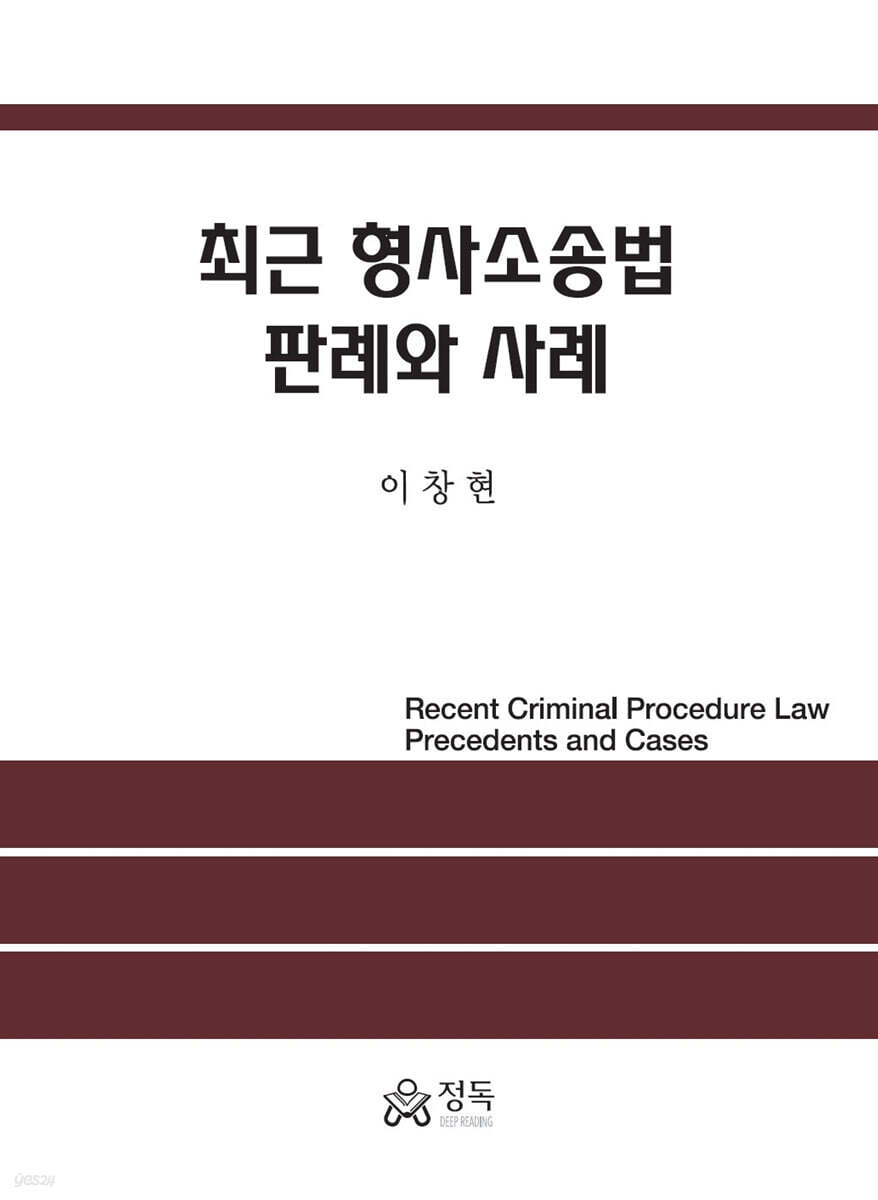
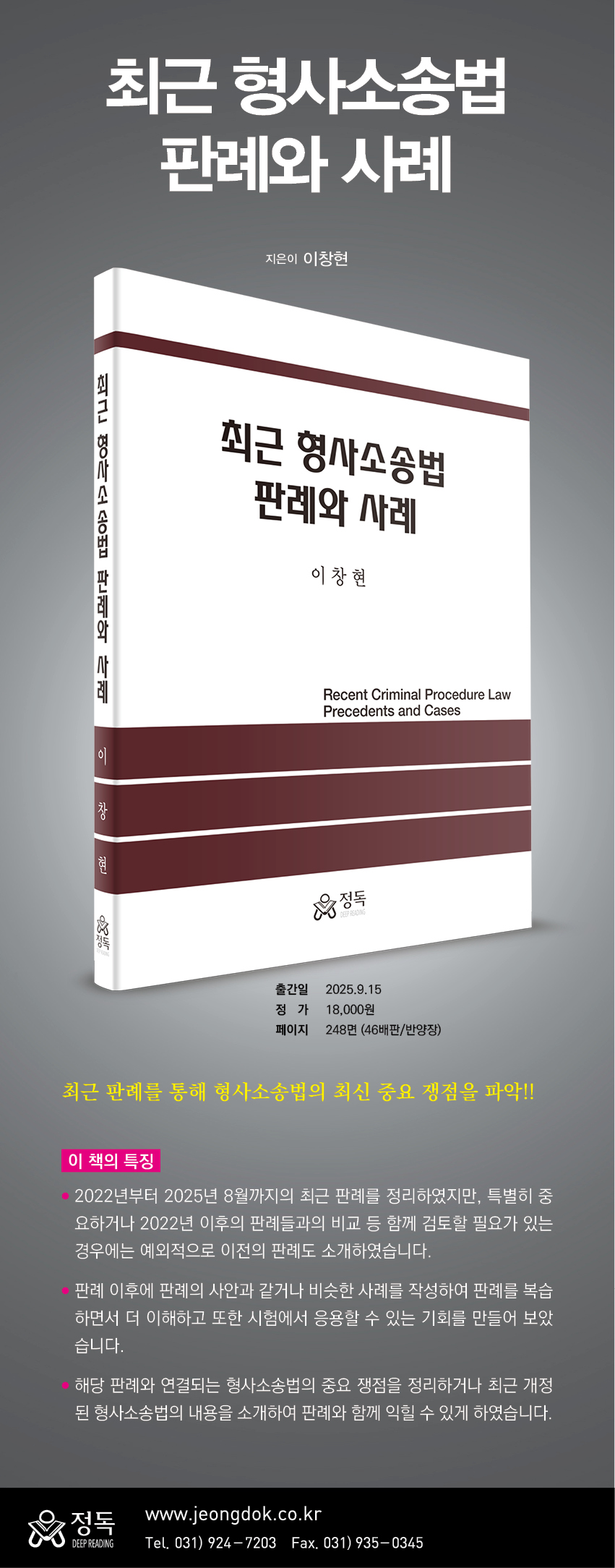
Recent criminal procedure law precedents and cases
 |
Description
Book Introduction
The contents and features of this book
First, in principle, recent case law from 2022 to August 2025 was summarized. However, in exceptional cases where it was particularly important or necessary to review case law together with case law after 2022, case law prior to 2022 was also introduced.
And while maintaining the content of the case law, we tried to make it easier to read and understand the case law by using sequential numbers such as ①, ② or ⓐ, ⓑ, underlining, and bolding.
Second, after the case law, I wrote a case that was the same or similar to the case law, and reviewed the case law to better understand it and also created an opportunity to apply it in the exam.
Therefore, after reading it once, you may be able to save time by quickly reviewing only one of the case laws or examples.
Third, we have organized important issues in criminal procedure law that are related to the relevant case law and introduced the contents of the recently revised criminal procedure law so that you can learn them together with the case law.
First, in principle, recent case law from 2022 to August 2025 was summarized. However, in exceptional cases where it was particularly important or necessary to review case law together with case law after 2022, case law prior to 2022 was also introduced.
And while maintaining the content of the case law, we tried to make it easier to read and understand the case law by using sequential numbers such as ①, ② or ⓐ, ⓑ, underlining, and bolding.
Second, after the case law, I wrote a case that was the same or similar to the case law, and reviewed the case law to better understand it and also created an opportunity to apply it in the exam.
Therefore, after reading it once, you may be able to save time by quickly reviewing only one of the case laws or examples.
Third, we have organized important issues in criminal procedure law that are related to the relevant case law and introduced the contents of the recently revised criminal procedure law so that you can learn them together with the case law.
index
Ⅰ.
Litigant and litigation act
1.
The meaning of "when the defendant is detained" in Article 33, Paragraph 1 of the Criminal Procedure Act
2.
'Proxy for litigation' is not possible in cases where there are no express provisions.
3.
In exceptional cases, the property manager becomes the legal representative and a person with the right to file a complaint.
4.
Other recent case law
Ⅱ.
Investigation and prosecution
1.
The necessity of arrest and its criteria for arrest in the act
2.
In cases where ‘objective relevance’ is not recognized in a material compulsory disposition
3.
When 'objective relevance' is recognized in a search and seizure for digital sex crimes
4.
If a search or seizure is conducted again after the validity period of the warrant and the completion of the search or seizure execution
5.
In principle, it is illegal for a third party to participate in the execution of a search and seizure warrant.
6.
The illegality of the procedure for confiscating a cell phone used or managed by a minor child through a parent with parental authority.
7.
Investigative agencies may seize and search the electronic information of the complainant stored by an Internet service provider.
8.
The ability to participate, including the owner of the residence, is required for seizure and search of the residence.
9.
If the warrant is rejected after seizure at the crime scene, it must be returned immediately.
10.
If you discover a separate suspicion during the process of searching by printing out all electronic information stored on your mobile phone in Excel format
11.
Evidence in cases where photos of crimes against other victims are found on the defendant's cell phone voluntarily submitted by the victim
12.
If it is determined that the suspect is not the actual subject of seizure
13.
If electronic information is copied to a storage medium owned or managed by a third party (victim) and arbitrarily submitted, the right to participate of the original electronic information management and disposal authority (defendant) need not be guaranteed.
14.
The meaning of "listening" in Article 3 and Article 16, Paragraph 1 of the Communications Secrets Protection Act
15.
Recorded conversation between a police officer and the defendant who arranged prostitution and a statement from the attempted prostitution victim
16.
Cancellation of the suspended prosecution order in a theft case involving taking another person's umbrella
17.
Whether or not it is an abuse of public prosecution power when a prosecution is filed four years after a suspended prosecution order
18.
Other recent case law
Ⅲ.
Trial and Evidence
1.
In cases where the identity of the facts of the indictment is acknowledged
2.
In cases where the identity of the facts of the indictment is not recognized
3.
In cases where there are special circumstances in which amendment of the indictment cannot be permitted
4.
Obligation to acknowledge the reduced facts among the facts of the indictment
5.
The obligation to recognize ex officio the facts of the crime of attempted rape with impediment when the facts of the crime of attempted rape with impediment are recognized as the facts of the crime of attempted rape with impediment
6.
Cases where evidence is recognized as admissible as an exception to the rule of exclusion of illegally collected evidence: Guarantee of the right of attorney to participate
7.
Denial of the admissibility of evidence in cases where the victim arbitrarily submits the suspect's cell phone
8.
Denial of evidentiary value of unrelated information that was deleted or not destroyed in a prior case
9.
If the evidence is deemed inadmissible due to irrelevant duplication, printing, access to irrelevant information, or secondary evidence.
10.
In the case where the causal relationship is not diluted or severed in the defendant's court statement, which is secondary evidence,
11.
The evidentiary value of the recorded phone conversation between the defendant and the witness, secretly recorded by the witness
12.
The meaning of "undisclosed" under the Communications Secrets Protection Act and the method of judgment thereon
13.
Voluntariness and credibility of the confession made by the defendant after he was detained in court during the appeal trial
14.
The scope of the 'suspect interrogation record prepared by the prosecutor' under Article 312, Paragraph 1 of the Criminal Procedure Act
15.
Video recordings that violate the method and procedure cannot be used to prove the authenticity of the recordings as stipulated in Article 312, Paragraph 4 of the Criminal Procedure Act.
16.
Compliance with the 'due process and method' requirements for statements prepared during the investigation process
17.
Decision on the unconstitutionality of the special provisions regarding the evidentiary capacity of statements made by victims of sexual violence under the age of 19 recorded in video footage
18.
The video recording of the interview with the victim by a statement analysis officer at the Supreme Prosecutors' Office is denied as evidence.
19.
Denial of evidentiary value of criminal mediation records
20.
Evidence of the documents containing the defendant's statement
21.
If the victim fails to appear at the witness examination date that is continued with about half of the defense attorney's cross-examination remaining and then disappears, the admissibility of evidence is denied.
22.
The evidentiary value of a will and the "special circumstances" under Article 314 of the Criminal Procedure Act
23.
The meaning of 'special circumstances' and the extent of proof in investigator testimony
24.
If a copy of the recording file is submitted and its identity can be proven even without the original,
25.
The credibility of the victim's statement in the sexual assault case on a subway train ('she has no victimhood')
26.
Cases where the appellate court can overturn the first trial court's decision that rejected the credibility of a witness's statement
27.
The probative value of testimony unfavorable to the defendant from a witness who has undergone a preliminary interview with the prosecutor
28.
If it is determined that the defendant's statement can serve as indirect evidence supporting the facts of the indictment
29.
A case regarding whether a person with autism and intellectual disability committed 'assault'
30.
Methods of proving facts of the case through indirect evidence and subjects of proof through scientific evidence in the case of the girl-switching incident
31.
Other recent case law
Ⅳ.
Trial and appeal, retrial and extraordinary appeal, execution
1.
The end point of sentencing and the limits on the possibility of changing the sentencing
2.
If the crime is no longer a crime or the sentence is reduced due to a change in the law after the crime is committed
3.
If the period of probation has expired during the appeal against the decision to cancel probation
4.
Res judicata effect in cases where there is a final judgment on some of the crimes committed in a comprehensive crime
5.
Determining the credibility of the victim's statement in the appeal trial of the military sexual assault case.
6.
The validity of the defendant's appeal in cases where the defendant's appeal and the prosecutor's appeal are in conflict
7.
Request for retrial based on the final judgment of the crime of serious bodily harm and Article 420, Paragraph 7 of the Criminal Procedure Act, etc.
8.
In case the completion date of sentence execution is delayed due to an order to change the order of sentence execution
9.
Other recent case law
Litigant and litigation act
1.
The meaning of "when the defendant is detained" in Article 33, Paragraph 1 of the Criminal Procedure Act
2.
'Proxy for litigation' is not possible in cases where there are no express provisions.
3.
In exceptional cases, the property manager becomes the legal representative and a person with the right to file a complaint.
4.
Other recent case law
Ⅱ.
Investigation and prosecution
1.
The necessity of arrest and its criteria for arrest in the act
2.
In cases where ‘objective relevance’ is not recognized in a material compulsory disposition
3.
When 'objective relevance' is recognized in a search and seizure for digital sex crimes
4.
If a search or seizure is conducted again after the validity period of the warrant and the completion of the search or seizure execution
5.
In principle, it is illegal for a third party to participate in the execution of a search and seizure warrant.
6.
The illegality of the procedure for confiscating a cell phone used or managed by a minor child through a parent with parental authority.
7.
Investigative agencies may seize and search the electronic information of the complainant stored by an Internet service provider.
8.
The ability to participate, including the owner of the residence, is required for seizure and search of the residence.
9.
If the warrant is rejected after seizure at the crime scene, it must be returned immediately.
10.
If you discover a separate suspicion during the process of searching by printing out all electronic information stored on your mobile phone in Excel format
11.
Evidence in cases where photos of crimes against other victims are found on the defendant's cell phone voluntarily submitted by the victim
12.
If it is determined that the suspect is not the actual subject of seizure
13.
If electronic information is copied to a storage medium owned or managed by a third party (victim) and arbitrarily submitted, the right to participate of the original electronic information management and disposal authority (defendant) need not be guaranteed.
14.
The meaning of "listening" in Article 3 and Article 16, Paragraph 1 of the Communications Secrets Protection Act
15.
Recorded conversation between a police officer and the defendant who arranged prostitution and a statement from the attempted prostitution victim
16.
Cancellation of the suspended prosecution order in a theft case involving taking another person's umbrella
17.
Whether or not it is an abuse of public prosecution power when a prosecution is filed four years after a suspended prosecution order
18.
Other recent case law
Ⅲ.
Trial and Evidence
1.
In cases where the identity of the facts of the indictment is acknowledged
2.
In cases where the identity of the facts of the indictment is not recognized
3.
In cases where there are special circumstances in which amendment of the indictment cannot be permitted
4.
Obligation to acknowledge the reduced facts among the facts of the indictment
5.
The obligation to recognize ex officio the facts of the crime of attempted rape with impediment when the facts of the crime of attempted rape with impediment are recognized as the facts of the crime of attempted rape with impediment
6.
Cases where evidence is recognized as admissible as an exception to the rule of exclusion of illegally collected evidence: Guarantee of the right of attorney to participate
7.
Denial of the admissibility of evidence in cases where the victim arbitrarily submits the suspect's cell phone
8.
Denial of evidentiary value of unrelated information that was deleted or not destroyed in a prior case
9.
If the evidence is deemed inadmissible due to irrelevant duplication, printing, access to irrelevant information, or secondary evidence.
10.
In the case where the causal relationship is not diluted or severed in the defendant's court statement, which is secondary evidence,
11.
The evidentiary value of the recorded phone conversation between the defendant and the witness, secretly recorded by the witness
12.
The meaning of "undisclosed" under the Communications Secrets Protection Act and the method of judgment thereon
13.
Voluntariness and credibility of the confession made by the defendant after he was detained in court during the appeal trial
14.
The scope of the 'suspect interrogation record prepared by the prosecutor' under Article 312, Paragraph 1 of the Criminal Procedure Act
15.
Video recordings that violate the method and procedure cannot be used to prove the authenticity of the recordings as stipulated in Article 312, Paragraph 4 of the Criminal Procedure Act.
16.
Compliance with the 'due process and method' requirements for statements prepared during the investigation process
17.
Decision on the unconstitutionality of the special provisions regarding the evidentiary capacity of statements made by victims of sexual violence under the age of 19 recorded in video footage
18.
The video recording of the interview with the victim by a statement analysis officer at the Supreme Prosecutors' Office is denied as evidence.
19.
Denial of evidentiary value of criminal mediation records
20.
Evidence of the documents containing the defendant's statement
21.
If the victim fails to appear at the witness examination date that is continued with about half of the defense attorney's cross-examination remaining and then disappears, the admissibility of evidence is denied.
22.
The evidentiary value of a will and the "special circumstances" under Article 314 of the Criminal Procedure Act
23.
The meaning of 'special circumstances' and the extent of proof in investigator testimony
24.
If a copy of the recording file is submitted and its identity can be proven even without the original,
25.
The credibility of the victim's statement in the sexual assault case on a subway train ('she has no victimhood')
26.
Cases where the appellate court can overturn the first trial court's decision that rejected the credibility of a witness's statement
27.
The probative value of testimony unfavorable to the defendant from a witness who has undergone a preliminary interview with the prosecutor
28.
If it is determined that the defendant's statement can serve as indirect evidence supporting the facts of the indictment
29.
A case regarding whether a person with autism and intellectual disability committed 'assault'
30.
Methods of proving facts of the case through indirect evidence and subjects of proof through scientific evidence in the case of the girl-switching incident
31.
Other recent case law
Ⅳ.
Trial and appeal, retrial and extraordinary appeal, execution
1.
The end point of sentencing and the limits on the possibility of changing the sentencing
2.
If the crime is no longer a crime or the sentence is reduced due to a change in the law after the crime is committed
3.
If the period of probation has expired during the appeal against the decision to cancel probation
4.
Res judicata effect in cases where there is a final judgment on some of the crimes committed in a comprehensive crime
5.
Determining the credibility of the victim's statement in the appeal trial of the military sexual assault case.
6.
The validity of the defendant's appeal in cases where the defendant's appeal and the prosecutor's appeal are in conflict
7.
Request for retrial based on the final judgment of the crime of serious bodily harm and Article 420, Paragraph 7 of the Criminal Procedure Act, etc.
8.
In case the completion date of sentence execution is delayed due to an order to change the order of sentence execution
9.
Other recent case law
Detailed image
Publisher's Review
preface
For a long time, I have been teaching 'Criminal Procedure Law Case Law of the Last 3 Years' in the form of a special lecture at various law schools.
I believe it is necessary to understand the latest important issues in criminal procedure law through recent case law that is not found in the law textbooks used during the first and second years of law school, and to summarize them as they are frequently tested on the bar exam.
In this situation, I am unable to attend all the special lectures offered by many law schools, and at the request of students preparing for the bar exam, I have prepared a textbook to organize criminal procedure law.
The contents and features of this book are as follows:
First, in principle, recent case law from 2022 to August 2025 was summarized. However, in exceptional cases where it was particularly important or necessary to review case law together with case law after 2022, case law prior to 2022 was also introduced.
And while maintaining the content of the case law, we tried to make it easier to read and understand the case law by using sequential numbers such as ①, ② or ⓐ, ⓑ, underlining, and bolding.
Second, after the case law, I wrote a case that was the same or similar to the case law, and reviewed the case law to better understand it and also created an opportunity to apply it in the exam.
Therefore, after reading it once, you may be able to save time by quickly reviewing only one of the case laws or examples.
Third, we have organized important issues in criminal procedure law that are related to the relevant case law and introduced the contents of the recently revised criminal procedure law so that you can learn them together with the case law.
The main points of contention include ① the criteria for determining the 'necessity of arrest' as a requirement for arrest in the act, ② whether the person is a substantive subject of seizure, ③ whether the seizure of voluntary submission of information storage media is recognized as evidence, ④ the trend of precedents in seizure and search of electronic information, ⑤ the degree of specificity of 'items to be seized' in seizure and search warrants, ⑥ the distinction between communication restriction measures, communication fact confirmation data, and communication data and the corresponding warrants, ⑦ a summary of the issues related to amendment of the indictment, ⑧ cases where the admissibility of evidence is recognized as an exception to the rule of exclusion of illegally collected evidence, etc.
This book was painstakingly prepared immediately after the publication of the 11th edition of the "Criminal Procedure Act," hoping that it would be helpful to law students as a final review or supplementary textbook for the bar exam. I sincerely hope that it will achieve the desired results.
I would like to express my gratitude to President Kim Jung-yong, Director Sim Seong-bo, and Manager Kim In-sook of Jeongdok, who quickly and diligently assisted with the new format of the booklet. I hope to see you end the overly hot summer of 2025 and welcome the vibrant autumn.
September 2025
Lee Chang-Hyeon, Law School, Hankuk University of Foreign Studies
For a long time, I have been teaching 'Criminal Procedure Law Case Law of the Last 3 Years' in the form of a special lecture at various law schools.
I believe it is necessary to understand the latest important issues in criminal procedure law through recent case law that is not found in the law textbooks used during the first and second years of law school, and to summarize them as they are frequently tested on the bar exam.
In this situation, I am unable to attend all the special lectures offered by many law schools, and at the request of students preparing for the bar exam, I have prepared a textbook to organize criminal procedure law.
The contents and features of this book are as follows:
First, in principle, recent case law from 2022 to August 2025 was summarized. However, in exceptional cases where it was particularly important or necessary to review case law together with case law after 2022, case law prior to 2022 was also introduced.
And while maintaining the content of the case law, we tried to make it easier to read and understand the case law by using sequential numbers such as ①, ② or ⓐ, ⓑ, underlining, and bolding.
Second, after the case law, I wrote a case that was the same or similar to the case law, and reviewed the case law to better understand it and also created an opportunity to apply it in the exam.
Therefore, after reading it once, you may be able to save time by quickly reviewing only one of the case laws or examples.
Third, we have organized important issues in criminal procedure law that are related to the relevant case law and introduced the contents of the recently revised criminal procedure law so that you can learn them together with the case law.
The main points of contention include ① the criteria for determining the 'necessity of arrest' as a requirement for arrest in the act, ② whether the person is a substantive subject of seizure, ③ whether the seizure of voluntary submission of information storage media is recognized as evidence, ④ the trend of precedents in seizure and search of electronic information, ⑤ the degree of specificity of 'items to be seized' in seizure and search warrants, ⑥ the distinction between communication restriction measures, communication fact confirmation data, and communication data and the corresponding warrants, ⑦ a summary of the issues related to amendment of the indictment, ⑧ cases where the admissibility of evidence is recognized as an exception to the rule of exclusion of illegally collected evidence, etc.
This book was painstakingly prepared immediately after the publication of the 11th edition of the "Criminal Procedure Act," hoping that it would be helpful to law students as a final review or supplementary textbook for the bar exam. I sincerely hope that it will achieve the desired results.
I would like to express my gratitude to President Kim Jung-yong, Director Sim Seong-bo, and Manager Kim In-sook of Jeongdok, who quickly and diligently assisted with the new format of the booklet. I hope to see you end the overly hot summer of 2025 and welcome the vibrant autumn.
September 2025
Lee Chang-Hyeon, Law School, Hankuk University of Foreign Studies
GOODS SPECIFICS
- Date of issue: September 15, 2025
- Format: Paperback book binding method guide
- Page count, weight, size: 248 pages | 188*257*20mm
- ISBN13: 9791168584068
- ISBN10: 116858406X
You may also like
카테고리
korean


korean

![ELLE 엘르 스페셜 에디션 A형 : 12월 [2025]](http://librairie.coreenne.fr/cdn/shop/files/b8e27a3de6c9538896439686c6b0e8fb.jpg?v=1766436872&width=3840)


