

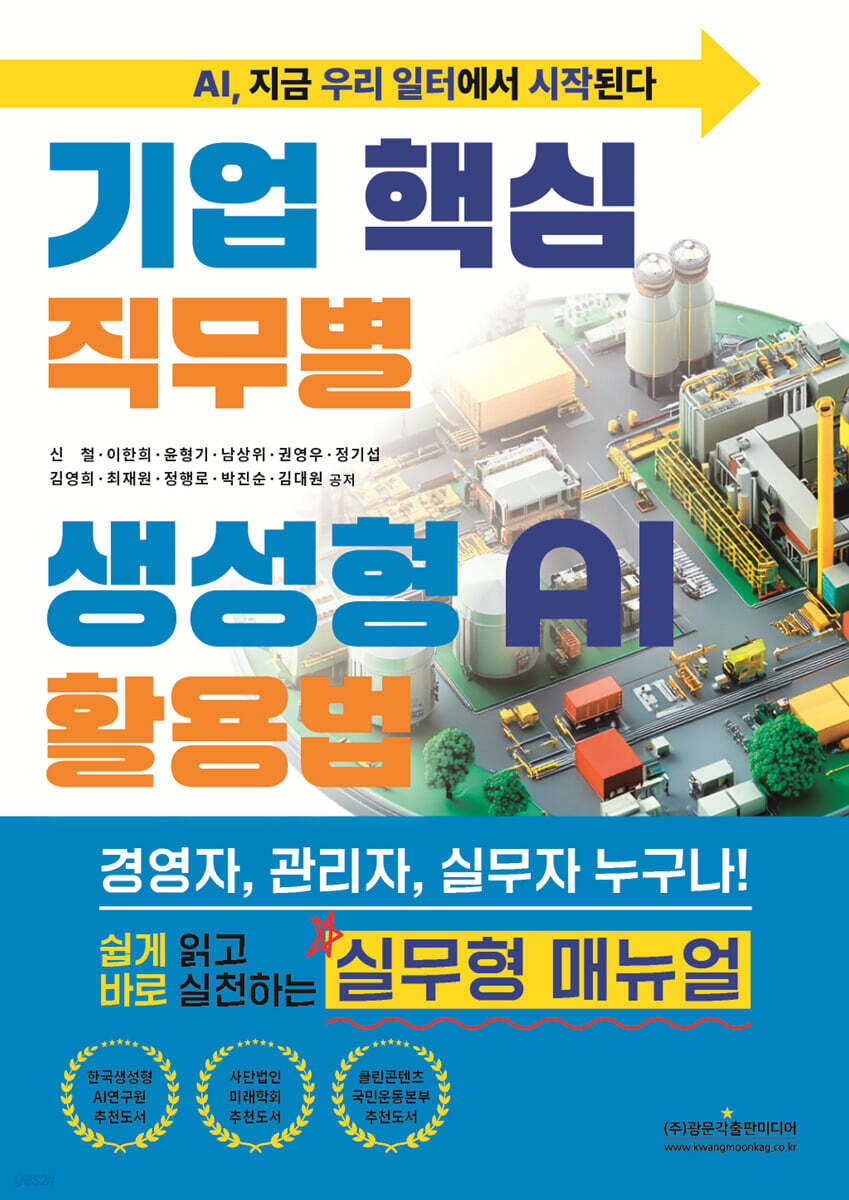
How to Use Generative AI for Core Corporate Functions
 |
Description
Book Introduction
“AI is no longer a distant future.
It starts now, in our workplace.”
Over the past few years, AI has evolved at a pace that has shaken the world.
In particular, the emergence of generative AI has become an inflection point that goes beyond simple technological advancement and demands innovation in the very way we work.
AI is no longer the exclusive domain of a select few large corporations; it has become a practical competitive tool for all businesses, especially small and medium-sized enterprises.
But what's the reality? While the need for AI is palpable, many in the field are left wondering, "I don't know where to start," or, "We lack the infrastructure and talent. Is it even possible?" While AI is vaguely a great and promising technology, practitioners still harbor a sense of distance, wondering, "What does it have to do with my work?"
This book, "Using Generative AI for Core Corporate Functions," is designed as a practical guide to bridge this gap and connect technology and practice, potential and execution.
It starts now, in our workplace.”
Over the past few years, AI has evolved at a pace that has shaken the world.
In particular, the emergence of generative AI has become an inflection point that goes beyond simple technological advancement and demands innovation in the very way we work.
AI is no longer the exclusive domain of a select few large corporations; it has become a practical competitive tool for all businesses, especially small and medium-sized enterprises.
But what's the reality? While the need for AI is palpable, many in the field are left wondering, "I don't know where to start," or, "We lack the infrastructure and talent. Is it even possible?" While AI is vaguely a great and promising technology, practitioners still harbor a sense of distance, wondering, "What does it have to do with my work?"
This book, "Using Generative AI for Core Corporate Functions," is designed as a practical guide to bridge this gap and connect technology and practice, potential and execution.
- You can preview some of the book's contents.
Preview
index
preface
About the Author
Chapter 1: General Introduction: The Era of AI Management Innovation
1.
Small Businesses and AI: Why Now?
2. Pros and Cons of AI Implementation and Considerations
3.
Successful AI Implementation Process
4. AI Literacy: Key Know-How for Executives and Employees
5.
Small and medium-sized enterprise core job classification-based on NCS
Chapter 2: General Discussion: From AI Introduction to Utilization by Core Job Function
2-1.
Management Planning
1.
General Status and Issues
2.
Establishing management and business strategies
3. Writing an AI-based business plan
4. Improving Performance Management Efficiency through AI
5.
Risk Management and Scenario Planning
2-2.
Marketing/Sales (B2B)
1.
General Status and Issues
2.
Establish marketing/sales goals
3.
Discovering new business items
4. Establishing an STP strategy
5.
Establishing a 4P mix strategy
2-3.
Marketing/Sales (B2C)
1.
General Status and Issues
2.
consumer research
3.
advertisement
4.
Online channel (shopping mall) promotion planning
5.
Sales Forecast
2-4.
Human Resources Management
1.
General Status and Issues
2.
Recruitment Management
3.
Education and Training Management
4.
Member Retention
5.
Evaluation Management
2-5.
Finance and Accounting
1.
General status and problems
2.
Financial statement analysis
3.
Establishing a financial plan
4.
Economic analysis
5.
Cost Analysis
2-6.
production management
1.
General status and problems
2.
Improved optimization of production planning to respond to order fluctuations
3.
Improve productivity through quality and resource management efficiency
4.
Maintain and improve inventory management optimization
5.
Improved pre-production and delivery management
2-7.
Research and development
1.
General Status and Issues
2.
Writing a Technology Business Plan
3.
Trend analysis for new product development
4.
Research and Development Data Analysis
5.
Writing research notes
2-8.
Informatization
1.
Why do companies need informatization?
2. Improving work efficiency using GPTs
3.
Creating PowerPoint Presentations Using Generative AI
Chapter 3: The Biggest Battleground in AI Is Data Utilization
1.
AI without data organization is a house of cards.
2.
Transitioning to a Data-Driven Organization
3. Data Platform for AI Utilization
4.
Data analysis and insight generation
5.
conclusion
Chapter 4: Strategies for Successful AI Development and Utilization
4-1.
Is AI the panacea for business innovation?
1. Positive aspects of AI utilization
2. Limitations of AI Utilization
3.
How to Use AI Properly
4-2.
AI Utilization Outlook by Industry
1.
Manufacturing: Implementing Smart Factories
2.
Service Industry: Customer Experience Innovation
3.
Wholesale and Retail: Omni-Channel Strategy and Personalization
4.
Construction: Design Optimization and Process Planning
5.
Information and Communications Industry: Artificial Intelligence in Daily Life
4-3.
AI Management Roadmap for Small and Medium Enterprises
1.
Preparation stage
2.
pilot project
3.
expansion
4.
Integration
5.
Optimization
6.
innovation
4-4. 10 Commandments for AI Management Success
1.
Set clear goals
2.
Data is a key asset for AI success.
3. Introduce AI gradually.
4.
Choose the right AI solution
5. Create an AI organizational culture.
6.
Management's interest and support determine success or failure.
7.
Empower your employees with AI capabilities.
8.
Comply with ethical responsibilities and regulations
9.
Drive results through measurement and improvement.
10.
Actively embrace continuous change.
About the Author
Chapter 1: General Introduction: The Era of AI Management Innovation
1.
Small Businesses and AI: Why Now?
2. Pros and Cons of AI Implementation and Considerations
3.
Successful AI Implementation Process
4. AI Literacy: Key Know-How for Executives and Employees
5.
Small and medium-sized enterprise core job classification-based on NCS
Chapter 2: General Discussion: From AI Introduction to Utilization by Core Job Function
2-1.
Management Planning
1.
General Status and Issues
2.
Establishing management and business strategies
3. Writing an AI-based business plan
4. Improving Performance Management Efficiency through AI
5.
Risk Management and Scenario Planning
2-2.
Marketing/Sales (B2B)
1.
General Status and Issues
2.
Establish marketing/sales goals
3.
Discovering new business items
4. Establishing an STP strategy
5.
Establishing a 4P mix strategy
2-3.
Marketing/Sales (B2C)
1.
General Status and Issues
2.
consumer research
3.
advertisement
4.
Online channel (shopping mall) promotion planning
5.
Sales Forecast
2-4.
Human Resources Management
1.
General Status and Issues
2.
Recruitment Management
3.
Education and Training Management
4.
Member Retention
5.
Evaluation Management
2-5.
Finance and Accounting
1.
General status and problems
2.
Financial statement analysis
3.
Establishing a financial plan
4.
Economic analysis
5.
Cost Analysis
2-6.
production management
1.
General status and problems
2.
Improved optimization of production planning to respond to order fluctuations
3.
Improve productivity through quality and resource management efficiency
4.
Maintain and improve inventory management optimization
5.
Improved pre-production and delivery management
2-7.
Research and development
1.
General Status and Issues
2.
Writing a Technology Business Plan
3.
Trend analysis for new product development
4.
Research and Development Data Analysis
5.
Writing research notes
2-8.
Informatization
1.
Why do companies need informatization?
2. Improving work efficiency using GPTs
3.
Creating PowerPoint Presentations Using Generative AI
Chapter 3: The Biggest Battleground in AI Is Data Utilization
1.
AI without data organization is a house of cards.
2.
Transitioning to a Data-Driven Organization
3. Data Platform for AI Utilization
4.
Data analysis and insight generation
5.
conclusion
Chapter 4: Strategies for Successful AI Development and Utilization
4-1.
Is AI the panacea for business innovation?
1. Positive aspects of AI utilization
2. Limitations of AI Utilization
3.
How to Use AI Properly
4-2.
AI Utilization Outlook by Industry
1.
Manufacturing: Implementing Smart Factories
2.
Service Industry: Customer Experience Innovation
3.
Wholesale and Retail: Omni-Channel Strategy and Personalization
4.
Construction: Design Optimization and Process Planning
5.
Information and Communications Industry: Artificial Intelligence in Daily Life
4-3.
AI Management Roadmap for Small and Medium Enterprises
1.
Preparation stage
2.
pilot project
3.
expansion
4.
Integration
5.
Optimization
6.
innovation
4-4. 10 Commandments for AI Management Success
1.
Set clear goals
2.
Data is a key asset for AI success.
3. Introduce AI gradually.
4.
Choose the right AI solution
5. Create an AI organizational culture.
6.
Management's interest and support determine success or failure.
7.
Empower your employees with AI capabilities.
8.
Comply with ethical responsibilities and regulations
9.
Drive results through measurement and improvement.
10.
Actively embrace continuous change.
Detailed image

Publisher's Review
First, this book provides specific guidance on how to leverage AI in core business functions of small and medium-sized enterprises.
While many AI books focus on technical concepts or introduce successful foreign cases, this book is written from a practical, business-oriented perspective.
We've compiled the potential for AI adoption and application points for each core function, including management planning, marketing/sales, human resources management, production/quality control, R&D, and informatization.
For example, marketers can leverage generative AI to automatically generate advertising copy and content, while salespeople can analyze customer history to create personalized offers.
Human resources departments can reduce workload and increase fairness by utilizing AI for job application evaluation and organizational assessment.
A job-centered approach is directly linked to practicality.
Readers will gain concrete ideas from this book, thinking, "We can apply this to our work in this way."
Second, this book is based on vivid, field-oriented examples.
We focused on capturing the "voices from the field" of small and medium-sized enterprises (SMEs) who have actually adopted and attempted AI, cases where initial failures were followed by improvements through trial and error, and the process of expanding from simple tool use to organizational change.
AI, as perceived in the field, should not be complex or advanced technology, but rather a practical solution to problems that require immediate efficiency improvement.
This book helps readers view AI from that perspective and apply it in a customized way to fit their organization's current situation.
Third, this book is a practical manual that anyone, including managers, administrators, and practitioners, can easily read and immediately put into practice.
Implementing AI doesn't require complex theories or specialized knowledge.
What's important is easy-to-understand language, intuitive explanations, and immediately actionable application.
So, this book is free of jargon, focuses on illustrations and case studies, and includes "practical tips," "question checklists," and "application examples" in each chapter.
As you read this book, you will experience the process of organizing ideas and implementation plans in your head rather than the difficulties of the technology.
AI is not something that takes away people's jobs, but rather a partner that expands their potential.
It's a tool that helps you break free from repetitive and inefficient tasks and focus on more creative and valuable work.
Rather than fearing, “We are not ready,” this is a time when we need to take action and say, “Let’s start small, even now.”
I hope this book can help you take that small, powerful first step.
Finally, this book is not just a simple guide to AI technologies.
This is a practice-oriented change guide that takes into account the realities of small and medium-sized businesses.
If your organization finds AI adoption burdensome or daunting, this book will serve as your most accessible, practical partner.
AI is no longer a matter of choice, but rather a question of how to introduce and internalize it.
I sincerely hope that this book will serve as a spark for readers on their journey to AI innovation.
Spring 2025
All authors
While many AI books focus on technical concepts or introduce successful foreign cases, this book is written from a practical, business-oriented perspective.
We've compiled the potential for AI adoption and application points for each core function, including management planning, marketing/sales, human resources management, production/quality control, R&D, and informatization.
For example, marketers can leverage generative AI to automatically generate advertising copy and content, while salespeople can analyze customer history to create personalized offers.
Human resources departments can reduce workload and increase fairness by utilizing AI for job application evaluation and organizational assessment.
A job-centered approach is directly linked to practicality.
Readers will gain concrete ideas from this book, thinking, "We can apply this to our work in this way."
Second, this book is based on vivid, field-oriented examples.
We focused on capturing the "voices from the field" of small and medium-sized enterprises (SMEs) who have actually adopted and attempted AI, cases where initial failures were followed by improvements through trial and error, and the process of expanding from simple tool use to organizational change.
AI, as perceived in the field, should not be complex or advanced technology, but rather a practical solution to problems that require immediate efficiency improvement.
This book helps readers view AI from that perspective and apply it in a customized way to fit their organization's current situation.
Third, this book is a practical manual that anyone, including managers, administrators, and practitioners, can easily read and immediately put into practice.
Implementing AI doesn't require complex theories or specialized knowledge.
What's important is easy-to-understand language, intuitive explanations, and immediately actionable application.
So, this book is free of jargon, focuses on illustrations and case studies, and includes "practical tips," "question checklists," and "application examples" in each chapter.
As you read this book, you will experience the process of organizing ideas and implementation plans in your head rather than the difficulties of the technology.
AI is not something that takes away people's jobs, but rather a partner that expands their potential.
It's a tool that helps you break free from repetitive and inefficient tasks and focus on more creative and valuable work.
Rather than fearing, “We are not ready,” this is a time when we need to take action and say, “Let’s start small, even now.”
I hope this book can help you take that small, powerful first step.
Finally, this book is not just a simple guide to AI technologies.
This is a practice-oriented change guide that takes into account the realities of small and medium-sized businesses.
If your organization finds AI adoption burdensome or daunting, this book will serve as your most accessible, practical partner.
AI is no longer a matter of choice, but rather a question of how to introduce and internalize it.
I sincerely hope that this book will serve as a spark for readers on their journey to AI innovation.
Spring 2025
All authors
GOODS SPECIFICS
- Date of issue: June 5, 2025
- Page count, weight, size: 240 pages | 570g | 174*246*20mm
- ISBN13: 9791193205624
- ISBN10: 119320562X
You may also like
카테고리
korean


korean

![ELLE 엘르 스페셜 에디션 A형 : 12월 [2025]](http://librairie.coreenne.fr/cdn/shop/files/b8e27a3de6c9538896439686c6b0e8fb.jpg?v=1766436872&width=3840)


