

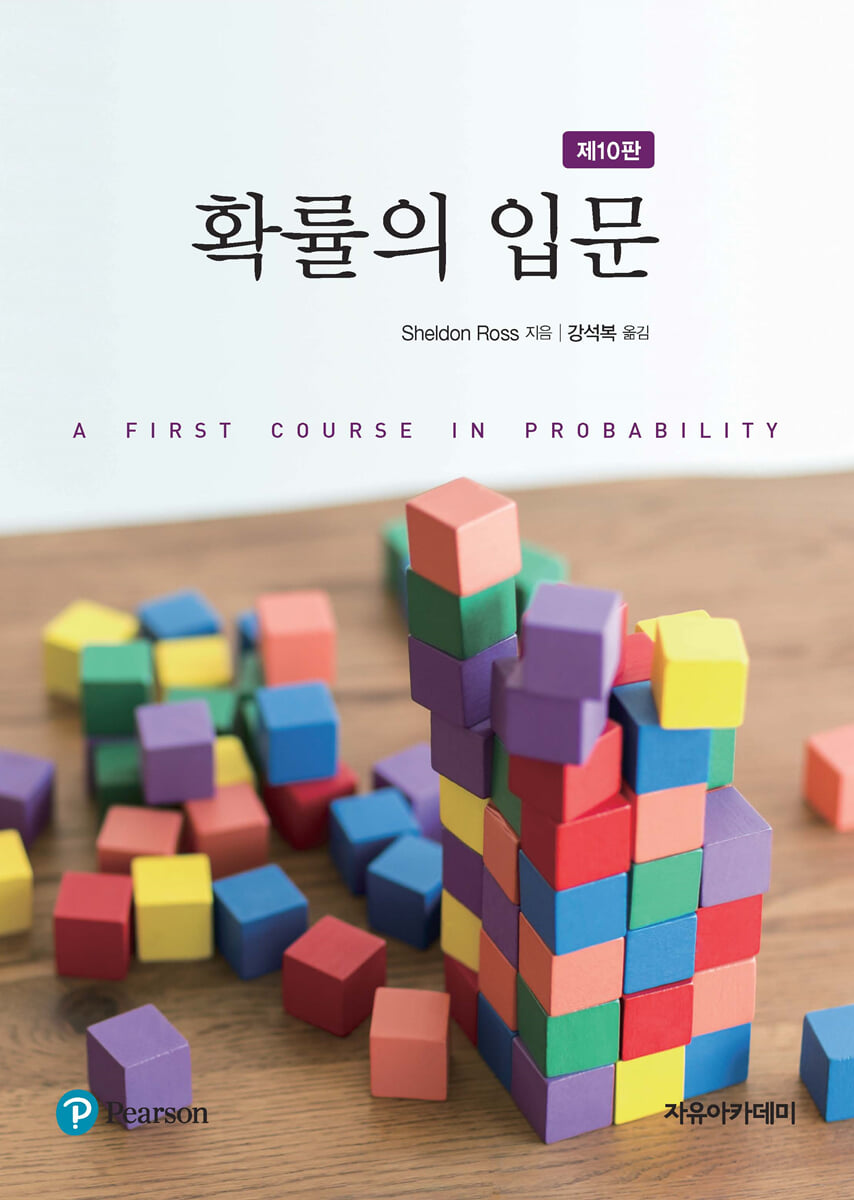
Introduction to Ross Probability
 |
Description
Book Introduction
Ross's Introduction to Probability covers the fundamentals of probability theory for students majoring in mathematics, statistics, engineering, and science (computer science, biology, social science, management science, etc.), including prior knowledge of basic calculus.
In addition to the mathematical content of probability theory, it presents various application fields through numerous examples.
In addition to the mathematical content of probability theory, it presents various application fields through numerous examples.
index
Chapter 1 Combinatorial Analysis
1.1 Introduction
1.2 Basic principles of calculation
1.3 Permutations
1.4 Combination
1.5 polynomial coefficients
1.6 Number of integer solutions to an equation
Chapter 2 Axioms of Probability
2.1 Introduction
2.2 Sample space and events
2.3 Axioms of Probability
2.4 Some simple propositions
2.5 Sample space with equal probability outcomes
2.6 Probability as a continuous set function
2.7 Probability as a measure of confidence
Chapter 3 Conditional Probability and Independence
3.1 Introduction
3.2 Conditional probability
3.3 Bayes' formula
3.4 Independent incident
3.5 Probability P(·|F)
Chapter 4 Random Variables
4.1 Random variables
4.2 Discrete random variables
4.3 Expected value
4.4 Expected value of a random variable function
4.5 Dispersion
4.6 Bernoulli and binomial random variables
4.7 Poisson random variables
4.8 Other Discrete Probability Distributions
4.9 Expected value of the sum of random variables
4.10 Properties of cumulative distribution functions
Chapter 5 Continuous Random Variables
5.1 Introduction
5.2 Expected value and variance of continuous random variables
5.3 Uniform random variables
5.4 Normal random variables
5.5 Exponential random variables
5.6 Other continuous distributions
5.7 Distribution of random variable functions
Chapter 6: Random variables distributed jointly
6.1 Joint distribution function
6.2 Independent random variables
6.3 Sum of independent random variables
6.4 Conditional Distributions: The Discrete Case
6.5 Conditional Distribution: Continuous Case
6.6 Order statistics
6.7 Joint probability distribution of random variable functions
6.8 Exchangeable random variables
Chapter 7: Properties of Expected Value
7.1 Introduction
7.2 Expected value of the sum of random variables
7.3 The rate of occurrence of incidents
7.4 Covariance, variance of sum, and correlation coefficient
7.5 Conditional Expectation
7.6 Conditional Expectations and Forecasting
7.7 Moment-generating function
7.8 Additional properties of normal random variables
7.9 General definition of expected value
Chapter 8 Limit Theorem
8.1 Introduction
8.2 Chebyshev's Inequality and the Weak Law of Large Numbers
8.3 Central Limit Theorem
8.4 Strong Laws of Large Numbers
8.5 Other Inequalities and Poisson Limit Results
8.6 Limits on the probability of error when approximating the sum of independent Bernoulli random variables to a Poisson random variable
8.7 Lorenz curve
Chapter 9 Additional Information on Probability
9.1 Poisson process
9.2 Markov chain
9.3 Surprise, Uncertainty, and Entropy
9.4 Coding Theory and Entropy
Chapter 10 Simulation
10.1 Introduction
10.2 General Techniques for Simulating Continuous Random Variables
10.3 Simulation in Discrete Distributions
10.4 Variance Reduction Techniques
Solution to the selection problem
Self-study problem solving
1.1 Introduction
1.2 Basic principles of calculation
1.3 Permutations
1.4 Combination
1.5 polynomial coefficients
1.6 Number of integer solutions to an equation
Chapter 2 Axioms of Probability
2.1 Introduction
2.2 Sample space and events
2.3 Axioms of Probability
2.4 Some simple propositions
2.5 Sample space with equal probability outcomes
2.6 Probability as a continuous set function
2.7 Probability as a measure of confidence
Chapter 3 Conditional Probability and Independence
3.1 Introduction
3.2 Conditional probability
3.3 Bayes' formula
3.4 Independent incident
3.5 Probability P(·|F)
Chapter 4 Random Variables
4.1 Random variables
4.2 Discrete random variables
4.3 Expected value
4.4 Expected value of a random variable function
4.5 Dispersion
4.6 Bernoulli and binomial random variables
4.7 Poisson random variables
4.8 Other Discrete Probability Distributions
4.9 Expected value of the sum of random variables
4.10 Properties of cumulative distribution functions
Chapter 5 Continuous Random Variables
5.1 Introduction
5.2 Expected value and variance of continuous random variables
5.3 Uniform random variables
5.4 Normal random variables
5.5 Exponential random variables
5.6 Other continuous distributions
5.7 Distribution of random variable functions
Chapter 6: Random variables distributed jointly
6.1 Joint distribution function
6.2 Independent random variables
6.3 Sum of independent random variables
6.4 Conditional Distributions: The Discrete Case
6.5 Conditional Distribution: Continuous Case
6.6 Order statistics
6.7 Joint probability distribution of random variable functions
6.8 Exchangeable random variables
Chapter 7: Properties of Expected Value
7.1 Introduction
7.2 Expected value of the sum of random variables
7.3 The rate of occurrence of incidents
7.4 Covariance, variance of sum, and correlation coefficient
7.5 Conditional Expectation
7.6 Conditional Expectations and Forecasting
7.7 Moment-generating function
7.8 Additional properties of normal random variables
7.9 General definition of expected value
Chapter 8 Limit Theorem
8.1 Introduction
8.2 Chebyshev's Inequality and the Weak Law of Large Numbers
8.3 Central Limit Theorem
8.4 Strong Laws of Large Numbers
8.5 Other Inequalities and Poisson Limit Results
8.6 Limits on the probability of error when approximating the sum of independent Bernoulli random variables to a Poisson random variable
8.7 Lorenz curve
Chapter 9 Additional Information on Probability
9.1 Poisson process
9.2 Markov chain
9.3 Surprise, Uncertainty, and Entropy
9.4 Coding Theory and Entropy
Chapter 10 Simulation
10.1 Introduction
10.2 General Techniques for Simulating Continuous Random Variables
10.3 Simulation in Discrete Distributions
10.4 Variance Reduction Techniques
Solution to the selection problem
Self-study problem solving
Publisher's Review
Differences from the previous version
* Includes problems and practice questions that can build readers' intuition about probability.
*Added new information on the Pareto distribution (Section 5.6.5), Poisson limit results (Section 8.5), and Lorenz curves (Section 8.7).
Translator's Preface
This book covers the fundamentals of probability theory for students majoring in mathematics, statistics, engineering, and science (computer science, biology, social science, management science, etc.), including prior knowledge of basic calculus.
In addition to the mathematical content of probability theory, it presents various application fields through numerous examples.
Chapter 1 presents the basic principles of combinatorial analysis, which is very useful for probability calculations.
Chapter 2 covers the axioms of probability theory and shows how they can be applied to calculate various probabilities.
Chapter 3 covers the very important topic of conditional probability and independence of events.
We illustrate with examples how conditional probability can be used as a means to more easily calculate probabilities not only when partial information is available, but also when partial information is not available.
This very important method of finding probabilities by 'conditioning' is mentioned again in Chapter 7, where we use conditionals to find expected values.
In chapters 4, 5, and 6, we learn about the concept of random variables.
Discrete random variables are covered in Chapter 4, continuous random variables in Chapter 5, and joint random variables in Chapter 6.
The important concepts of expected value and variance of random variables are introduced in Chapters 4 and 5, and these values are also determined for many random variables of general form.
Additional properties of expected values are discussed in Chapter 7.
We also included many examples that illustrate the usefulness of the result that the expected value of the sum of random variables is equal to the sum of the expected values of each random variable.
There are also sections on conditional expectation, moment-generating functions, and the use of conditional expectation in forecasting.
In the final section, we introduce the multivariate normal distribution and present a simple proof regarding the joint distribution of the sample mean and sample variance of samples drawn from a normal distribution.
Chapter 8 examines important theoretical results in probability theory.
In particular, it proves the strong law of large numbers and the central limit theorem.
The proof of Kang's law is a relatively simple proof that assumes that the random variable has a finite fourth moment, and the proof of the central limit theorem assumes Levy's continuity theorem.
We also introduce probability inequalities such as Markov's inequality, Chebyshev's inequality, and Chernoff's bound, and in the final section we provide bounds on the error that occurs when the probability associated with the sum of independent Bernoulli random variables is approximated by the corresponding probability of Poisson random variables with the same expected value.
Chapter 9 presents additional material, including Markov chains, Poisson processes, and information and coding theory, and Chapter 10 covers simulation.
As with previous editions, each chapter ends with three types of practice problems: problems, theoretical exercises, and self-study problems.
Self-study problems with complete solutions will help readers test their comprehension and prepare for exams.
* Includes problems and practice questions that can build readers' intuition about probability.
*Added new information on the Pareto distribution (Section 5.6.5), Poisson limit results (Section 8.5), and Lorenz curves (Section 8.7).
Translator's Preface
This book covers the fundamentals of probability theory for students majoring in mathematics, statistics, engineering, and science (computer science, biology, social science, management science, etc.), including prior knowledge of basic calculus.
In addition to the mathematical content of probability theory, it presents various application fields through numerous examples.
Chapter 1 presents the basic principles of combinatorial analysis, which is very useful for probability calculations.
Chapter 2 covers the axioms of probability theory and shows how they can be applied to calculate various probabilities.
Chapter 3 covers the very important topic of conditional probability and independence of events.
We illustrate with examples how conditional probability can be used as a means to more easily calculate probabilities not only when partial information is available, but also when partial information is not available.
This very important method of finding probabilities by 'conditioning' is mentioned again in Chapter 7, where we use conditionals to find expected values.
In chapters 4, 5, and 6, we learn about the concept of random variables.
Discrete random variables are covered in Chapter 4, continuous random variables in Chapter 5, and joint random variables in Chapter 6.
The important concepts of expected value and variance of random variables are introduced in Chapters 4 and 5, and these values are also determined for many random variables of general form.
Additional properties of expected values are discussed in Chapter 7.
We also included many examples that illustrate the usefulness of the result that the expected value of the sum of random variables is equal to the sum of the expected values of each random variable.
There are also sections on conditional expectation, moment-generating functions, and the use of conditional expectation in forecasting.
In the final section, we introduce the multivariate normal distribution and present a simple proof regarding the joint distribution of the sample mean and sample variance of samples drawn from a normal distribution.
Chapter 8 examines important theoretical results in probability theory.
In particular, it proves the strong law of large numbers and the central limit theorem.
The proof of Kang's law is a relatively simple proof that assumes that the random variable has a finite fourth moment, and the proof of the central limit theorem assumes Levy's continuity theorem.
We also introduce probability inequalities such as Markov's inequality, Chebyshev's inequality, and Chernoff's bound, and in the final section we provide bounds on the error that occurs when the probability associated with the sum of independent Bernoulli random variables is approximated by the corresponding probability of Poisson random variables with the same expected value.
Chapter 9 presents additional material, including Markov chains, Poisson processes, and information and coding theory, and Chapter 10 covers simulation.
As with previous editions, each chapter ends with three types of practice problems: problems, theoretical exercises, and self-study problems.
Self-study problems with complete solutions will help readers test their comprehension and prepare for exams.
GOODS SPECIFICS
- Date of issue: September 1, 2020
- Page count, weight, size: 600 pages | 188*257*35mm
- ISBN13: 9791158086190
- ISBN10: 1158086199
You may also like
카테고리
korean


korean

![GQ KOREA Mark (Monthly): December [2025]](http://librairie.coreenne.fr/cdn/shop/files/8ef265dbbfbf186523ed75ba7319009d.jpg?v=1765340328&width=3840)


