

Architecture and Weathering
 |
Description
Book Introduction
Recently, the Jamsil Public Housing Complex 5 Apartment Reconstruction International Competition was held.
The first book by Jo Seong-ryong, a master of urban housing and public architecture!
Architecture and cities, a simple yet profound reflection on the geography and space of this land.
A complex yet fascinating modern city,
A place where cutting-edge architecture and new life constantly compete,
What are cities made of?
What does it mean for us to live in this city?
Couldn't our homes and lives have taken a different shape?
Jo Seong-ryong debuted in the architectural world in 1983 by winning the first international apartment design competition in Korea [Seoul Asian Games Athletes' Village and Memorial Park].
34 years later, in 2018, he once again won the public reconstruction project [International Competition for Jamsil 5 Complex Residential Complex], drawing on decades of experience and insight.
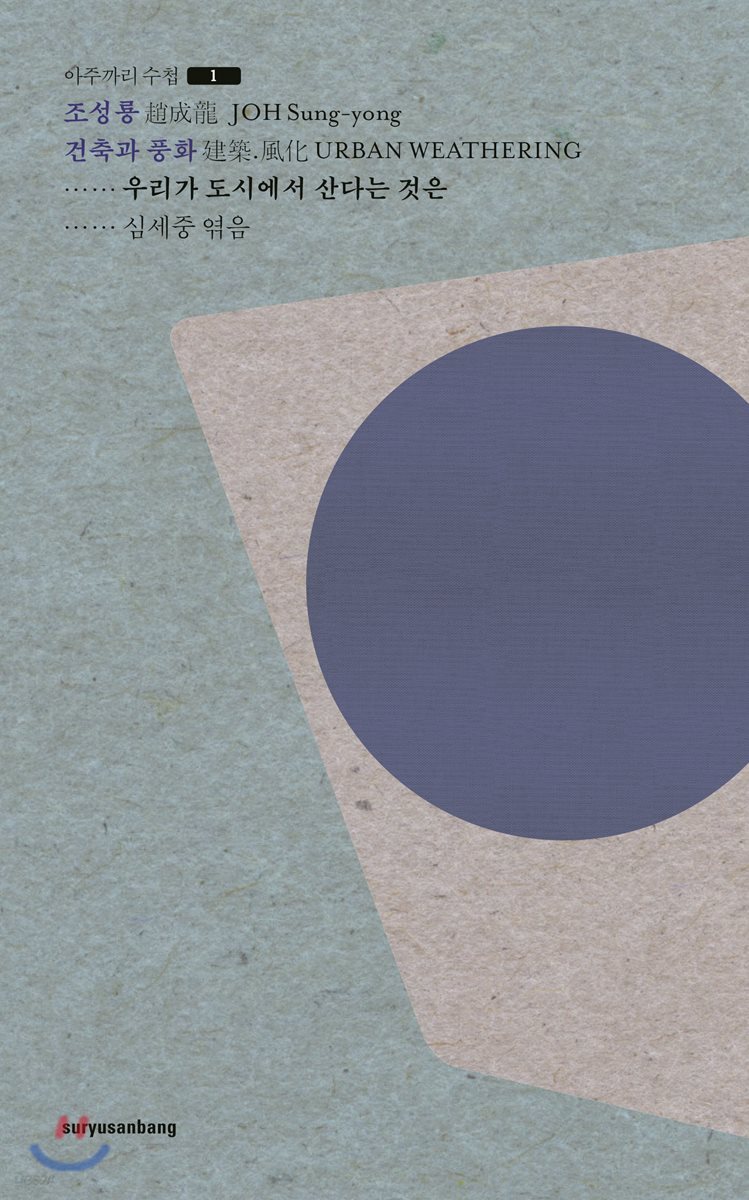
"Architecture and Weathering" is the first book by a veteran architect who contains his long-standing thoughts on urban housing and public architecture.
The first book by Jo Seong-ryong, a master of urban housing and public architecture!
Architecture and cities, a simple yet profound reflection on the geography and space of this land.
A complex yet fascinating modern city,
A place where cutting-edge architecture and new life constantly compete,
What are cities made of?
What does it mean for us to live in this city?
Couldn't our homes and lives have taken a different shape?
Jo Seong-ryong debuted in the architectural world in 1983 by winning the first international apartment design competition in Korea [Seoul Asian Games Athletes' Village and Memorial Park].
34 years later, in 2018, he once again won the public reconstruction project [International Competition for Jamsil 5 Complex Residential Complex], drawing on decades of experience and insight.
"Architecture and Weathering" is the first book by a veteran architect who contains his long-standing thoughts on urban housing and public architecture.
index
0.
Preface 005
1.
The Birth of Jamsil and the Asian Athletes' Village Apartment 013
2.
Soma Museum of Art 051, which may be our first and last.
3.
Seoul Station Overpass Utilization Project 083: Humanistic Regeneration of Urban Seoul
A Walk with, by and for the People The Seoul Station Overpass Project 142
4.
On Growing Old Gracefully, Children's Grand Park Dream Maru 151
210
5.
Reply 1: Urban Housing ① High-rise Apartments and Bukchon 231
6.
Reply 1998, Urban Housing ② Haeundae, Bundang, Yangjae, Dogok-dong 255
7.
The Cruel History of Ihwa Village ① The "Road Not Taken" in Seoul's Mountain Village 291
8.
The Brutal History of Ihwa Village ② Architecture and Democracy 323
9.
Living in the city means that we are [Sim Se-jung] 363 in Seongbuk-dong Tempura
Jo Seong-ryong Urban Architecture [UBAC] Major Project List 378
Preface 005
1.
The Birth of Jamsil and the Asian Athletes' Village Apartment 013
2.
Soma Museum of Art 051, which may be our first and last.
3.
Seoul Station Overpass Utilization Project 083: Humanistic Regeneration of Urban Seoul
A Walk with, by and for the People The Seoul Station Overpass Project 142
4.
On Growing Old Gracefully, Children's Grand Park Dream Maru 151
210
5.
Reply 1: Urban Housing ① High-rise Apartments and Bukchon 231
6.
Reply 1998, Urban Housing ② Haeundae, Bundang, Yangjae, Dogok-dong 255
7.
The Cruel History of Ihwa Village ① The "Road Not Taken" in Seoul's Mountain Village 291
8.
The Brutal History of Ihwa Village ② Architecture and Democracy 323
9.
Living in the city means that we are [Sim Se-jung] 363 in Seongbuk-dong Tempura
Jo Seong-ryong Urban Architecture [UBAC] Major Project List 378
Publisher's Review
Winner of the international competition for the reconstruction of Jamsil Public Housing Complex 5 Apartment Complex
It's like listening to Jo Seong-ryong's architectural views that he has been pondering for decades.
Suryusanbang presents a new series of books, ‘Ajukkari Notebook,’ with architect Jo Seong-ryong’s ‘Architecture and Weathering’ as the first volume.
This book begins by telling the story of how architect Cho Sung-ryong dissolved and resolved various issues of our land's natural and human geography, tradition and modernity, in the process of creating space, focusing on Seoul.
In the course of introducing the works he designed in an oral format, he covers various topics such as concerns that our architecture has overlooked, publicness and environmental issues, and the essence of urban life.
This story, which crosses fields such as urbanism, sociology, history, economics, politics, and housing studies, always focuses on people rather than architecture.
This book is not a typical collection of an architect's works or writings, or a critic's critique of the artist.
As we read the comfortable text, as if we were listening to a conversation face to face, both architectural experts and the general public will begin to realize what we have been missing and what we need to think about in our homes, various spaces, architecture, and cities.
This book is based on and supplemented by articles serialized under the title “Humanistic Architect Jo Seong-ryong Speaks of Seoul’s Time” in the webzine Minyeon of the Institute of Korean Culture at Korea University from 2015 to 2017.
The content narrated by Jo Seong-ryong was recorded and compiled by Sim Se-jung, editor-in-chief of Suryusanbang.
Reading "Architecture and Weathering," which overlaps oral history spanning ancient, modern, and contemporary times with photographs capturing the past and present of regions and buildings, will open new horizons for architecture and design methods, and provide an opportunity to reflect on the desolate grounds of our lives that have endured a turbulent era of development.
Meet Jo Seong-ryong's masterpiece
He is the architect with the most works on the list of 20 masterpieces of modern Korean architecture (joint research by 『SPACE』 and 『Dong-A Ilbo』, 2013), a leading figure in the April 3rd Group movement, the principal of Seoul School of Architecture (SA), and one of the most senior architects currently active, but there has been no literature explaining his world of work.
|
『Architecture and Weathering』 attempted to record the background and process of Jo Seong-ryong's work as honestly as possible.
[#232] The list of Jo Seong-ryong's representative works, including [Asia Athletes' Village Apartment], which was the first international apartment design competition in Korea; [SOMA Museum of Art], the only public art space in Songpa; [Seoul Station Overpass Utilization Project], which was unsuccessful in coming in second place in an international design competition; [Seoul Children's Grand Park Dream Maru], which was renovated while preserving the original form of the clubhouse designed by Na Sang-jin (1923-1973); the Hwabuk District Plan, the first public housing complex in Jeju; [Sanggye-dong Public Housing Apartment Complex 4], the first high-rise apartment complex in Korea; and [Ewha Village Project], which studied 'a redevelopment model suitable for hilly areas', including large and small row houses, are slightly different from the list of representative works known so far by Jo Seong-ryong.
Rather than focusing on the aesthetic expressions of architects, 『Architecture and Weathering』 focuses on the problems of urban housing and life that ordinary people face, and together with 『The Extinction of Architecture』 and 『Architecture and Pungryu』, which are scheduled to be published in the future, it will form the 'Jo Seong-ryong Trilogy'.
Who knew a city's houses could be so diverse!
[Asian Athletes' Village Apartment] Starting with the rare career of being an architect who designed apartments, Jo Seong-ryong has been considering various types of urban housing.
After the Bukchon Hanok Preservation District was lifted, there were low-rise townhouses proposed at 11 Gahoe-dong that preserved the traditional L-shaped and M-shaped houses and the topography of the village; houses in Haeundae that were designed to lessen the view of the houses behind and less block the gaze of people going up; apartments that built children's playgrounds between the 16th and 18th floors out of concern that children in high-rise buildings would be cut off from the outside world… Living in a city means living together, but it is also an area that architects have not dealt with much.
In "Architecture and Weathering," you can also see his multi-family housing projects, which have experimented with various housing forms that respect residents, from townhouses to high-rise apartments.
This book offers a glimpse into solutions to the various conflicts and problems facing cities across this land today.
|
“What I was thinking was that the key lies in the collective, not in individual generations.
As spaces become intertwined, a new city is created.
I started to look at the villas that were being built in that way.
The land shape and location are all different, but what kind of synergy can the houses achieve by coming together, and how can they become independent as individuals because of that?
” [Jo Sung-ryong]
|
“Perhaps what we need is not to choose the correct answer to a given question, but to constantly respond to one another, to continue asking questions through responses […] Why have townhouses become the second best option when apartments are not an option?
Why in this city, when you choose to live outside of an apartment, you have to give up playgrounds, parks, parking, laundry services, and concierge services.
Is it true that buildings packed with studio apartments called officetels are the standard form of housing for single people living in cities today?
As with all questions, the act of questioning housing—our living spaces and how they function—is inherently subversive.
Because of the question, words like politics, power, and conglomerates shed their abstractness and reach out like arrows to the concrete desires and intentions that reveal the phenomenon of housing.
” [Sim Se-jung]
The Ajukari notebook of the Suryusanbang begins.
The new book series “Ajukkari Notebook” presented by Suryusanbang introduces the works of those who have thought and explored beyond the framework of the humanities in various fields.
Architect Jo Seong-ryong's "Architecture and Weathering" is followed by deep, sharp, yet warm notebooks by Korean literature scholar Kim In-hwan, French literature scholar Hwang Hyeon-san, and architectural critic Kim Won-sik.
“The Ajukkari Notebook is the title of an old song.
Why it had to be an azuki bean notebook, what the notebook looked like, I can't figure it out even after carefully looking at the lyrics written by Jo Myeong-am in 1942.
It doesn't even tell us clearly whether the man who left the island was holding a notebook that had been carefully soaked in castor oil.
The Ajukkari Notebook is a story of waiting.
The Ajukari Notebook of Suryusanbang is a story of a very long wait.
It's a story about something that you can't know the future.
“The invisible human mind, while swaying unseen, creates a landscape layer by layer.”
It's like listening to Jo Seong-ryong's architectural views that he has been pondering for decades.
Suryusanbang presents a new series of books, ‘Ajukkari Notebook,’ with architect Jo Seong-ryong’s ‘Architecture and Weathering’ as the first volume.
This book begins by telling the story of how architect Cho Sung-ryong dissolved and resolved various issues of our land's natural and human geography, tradition and modernity, in the process of creating space, focusing on Seoul.
In the course of introducing the works he designed in an oral format, he covers various topics such as concerns that our architecture has overlooked, publicness and environmental issues, and the essence of urban life.
This story, which crosses fields such as urbanism, sociology, history, economics, politics, and housing studies, always focuses on people rather than architecture.
This book is not a typical collection of an architect's works or writings, or a critic's critique of the artist.
As we read the comfortable text, as if we were listening to a conversation face to face, both architectural experts and the general public will begin to realize what we have been missing and what we need to think about in our homes, various spaces, architecture, and cities.
This book is based on and supplemented by articles serialized under the title “Humanistic Architect Jo Seong-ryong Speaks of Seoul’s Time” in the webzine Minyeon of the Institute of Korean Culture at Korea University from 2015 to 2017.
The content narrated by Jo Seong-ryong was recorded and compiled by Sim Se-jung, editor-in-chief of Suryusanbang.
Reading "Architecture and Weathering," which overlaps oral history spanning ancient, modern, and contemporary times with photographs capturing the past and present of regions and buildings, will open new horizons for architecture and design methods, and provide an opportunity to reflect on the desolate grounds of our lives that have endured a turbulent era of development.
Meet Jo Seong-ryong's masterpiece
He is the architect with the most works on the list of 20 masterpieces of modern Korean architecture (joint research by 『SPACE』 and 『Dong-A Ilbo』, 2013), a leading figure in the April 3rd Group movement, the principal of Seoul School of Architecture (SA), and one of the most senior architects currently active, but there has been no literature explaining his world of work.
|
『Architecture and Weathering』 attempted to record the background and process of Jo Seong-ryong's work as honestly as possible.
[#232] The list of Jo Seong-ryong's representative works, including [Asia Athletes' Village Apartment], which was the first international apartment design competition in Korea; [SOMA Museum of Art], the only public art space in Songpa; [Seoul Station Overpass Utilization Project], which was unsuccessful in coming in second place in an international design competition; [Seoul Children's Grand Park Dream Maru], which was renovated while preserving the original form of the clubhouse designed by Na Sang-jin (1923-1973); the Hwabuk District Plan, the first public housing complex in Jeju; [Sanggye-dong Public Housing Apartment Complex 4], the first high-rise apartment complex in Korea; and [Ewha Village Project], which studied 'a redevelopment model suitable for hilly areas', including large and small row houses, are slightly different from the list of representative works known so far by Jo Seong-ryong.
Rather than focusing on the aesthetic expressions of architects, 『Architecture and Weathering』 focuses on the problems of urban housing and life that ordinary people face, and together with 『The Extinction of Architecture』 and 『Architecture and Pungryu』, which are scheduled to be published in the future, it will form the 'Jo Seong-ryong Trilogy'.
Who knew a city's houses could be so diverse!
[Asian Athletes' Village Apartment] Starting with the rare career of being an architect who designed apartments, Jo Seong-ryong has been considering various types of urban housing.
After the Bukchon Hanok Preservation District was lifted, there were low-rise townhouses proposed at 11 Gahoe-dong that preserved the traditional L-shaped and M-shaped houses and the topography of the village; houses in Haeundae that were designed to lessen the view of the houses behind and less block the gaze of people going up; apartments that built children's playgrounds between the 16th and 18th floors out of concern that children in high-rise buildings would be cut off from the outside world… Living in a city means living together, but it is also an area that architects have not dealt with much.
In "Architecture and Weathering," you can also see his multi-family housing projects, which have experimented with various housing forms that respect residents, from townhouses to high-rise apartments.
This book offers a glimpse into solutions to the various conflicts and problems facing cities across this land today.
|
“What I was thinking was that the key lies in the collective, not in individual generations.
As spaces become intertwined, a new city is created.
I started to look at the villas that were being built in that way.
The land shape and location are all different, but what kind of synergy can the houses achieve by coming together, and how can they become independent as individuals because of that?
” [Jo Sung-ryong]
|
“Perhaps what we need is not to choose the correct answer to a given question, but to constantly respond to one another, to continue asking questions through responses […] Why have townhouses become the second best option when apartments are not an option?
Why in this city, when you choose to live outside of an apartment, you have to give up playgrounds, parks, parking, laundry services, and concierge services.
Is it true that buildings packed with studio apartments called officetels are the standard form of housing for single people living in cities today?
As with all questions, the act of questioning housing—our living spaces and how they function—is inherently subversive.
Because of the question, words like politics, power, and conglomerates shed their abstractness and reach out like arrows to the concrete desires and intentions that reveal the phenomenon of housing.
” [Sim Se-jung]
The Ajukari notebook of the Suryusanbang begins.
The new book series “Ajukkari Notebook” presented by Suryusanbang introduces the works of those who have thought and explored beyond the framework of the humanities in various fields.
Architect Jo Seong-ryong's "Architecture and Weathering" is followed by deep, sharp, yet warm notebooks by Korean literature scholar Kim In-hwan, French literature scholar Hwang Hyeon-san, and architectural critic Kim Won-sik.
“The Ajukkari Notebook is the title of an old song.
Why it had to be an azuki bean notebook, what the notebook looked like, I can't figure it out even after carefully looking at the lyrics written by Jo Myeong-am in 1942.
It doesn't even tell us clearly whether the man who left the island was holding a notebook that had been carefully soaked in castor oil.
The Ajukkari Notebook is a story of waiting.
The Ajukari Notebook of Suryusanbang is a story of a very long wait.
It's a story about something that you can't know the future.
“The invisible human mind, while swaying unseen, creates a landscape layer by layer.”
GOODS SPECIFICS
- Date of issue: May 29, 2018
- Page count, weight, size: 384 pages | 140*224*30mm
- ISBN13: 9788991555594
- ISBN10: 8991555594
You may also like
카테고리
korean


korean

![ELLE 엘르 스페셜 에디션 A형 : 12월 [2025]](http://librairie.coreenne.fr/cdn/shop/files/b8e27a3de6c9538896439686c6b0e8fb.jpg?v=1766436872&width=3840)


