

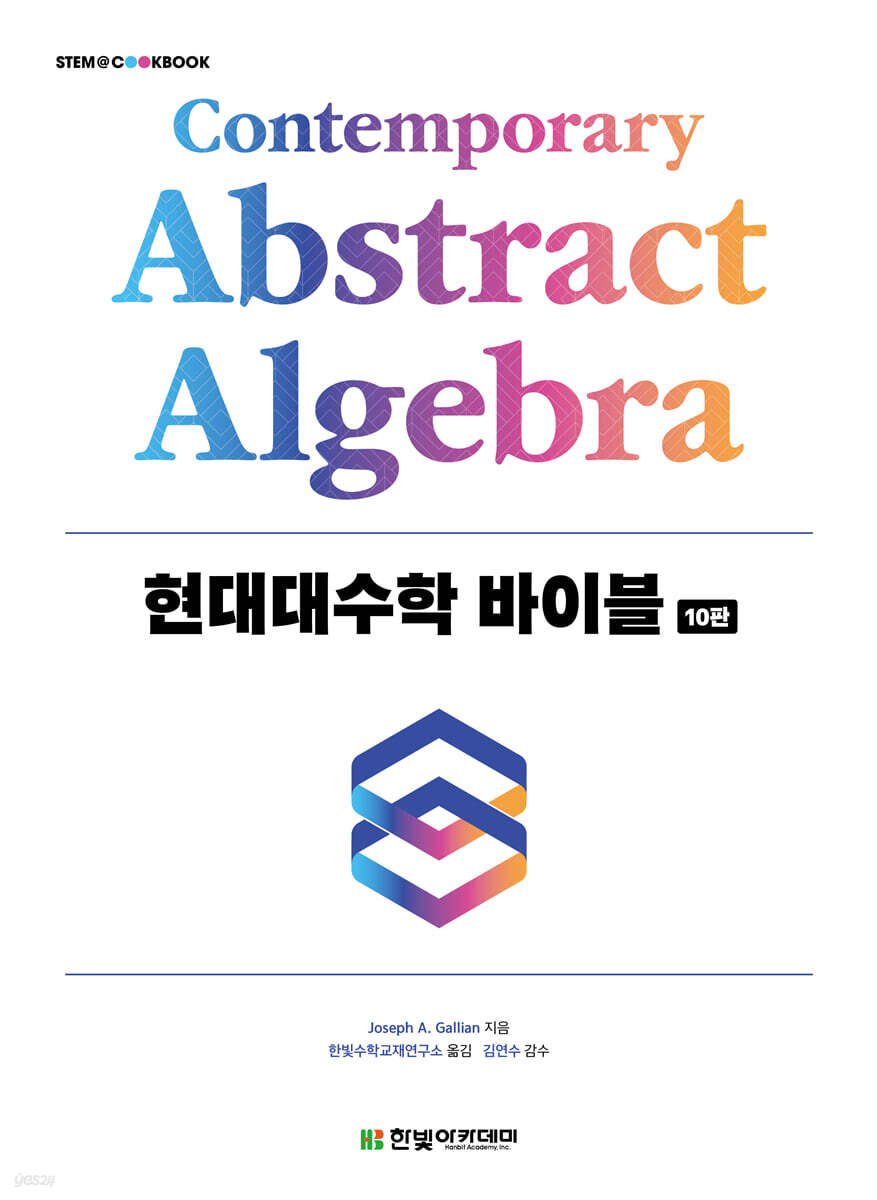
Modern Algebra Bible
 |
Description
Book Introduction
Gallian's 30 years of expertise in modern algebra,
The theory and applications of modern algebra are all in one volume!
This book explores the nature of abstract algebraic structures: groups, rings, and fields.
With solid explanations, you can understand the core principles of modern algebra and how the theory of modern algebra is related to applied fields such as science and computing.
Additionally, you can directly prove and generalize the core theories of modern algebra by solving over 1,900 diverse practice problems, and expand concepts and develop application skills through problems organized by level from basic to advanced.
If you want to master modern algebra, this one book is enough.
The theory and applications of modern algebra are all in one volume!
This book explores the nature of abstract algebraic structures: groups, rings, and fields.
With solid explanations, you can understand the core principles of modern algebra and how the theory of modern algebra is related to applied fields such as science and computing.
Additionally, you can directly prove and generalize the core theories of modern algebra by solving over 1,900 diverse practice problems, and expand concepts and develop application skills through problems organized by level from basic to advanced.
If you want to master modern algebra, this one book is enough.
- You can preview some of the book's contents.
Preview
index
Chapter 0 Introduction
Properties of integers 0.1
0.2 joint operation
0.3 complex number
0.4 Mathematical induction
0.5 equivalence relation
0.6 function (mapping)
Practice problems
Chapter 1: Overview of the Army
1.1 Symmetry of a square
1.2 Regular dihedral group
Practice problems
Chapter 2 Military
2.1 Definition and examples of military
2.2 Basic properties of groups
2.3 Historical Records
Practice problems
Chapter 3 Finite Groups and Subgroups
3.1 Terms and Symbols
3.2 Subgroup Determination Method
3.3 Examples of subgroups
Practice problems
Chapter 4 Circular Groups
4.1 Properties of cyclic groups
4.2 Classification of subgroups of cyclic groups
Practice problems
Chapter 5 Substitution Groups
5.1 Definitions and Symbols
5.2 Circular substitution notation
5.3 Properties of substitution
5.4 D?-based check digit system
Practice problems
Chapter 6: Isomorphism
6.1 Overview
6.2 Definitions and Examples
6.3 Properties of isomorphism
6.4 Automorphism
6.5 Cayley's theorem
Practice problems
Chapter 7: Residues and Lagrange's Theorem
7.1 Nature of surplus
7.2 Lagrange's theorem and results
7.3 Application of the surplus to the substitution group
7.4 Rotational groups of a cube and a soccer ball
7.5 Application of the redundancy to the Rubik's Cube
Practice problems
Chapter 8 External
8.1 Definitions and Examples
8.2 Nature of external objects
8.3 Extrinsic representation of the unit group for law n
8.4 Applications
Practice problems
Chapter 9 Regular Subgroups and Remainder Groups
9.1 Normal subgroups
9.2 Surplus Army
9.3 Application of the Surplus Army
9.4 Internal
Practice problems
Chapter 10 Military Homomorphism
10.1 Definitions and Examples
10.2 Properties of homomorphism
10.3 First Isomorphism Theorem
Practice problems
Chapter 11 Fundamental Theorem of Finite Commutative Groups
11.1 Fundamental theorem of finite commutative groups
11.2 Isomorphisms of commutative groups
11.3 Proof of the fundamental theorem of finite commutative groups
Practice problems
Chapter 12 Overview of the Ring
12.1 Definition of a circle
12.2 Example of a circle
12.3 Properties of rings
12.4 Partial exchange
Practice problems
Chapter 13: The Proper Translation
13.1 Definitions and Examples
13.2 body
13.3 The symbol of the circle
Practice problems
Chapter 14: Ideals and Surplus Exchange
14.1 Ideal
14.2 Surplus Exchange
14.3 Small Ideals and Maximal Ideals
Practice problems
Chapter 15: Ring Homomorphism
15.1 Definitions and Examples
15.2 Properties of ring homomorphisms
15.3 Fractions
Practice problems
Chapter 16 Polynomial Rings
16.1 Symbols and Terms
16.2 Division Algorithm and Results
Practice problems
Chapter 17 Factoring Polynomials
17.1 Vulnerability Determination Method
17.2 Determining the probability
17.3 Unique factorization of Z[x]
17.4 The Mysterious Dice: Applications of Unique Factorization
Practice problems
Chapter 18 Division of the Proper Translation
18.1 Promises and Wishes
18.2 Historical Discussion of Fermat's Last Theorem
18.3 Unique factorization domain
18.4 Euclidean equations
Practice problems
Chapter 19 Extension
19.1 Fundamental theorems of body theory
19.2 Decomposition
19.3 Roots of irreducible polynomials
Practice problems
Chapter 20 Algebraic Extensions
20.1 Properties of extensions
20.2 Finite extensions
20.3 Properties of algebraic extensions
Practice problems
Chapter 21 Finite Fields
21.1 Classification of finite fields
21.2 Structure of finite fields
21.3 Subfields of finite fields
Practice problems
Chapter 22 Geometric Construction
22.1 Historical Discussions on Geometric Construction
22.2 Constructible numbers
22.3 Trisecting an angle and squaring a circle
Practice problems
Chapter 23: Shilow's Theorem
23.1 Pairs
23.2 Ryu's equation
23.3 Shilow's Theorem
23.4 Application of Shilow's theorem
Practice problems
Chapter 24 Finite Simple Groups
24.1 Historical Background
24.2 Non-simple group determination method
24.3 The Simplicity of A?
24.4 Fields Medal
24.5 Call
Practice problems
Chapter 25: Sources and Relationships
25.1 Overview
25.2 Definitions and Symbols
25.3 Free Army
25.4 Sources and Relationships
25.5 Classification of groups with ranks less than or equal to 15
25.6 Characterization of the regular dihedral group
Practice problems
Chapter 26 Symmetry Groups
26.1 Equidistant Transformation
26.2 Classification of finite plane symmetry groups
26.3 Classification of finite rotation groups in R³
Practice problems
Chapter 27: Symmetry and Computation
27.1 Overview
27.2 Burnside Problem
27.3 Applications
27.4 Army action
Practice problems
Chapter 28: Cayley's Rheological Graph
28.1 Overview
28.2 Army Keighley directional graph
28.3 Hamiltonian Circuits and Paths
28.4 Applications
Practice problems
Chapter 29: Overview of Algebraic Sign Theory
29.1 Overview
29.2 Linear codes
29.3 Decryption of the Parity Check Matrix
29.4 Decrypting the surplus stream
29.5 Historical Records
Practice problems
Chapter 30: Overview of Galois Theory
30.1 Fundamental theorem of Galois theory
30.2 Solvability of polynomial equations by square roots
30.3 Unsolvability of 5th-degree equations
Practice problems
Chapter 31: The expanded circle
31.1 Overview
31.2 Circular polynomials
31.3 Constructible regular n-gons
Practice problems
References
List of symbols
Search
Properties of integers 0.1
0.2 joint operation
0.3 complex number
0.4 Mathematical induction
0.5 equivalence relation
0.6 function (mapping)
Practice problems
Chapter 1: Overview of the Army
1.1 Symmetry of a square
1.2 Regular dihedral group
Practice problems
Chapter 2 Military
2.1 Definition and examples of military
2.2 Basic properties of groups
2.3 Historical Records
Practice problems
Chapter 3 Finite Groups and Subgroups
3.1 Terms and Symbols
3.2 Subgroup Determination Method
3.3 Examples of subgroups
Practice problems
Chapter 4 Circular Groups
4.1 Properties of cyclic groups
4.2 Classification of subgroups of cyclic groups
Practice problems
Chapter 5 Substitution Groups
5.1 Definitions and Symbols
5.2 Circular substitution notation
5.3 Properties of substitution
5.4 D?-based check digit system
Practice problems
Chapter 6: Isomorphism
6.1 Overview
6.2 Definitions and Examples
6.3 Properties of isomorphism
6.4 Automorphism
6.5 Cayley's theorem
Practice problems
Chapter 7: Residues and Lagrange's Theorem
7.1 Nature of surplus
7.2 Lagrange's theorem and results
7.3 Application of the surplus to the substitution group
7.4 Rotational groups of a cube and a soccer ball
7.5 Application of the redundancy to the Rubik's Cube
Practice problems
Chapter 8 External
8.1 Definitions and Examples
8.2 Nature of external objects
8.3 Extrinsic representation of the unit group for law n
8.4 Applications
Practice problems
Chapter 9 Regular Subgroups and Remainder Groups
9.1 Normal subgroups
9.2 Surplus Army
9.3 Application of the Surplus Army
9.4 Internal
Practice problems
Chapter 10 Military Homomorphism
10.1 Definitions and Examples
10.2 Properties of homomorphism
10.3 First Isomorphism Theorem
Practice problems
Chapter 11 Fundamental Theorem of Finite Commutative Groups
11.1 Fundamental theorem of finite commutative groups
11.2 Isomorphisms of commutative groups
11.3 Proof of the fundamental theorem of finite commutative groups
Practice problems
Chapter 12 Overview of the Ring
12.1 Definition of a circle
12.2 Example of a circle
12.3 Properties of rings
12.4 Partial exchange
Practice problems
Chapter 13: The Proper Translation
13.1 Definitions and Examples
13.2 body
13.3 The symbol of the circle
Practice problems
Chapter 14: Ideals and Surplus Exchange
14.1 Ideal
14.2 Surplus Exchange
14.3 Small Ideals and Maximal Ideals
Practice problems
Chapter 15: Ring Homomorphism
15.1 Definitions and Examples
15.2 Properties of ring homomorphisms
15.3 Fractions
Practice problems
Chapter 16 Polynomial Rings
16.1 Symbols and Terms
16.2 Division Algorithm and Results
Practice problems
Chapter 17 Factoring Polynomials
17.1 Vulnerability Determination Method
17.2 Determining the probability
17.3 Unique factorization of Z[x]
17.4 The Mysterious Dice: Applications of Unique Factorization
Practice problems
Chapter 18 Division of the Proper Translation
18.1 Promises and Wishes
18.2 Historical Discussion of Fermat's Last Theorem
18.3 Unique factorization domain
18.4 Euclidean equations
Practice problems
Chapter 19 Extension
19.1 Fundamental theorems of body theory
19.2 Decomposition
19.3 Roots of irreducible polynomials
Practice problems
Chapter 20 Algebraic Extensions
20.1 Properties of extensions
20.2 Finite extensions
20.3 Properties of algebraic extensions
Practice problems
Chapter 21 Finite Fields
21.1 Classification of finite fields
21.2 Structure of finite fields
21.3 Subfields of finite fields
Practice problems
Chapter 22 Geometric Construction
22.1 Historical Discussions on Geometric Construction
22.2 Constructible numbers
22.3 Trisecting an angle and squaring a circle
Practice problems
Chapter 23: Shilow's Theorem
23.1 Pairs
23.2 Ryu's equation
23.3 Shilow's Theorem
23.4 Application of Shilow's theorem
Practice problems
Chapter 24 Finite Simple Groups
24.1 Historical Background
24.2 Non-simple group determination method
24.3 The Simplicity of A?
24.4 Fields Medal
24.5 Call
Practice problems
Chapter 25: Sources and Relationships
25.1 Overview
25.2 Definitions and Symbols
25.3 Free Army
25.4 Sources and Relationships
25.5 Classification of groups with ranks less than or equal to 15
25.6 Characterization of the regular dihedral group
Practice problems
Chapter 26 Symmetry Groups
26.1 Equidistant Transformation
26.2 Classification of finite plane symmetry groups
26.3 Classification of finite rotation groups in R³
Practice problems
Chapter 27: Symmetry and Computation
27.1 Overview
27.2 Burnside Problem
27.3 Applications
27.4 Army action
Practice problems
Chapter 28: Cayley's Rheological Graph
28.1 Overview
28.2 Army Keighley directional graph
28.3 Hamiltonian Circuits and Paths
28.4 Applications
Practice problems
Chapter 29: Overview of Algebraic Sign Theory
29.1 Overview
29.2 Linear codes
29.3 Decryption of the Parity Check Matrix
29.4 Decrypting the surplus stream
29.5 Historical Records
Practice problems
Chapter 30: Overview of Galois Theory
30.1 Fundamental theorem of Galois theory
30.2 Solvability of polynomial equations by square roots
30.3 Unsolvability of 5th-degree equations
Practice problems
Chapter 31: The expanded circle
31.1 Overview
31.2 Circular polynomials
31.3 Constructible regular n-gons
Practice problems
References
List of symbols
Search
Detailed image

Publisher's Review
An introductory book that clearly explains the theory of modern algebra and covers its applications.
This book is written by Joseph A., a renowned authority in the field of modern algebra.
This is a translation of Gallian's famous work, 『Contemporary Abstract Algebra, 10th edition』.
This bible covers all the essential theories of modern algebra, and allows you to study both theory and application by showing how modern algebra theory is connected to various application fields.
Additionally, we present the content in more detail using various graphical aids to make it easier to understand the complex and abstract concepts of modern algebra.
And, to help you develop problem-solving and application skills, we have included various types of problems, from basic to advanced.
By following the rigorous and clear explanations in this book, you can master modern algebra.
This book is written by Joseph A., a renowned authority in the field of modern algebra.
This is a translation of Gallian's famous work, 『Contemporary Abstract Algebra, 10th edition』.
This bible covers all the essential theories of modern algebra, and allows you to study both theory and application by showing how modern algebra theory is connected to various application fields.
Additionally, we present the content in more detail using various graphical aids to make it easier to understand the complex and abstract concepts of modern algebra.
And, to help you develop problem-solving and application skills, we have included various types of problems, from basic to advanced.
By following the rigorous and clear explanations in this book, you can master modern algebra.
GOODS SPECIFICS
- Date of issue: December 6, 2024
- Page count, weight, size: 608 pages | 1,209g | 188*257*24mm
- ISBN13: 9791156640424
You may also like
카테고리
korean


korean

![ELLE 엘르 스페셜 에디션 A형 : 12월 [2025]](http://librairie.coreenne.fr/cdn/shop/files/b8e27a3de6c9538896439686c6b0e8fb.jpg?v=1766436872&width=3840)


