

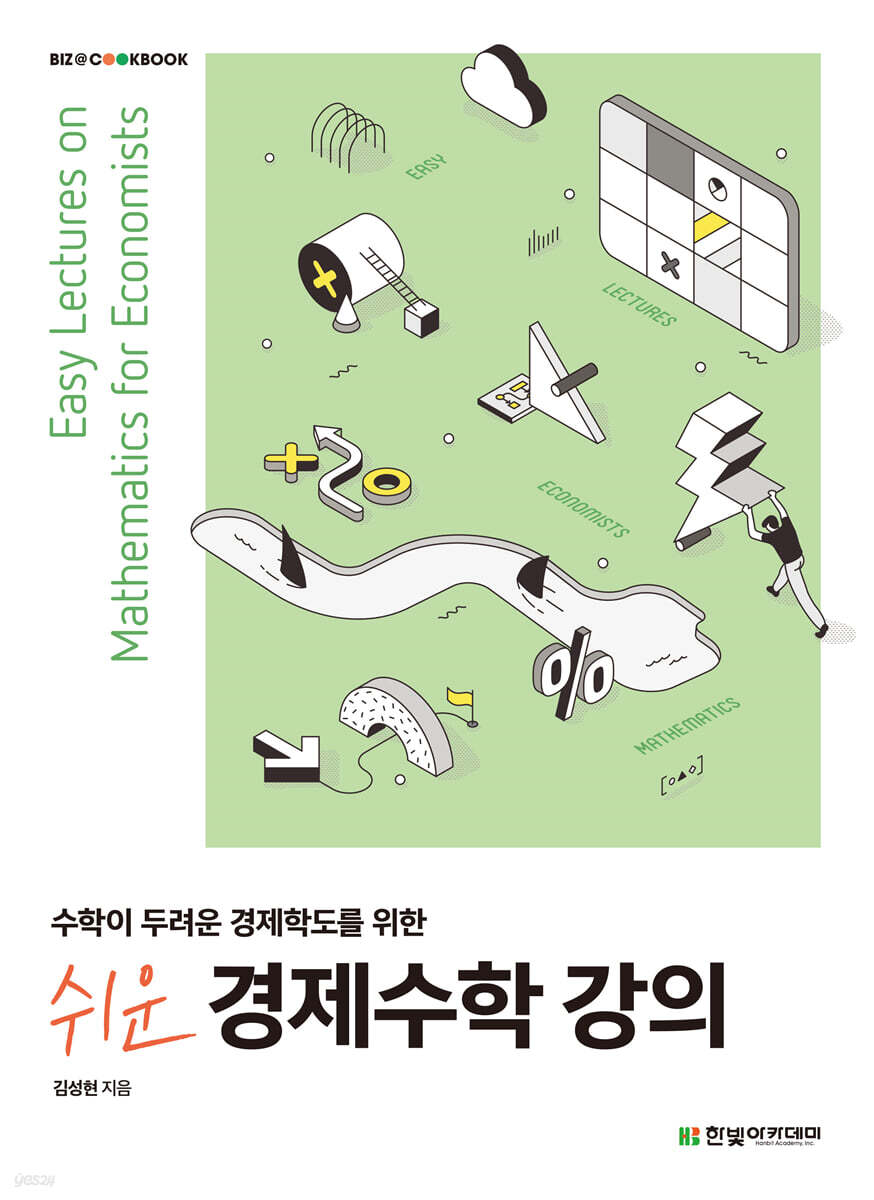
Easy Economic Mathematics Lecture
 |
Description
Book Introduction
An economics textbook for economics students who are afraid of math.
This book is a basic economic mathematics textbook for true liberal arts students who are worried about mathematics before studying economics.
The goal is to open up some of the areas that are hindered by mathematics in learning economics.
Through "Easy Economic Mathematics Lectures," you can build a solid foundation in mathematical concepts, interpret them from an economic perspective, and learn step-by-step how to handle economic models.
To achieve this, I tried to stick to the following principles: ① Repeat important concepts to the point of boredom.
② Whenever mathematical concepts are introduced, they are connected to economic concepts.
③ Mathematics is the focus, but economic models are also explained in as much detail as possible.
This book is a basic economic mathematics textbook for true liberal arts students who are worried about mathematics before studying economics.
The goal is to open up some of the areas that are hindered by mathematics in learning economics.
Through "Easy Economic Mathematics Lectures," you can build a solid foundation in mathematical concepts, interpret them from an economic perspective, and learn step-by-step how to handle economic models.
To achieve this, I tried to stick to the following principles: ① Repeat important concepts to the point of boredom.
② Whenever mathematical concepts are introduced, they are connected to economic concepts.
③ Mathematics is the focus, but economic models are also explained in as much detail as possible.
- You can preview some of the book's contents.
Preview
index
PART 01 Functions and Calculus: Basics
CHAPTER 01 Functions
1.1 Basic tools of economic models: variables
1.2 Basic tools of economic models: functions
1.3 Application: Demand Curves and Demand Functions
1.4 Properties of important functions in economic models: increasing/decreasing
1.5 Functions and Inverse Functions: The demand function and the demand curve are inverse functions of each other.
Practice problems
CHAPTER 02 Slope of a Line: Constant Function and Linear Function
2.1 Constant functions
2.2 Linear functions
2.3 Application of Linear Functions: Economic Model Examples
Practice problems
CHAPTER 03 Differentiation of Curves: Square Functions, Square Root Functions, and Inverse Functions
3.1 Power functions
3.2 Square function
3.3 Square root function
3.4 Inverse function
Practice problems
CHAPTER 04 Basic Rules of Derivatives and Differentiation: Polynomial Functions
4.1 Derivatives
4.2 Power rule when n is a natural number
4.3 Basic rules of differentiation and derivatives of polynomial functions
Practice problems
CHAPTER 05 Application of Differentiation (1) Graphs and Inverse Derivatives of Functions
5.1 Graphing a Function
5.2 Applications: Cost Curves, Marginal Cost Curves
5.3 Antiderivatives and Constants of Integration
5.4 Basic rules of integration and indefinite integrals of polynomial functions
Practice problems
CHAPTER 06 Application of Differentiation (2) Rate of Change, Elasticity, Differentiation
6.1 Amount of change, rate of change
6.2 Extension of Differentiation: Elasticity
6.3 Application of Differential Coefficients: Differential Quantity
Practice problems
PART 02 Functions and Calculus: Advanced
CHAPTER 07 Advanced Rules of Differentiation (1) Function Product, Derivative of Composite Function
7.1 Differentiation of Function Multiplication: The Product Rule
7.2 Application of the Multiplication Rule: Marginal Revenue and Demand Curves
7.3 Differentiation of Composite Functions: Chain Rule
Practice problems
CHAPTER 08 Advanced Rules of Differentiation (2) Function Quotient (Fraction Function), Derivative of Inverse Function
8.1 Differentiation of Fractional Functions: Quotient Rule
8.2 Applications: Average cost function, average cost curve
8.3 Differentiation of inverse functions
8.4 Application: Marginal Revenue and Price Elasticity of Demand
Practice problems
CHAPTER 09 Exponents and Logarithms: Natural Exponential Functions, Natural Logarithmic Functions
9.1 Natural exponential function
9.2 Natural logarithm function
9.3 Derivatives of Exponential and Logarithmic Functions
Practice problems
CHAPTER 10 APPLICATIONS OF EXPONENTS AND LOGINS
10.1 Calculation of principal and interest
10.2 Exponential Growth Model
10.3 Decomposing Multiplication and Exponential Expressions Using Logarithms
10.4 Calculating the rate of change using the derivative of the natural logarithm
Practice problems
CHAPTER 11 Advanced Rules of Integration: Integration by Parts, Integral by Substitution
11.1 Integration of exponential and inverse functions
11.2 Integration by parts
11.3 Substitution integral
11.4 Integrating fractional functions and inverse functions
Practice problems
CHAPTER 12 Applications of Integration
12.1 Meaning of the constant of integration
12.2 Area function, definite integral, and fundamental theorem of calculus
12.3 Using the Definite Integral: Consumer Surplus
12.4 Using Definite Integrators: Cumulative Distributions and Inequality Indices
Practice problems
PART 03 Economic Models: Basics
CHAPTER 13: STRUCTURE AND ANALYSIS OF ECONOMIC MODELS
13.1 Components of an Economic Model: Economic Agents
13.2 Structure of Economic Models: Exogenous and Endogenous Variables
13.3 Representative types of economic models
Practice problems
CHAPTER 14 Optimization Problems: First-Order and Second-Order Conditions
14.1 Optimization Problems
14.2 One-order conditions: Necessary conditions for internal maxima and minima
14.3 Extraterrestrial conditions: maximum and minimum sufficient conditions
Practice problems
CHAPTER 15 Analysis of the Profit Maximization Model
15.1 Overview of the Profit Maximization Model
15.2 Profit Maximization in a Perfectly Competitive Firm
15.3 Profit Maximization in Monopolies
Practice problems
CHAPTER 16 Linear Systems of Equations: Fundamentals of Vector and Matrix Operations
16.1 Systems of linear equations
16.2 Systems of linear equations with two unknowns
16.3 Matrix Algebra Basics
Practice problems
CHAPTER 17 Analysis of the Linear Equilibrium Model (1) Supply and Demand Model
17.1 Overview of the Supply and Demand Model
17.2 Analysis of a Linear Supply and Demand Model: One Good
17.3 Analysis of a Linear Supply and Demand Model: Two Goods
Practice problems
CHAPTER 18 Analysis of Linear Equilibrium Models (2) Keynesian Macroeconomic Model
18.1 Overview of Macroeconomic Models
18.2 Analysis of the Linear Keynesian Macroeconomic Model: Basic Model
18.3 Analysis of the Linear Keynesian Macroeconomic Model: IS-LM
Practice problems
PART 04 Economic Models: Advanced
CHAPTER 19 Multivariable Functions and Differentiation: Homogeneous Functions, Partial Differentiation, Total Differentiation
19.1 Multivariable functions
19.2 Partial Differentiation: First and Second-Order Partial Derivatives
19.3 Total amount
Practice problems
CHAPTER 20 Isolines of Multivariable Functions: Indifference Curves, Isoquants
20.1 Isoline
20.2 Equilibrium lines of utility and production functions
20.3 Marginal rate of substitution
Practice problems
CHAPTER 21 Analysis of Nonlinear Equilibrium Models
21.1 Overview of Analysis Using Total Differentials
21.2 Nonlinear supply and demand model
21.3 Nonlinear Macroeconomic Models
21.4 Analysis of Equilibrium Models Using Total Differentials
Practice problems
CHAPTER 22 Optimization of Multivariable Functions
22.1 Optimization of Multivariable Functions: First-Order Conditions
22.2 Optimization of Multivariable Functions: Second-Order Conditions
22.3 Application: Factor Input Selection in a Perfectly Competitive Firm
22.4 Application: Monopoly Model Selling in Two Markets
Practice problems
CHAPTER 23 Constrained Maximization Problems: Analysis of Utility Maximization Models
23.1 Overview of Constrained Optimization Problems
23.2 Utility Maximization Model
23.3 Solution to the utility maximization model
23.4 Demand Analysis
Practice problems
CHAPTER 24 Constrained Minimization Problems: Analysis of Cost Minimization Models
24.1 Cost Minimization Model
24.2 Solution to the cost minimization model
24.3 Cost Analysis
Practice problems
Search
CHAPTER 01 Functions
1.1 Basic tools of economic models: variables
1.2 Basic tools of economic models: functions
1.3 Application: Demand Curves and Demand Functions
1.4 Properties of important functions in economic models: increasing/decreasing
1.5 Functions and Inverse Functions: The demand function and the demand curve are inverse functions of each other.
Practice problems
CHAPTER 02 Slope of a Line: Constant Function and Linear Function
2.1 Constant functions
2.2 Linear functions
2.3 Application of Linear Functions: Economic Model Examples
Practice problems
CHAPTER 03 Differentiation of Curves: Square Functions, Square Root Functions, and Inverse Functions
3.1 Power functions
3.2 Square function
3.3 Square root function
3.4 Inverse function
Practice problems
CHAPTER 04 Basic Rules of Derivatives and Differentiation: Polynomial Functions
4.1 Derivatives
4.2 Power rule when n is a natural number
4.3 Basic rules of differentiation and derivatives of polynomial functions
Practice problems
CHAPTER 05 Application of Differentiation (1) Graphs and Inverse Derivatives of Functions
5.1 Graphing a Function
5.2 Applications: Cost Curves, Marginal Cost Curves
5.3 Antiderivatives and Constants of Integration
5.4 Basic rules of integration and indefinite integrals of polynomial functions
Practice problems
CHAPTER 06 Application of Differentiation (2) Rate of Change, Elasticity, Differentiation
6.1 Amount of change, rate of change
6.2 Extension of Differentiation: Elasticity
6.3 Application of Differential Coefficients: Differential Quantity
Practice problems
PART 02 Functions and Calculus: Advanced
CHAPTER 07 Advanced Rules of Differentiation (1) Function Product, Derivative of Composite Function
7.1 Differentiation of Function Multiplication: The Product Rule
7.2 Application of the Multiplication Rule: Marginal Revenue and Demand Curves
7.3 Differentiation of Composite Functions: Chain Rule
Practice problems
CHAPTER 08 Advanced Rules of Differentiation (2) Function Quotient (Fraction Function), Derivative of Inverse Function
8.1 Differentiation of Fractional Functions: Quotient Rule
8.2 Applications: Average cost function, average cost curve
8.3 Differentiation of inverse functions
8.4 Application: Marginal Revenue and Price Elasticity of Demand
Practice problems
CHAPTER 09 Exponents and Logarithms: Natural Exponential Functions, Natural Logarithmic Functions
9.1 Natural exponential function
9.2 Natural logarithm function
9.3 Derivatives of Exponential and Logarithmic Functions
Practice problems
CHAPTER 10 APPLICATIONS OF EXPONENTS AND LOGINS
10.1 Calculation of principal and interest
10.2 Exponential Growth Model
10.3 Decomposing Multiplication and Exponential Expressions Using Logarithms
10.4 Calculating the rate of change using the derivative of the natural logarithm
Practice problems
CHAPTER 11 Advanced Rules of Integration: Integration by Parts, Integral by Substitution
11.1 Integration of exponential and inverse functions
11.2 Integration by parts
11.3 Substitution integral
11.4 Integrating fractional functions and inverse functions
Practice problems
CHAPTER 12 Applications of Integration
12.1 Meaning of the constant of integration
12.2 Area function, definite integral, and fundamental theorem of calculus
12.3 Using the Definite Integral: Consumer Surplus
12.4 Using Definite Integrators: Cumulative Distributions and Inequality Indices
Practice problems
PART 03 Economic Models: Basics
CHAPTER 13: STRUCTURE AND ANALYSIS OF ECONOMIC MODELS
13.1 Components of an Economic Model: Economic Agents
13.2 Structure of Economic Models: Exogenous and Endogenous Variables
13.3 Representative types of economic models
Practice problems
CHAPTER 14 Optimization Problems: First-Order and Second-Order Conditions
14.1 Optimization Problems
14.2 One-order conditions: Necessary conditions for internal maxima and minima
14.3 Extraterrestrial conditions: maximum and minimum sufficient conditions
Practice problems
CHAPTER 15 Analysis of the Profit Maximization Model
15.1 Overview of the Profit Maximization Model
15.2 Profit Maximization in a Perfectly Competitive Firm
15.3 Profit Maximization in Monopolies
Practice problems
CHAPTER 16 Linear Systems of Equations: Fundamentals of Vector and Matrix Operations
16.1 Systems of linear equations
16.2 Systems of linear equations with two unknowns
16.3 Matrix Algebra Basics
Practice problems
CHAPTER 17 Analysis of the Linear Equilibrium Model (1) Supply and Demand Model
17.1 Overview of the Supply and Demand Model
17.2 Analysis of a Linear Supply and Demand Model: One Good
17.3 Analysis of a Linear Supply and Demand Model: Two Goods
Practice problems
CHAPTER 18 Analysis of Linear Equilibrium Models (2) Keynesian Macroeconomic Model
18.1 Overview of Macroeconomic Models
18.2 Analysis of the Linear Keynesian Macroeconomic Model: Basic Model
18.3 Analysis of the Linear Keynesian Macroeconomic Model: IS-LM
Practice problems
PART 04 Economic Models: Advanced
CHAPTER 19 Multivariable Functions and Differentiation: Homogeneous Functions, Partial Differentiation, Total Differentiation
19.1 Multivariable functions
19.2 Partial Differentiation: First and Second-Order Partial Derivatives
19.3 Total amount
Practice problems
CHAPTER 20 Isolines of Multivariable Functions: Indifference Curves, Isoquants
20.1 Isoline
20.2 Equilibrium lines of utility and production functions
20.3 Marginal rate of substitution
Practice problems
CHAPTER 21 Analysis of Nonlinear Equilibrium Models
21.1 Overview of Analysis Using Total Differentials
21.2 Nonlinear supply and demand model
21.3 Nonlinear Macroeconomic Models
21.4 Analysis of Equilibrium Models Using Total Differentials
Practice problems
CHAPTER 22 Optimization of Multivariable Functions
22.1 Optimization of Multivariable Functions: First-Order Conditions
22.2 Optimization of Multivariable Functions: Second-Order Conditions
22.3 Application: Factor Input Selection in a Perfectly Competitive Firm
22.4 Application: Monopoly Model Selling in Two Markets
Practice problems
CHAPTER 23 Constrained Maximization Problems: Analysis of Utility Maximization Models
23.1 Overview of Constrained Optimization Problems
23.2 Utility Maximization Model
23.3 Solution to the utility maximization model
23.4 Demand Analysis
Practice problems
CHAPTER 24 Constrained Minimization Problems: Analysis of Cost Minimization Models
24.1 Cost Minimization Model
24.2 Solution to the cost minimization model
24.3 Cost Analysis
Practice problems
Search
Detailed image

GOODS SPECIFICS
- Date of issue: June 28, 2024
- Page count, weight, size: 388 pages | 770g | 188*257*15mm
- ISBN13: 9791156646709
You may also like
카테고리
korean


korean

![GQ KOREA Mark (Monthly): December [2025]](http://librairie.coreenne.fr/cdn/shop/files/8ef265dbbfbf186523ed75ba7319009d.jpg?v=1765340328&width=3840)


