

Spring Textbook
 |
Description
Book Introduction
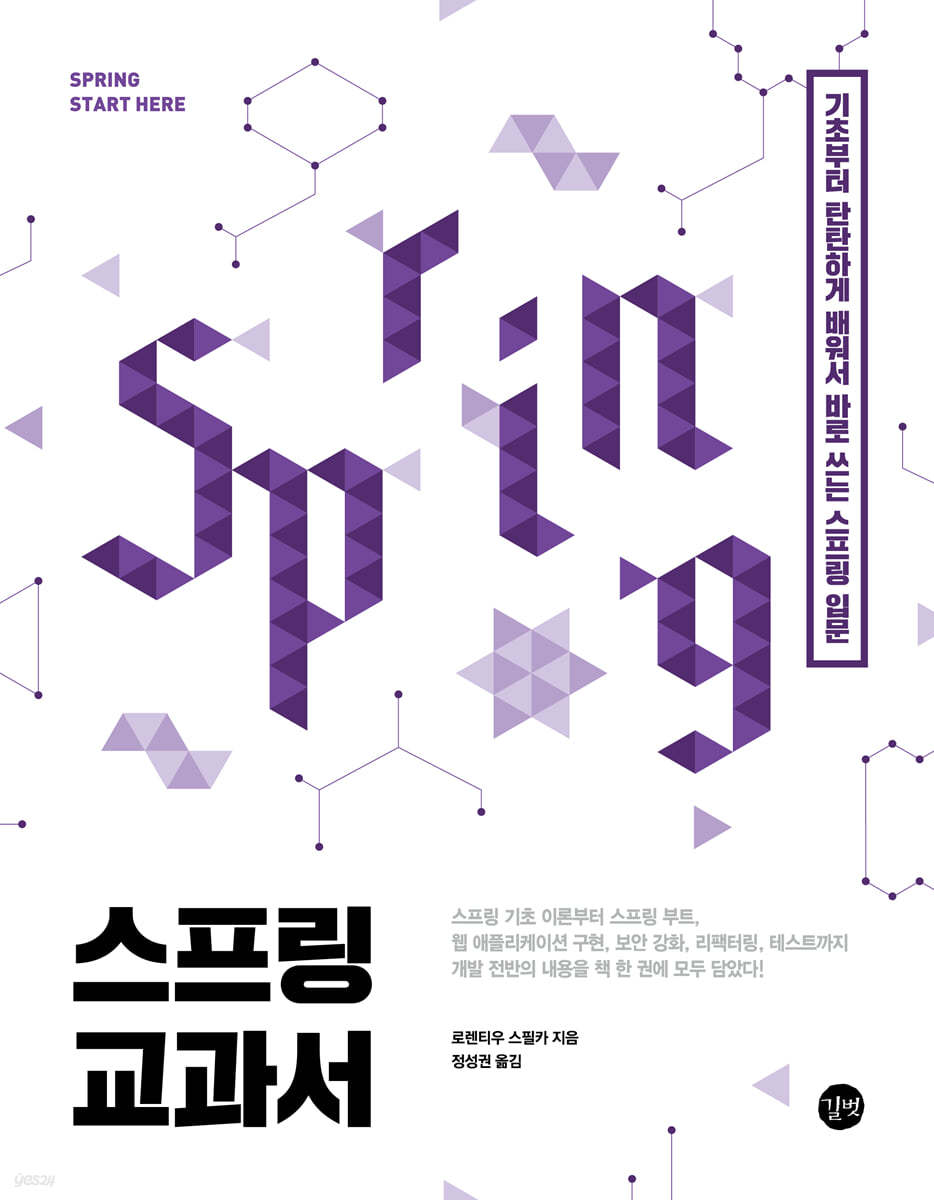
From Spring basics to Spring Boot, web application implementation, security enhancement, refactoring, and testing.
All the development content is included in one book!
The ultimate goal of this book is to learn Spring slowly by following various examples, and to enhance practical skills so that they can be applied immediately in real-world situations.
To this end, in Part 1, you will learn the basics, and in Part 2, you will implement a web application directly through the given practice.
In Part 1, you will learn how to use Spring context and Spring aspects, which are the basic components of Spring.
Later in the book, you will see that all Spring functionality relies on these essential components.
In Part 2, you will learn how to implement an app using commonly used Spring features.
And you'll find that Spring makes this task simple and easy.
This book covers everything from writing unit tests and integration tests for the functions implemented in Spring apps, so you can learn the entire development process with just one book.
This book clearly covers only the essential concepts you need to learn, so you can easily get started with Spring and apply them to your work right away.
All the development content is included in one book!
The ultimate goal of this book is to learn Spring slowly by following various examples, and to enhance practical skills so that they can be applied immediately in real-world situations.
To this end, in Part 1, you will learn the basics, and in Part 2, you will implement a web application directly through the given practice.
In Part 1, you will learn how to use Spring context and Spring aspects, which are the basic components of Spring.
Later in the book, you will see that all Spring functionality relies on these essential components.
In Part 2, you will learn how to implement an app using commonly used Spring features.
And you'll find that Spring makes this task simple and easy.
This book covers everything from writing unit tests and integration tests for the functions implemented in Spring apps, so you can learn the entire development process with just one book.
This book clearly covers only the essential concepts you need to learn, so you can easily get started with Spring and apply them to your work right away.
- You can preview some of the book's contents.
Preview
index
Part 1 Basics
Chapter 1 Springs in the Real World
1.1 Evolving to a Microservices Architecture
1.2 Spring Ecosystem
__1.2.1 Understanding Spring Core: Spring Basics
__1.2.2 Implementing app persistence using Spring Data access features
__1.2.3 Spring MVC features for web app development
__1.2.4 Spring Test Features
__1.2.5 Projects in the Spring Ecosystem
1.3 Spring in real-world scenarios
__1.3.1 Using Spring in Backend App Development
__1.3.2 Using Spring in Automated Testing Apps
__1.3.3 Using Spring in Desktop App Development
__1.3.4 Using Spring in Mobile Apps
1.4 When not to use frameworks
__1.4.1 It should be made small
__1.4.2 Security requires custom code
__1.4.3 Excessive customization makes the framework impractical.
There is no benefit to switching to the __1.4.4 framework.
1.5 What you will learn from this book
1.6 Summary
Chapter 2 Spring Context: Bean Definition
2.1 Creating a Maven Project
2.2 Adding a new bean to the Spring context
__2.2.1 Adding a bean to the Spring context using the @Bean annotation
__2.2.2 Adding beans to the Spring context with stereotype annotations
__2.2.3 Adding beans to the Spring context programmatically
2.3 Summary
Chapter 3 Spring Context: Creating Beans
3.1 Implementing empty relationships defined in the configuration file
__3.1.1 Creating a bean that directly calls a method between two @Bean methods
__3.1.2 Wiring beans as parameters of @Bean methods
3.2 Bean injection using the @Autowired annotation
__3.2.1 Injecting values using class fields with @Autowired
__3.2.2 Injecting values into constructors using @Autowired
__3.2.3 Using dependency injection using setters
3.3 Handling Circular Dependencies
3.4 Selecting between multiple beans in a Spring context
3.5 Summary
Chapter 4 Spring Context: Abstraction
4.1 Using Interfaces to Define Contracts
__4.1.1 Using interfaces to separate implementation
__4.1.2 Scenario Requirements
__4.1.3 Implementing requirements without a framework
4.2 Dependency Injection with Abstraction
__4.2.1 Determining objects to be included in the Spring context
__4.2.2 Choosing which implementation of an abstraction to autowire
4.3 Focusing Object Responsibilities with Stereotype Annotations
4.4 Summary
Chapter 5 Spring Context: Bean Scope and Lifecycle
5.1 Using Singleton Bean Scope
__5.1.1 How Singleton Beans Work
__5.1.2 Singleton beans in real-world scenarios
__5.1.3 Immediate and delayed instance creation methods
5.2 Using the prototype empty scope
__5.2.1 How Prototype Beans Work
__5.2.2 Managing Prototype Beans in Real-World Scenarios
5.3 Summary
Chapter 6: Using Aspects with Spring AOP
6.1 How Aspects Work in Spring
6.2 Implementing aspects using Spring AOP
__6.2.1 Simple Aspect Implementation
__6.2.2 Changing the parameters and return values of the intercepted method
__6.2.3 Intercepting annotated methods
__6.2.4 Other available advice annotations
6.3 Aspect Execution Chain
6.4 Summary
Part 2 Implementation
Chapter 7: Understanding Spring Boot and Spring MVC
7.1 What is a web app?
__7.1.1 General Overview of Web Apps
__7.1.2 Various ways to implement web apps with Spring
__7.1.3 Using Servlet Containers in Web App Development
7.2 The Magic of Spring Boot
__7.2.1 Creating a Spring Boot Project Using the Project Initialization Service
__7.2.2 Simplifying Dependency Management with Dependency Starters
__7.2.3 Use autoconfiguration according to convention based on dependencies
7.3 Implementing a Web App with Spring MVC
7.4 Summary
Chapter 8: Building a Web App Using Spring Boot and Spring MVC
8.1 Implementing a Web App Using Dynamic Views
__8.1.1 Getting data from an HTTP request
__8.1.2 Using request parameters to send data from the client to the server
__8.1.3 Sending data from client to server using path variables
8.2 Using HTTP GET and POST Methods
8.3 Summary
Chapter 9 Spring Web Scope
9.1 Using Request Scopes in Spring Web Apps
9.2 Using Session Scope in Spring Web Apps
9.3 Using Application Scope in Spring Web Apps
9.4 Summary
Chapter 10: Implementing REST Services
10.1 Exchanging data between apps using REST services
10.2 Implementing REST Endpoints
10.3 HTTP Response Management
__10.3.1 Sending an object to the response body
__10.3.2 Response status and header settings
__10.3.3 Exception Management at the Endpoint Level
10.4 Retrieving data from the client using the request body
10.5 Summary
Chapter 11: Using REST Endpoints
11.1 Calling REST Endpoints with Spring Cloud OpenFeign
11.2 Calling REST endpoints with RestTemplate
11.3 Calling REST endpoints with WebClient
11.4 Summary
Chapter 12 Using Data Sources in Spring Apps
12.1 Data Sources
12.2 Working with Persistent Data with JdbcTemplate
12.3 Customizing Data Source Configuration
__12.3.1 Defining a data source in the application properties file
__12.3.2 Using a Custom DataSource Bean
12.4 Summary
Chapter 13: Using Transactions in Spring Apps
13.1 Transactions
13.2 How Transactions Work in Spring
13.3 Using Transactions in Spring Apps
13.4 Summary
Chapter 14: Implementing Data Persistence with Spring Data
14.1 What is Spring Data?
14.2 How Spring Data Works
14.3 Using Spring Data JDBC
14.4 Summary
Chapter 15: Testing Spring Apps
15.1 Writing Correct Tests
15.2 Implementing Tests in Spring Apps
__15.2.1 Implementing Unit Tests
__15.2.2 Implementing Integration Tests
15.3 Summary
Appendix A
A.1 Architectural approach
A.2 Using XML to Configure Context
A.3 Understanding HTTP Basics
A.4 Using JSON format
A.5 Installing MySQL and Creating a Database
A.6 Recommended Tools
A.7 Recommended Materials for In-Depth Study
A.8 Opening and Running the Example Project in IntelliJ
Chapter 1 Springs in the Real World
1.1 Evolving to a Microservices Architecture
1.2 Spring Ecosystem
__1.2.1 Understanding Spring Core: Spring Basics
__1.2.2 Implementing app persistence using Spring Data access features
__1.2.3 Spring MVC features for web app development
__1.2.4 Spring Test Features
__1.2.5 Projects in the Spring Ecosystem
1.3 Spring in real-world scenarios
__1.3.1 Using Spring in Backend App Development
__1.3.2 Using Spring in Automated Testing Apps
__1.3.3 Using Spring in Desktop App Development
__1.3.4 Using Spring in Mobile Apps
1.4 When not to use frameworks
__1.4.1 It should be made small
__1.4.2 Security requires custom code
__1.4.3 Excessive customization makes the framework impractical.
There is no benefit to switching to the __1.4.4 framework.
1.5 What you will learn from this book
1.6 Summary
Chapter 2 Spring Context: Bean Definition
2.1 Creating a Maven Project
2.2 Adding a new bean to the Spring context
__2.2.1 Adding a bean to the Spring context using the @Bean annotation
__2.2.2 Adding beans to the Spring context with stereotype annotations
__2.2.3 Adding beans to the Spring context programmatically
2.3 Summary
Chapter 3 Spring Context: Creating Beans
3.1 Implementing empty relationships defined in the configuration file
__3.1.1 Creating a bean that directly calls a method between two @Bean methods
__3.1.2 Wiring beans as parameters of @Bean methods
3.2 Bean injection using the @Autowired annotation
__3.2.1 Injecting values using class fields with @Autowired
__3.2.2 Injecting values into constructors using @Autowired
__3.2.3 Using dependency injection using setters
3.3 Handling Circular Dependencies
3.4 Selecting between multiple beans in a Spring context
3.5 Summary
Chapter 4 Spring Context: Abstraction
4.1 Using Interfaces to Define Contracts
__4.1.1 Using interfaces to separate implementation
__4.1.2 Scenario Requirements
__4.1.3 Implementing requirements without a framework
4.2 Dependency Injection with Abstraction
__4.2.1 Determining objects to be included in the Spring context
__4.2.2 Choosing which implementation of an abstraction to autowire
4.3 Focusing Object Responsibilities with Stereotype Annotations
4.4 Summary
Chapter 5 Spring Context: Bean Scope and Lifecycle
5.1 Using Singleton Bean Scope
__5.1.1 How Singleton Beans Work
__5.1.2 Singleton beans in real-world scenarios
__5.1.3 Immediate and delayed instance creation methods
5.2 Using the prototype empty scope
__5.2.1 How Prototype Beans Work
__5.2.2 Managing Prototype Beans in Real-World Scenarios
5.3 Summary
Chapter 6: Using Aspects with Spring AOP
6.1 How Aspects Work in Spring
6.2 Implementing aspects using Spring AOP
__6.2.1 Simple Aspect Implementation
__6.2.2 Changing the parameters and return values of the intercepted method
__6.2.3 Intercepting annotated methods
__6.2.4 Other available advice annotations
6.3 Aspect Execution Chain
6.4 Summary
Part 2 Implementation
Chapter 7: Understanding Spring Boot and Spring MVC
7.1 What is a web app?
__7.1.1 General Overview of Web Apps
__7.1.2 Various ways to implement web apps with Spring
__7.1.3 Using Servlet Containers in Web App Development
7.2 The Magic of Spring Boot
__7.2.1 Creating a Spring Boot Project Using the Project Initialization Service
__7.2.2 Simplifying Dependency Management with Dependency Starters
__7.2.3 Use autoconfiguration according to convention based on dependencies
7.3 Implementing a Web App with Spring MVC
7.4 Summary
Chapter 8: Building a Web App Using Spring Boot and Spring MVC
8.1 Implementing a Web App Using Dynamic Views
__8.1.1 Getting data from an HTTP request
__8.1.2 Using request parameters to send data from the client to the server
__8.1.3 Sending data from client to server using path variables
8.2 Using HTTP GET and POST Methods
8.3 Summary
Chapter 9 Spring Web Scope
9.1 Using Request Scopes in Spring Web Apps
9.2 Using Session Scope in Spring Web Apps
9.3 Using Application Scope in Spring Web Apps
9.4 Summary
Chapter 10: Implementing REST Services
10.1 Exchanging data between apps using REST services
10.2 Implementing REST Endpoints
10.3 HTTP Response Management
__10.3.1 Sending an object to the response body
__10.3.2 Response status and header settings
__10.3.3 Exception Management at the Endpoint Level
10.4 Retrieving data from the client using the request body
10.5 Summary
Chapter 11: Using REST Endpoints
11.1 Calling REST Endpoints with Spring Cloud OpenFeign
11.2 Calling REST endpoints with RestTemplate
11.3 Calling REST endpoints with WebClient
11.4 Summary
Chapter 12 Using Data Sources in Spring Apps
12.1 Data Sources
12.2 Working with Persistent Data with JdbcTemplate
12.3 Customizing Data Source Configuration
__12.3.1 Defining a data source in the application properties file
__12.3.2 Using a Custom DataSource Bean
12.4 Summary
Chapter 13: Using Transactions in Spring Apps
13.1 Transactions
13.2 How Transactions Work in Spring
13.3 Using Transactions in Spring Apps
13.4 Summary
Chapter 14: Implementing Data Persistence with Spring Data
14.1 What is Spring Data?
14.2 How Spring Data Works
14.3 Using Spring Data JDBC
14.4 Summary
Chapter 15: Testing Spring Apps
15.1 Writing Correct Tests
15.2 Implementing Tests in Spring Apps
__15.2.1 Implementing Unit Tests
__15.2.2 Implementing Integration Tests
15.3 Summary
Appendix A
A.1 Architectural approach
A.2 Using XML to Configure Context
A.3 Understanding HTTP Basics
A.4 Using JSON format
A.5 Installing MySQL and Creating a Database
A.6 Recommended Tools
A.7 Recommended Materials for In-Depth Study
A.8 Opening and Running the Example Project in IntelliJ
Detailed image

Publisher's Review
Complete everything from principle to implementation in one go!
Spring Introduction is Not Difficult at All
The easiest starting point for getting started with Spring
For Java developers, Spring is a must-learn framework.
The Spring Framework enables everything from small e-commerce applications to large-scale microservices.
Perhaps this is why you may find Spring difficult to get started with.
This book contains only the most essential and frequently repeated concepts, presented in a practical order.
It also clearly explains the components and functions of the framework, not only how to use them, but also the essence of what happens behind the scenes.
For developers who want to properly understand and use the core principles of Spring, this book will be the easiest starting point.
From Spring basics to building and testing apps!
The book begins by explaining what a framework is.
Part 1 covers the basics of Spring context, bean definition and usage, AOP, abstraction, etc. Part 2 explains understanding Spring Boot and Spring MVC and implementing web applications, how to use Spring to make SQL database requests and REST calls, and how to strengthen security with Spring Security.
It also covers how to refactor existing applications with Spring and how to test apps, allowing you to learn everything from principles and implementation to testing.
Spring Introduction is Not Difficult at All
The easiest starting point for getting started with Spring
For Java developers, Spring is a must-learn framework.
The Spring Framework enables everything from small e-commerce applications to large-scale microservices.
Perhaps this is why you may find Spring difficult to get started with.
This book contains only the most essential and frequently repeated concepts, presented in a practical order.
It also clearly explains the components and functions of the framework, not only how to use them, but also the essence of what happens behind the scenes.
For developers who want to properly understand and use the core principles of Spring, this book will be the easiest starting point.
From Spring basics to building and testing apps!
The book begins by explaining what a framework is.
Part 1 covers the basics of Spring context, bean definition and usage, AOP, abstraction, etc. Part 2 explains understanding Spring Boot and Spring MVC and implementing web applications, how to use Spring to make SQL database requests and REST calls, and how to strengthen security with Spring Security.
It also covers how to refactor existing applications with Spring and how to test apps, allowing you to learn everything from principles and implementation to testing.
GOODS SPECIFICS
- Date of issue: May 31, 2024
- Page count, weight, size: 464 pages | 183*235*18mm
- ISBN13: 9791140710119
You may also like
카테고리
korean


korean

![GQ KOREA Mark (Monthly): December [2025]](http://librairie.coreenne.fr/cdn/shop/files/8ef265dbbfbf186523ed75ba7319009d.jpg?v=1765340328&width=3840)


