

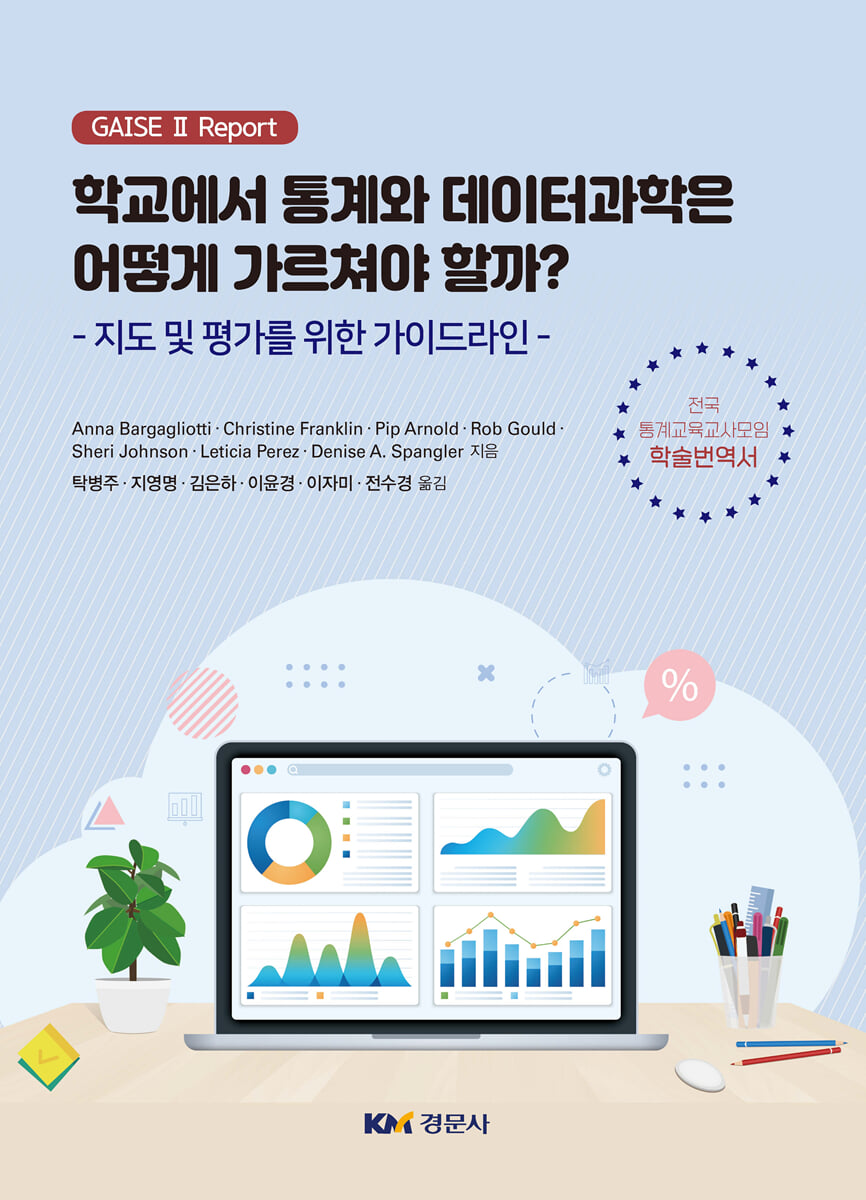
How should statistics and data science be taught in schools?
 |
Description
Book Introduction
The "GAISE Report" has had a significant impact on establishing the direction for improving statistical education not only in the United States but also in many countries, including Korea, and is a document that has made a significant contribution to statistical education curriculum and research in statistical education.
In 2020, a revised version of the "GAISE II Report" was published.
The "GAISE II Report" was published from the perspective that the spirit of the existing "GAISE Report", which aimed to cultivate statistical literacy and emphasize statistical problem-solving experience, should be maintained, but the content of elementary, middle, and high school statistics education should be restructured to reflect the changing status of data and the latest technology.
The "GAISE II Report" serves as a standard for elementary, middle, and high school statistics education on the one hand, and on the other hand, it is an important teaching and learning resource that provides teachers with a variety of ideas and guidelines for statistics classes through various case studies.
Therefore, this translation will be of great value to both statistical education researchers and teachers.
While establishing the content structure of statistical education is grounded in academic discussion, this book also presents specific teaching and learning examples of how the content is implemented in actual statistics classes. It is hoped that this book will connect research and instruction in the field of statistics education.
In 2020, a revised version of the "GAISE II Report" was published.
The "GAISE II Report" was published from the perspective that the spirit of the existing "GAISE Report", which aimed to cultivate statistical literacy and emphasize statistical problem-solving experience, should be maintained, but the content of elementary, middle, and high school statistics education should be restructured to reflect the changing status of data and the latest technology.
The "GAISE II Report" serves as a standard for elementary, middle, and high school statistics education on the one hand, and on the other hand, it is an important teaching and learning resource that provides teachers with a variety of ideas and guidelines for statistics classes through various case studies.
Therefore, this translation will be of great value to both statistical education researchers and teachers.
While establishing the content structure of statistical education is grounded in academic discussion, this book also presents specific teaching and learning examples of how the content is implemented in actual statistics classes. It is hoped that this book will connect research and instruction in the field of statistics education.
- You can preview some of the book's contents.
Preview
index
Translator's Preface / ⅲ
To begin with
Author's Preface / 2
Introduction / 6
Statistics Education System / 17
A level
Introduction / 28
Step-by-step key elements / 29
Example 1: Choosing a Band for a Holiday Party - Survey and Data Summary / 30
Example 2: Family Size - Mean as Fair Distribution and Variability as Number of Steps / 36
Example 3: What Does a Ladybug Look Like? - Collecting, Summarizing, and Comparing Data / 40
Example 4: Growing Kidney Beans - A Simple Comparative Experiment / 46
Example 5: Bean Cultivation [Continued] - Time Series / 49
Example 6: Census@Schools - Using Secondary Data and Correlation Analysis / 51
A-Level Summary / 55
B level
Introduction / 58
Step-by-Step Key Elements / 59
Example 1: A-Level Review: School Festival Music Selection - Multivariate and Group Expansion / 61
Example 2: School Festival Music Selection [Continued] - Group Comparison / 65
Example 3: School Festival Music Selection [Continued] - Linking Two Categorical Variables / 68
Example 4: Darwin's Finches - Comparing Numerical Variables Across Populations / 71
Example 5: Darwin's Finches [continued] - Segregation vs. Overlapping / 77
Example 6: Darwin's Finches [continued] - Measuring the Strength of Association Between Two Numerical Variables / 81
Example 7: Darwin's Finches [Continued] - Time Series / 84
Example 8: Dollar Street - Photo Data / 86
Example 9: Memory and Music - A Comparative Experiment / 93
B-Level Summary / 97
C level
Introduction / 100
The Role of Engineering Tools / 102
The Role of Probability in Statistics / 103
Step-by-Step Key Elements / 106
Example 1: Revisiting Level B: Darwin's Finches - From Absolute Mean Deviation to Standard Deviation / 108
Example 2: Revisiting Levels A and B [Continued]: School Festival Music Selection - Generalizing Results / 112
Example 3: School Festival Music Selection [Continued] - Reasoning About Associations / 117
Example 4: Effect of Light on the Growth of Radish Sprouts - Experiment / 120
Example 5: Considering Sizes When Designing Clothing - Linear Regression / 126
Example 6: Napping and Heart Attacks - Inferring Associations from Observational Studies / 130
Example 7: Core Workforce - Exploring Secondary Data / 134
Example 8: Lizard Classification - Predicting Categorical Variables / 137
C-Level Summary / 146
evaluation
Rating / 150
National and International Standardization Assessment / 151
Teacher Resources / 151
A-Level Assessment Example / 153
Level B Assessment Example / 156
C-Level Evaluation Example / 160
References / 164
To begin with
Author's Preface / 2
Introduction / 6
Statistics Education System / 17
A level
Introduction / 28
Step-by-step key elements / 29
Example 1: Choosing a Band for a Holiday Party - Survey and Data Summary / 30
Example 2: Family Size - Mean as Fair Distribution and Variability as Number of Steps / 36
Example 3: What Does a Ladybug Look Like? - Collecting, Summarizing, and Comparing Data / 40
Example 4: Growing Kidney Beans - A Simple Comparative Experiment / 46
Example 5: Bean Cultivation [Continued] - Time Series / 49
Example 6: Census@Schools - Using Secondary Data and Correlation Analysis / 51
A-Level Summary / 55
B level
Introduction / 58
Step-by-Step Key Elements / 59
Example 1: A-Level Review: School Festival Music Selection - Multivariate and Group Expansion / 61
Example 2: School Festival Music Selection [Continued] - Group Comparison / 65
Example 3: School Festival Music Selection [Continued] - Linking Two Categorical Variables / 68
Example 4: Darwin's Finches - Comparing Numerical Variables Across Populations / 71
Example 5: Darwin's Finches [continued] - Segregation vs. Overlapping / 77
Example 6: Darwin's Finches [continued] - Measuring the Strength of Association Between Two Numerical Variables / 81
Example 7: Darwin's Finches [Continued] - Time Series / 84
Example 8: Dollar Street - Photo Data / 86
Example 9: Memory and Music - A Comparative Experiment / 93
B-Level Summary / 97
C level
Introduction / 100
The Role of Engineering Tools / 102
The Role of Probability in Statistics / 103
Step-by-Step Key Elements / 106
Example 1: Revisiting Level B: Darwin's Finches - From Absolute Mean Deviation to Standard Deviation / 108
Example 2: Revisiting Levels A and B [Continued]: School Festival Music Selection - Generalizing Results / 112
Example 3: School Festival Music Selection [Continued] - Reasoning About Associations / 117
Example 4: Effect of Light on the Growth of Radish Sprouts - Experiment / 120
Example 5: Considering Sizes When Designing Clothing - Linear Regression / 126
Example 6: Napping and Heart Attacks - Inferring Associations from Observational Studies / 130
Example 7: Core Workforce - Exploring Secondary Data / 134
Example 8: Lizard Classification - Predicting Categorical Variables / 137
C-Level Summary / 146
evaluation
Rating / 150
National and International Standardization Assessment / 151
Teacher Resources / 151
A-Level Assessment Example / 153
Level B Assessment Example / 156
C-Level Evaluation Example / 160
References / 164
Publisher's Review
Over the past decade, the scope of what we call data has expanded dramatically, and the technology for processing data has also advanced significantly. This has led to a dramatic increase in the accessibility and value of data in our society.
In this context, since the revised mathematics curriculum in 2015 proposed 'restructuring statistical content centered on real-life situations' as a key direction for revision, the number of mathematics education researchers and teachers who have become interested in statistics education has increased.
Among them, the 'National Statistics Education Teachers' Association' was founded and is continuing its activities to overcome the limitations of statistics classes conducted as part of the mathematics curriculum and to establish a future-oriented trend in statistics education in the field.
Rather than relying solely on the expertise of individual teachers, the National Association of Statistics Education Teachers felt the need for standardized content to foster the professional development of many teachers and researchers involved in statistical education and research. This led them to focus on the "GAISE Report" published by the American Statistical Association.
The "GAISE Report" has had a significant impact on establishing the direction for improving statistical education not only in the United States but also in many countries, including Korea, and is a document that has made a significant contribution to statistical education curriculum and research in statistical education.
In 2020, a revised version of the "GAISE II Report" was published.
The "GAISE II Report" was published from the perspective that the spirit of the existing "GAISE Report", which aimed to cultivate statistical literacy and emphasize statistical problem-solving experience, should be maintained, but the content of elementary, middle, and high school statistics education should be restructured to reflect the changing status of data and the latest technology.
The "GAISE II Report" serves as a standard for elementary, middle, and high school statistics education on the one hand, and on the other hand, it is an important teaching and learning resource that provides teachers with a variety of ideas and guidelines for statistics classes through various case studies.
Therefore, this translation will be of great value to both statistical education researchers and teachers.
While establishing the content structure of statistical education is grounded in academic discussion, this book also presents specific teaching and learning examples of how the content is implemented in actual statistics classes. It is hoped that this book will connect research and instruction in the field of statistics education.
*All translators are members of the National Association of Statistics Teachers, a research group of teachers established in collaboration with the National Statistical Office to overcome the limitations of statistics classes conducted as part of the mathematics curriculum and to ensure that future-oriented statistics education trends are established in the field.
(Website: https://cafe.naver.com/koreastat)
In this context, since the revised mathematics curriculum in 2015 proposed 'restructuring statistical content centered on real-life situations' as a key direction for revision, the number of mathematics education researchers and teachers who have become interested in statistics education has increased.
Among them, the 'National Statistics Education Teachers' Association' was founded and is continuing its activities to overcome the limitations of statistics classes conducted as part of the mathematics curriculum and to establish a future-oriented trend in statistics education in the field.
Rather than relying solely on the expertise of individual teachers, the National Association of Statistics Education Teachers felt the need for standardized content to foster the professional development of many teachers and researchers involved in statistical education and research. This led them to focus on the "GAISE Report" published by the American Statistical Association.
The "GAISE Report" has had a significant impact on establishing the direction for improving statistical education not only in the United States but also in many countries, including Korea, and is a document that has made a significant contribution to statistical education curriculum and research in statistical education.
In 2020, a revised version of the "GAISE II Report" was published.
The "GAISE II Report" was published from the perspective that the spirit of the existing "GAISE Report", which aimed to cultivate statistical literacy and emphasize statistical problem-solving experience, should be maintained, but the content of elementary, middle, and high school statistics education should be restructured to reflect the changing status of data and the latest technology.
The "GAISE II Report" serves as a standard for elementary, middle, and high school statistics education on the one hand, and on the other hand, it is an important teaching and learning resource that provides teachers with a variety of ideas and guidelines for statistics classes through various case studies.
Therefore, this translation will be of great value to both statistical education researchers and teachers.
While establishing the content structure of statistical education is grounded in academic discussion, this book also presents specific teaching and learning examples of how the content is implemented in actual statistics classes. It is hoped that this book will connect research and instruction in the field of statistics education.
*All translators are members of the National Association of Statistics Teachers, a research group of teachers established in collaboration with the National Statistical Office to overcome the limitations of statistics classes conducted as part of the mathematics curriculum and to ensure that future-oriented statistics education trends are established in the field.
(Website: https://cafe.naver.com/koreastat)
GOODS SPECIFICS
- Publication date: May 26, 2022
- Page count, weight, size: 176 pages | 188*257*20mm
- ISBN13: 9791160735413
- ISBN10: 1160735417
You may also like
카테고리
korean


korean

![ELLE 엘르 스페셜 에디션 A형 : 12월 [2025]](http://librairie.coreenne.fr/cdn/shop/files/b8e27a3de6c9538896439686c6b0e8fb.jpg?v=1766436872&width=3840)


