

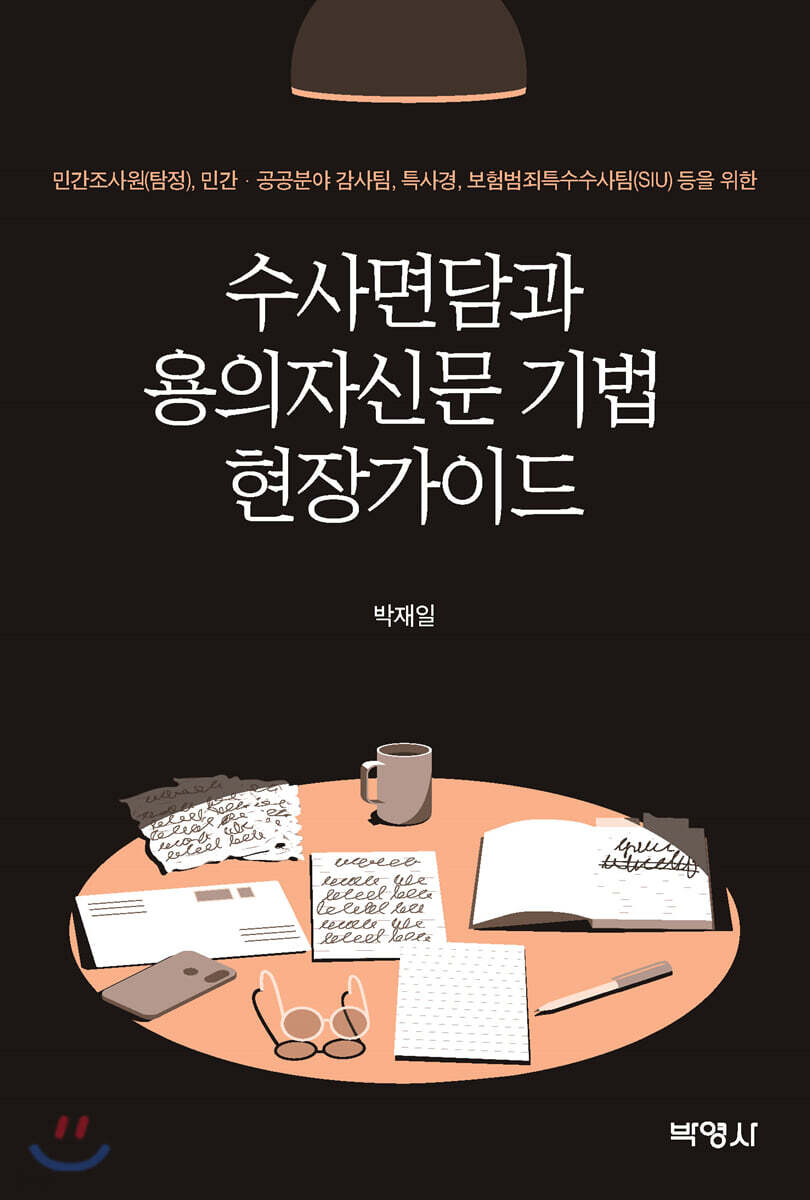
Field Guide to Investigative Interviews and Suspect Questioning Techniques
 |
Description
Book Introduction
This book provides an easy-to-understand explanation of the entire interview and questioning process to achieve investigative objectives.
In particular, we presented a 'Stairway Model for Korean-style investigative interviews and suspect interrogation' that can be immediately applied in the field, and introduced in detail the techniques that must be learned at each stage.
The importance of preventing false confessions and discovering the substantive truth by verifying the importance of rapport building and facilitation techniques, types of questions and utilization techniques, techniques for presenting secured physical evidence, techniques for discovering and accumulating contradictions in the subject's statement, and techniques for persuading confessions were emphasized.
In particular, we presented a 'Stairway Model for Korean-style investigative interviews and suspect interrogation' that can be immediately applied in the field, and introduced in detail the techniques that must be learned at each stage.
The importance of preventing false confessions and discovering the substantive truth by verifying the importance of rapport building and facilitation techniques, types of questions and utilization techniques, techniques for presenting secured physical evidence, techniques for discovering and accumulating contradictions in the subject's statement, and techniques for persuading confessions were emphasized.
index
PART 1
What are investigative interviews and suspect interrogations?
1.
The Need to Learn Investigative Interview and Suspect Interrogation Techniques / 20
2.
The Meaning of the Korean-Style Investigative Interview and Suspect Interrogation Model (Stairway Model) / 29
PART 2
Korean-style investigative interview and suspect interrogation model - Stairway Model
1.
The composition of the 'Stairway Model' / 38
2.
Stairway Model Details / 41
3.
Summary / 66
PART 3
Prerequisites for effective investigative interviews and suspect interrogation
1.
Rapport Building Skills / 72
2.
The Art of Listening / 80
3.
The Art of Questioning / 92
4.
Experts in investigative interviews and suspect questioning must be aware of two common errors in criminal justice procedures / 109
PART 4
Lie detection and cognitive interviewing
1.
Lie Detection / 112
2.
Cognitive Interview / 126
PART 5
Integrated use of the Stairway Model in investigative interviews and suspect interrogation.
1.
Interview and Interview Plan Preparation / 133
2.
Conducting Investigative Interviews and Suspect Questioning / 136
Search / 149
What are investigative interviews and suspect interrogations?
1.
The Need to Learn Investigative Interview and Suspect Interrogation Techniques / 20
2.
The Meaning of the Korean-Style Investigative Interview and Suspect Interrogation Model (Stairway Model) / 29
PART 2
Korean-style investigative interview and suspect interrogation model - Stairway Model
1.
The composition of the 'Stairway Model' / 38
2.
Stairway Model Details / 41
3.
Summary / 66
PART 3
Prerequisites for effective investigative interviews and suspect interrogation
1.
Rapport Building Skills / 72
2.
The Art of Listening / 80
3.
The Art of Questioning / 92
4.
Experts in investigative interviews and suspect questioning must be aware of two common errors in criminal justice procedures / 109
PART 4
Lie detection and cognitive interviewing
1.
Lie Detection / 112
2.
Cognitive Interview / 126
PART 5
Integrated use of the Stairway Model in investigative interviews and suspect interrogation.
1.
Interview and Interview Plan Preparation / 133
2.
Conducting Investigative Interviews and Suspect Questioning / 136
Search / 149
Publisher's Review
Conducting interviews and questioning of relevant subjects (suspects, victims, witnesses, etc.) at a crime scene involves a different dynamic than communication based on general conversation.
Although there may be a similarity in the process of obtaining information through the repetition of questions and answers on the surface, this is because the sharp, active inner energy of those who seek to uncover the truth and those who seek to hide it intersect in terms of achieving the purpose of the investigation.
During the investigation process, there are times when decisive physical evidence is collected, and times when it is not (especially in some crimes where there is only circumstantial evidence), but in either case, the reliance on 'interview and questioning techniques' inevitably increases.
Even if physical evidence is secured, it is impossible to completely reconstruct the incident with this alone.
Since physical evidence alone can only provide a limited reconstruction of the facts, a voluntary statement (confession) about the subject's subjective world of experience is necessary to discover the substantive truth.
Confessions provide information about the psychological and behavioral reasons underlying criminal acts, the use of tools, and situational conditions that cannot be explained logically.
Effectively gathering this information, which cannot be obtained through physical evidence, can only be achieved through the application of structured and systematic interview and questioning techniques.
Nonetheless, it seems that the investigators' 'interrogation to obtain a confession' in the current investigative interviews and suspect interrogation scenes is being used synonymously with 'human rights violation'.
This phenomenon may not be unrelated to the fact that false confessions have been identified as the main cause of several recent cases in which false accusations were cleared through retrials.
As part of efforts to prevent false confessions, the 'PEACE Model (information-gathering interview model)' developed in the UK is being introduced to frontline investigators.
Even in academic circles, there is an argument for its use compared to the American Reid Technique, which extracts confessions through questioning.
However, judging from my practical perspective of having conducted tens of thousands of interviews and questioning at investigative sites over the past 27 years, this is flawed on two counts.
First, the insistence on using only the information-gathering interview method (PEACE Model), which is characterized by “non-questioning and non-pressure” in the area of suspect interrogation due to the possibility of “false confessions,” is nothing more than the fantasy of theorists who overlook the dynamics of the investigative scene.
It is no different from asking a skilled doctor to perform surgery without using a surgical knife and save a person's life by highlighting only the negative aspects of the instrumental dangers of the knife.
It is almost impossible to get a person to voluntarily state something that contains the "substantial truth" that is against their own interests by passively listening to their statement without going through the "systematic questioning" process to secure a confession.
The risk of 'false confessions' that may arise through interrogation will be prevented by re-examining them through the 'verification' process of investigative activities.
Verification will be rigorously assessed through the presence or absence of independent corroborating evidence.
This is because verifying the truth of confessions obtained through structured interviews and questioning is an important process through intensive investigative activities.
If the subject's false confession is used as an investigation result without being verified and corrected, it will only result in an ethical problem for the individual investigator.
Second, in the investigative field, it is impossible to secure a voluntary statement of criminal involvement without ‘active persuasion.’
The core of the information-gathering interview (PEACE Model) method is to have the suspect 'voluntarily state' his involvement in the criminal act.
First, a positive relationship is established with the subject, and based on this, voluntary statements are encouraged, and inconsistencies found in the statements are pointed out and corrected statements are requested (challenged).
By repeating this process, he is encouraged to voluntarily tell the 'true facts', and this is introduced as a desirable process for discovering the substantive truth.
However, confession is not possible through the passive method introduced in information-gathering interview techniques.
If we are to ask a subject to make a statement against his or her own interests (a confession that could potentially destroy his or her entire life), we must be able to pave the way for this in a dignified way through the application of structured interviewing and interrogation techniques.
This book provides an easy-to-understand explanation of the entire interview and questioning process to achieve investigative objectives.
In particular, we presented a 'Stairway Model for Korean-style investigative interviews and suspect interrogation' that can be immediately applied in the field, and introduced in detail the techniques that must be learned at each stage.
The importance of preventing false confessions and discovering the substantive truth by verifying the importance of rapport building and facilitation techniques, types of questions and utilization techniques, techniques for presenting secured physical evidence, techniques for discovering and accumulating contradictions in the subject's statement, and techniques for persuading confessions were emphasized.
In 'Part 1', we discussed the necessity of learning and becoming proficient in interview and suspect interrogation techniques to achieve investigative objectives.
The final piece of the puzzle for discovering the substantive truth comes from testimonial evidence obtained from the subject, not physical evidence.
Therefore, it is essential for investigators to have effective interview and questioning techniques to secure testimony evidence.
In 'Part 2', the 'Stairway Model', a Korean-style investigative interview and suspect interrogation model, was presented.
The step-by-step components and application techniques of the structured 'staircase model' will be helpful in the field when conducting interviews and interviews.
In 'Part 3', rapport building, questioning, and listening skills are introduced as prerequisites for effective investigative interviews and suspect interrogation.
In addition to the theoretical explanations, where necessary, spaces were inserted to allow readers to develop their own ideas further by writing their own. In 'Part 4', lie detection and cognitive interviewing were introduced.
It was emphasized that it is necessary to interpret the verbal, nonverbal, and paraverbal signals shown by the subject during the interview and questioning process not as the result of a ‘lie’, but as the ‘possibility of a lie.’
The possibility of falsehood thus captured is a gap that must be filled by verifying it through investigative activities.
Additionally, cognitive interviews may be somewhat helpful in overcoming memory limitations, making them useful in terms of field applicability.
In 'Part 5', the previously covered content is presented in an integrated manner.
The case will help readers understand by visually highlighting the interview and questioning processes necessary to achieve investigative objectives and by demonstrating the process of securing testimony evidence essential to reconstructing a case.
This book will serve as a useful guide in our current reality, where there are no available textbooks for learning or becoming proficient in investigative interview and suspect interrogation techniques.
In particular, it will help investigators in various investigative fields, including existing law enforcement agencies, private enterprise and public sector audit teams, private investigators (detectives), special investigators (tax, environment, health, food, etc.), insurance crime special investigation teams, and military investigation teams, to discover the substantive truth.
Although there may be a similarity in the process of obtaining information through the repetition of questions and answers on the surface, this is because the sharp, active inner energy of those who seek to uncover the truth and those who seek to hide it intersect in terms of achieving the purpose of the investigation.
During the investigation process, there are times when decisive physical evidence is collected, and times when it is not (especially in some crimes where there is only circumstantial evidence), but in either case, the reliance on 'interview and questioning techniques' inevitably increases.
Even if physical evidence is secured, it is impossible to completely reconstruct the incident with this alone.
Since physical evidence alone can only provide a limited reconstruction of the facts, a voluntary statement (confession) about the subject's subjective world of experience is necessary to discover the substantive truth.
Confessions provide information about the psychological and behavioral reasons underlying criminal acts, the use of tools, and situational conditions that cannot be explained logically.
Effectively gathering this information, which cannot be obtained through physical evidence, can only be achieved through the application of structured and systematic interview and questioning techniques.
Nonetheless, it seems that the investigators' 'interrogation to obtain a confession' in the current investigative interviews and suspect interrogation scenes is being used synonymously with 'human rights violation'.
This phenomenon may not be unrelated to the fact that false confessions have been identified as the main cause of several recent cases in which false accusations were cleared through retrials.
As part of efforts to prevent false confessions, the 'PEACE Model (information-gathering interview model)' developed in the UK is being introduced to frontline investigators.
Even in academic circles, there is an argument for its use compared to the American Reid Technique, which extracts confessions through questioning.
However, judging from my practical perspective of having conducted tens of thousands of interviews and questioning at investigative sites over the past 27 years, this is flawed on two counts.
First, the insistence on using only the information-gathering interview method (PEACE Model), which is characterized by “non-questioning and non-pressure” in the area of suspect interrogation due to the possibility of “false confessions,” is nothing more than the fantasy of theorists who overlook the dynamics of the investigative scene.
It is no different from asking a skilled doctor to perform surgery without using a surgical knife and save a person's life by highlighting only the negative aspects of the instrumental dangers of the knife.
It is almost impossible to get a person to voluntarily state something that contains the "substantial truth" that is against their own interests by passively listening to their statement without going through the "systematic questioning" process to secure a confession.
The risk of 'false confessions' that may arise through interrogation will be prevented by re-examining them through the 'verification' process of investigative activities.
Verification will be rigorously assessed through the presence or absence of independent corroborating evidence.
This is because verifying the truth of confessions obtained through structured interviews and questioning is an important process through intensive investigative activities.
If the subject's false confession is used as an investigation result without being verified and corrected, it will only result in an ethical problem for the individual investigator.
Second, in the investigative field, it is impossible to secure a voluntary statement of criminal involvement without ‘active persuasion.’
The core of the information-gathering interview (PEACE Model) method is to have the suspect 'voluntarily state' his involvement in the criminal act.
First, a positive relationship is established with the subject, and based on this, voluntary statements are encouraged, and inconsistencies found in the statements are pointed out and corrected statements are requested (challenged).
By repeating this process, he is encouraged to voluntarily tell the 'true facts', and this is introduced as a desirable process for discovering the substantive truth.
However, confession is not possible through the passive method introduced in information-gathering interview techniques.
If we are to ask a subject to make a statement against his or her own interests (a confession that could potentially destroy his or her entire life), we must be able to pave the way for this in a dignified way through the application of structured interviewing and interrogation techniques.
This book provides an easy-to-understand explanation of the entire interview and questioning process to achieve investigative objectives.
In particular, we presented a 'Stairway Model for Korean-style investigative interviews and suspect interrogation' that can be immediately applied in the field, and introduced in detail the techniques that must be learned at each stage.
The importance of preventing false confessions and discovering the substantive truth by verifying the importance of rapport building and facilitation techniques, types of questions and utilization techniques, techniques for presenting secured physical evidence, techniques for discovering and accumulating contradictions in the subject's statement, and techniques for persuading confessions were emphasized.
In 'Part 1', we discussed the necessity of learning and becoming proficient in interview and suspect interrogation techniques to achieve investigative objectives.
The final piece of the puzzle for discovering the substantive truth comes from testimonial evidence obtained from the subject, not physical evidence.
Therefore, it is essential for investigators to have effective interview and questioning techniques to secure testimony evidence.
In 'Part 2', the 'Stairway Model', a Korean-style investigative interview and suspect interrogation model, was presented.
The step-by-step components and application techniques of the structured 'staircase model' will be helpful in the field when conducting interviews and interviews.
In 'Part 3', rapport building, questioning, and listening skills are introduced as prerequisites for effective investigative interviews and suspect interrogation.
In addition to the theoretical explanations, where necessary, spaces were inserted to allow readers to develop their own ideas further by writing their own. In 'Part 4', lie detection and cognitive interviewing were introduced.
It was emphasized that it is necessary to interpret the verbal, nonverbal, and paraverbal signals shown by the subject during the interview and questioning process not as the result of a ‘lie’, but as the ‘possibility of a lie.’
The possibility of falsehood thus captured is a gap that must be filled by verifying it through investigative activities.
Additionally, cognitive interviews may be somewhat helpful in overcoming memory limitations, making them useful in terms of field applicability.
In 'Part 5', the previously covered content is presented in an integrated manner.
The case will help readers understand by visually highlighting the interview and questioning processes necessary to achieve investigative objectives and by demonstrating the process of securing testimony evidence essential to reconstructing a case.
This book will serve as a useful guide in our current reality, where there are no available textbooks for learning or becoming proficient in investigative interview and suspect interrogation techniques.
In particular, it will help investigators in various investigative fields, including existing law enforcement agencies, private enterprise and public sector audit teams, private investigators (detectives), special investigators (tax, environment, health, food, etc.), insurance crime special investigation teams, and military investigation teams, to discover the substantive truth.
GOODS SPECIFICS
- Date of issue: July 10, 2020
- Page count, weight, size: 154 pages | 302g | 152*224*20mm
- ISBN13: 9791130310473
- ISBN10: 1130310477
You may also like
카테고리
korean


korean

![GQ KOREA Mark (Monthly): December [2025]](http://librairie.coreenne.fr/cdn/shop/files/8ef265dbbfbf186523ed75ba7319009d.jpg?v=1765340328&width=3840)


