

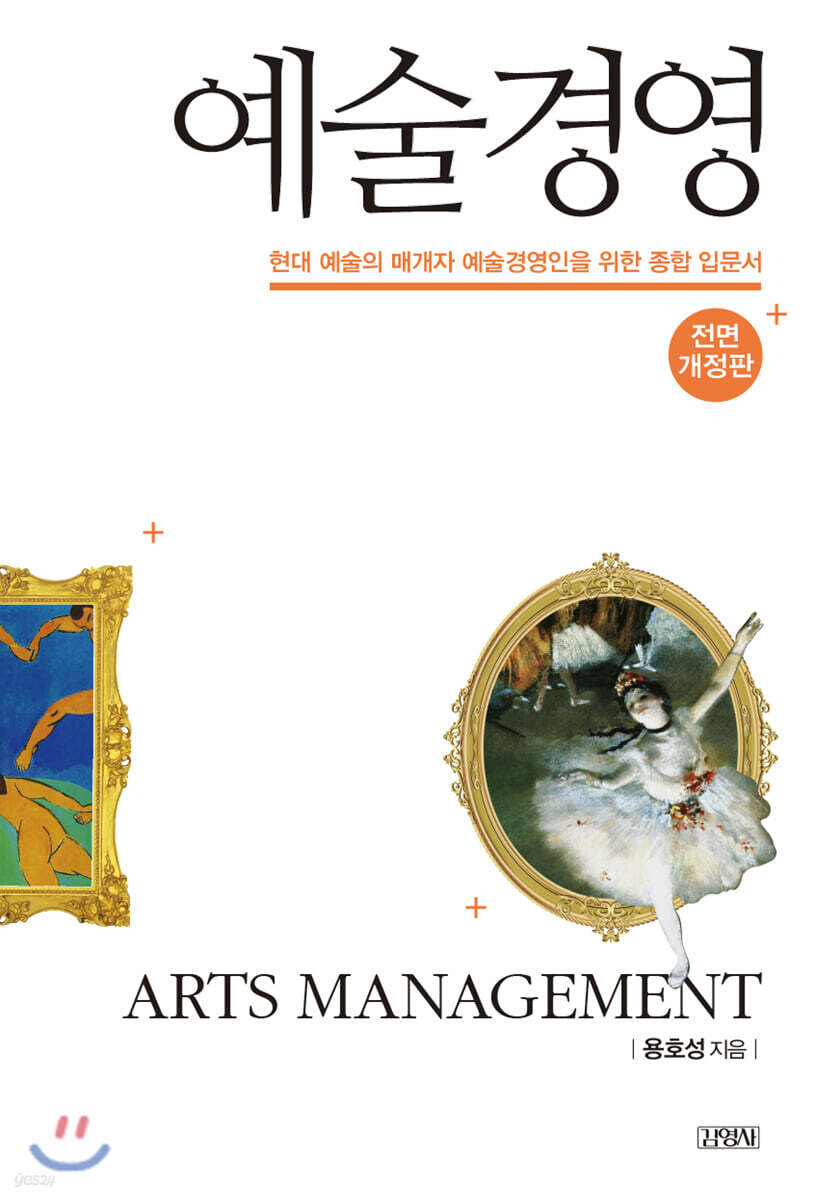
Arts Management
 |
Description
Book Introduction
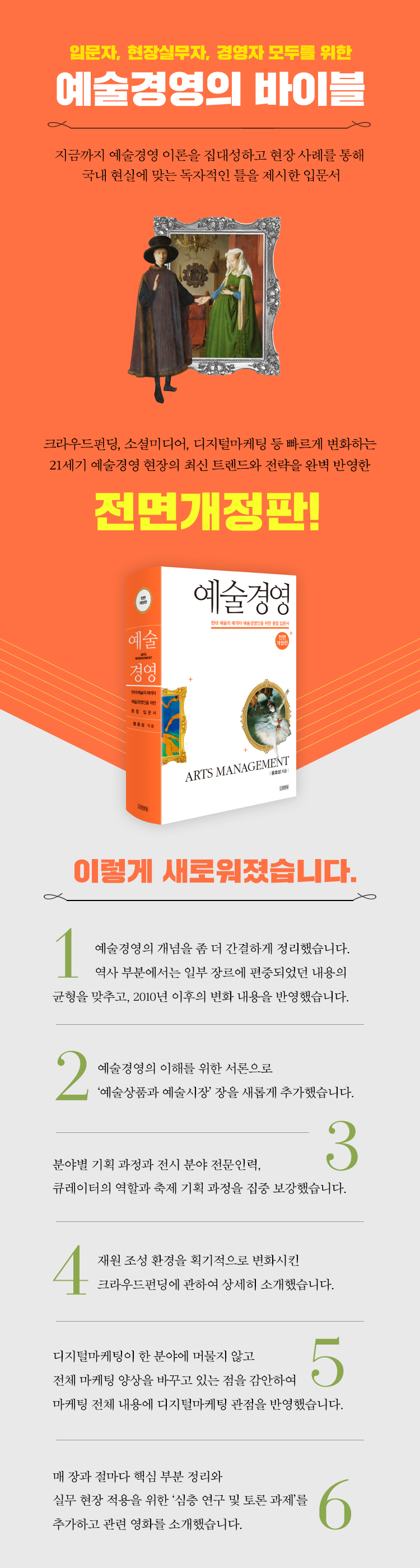
For everyone from beginners to practitioners and managers
The Bible of 21st Century Arts Management
Arts management is different from general business management, which is driven solely by economic value.
The essence of arts management is to pursue artistic value through economic value.
Everything about arts management, presenting the most systematic and vivid strategies and methods for planning, organization and personnel, marketing and promotion, audience development, and fundraising in all fields of the arts, including performances, exhibitions, festivals, and education.
The 2020 fully revised edition introduces and reinforces the latest management theories to respond to the rapidly changing market environment of the digital age.
We added a new chapter, 'Art Commodities and the Art Market,' and reflected a digital marketing perspective throughout the marketing section.
We have included a large number of specific examples from arts management practices so that practitioners can easily apply them to their own work.
Each chapter and section concludes with 'In-Depth Study and Discussion Assignments' to help you recap the key points and apply them to practical situations.
In addition, we introduced movies that covered related topics along with the supplementary recommended books for each chapter.
The Bible of 21st Century Arts Management
Arts management is different from general business management, which is driven solely by economic value.
The essence of arts management is to pursue artistic value through economic value.
Everything about arts management, presenting the most systematic and vivid strategies and methods for planning, organization and personnel, marketing and promotion, audience development, and fundraising in all fields of the arts, including performances, exhibitions, festivals, and education.
The 2020 fully revised edition introduces and reinforces the latest management theories to respond to the rapidly changing market environment of the digital age.
We added a new chapter, 'Art Commodities and the Art Market,' and reflected a digital marketing perspective throughout the marketing section.
We have included a large number of specific examples from arts management practices so that practitioners can easily apply them to their own work.
Each chapter and section concludes with 'In-Depth Study and Discussion Assignments' to help you recap the key points and apply them to practical situations.
In addition, we introduced movies that covered related topics along with the supplementary recommended books for each chapter.
- You can preview some of the book's contents.
Preview
index
introduction
Preface to the 2nd Revised Edition
Preface to the first edition
Chapter 1: The Significance of Arts Management
1.
The concept of arts management
1) Arts Management as a Mediator | 2) Arts Management and Related Terminology | 3) Categories and Objects of Arts Management
2.
History of Arts Management
1) Ancient Arts Management | 2) Medieval Arts Management | 3) Renaissance Arts Management | 4) Modern Arts Management | 5) Contemporary Arts Management | 6) 21st Century Arts Management
3.
Arts Management in Korea
1) 1945–1980 | 2) 1980–1990 | 3) 1990–2000 | 4) 2000–2010 | 5) After 2010
Chapter 2: Art Commodities and the Art Market
1.
art products
1) The significance and characteristics of art products | 2) The components of art products
2.
art market
1) Supply of art products | 2) Demand for art products | 3) Distribution of art products
3.
Art product consumers
1) Motivational and behavioral characteristics of art consumers | 2) The complex subject of art consumption | 3) Factors influencing art consumption | 4) Types of art consumers and their gradual growth
4.
Korean art market
Chapter 3 Arts Organization
1.
The significance of arts organizations
1) The concept and necessity of arts organizations | 2) The structure of arts organizations | 3) Types of arts organizations
2.
concert hall
1) The significance of a performance venue | 2) Types of performance venues | 3) Spatial configuration of performance venues | 4) Organizational structure of performance venues
3.
Museums and Art Galleries 1) The Meaning of Museums and Art Galleries | 2) Types of Museums and Art Galleries and Exhibition Spaces | 3) Spatial Structure of Museums and Art Galleries | 4) Organizational Structure of Museums and Art Galleries
4.
Arts groups and other arts organizations
1) The meaning of arts organizations | 2) Types and organizational structures of arts organizations | 3) Other arts organizations
Chapter 4 Human Resources
1.
artist
1) Successful and Failing Artists | 2) The Economic and Social Conditions for Artists | 3) Types of Relationships with Artists
2.
Arts Manager
1) The Meaning of Arts Managers | 2) The Roles and Duties of Arts Managers
3.
council
1) The significance and role of the board of directors | 2) The composition and operation of the board of directors
4.
volunteers
1) The significance of the volunteer system | 2) Motivation for volunteering | 3) The scope of volunteer work | 4) Planning and preparation for the volunteer system | 5) Selection and placement of volunteers | 6) Operation of the volunteer system
Chapter 5: Fundraising
1.
Budget management
1) Arts organization budget | 2) Arts organization income and expenditure | 3) Budget preparation
2.
The significance of raising funds
1) The concept of resource creation | 2) The development and current status of resource creation | 3) The characteristics and prerequisites of resource creation | 4) Types of resource creation
3.
The process of raising funds
1) Prepare for fundraising | 2) Analyze the SWOT | 3) Write a fundraising statement | 4) Survey potential applicants | 5) Build relationships with potential applicants | 6) Request support | 7) Finalize and evaluate the fundraising process
4.
Fundraising strategies by support entity
1) Government and public institutions | 2) Corporations | 3) Foundations | 4) Individuals
Chapter 6 Planning
1.
strategic planning
1) Arts Management Process and Planning | 2) Understanding Strategic Planning | 3) The Strategic Planning Process
2.
Performance planning
1) The significance of performance planning | 2) The significance and role of performance planners | 3) The performance planning process
3.
Exhibition planning
1) The significance of exhibition planning | 2) The role and types of exhibitions | 3) The significance and role of curators | 4) The exhibition planning process
4.
Festival Planning
1) The meaning of festivals | 2) Types of festivals | 3) The festival planning process
5.
Cultural and Arts Education Planning
1) The significance of cultural arts education | 2) The role of cultural arts education | 3) Characteristics of cultural arts education programs | 4) The planning process of cultural arts education programs
Chapter 7 Marketing
1.
Marketing of art products
1) Arts Organizations and Marketing | 2) Marketing in Domestic Arts Organizations | 3) Structure of a Marketing-Oriented Organization | 4) Marketing Planning | 5) Audience Research
2. STP Strategy
1) Market segmentation | 2) Target market setting | 3) Positioning
3.
Marketing mix
1) Product | 2) Price | 3) Location/Distribution | 4) Promotion
supplement
Press Release Example | Audience Survey Example
References
Search
Preface to the 2nd Revised Edition
Preface to the first edition
Chapter 1: The Significance of Arts Management
1.
The concept of arts management
1) Arts Management as a Mediator | 2) Arts Management and Related Terminology | 3) Categories and Objects of Arts Management
2.
History of Arts Management
1) Ancient Arts Management | 2) Medieval Arts Management | 3) Renaissance Arts Management | 4) Modern Arts Management | 5) Contemporary Arts Management | 6) 21st Century Arts Management
3.
Arts Management in Korea
1) 1945–1980 | 2) 1980–1990 | 3) 1990–2000 | 4) 2000–2010 | 5) After 2010
Chapter 2: Art Commodities and the Art Market
1.
art products
1) The significance and characteristics of art products | 2) The components of art products
2.
art market
1) Supply of art products | 2) Demand for art products | 3) Distribution of art products
3.
Art product consumers
1) Motivational and behavioral characteristics of art consumers | 2) The complex subject of art consumption | 3) Factors influencing art consumption | 4) Types of art consumers and their gradual growth
4.
Korean art market
Chapter 3 Arts Organization
1.
The significance of arts organizations
1) The concept and necessity of arts organizations | 2) The structure of arts organizations | 3) Types of arts organizations
2.
concert hall
1) The significance of a performance venue | 2) Types of performance venues | 3) Spatial configuration of performance venues | 4) Organizational structure of performance venues
3.
Museums and Art Galleries 1) The Meaning of Museums and Art Galleries | 2) Types of Museums and Art Galleries and Exhibition Spaces | 3) Spatial Structure of Museums and Art Galleries | 4) Organizational Structure of Museums and Art Galleries
4.
Arts groups and other arts organizations
1) The meaning of arts organizations | 2) Types and organizational structures of arts organizations | 3) Other arts organizations
Chapter 4 Human Resources
1.
artist
1) Successful and Failing Artists | 2) The Economic and Social Conditions for Artists | 3) Types of Relationships with Artists
2.
Arts Manager
1) The Meaning of Arts Managers | 2) The Roles and Duties of Arts Managers
3.
council
1) The significance and role of the board of directors | 2) The composition and operation of the board of directors
4.
volunteers
1) The significance of the volunteer system | 2) Motivation for volunteering | 3) The scope of volunteer work | 4) Planning and preparation for the volunteer system | 5) Selection and placement of volunteers | 6) Operation of the volunteer system
Chapter 5: Fundraising
1.
Budget management
1) Arts organization budget | 2) Arts organization income and expenditure | 3) Budget preparation
2.
The significance of raising funds
1) The concept of resource creation | 2) The development and current status of resource creation | 3) The characteristics and prerequisites of resource creation | 4) Types of resource creation
3.
The process of raising funds
1) Prepare for fundraising | 2) Analyze the SWOT | 3) Write a fundraising statement | 4) Survey potential applicants | 5) Build relationships with potential applicants | 6) Request support | 7) Finalize and evaluate the fundraising process
4.
Fundraising strategies by support entity
1) Government and public institutions | 2) Corporations | 3) Foundations | 4) Individuals
Chapter 6 Planning
1.
strategic planning
1) Arts Management Process and Planning | 2) Understanding Strategic Planning | 3) The Strategic Planning Process
2.
Performance planning
1) The significance of performance planning | 2) The significance and role of performance planners | 3) The performance planning process
3.
Exhibition planning
1) The significance of exhibition planning | 2) The role and types of exhibitions | 3) The significance and role of curators | 4) The exhibition planning process
4.
Festival Planning
1) The meaning of festivals | 2) Types of festivals | 3) The festival planning process
5.
Cultural and Arts Education Planning
1) The significance of cultural arts education | 2) The role of cultural arts education | 3) Characteristics of cultural arts education programs | 4) The planning process of cultural arts education programs
Chapter 7 Marketing
1.
Marketing of art products
1) Arts Organizations and Marketing | 2) Marketing in Domestic Arts Organizations | 3) Structure of a Marketing-Oriented Organization | 4) Marketing Planning | 5) Audience Research
2. STP Strategy
1) Market segmentation | 2) Target market setting | 3) Positioning
3.
Marketing mix
1) Product | 2) Price | 3) Location/Distribution | 4) Promotion
supplement
Press Release Example | Audience Survey Example
References
Search
Detailed image
Into the book
I hope that this book will serve as a basic academic text while also helping those working in the field organize their daily experiences.
Furthermore, just as arts management mediates the supply and demand for art products, I hope this book will serve as a medium for those interested in arts management to connect with the academic system of arts management.
--- From the "Preface"
The goal of an arts manager is to experience the joy of creating works together with artists and connecting them with consumers who enjoy them.
An arts manager is someone who listens to the stories of artists' creative inspirations that are either completely unrealized or perhaps difficult to realize, and ponders how to bring them to life and connect them with those who can enjoy them.
--- p.237
While performance planners utilize artists as one of their primary resources, they also utilize the stage, technology, and capital to plan the final artistic product that can be delivered to the audience.
In other words, the performance planner's role is to lead the entire process of an artistic product being developed from the idea stage, implemented on stage, and delivered to the audience for consumption.
Through this role, performance planners must achieve not only artistic success but also economic success.
--- p.417
Art consumers accustomed to digital communities no longer listen to one-way messages from art producers as they used to.
However, I trust the reviews and recommendations of my fellow club members and social media friends who share various aspects of me, including my daily life and tastes.
This is the core of the new digital community marketing.
We have entered an era where art consumers choose the art products they want based on content and experiences voluntarily shared through digital communities, rather than through one-sided promotional flyers or advertising slogans.
Furthermore, just as arts management mediates the supply and demand for art products, I hope this book will serve as a medium for those interested in arts management to connect with the academic system of arts management.
--- From the "Preface"
The goal of an arts manager is to experience the joy of creating works together with artists and connecting them with consumers who enjoy them.
An arts manager is someone who listens to the stories of artists' creative inspirations that are either completely unrealized or perhaps difficult to realize, and ponders how to bring them to life and connect them with those who can enjoy them.
--- p.237
While performance planners utilize artists as one of their primary resources, they also utilize the stage, technology, and capital to plan the final artistic product that can be delivered to the audience.
In other words, the performance planner's role is to lead the entire process of an artistic product being developed from the idea stage, implemented on stage, and delivered to the audience for consumption.
Through this role, performance planners must achieve not only artistic success but also economic success.
--- p.417
Art consumers accustomed to digital communities no longer listen to one-way messages from art producers as they used to.
However, I trust the reviews and recommendations of my fellow club members and social media friends who share various aspects of me, including my daily life and tastes.
This is the core of the new digital community marketing.
We have entered an era where art consumers choose the art products they want based on content and experiences voluntarily shared through digital communities, rather than through one-sided promotional flyers or advertising slogans.
--- p.635
Publisher's Review
Connecting producers and consumers in the art market,
Market your art as a "product," not a "work of art"!
First published in 2002, "Arts Management," which has been regarded as the unrivaled introductory textbook on arts management in Korea for over 20 years, has undergone another major transformation! This fully revised edition of "Arts Management" is a comprehensive compilation of the latest cases and innovative theories in the rapidly evolving arts management landscape, drawing on the author's theoretical and practical experience accumulated over 30 years in academia and the field, both domestically and internationally.
The 2020 fully revised edition introduces and reinforces the latest management theories to respond to the rapidly changing market environment of the digital age.
We added a new chapter, 'Art Commodities and the Art Market,' and reflected a digital marketing perspective throughout the marketing section.
We have included a large number of specific examples from arts management practices so that practitioners can easily apply them to their own work.
Each chapter and section concludes with 'In-Depth Study and Discussion Assignments' to help you recap the key points and apply them to practical situations.
In addition, we introduced movies that covered related topics along with the supplementary recommended books for each chapter.
An integrated arts management manual that vividly analyzes and integrates theories, cases, concepts, and practices of arts management!
Arts management is literally an activity that combines ‘art’ and ‘management.’
Art and management are actually two fields with no similarities, but rather opposite goals.
Art and management are separate worlds that operate with completely different contexts and logic.
The art world values aesthetics, while the business world values efficiency.
In the art world, subjective satisfaction is the main variable, but in the business world, objective results are the main variable.
Arts management is what allows these two different worlds to come together.
However, arts management does not mean judging and creating art itself by management standards.
Because art has its own logic and direction.
Arts management serves the purpose of helping more people access higher quality art.
It is not so much ‘managing art’ as ‘managing for art’.
If I had to choose just one word to best describe the nature of this arts management, it would be 'mediation.'
Arts management is the process of mediating the artistic work created by the artist through his/her own creative process so that it can be delivered as a product to the audience, the consumer.
In the increasingly fragmented and specialized world of modern art, ironically, arts management, which unites these specialized roles, is becoming increasingly important as an essential process.
This book, which delves into the evolution and vision of arts management from the late 20th century, when it first entered Korea, to the present, is the ultimate guidebook not only for those involved but also for those who actively enjoy and participate in the arts.
From planning and production to marketing and promotion of performances, exhibitions, festivals, art, and cultural education,
A comprehensive introduction that delves into every aspect of art!
This book, "Arts Management," is the first comprehensive introductory book published in Korea by the author, who has observed and sometimes directly participated in the changing landscape of arts management in Korea for 20 years.
Although this is a revised edition of the first edition published in 2002, it is no exaggeration to say that the contents have been comprehensively revised and supplemented to the point that it is no exaggeration to say that it is a newly written book.
The author's vivid stories of domestic situations, which he learned firsthand through his three years of experience in academia and the field, are described in detail with rich and diverse examples, helping readers understand and be more interested.
Most arts management books, including the first edition, have focused on performing arts, but this book covers visual arts, and it is notable for dividing the most basic planning part of arts management into exhibition planning, festival planning, and arts education program planning in addition to performance planning.
Each store also introduces books that are good to read for in-depth study.
It explains the domestic and international art history that serves as the background for arts management, and clearly defines the history and vision of arts management, helping beginners in arts management understand it.
Additionally, it focuses on raising funds, human resources, and marketing art products, which are essential for field work, and introduces exemplary domestic and international cases by field.
In addition, the practical manual for practitioners is of unparalleled value, as it provides practical examples of work progress stages, know-how, and actual use cases for writing business reports and press releases.
Everything you need to know about the explosive change and growth of arts management in Korea!
Arts management involves artistic values that are difficult to find in general corporate management.
In arts management, something that cannot be explained simply by economic value acts as real value.
Furthermore, the creative and flexible values inherent in art itself are now permeating the corporate world beyond arts management and under the name of cultural management.
Moreover, domestic arts management, which is growing at an incredible rate, is now in contact with the global arts scene and moves almost simultaneously.
Our productions are now being staged on Broadway, and the production of art products targeting the global market is becoming a new trend.
There are clear limitations to evaluating and examining the domestic arts management scene solely through general management theory or foreign arts management methodologies.
This book goes beyond simply introducing the latest theories and aims to establish a theoretical framework suitable for the domestic arts management field.
It presents diverse stories of the domestic art scene, examines its development and growth, and provides a detailed and incisive analysis of the past, present, and future trends of Korean art.
Just as arts management mediates the supply and demand for art products, this book will serve as a medium for those interested in art and arts management to connect with the academic discipline of arts management.
Market your art as a "product," not a "work of art"!
First published in 2002, "Arts Management," which has been regarded as the unrivaled introductory textbook on arts management in Korea for over 20 years, has undergone another major transformation! This fully revised edition of "Arts Management" is a comprehensive compilation of the latest cases and innovative theories in the rapidly evolving arts management landscape, drawing on the author's theoretical and practical experience accumulated over 30 years in academia and the field, both domestically and internationally.
The 2020 fully revised edition introduces and reinforces the latest management theories to respond to the rapidly changing market environment of the digital age.
We added a new chapter, 'Art Commodities and the Art Market,' and reflected a digital marketing perspective throughout the marketing section.
We have included a large number of specific examples from arts management practices so that practitioners can easily apply them to their own work.
Each chapter and section concludes with 'In-Depth Study and Discussion Assignments' to help you recap the key points and apply them to practical situations.
In addition, we introduced movies that covered related topics along with the supplementary recommended books for each chapter.
An integrated arts management manual that vividly analyzes and integrates theories, cases, concepts, and practices of arts management!
Arts management is literally an activity that combines ‘art’ and ‘management.’
Art and management are actually two fields with no similarities, but rather opposite goals.
Art and management are separate worlds that operate with completely different contexts and logic.
The art world values aesthetics, while the business world values efficiency.
In the art world, subjective satisfaction is the main variable, but in the business world, objective results are the main variable.
Arts management is what allows these two different worlds to come together.
However, arts management does not mean judging and creating art itself by management standards.
Because art has its own logic and direction.
Arts management serves the purpose of helping more people access higher quality art.
It is not so much ‘managing art’ as ‘managing for art’.
If I had to choose just one word to best describe the nature of this arts management, it would be 'mediation.'
Arts management is the process of mediating the artistic work created by the artist through his/her own creative process so that it can be delivered as a product to the audience, the consumer.
In the increasingly fragmented and specialized world of modern art, ironically, arts management, which unites these specialized roles, is becoming increasingly important as an essential process.
This book, which delves into the evolution and vision of arts management from the late 20th century, when it first entered Korea, to the present, is the ultimate guidebook not only for those involved but also for those who actively enjoy and participate in the arts.
From planning and production to marketing and promotion of performances, exhibitions, festivals, art, and cultural education,
A comprehensive introduction that delves into every aspect of art!
This book, "Arts Management," is the first comprehensive introductory book published in Korea by the author, who has observed and sometimes directly participated in the changing landscape of arts management in Korea for 20 years.
Although this is a revised edition of the first edition published in 2002, it is no exaggeration to say that the contents have been comprehensively revised and supplemented to the point that it is no exaggeration to say that it is a newly written book.
The author's vivid stories of domestic situations, which he learned firsthand through his three years of experience in academia and the field, are described in detail with rich and diverse examples, helping readers understand and be more interested.
Most arts management books, including the first edition, have focused on performing arts, but this book covers visual arts, and it is notable for dividing the most basic planning part of arts management into exhibition planning, festival planning, and arts education program planning in addition to performance planning.
Each store also introduces books that are good to read for in-depth study.
It explains the domestic and international art history that serves as the background for arts management, and clearly defines the history and vision of arts management, helping beginners in arts management understand it.
Additionally, it focuses on raising funds, human resources, and marketing art products, which are essential for field work, and introduces exemplary domestic and international cases by field.
In addition, the practical manual for practitioners is of unparalleled value, as it provides practical examples of work progress stages, know-how, and actual use cases for writing business reports and press releases.
Everything you need to know about the explosive change and growth of arts management in Korea!
Arts management involves artistic values that are difficult to find in general corporate management.
In arts management, something that cannot be explained simply by economic value acts as real value.
Furthermore, the creative and flexible values inherent in art itself are now permeating the corporate world beyond arts management and under the name of cultural management.
Moreover, domestic arts management, which is growing at an incredible rate, is now in contact with the global arts scene and moves almost simultaneously.
Our productions are now being staged on Broadway, and the production of art products targeting the global market is becoming a new trend.
There are clear limitations to evaluating and examining the domestic arts management scene solely through general management theory or foreign arts management methodologies.
This book goes beyond simply introducing the latest theories and aims to establish a theoretical framework suitable for the domestic arts management field.
It presents diverse stories of the domestic art scene, examines its development and growth, and provides a detailed and incisive analysis of the past, present, and future trends of Korean art.
Just as arts management mediates the supply and demand for art products, this book will serve as a medium for those interested in art and arts management to connect with the academic discipline of arts management.
GOODS SPECIFICS
- Date of issue: February 20, 2020
- Format: Hardcover book binding method guide
- Page count, weight, size: 668 pages | 1,194g | 159*232*40mm
- ISBN13: 9788934985655
- ISBN10: 8934985658
You may also like
카테고리
korean


korean

![GQ KOREA Mark (Monthly): December [2025]](http://librairie.coreenne.fr/cdn/shop/files/8ef265dbbfbf186523ed75ba7319009d.jpg?v=1765340328&width=3840)


