

Orthopedic Clinic Handbook
 |
Description
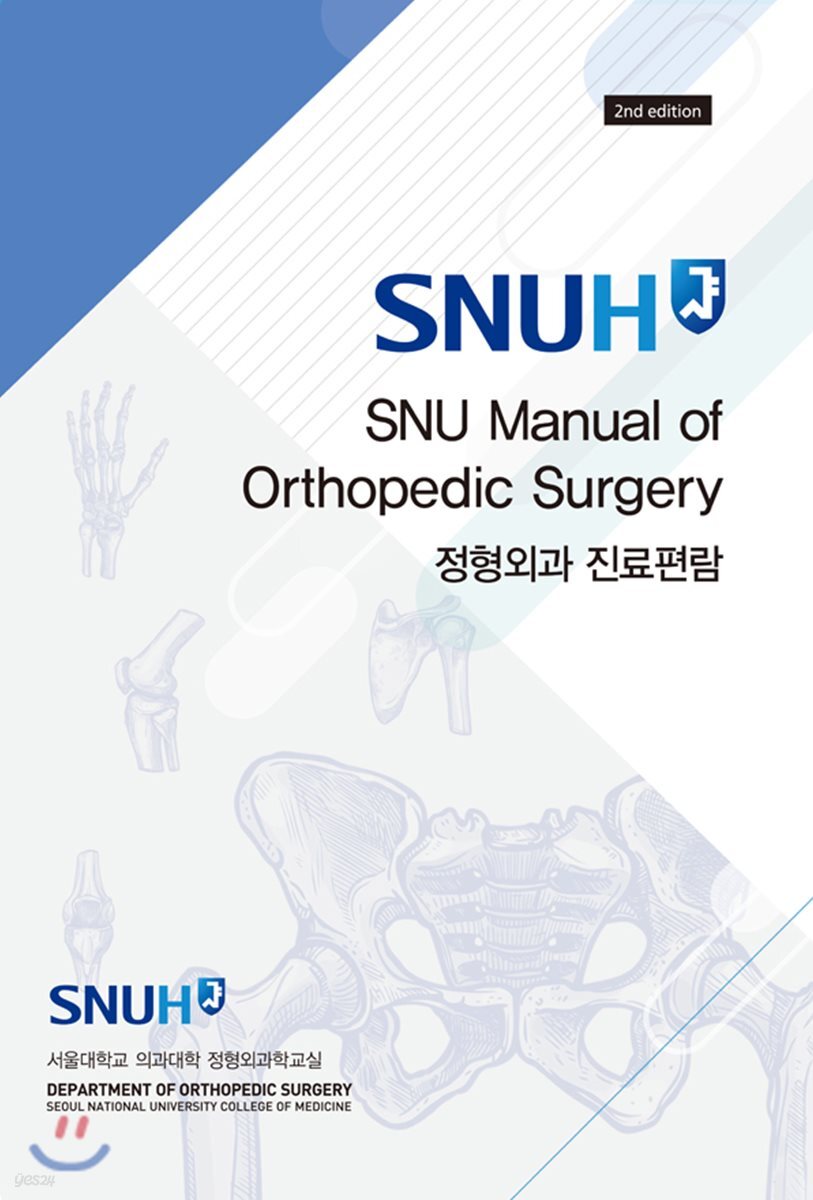
Book Introduction
Everyone agrees on the need for field practice guidelines that will help clinicians make accurate diagnoses and provide appropriate treatment for the diverse patients they encounter on the front lines.
With these hopes and callings in mind, the Department of Orthopedic Surgery, Seoul National University College of Medicine, published the first edition of the Orthopedic Surgery Handbook in 2013.
Five years have passed since then.
The past five years have seen remarkable advances in orthopedics, creating a need for new clinical guidelines that reflect these advancements.
Accordingly, we have published a newly revised second edition that incorporates the latest knowledge in the field of orthopedics.
The Orthopedic Handbook contains the core orthopedic knowledge needed to treat patients with various orthopedic conditions in the emergency room, ward, and operating room.
This book covers essential knowledge of orthopedic diseases, covering everything from the knowledge needed in the emergency room, such as evaluation and surgical techniques for orthopedic emergency patients with fractures, dislocations, and infections, to surgical preparation, as well as the specific fields of spine, shoulder joint, hand, hip joint, knee joint, foot, pediatrics, tumors, trauma, and microsurgery.
This book was written to enable many trainees, residents, and specialists to acquire practical orthopedic knowledge and to help them apply it in actual clinical settings.
We hope that this book, which includes the latest insights based on essential orthopedic knowledge and experience passed down from senior to junior doctors, will be of great help to all doctors practicing orthopedic surgery.
With these hopes and callings in mind, the Department of Orthopedic Surgery, Seoul National University College of Medicine, published the first edition of the Orthopedic Surgery Handbook in 2013.
Five years have passed since then.
The past five years have seen remarkable advances in orthopedics, creating a need for new clinical guidelines that reflect these advancements.
Accordingly, we have published a newly revised second edition that incorporates the latest knowledge in the field of orthopedics.
The Orthopedic Handbook contains the core orthopedic knowledge needed to treat patients with various orthopedic conditions in the emergency room, ward, and operating room.
This book covers essential knowledge of orthopedic diseases, covering everything from the knowledge needed in the emergency room, such as evaluation and surgical techniques for orthopedic emergency patients with fractures, dislocations, and infections, to surgical preparation, as well as the specific fields of spine, shoulder joint, hand, hip joint, knee joint, foot, pediatrics, tumors, trauma, and microsurgery.
This book was written to enable many trainees, residents, and specialists to acquire practical orthopedic knowledge and to help them apply it in actual clinical settings.
We hope that this book, which includes the latest insights based on essential orthopedic knowledge and experience passed down from senior to junior doctors, will be of great help to all doctors practicing orthopedic surgery.
index
01 General management of patients 1
Emergency Room Patient Management 1
I.
Evaluation of Orthopedic Emergency Room Patients 1
II.
Orthopedic Emergent and Urgent Situations 4
III.
Management of Pediatric Trauma Patients: See Pediatric Trauma 14
Management of General Surgery Patients 15
I.
Preoperative Evaluation and Preparation 15
II.
Postoperative Patient Care 20
III.
Major Complications 23
02 Splint and Plaster Bandage Method 31
I.
Materials and Equipment 31
II.
Basic Principle 34
III.
Splint 36
IV.
Plaster cast (Circular Cast) 45
03 Towing 53
I.
Objective 53
II.
53 essential items
III.
Category 53
04 Joint Aspiration 73
I.
Acute joint swelling 73
II.
Joint aspiration 98
05 Surgical Preparation and Instruments 103
I.
Pre-surgery Preparation 103
II.
Tourniquet 108
III.
Bloodborne pathogens 110
IV.
Prevention of Surgical Wound Infection 111
V.
Orthopedic Surgical Instruments and Their Use 113
06 Spine 133
Trauma 133
I.
Neurological Examination of Patients with Spinal Trauma 133
II.
Spinal Injury Basics 137
III.
Fractures of the Cervical Spine 149
IV.
Fracture of Thoracolumbar Spine 165
Major spinal diseases 178
I.
Cervical Radiculopathy 178
II.
Cervical Myelopathy 180
III.
Upper Cervical Disorders: Atlantoaxial Instability 184
IV.
Lumbar disc herniation 185
V.
Lumbar spinal stenosis 191
VI.
Spondylolisthesis 196
VII.
Idiopathic Scoliosis 199
VIII.
Congenital scoliosis 205
IX.
Neuromuscular scoliosis 208
X.
Kyphosis 210
XI.
Spinal tumor 213
XII.
Spinal infection 228
07 Shoulder Joint and Upper Arm 233
Trauma 233
I.
Fractures of the Clavicle 233
II.
Injuries of the Sternoclavicular Joint 236
III.
Injuries of the Acromioclavicular Joint 239
IV.
Anterior Shoulder Dislocation 243
V.
Posterior Shoulder Dislocation 248
VI.
Ruptures of the Long Head of Biceps Brachii 250
VII.
Fractures of the Scapula 251
VIII.
Fractures of the Proximal Humerus 252
IX.
Fractures of the Humerus Shaft 256
Major diseases 260
I.
Subacromial impingement syndrome 260
II.
Disorders of the Rotator Cuff 262
III.
Adhesive Capsulitis 267
IV.
Calcific Tendinitis 271
V.
Instability of the Shoulder 273
VI.
SLAP lesion 277
08 Joints and Forearms 281
Trauma 281
I.
Distal humerus fracture 281
II.
Proximal ulnar fracture 292
III.
Radial head fracture 295
IV.
Dislocation of the elbow joint 297
V.
Forearm bone ring injury 303
Major diseases 313
I.
Lateral epicondylitis-medial epicondylitis 313
II.
Osteochondritis dissecans 316
III.
Olecranon Bursitis 318
IV.
Deformity of the Elbow 320
V.
Recurrent Instability of the Elbow 322
VI.
Stiff Elbow 325
VII.
Cubital Tunnel Syndrome 327
VIII.
Compartment Syndrome of the Forearm 330
09 Wrist Joint and Hand 335
Trauma 335
I.
Distal Radial Fracture 335
II.
Distal Radioulnar Joint Injury 339
III.
Scaphoid Fracture 340
IV.
Perilunar Dislocation and Fracture-Dislocatior 344
V.
Radiocarpal Dislocation 346
VI.
Carpal Instability 347
VII.
First Metacarpal Base Fracture 349
VIII.
2nd-5th metacarpal fracture 351
IX.
2nd-5th phalangeal fracture 356
X.
Carpometacarpal Joint Dislocation and Ligament Injury 362
XI.
Metacarpophalangeal joint dislocation and ligament injury 363
XII.
Flexor tendon injury 367
XIII.
Extensor tendon injury 370
XIV.
Hand Amputation 373
XV.
Skin injury of the hand 378
Major Disorders of the Wrist and Hand 382
I.
Basic Examination 382
II.
Congenital Anomalies of the Hand 383
III.
Tendon Disease of the Hand 392
IV.
Nerve Disease of the Hand 395
V.
Hand Infections 400
VI.
Tumors and Tumorous Conditions of the Hand and Wrist405
VII.
Chronic Arthritis of the Wrist and Hand 409
VIII.
Vascular Disease of the Hand 411
IX.
Miscellaneous Disorders 414
10 Pelvis and Hip Joints 417
Trauma 417
I.
Pelvic Fractures 417
II.
Hip Dislocation 421
III.
Femoral Head Fracture 424
IV.
Acetabular Fracture 426
V.
Femoral Neck Fracture 431
VI.
Intertrochanteric Fracture 436
VII.
Subtrochanteric Fracture 441
Major diseases 444
I.
Avascular necrosis of the femoral head 444
II.
Snapping Hip (Coxa Saltans) 451
III.
Inflammatory diseases around the hip joint 455
IV.
Femoroacetabular Impingement Syndrome (FAI)
459
V.
Subchondral Stress Fracture of the Femoral Head
Femoral Head) 466
11 Femur and Knee Joint 471
Trauma I.
Fractures and Dislocations 471
I.
Distal Femoral Fracture 471
II.
Patellar Fracture 473
III.
Patellar Dislocation 475
IV.
Dislocation of the Knee 477
V.
Tibial Plateau Fracture 478
Trauma II.
Ligaments, cartilage, and meniscus 481
I.
Anterior Cruciate Ligament Injury 481
II.
Meniscus Injury 494
III.
Posterior Cruciate Ligament Injury 503
IV.
Lateral/Posterolateral Ligament Injury 508
V.
Medial Collateral Ligament Injury 512
VI.
Joint Cartilage Damage 516
Major diseases 522
I.
Degenerative Arthritis of the Knee (DA of the Knee)522
II.
Chronic Patellar Dislocation 529
III.
Anterior Knee Pain 531
IV.
Bursitis of the knee joint 533
V.
Knee Joint Cyst I - Baker's Cyst 534
VI.
Knee Joint Cyst II - Parameniscal Cyst (Meniscal Cyst)535
VII.
Synovial Plica Syndrome 536
VIII.
Pigmented Vilonodular Synovitis (PVNS)537
IX.
Intra-articular loose body 538
12 Foot and Ankle Joints 541
Trauma 541
I.
Ankle Sprain 541
II.
Ankle Dislocation 542
III.
Achilles Tendon Rupture 543
IV.
Ankle Fracture 544
V.
Distal tibial plafond fracture (pilon fracture)547
VI.
Fracture of the Talus 548
VII.
Fracture of the Calcaneus 551
VIII.
Fracture of the Navicula and Cuneiform (554)
IX.
Injury of the Tarsometatarsal Joint (Lisfranc Injury)555
X.
Fracture of Metatarsal Bone and Phalanx 556
Major diseases 558
I.
Skeletal Anatomy 558
II.
Ligament 560
III.
Biomechanics 562
IV.
Deformities of the Foot 563
V.
Diabetic Foot 570
VI.
Other foot diseases 571
13 Children 579
Trauma 579
I.
Introduction 579
II.
Clavicle Fracture 581
III.
Elbow-Distal Humerus 583
IV.
Elbow-Proximal Radius and Ulna 590
V.
Fracture of the Radius and Ulna 592
VI.
Hip Fracture 595
VII.
Femoral Shaft Fracture 597
VIII.
Distal Femoral Epiphyseal Injury 599
IX.
Tibia Fracture 600
X.
Ankle Fracture 604
Major diseases 609
I.
Limping Child 609
II.
Congenital Muscular Torticollis 612
III.
Developmental Dysplasia of the Hip (DDH)614
IV.
Legg-Calve'-Perthes disease 619
V.
Slipped Capital Femoral Epiphysis (SCFE) 624
VI.
Transient Synovitis and Septic Arthritis of the Hip
of the Hip vs.
Septic arthritis of the hip) 629
VII.
Discoid Meniscus 633
VIII.
Congenital Clubfoot 635
IX.
Flexible or Hypermobile Flat Foot 638
X.
Leg Length Discrepancy 640
XI.
Misalignment 1 - Angular Deformity 643
XII.
Misalignment 2 - Torsional Deformity 645
XIII.
Cerebral Palsy 648
XIV.
Meningomyelocele 652
XV.
Achondroplasia 654
XVI.
Rickets 656
14 Tumors 659
I.
Bone tumor 659
II.
Soft tissue tumor 668
Index 673
GOODS SPECIFICS
- Date of publication: June 15, 2018
- Page count, weight, size: 706 pages | 130*188*40mm
- ISBN13: 9791159553233
- ISBN10: 1159553238
You may also like
카테고리
korean


korean

![GQ KOREA Mark (Monthly): December [2025]](http://librairie.coreenne.fr/cdn/shop/files/8ef265dbbfbf186523ed75ba7319009d.jpg?v=1765340328&width=3840)


