

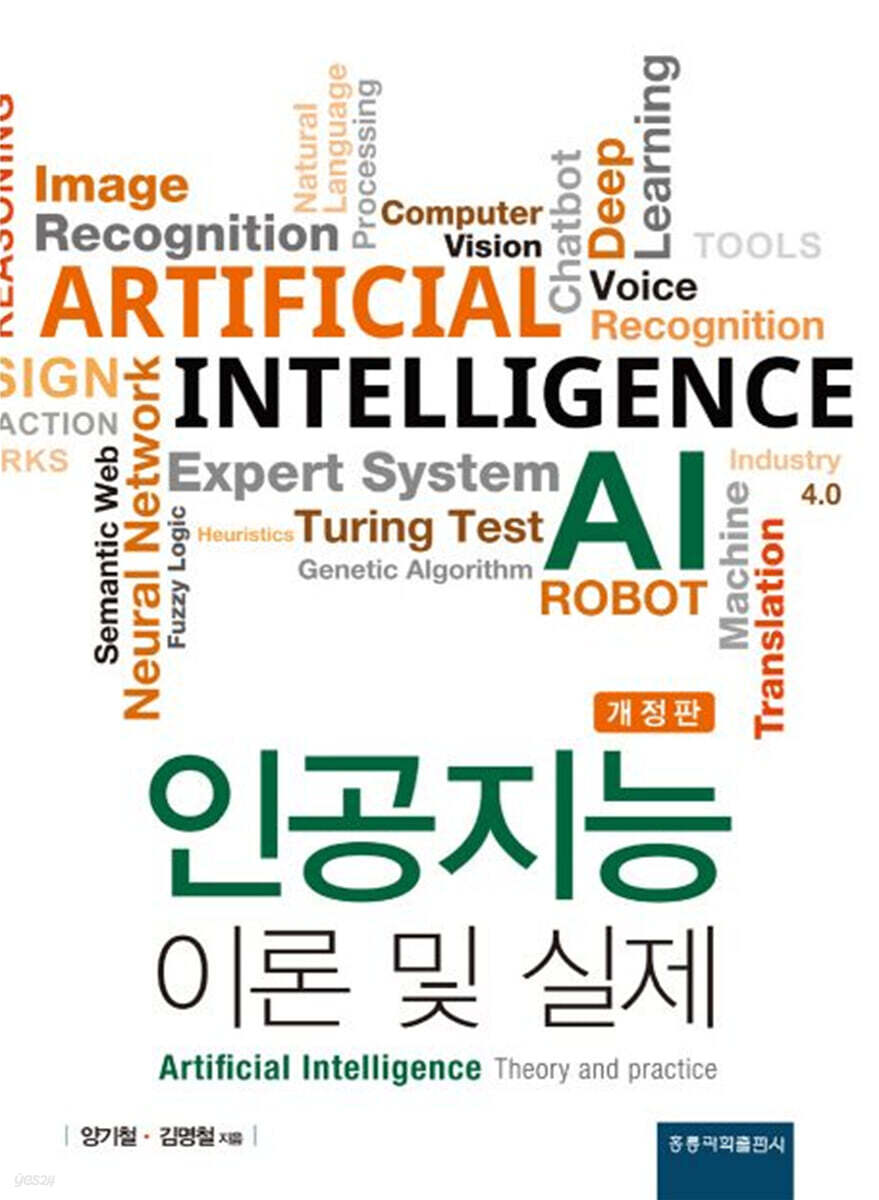
Artificial Intelligence Theory and Practice
 |
Description
index
PART I: Fundamentals of Artificial Intelligence
CHAPTER 01 Introduction to Artificial Intelligence
1.1.
What is artificial intelligence?
1.2.
Artificial intelligence and natural intelligence
1.3.
Artificial intelligence systems and general computer systems
1.4.
A Brief History of Artificial Intelligence
1.5.
Applications of artificial intelligence
1.6.
Classification of artificial intelligence
CHAPTER 02 Knowledge Expression
2.1.
The need for formal knowledge representation
2.1.1 Knowledge Representation Method
2.1.2 Considerations when Representing Knowledge
2.2.
Knowledge representation techniques
2.2.1 Logic
2.2.2 Frame
2.2.3 Semantic Network
2.2.4 Concept Graph
2.2.5 Three-dimensional concept graph
2.2.6 Script
2.2.7 Rules
2.2.8 Multiple Knowledge Representations
CHAPTER 03 EXPLORATION
3.1.
Information-free search techniques
3.1.1 Depth-first search
3.1.2 Breadth-first search
3.2.
Heuristic search techniques
3.2.1 Hill Climbing Exploration
3.2.2 Highest priority search
3.2.3 A* algorithm
3.2.4 Admissibility and monotonically increasing properties of the A* algorithm
3.3.
Games and Exploration
3.3.1 Minimax technique
3.3.2 Alpha-Beta Cutting Technique
3.4.
Implementing a search program
CHAPTER 04 Logic and Automatic Argumentation
4.1.
Propositional logic
4.2.
Predicate logic
4.2.1 Syntax
4.2.2 Semantics
4.2.3 Inference Rules
4.2.4 Unification
4.3.
automatic argument
4.3.1 Logic Fusion
4.3.2 Strategies for Logical Convergence
4.3.3 Question and answer using logical fusion refutation
4.3.4 Automated Argumentation System
CHAPTER 05 Uncertainty and Fuzzy Logic
5.1.
uncertainty
5.2.
probability
5.2.1 Conditional probability and Bayes' theorem
5.3.
Confidence factor
5.4.
fuzzy set theory
5.4.1 Fuzzy sets
5.4.2 Fuzzy numbers
5.4.3 Fuzzy Relationships
5.4.4 Fuzzy logic
5.4.5 Fuzzy Control
CHAPTER 06 PLANNING
6.1.
Planning and Stacking Boxes
6.2. STRIPS
6.3.
Hierarchical planning
CHAPTER 07 Machine Learning and Genetic Algorithms
7.1.
Elements related to machine learning
7.2.
Examples of inductive learning
7.3.
Generalization and Conceptual Space
7.4.
Exploring version space
7.5. ID3 Algorithm
7.6.
inductive bias
7.7.
explanation-based learning
7.8.
Learning by analogy
7.9.
unsupervised learning
7.9.1 Cohesive clustering
7.9.2 K-Means Clustering Algorithm
7.9.3 Conceptual clustering
7.10.
reinforcement learning
7.11.
Genetic Algorithms and Genetic Programming
7.11.1 Examples of Genetic Algorithms
7.11.2 Genetic Programming
CHAPTER 08 Artificial Neural Networks and Deep Learning
8.1.
artificial neural network
8.2.
Deep Neural Networks and Deep Learning
8.3.
Characteristics and tools of artificial neural networks
8.3.1 Characteristics of artificial neural networks
8.3.2 Tools for artificial neural networks
PART II Artificial Intelligence Applications
CHAPTER 09 EXPERT SYSTEMS
9.1.
A Brief History of Expert Systems
9.2.
Structure of an expert system
9.3.
Inference engine
9.3.1 Forward Inference
9.3.2 Retrospective Inference
9.3.3 Model-Based Argument
9.3.4 Case-Based Argumentation
9.4.
Expert System Development Process
9.4.1 Development Preparation Stage
9.4.2 System Analysis and Design Phase
9.4.3 Prototype Development Stage
9.4.4 System Development Phase
9.4.5 Implementation Steps
9.4.6 Maintenance Steps
9.5.
Example of an expert system in action
9.6.
Characteristics and development tools of expert systems
9.6.1 Characteristics of Expert Systems
9.6.2 Development Tools for Expert Systems
CHAPTER 10 NATURAL LANGUAGE PROCESSING
10.1.
Applications of Natural Language Processing
10.1.1 Machine Translation
10.1.2 Information Retrieval
10.1.3 Natural Language Interface
10.2.
Related knowledge and processing procedures
10.3.
Syntax analysis
10.3.1 Grammar
10.3.2 Parsing
10.3.3 Parser Implementation
10.3.4 Implementing a Bottom-Up Parser
10.4.
Semantic analysis
10.5.
Situation analysis
10.6.
Natural language generation
10.7.
voice recognition
CHAPTER 11 COMPUTER VISION
11.1.
Image acquisition
11.1.1 Generation of digital signals
11.2.
Image processing
11.2.1 Noise Reduction
11.2.2 Contrast scale conversion
11.3.
Video analysis
11.3.1 Boundary Detection
11.3.2 Border smoothing and finding areas
11.3.3 Stereoscopic Information Analysis
11.4.
Understanding the image
11.4.1 Circular Matching
11.4.2 Feature Matching
11.5.
Applications of computer vision
CHAPTER 12 Agents and Robots
12.1.
software agent
12.1.1 Classification of Agents
12.1.2 Agent Examples
12.1.3 Agent Characteristics
12.1.4 Multi-Agent Systems
12.1.5 System Integration Using Agents
12.2.
robot
12.2.1 Industrial Robots
12.2.2 Autonomous Mobile Robots
12.2.3 Humanoid robots
12.2.4 Other robots
CHAPTER 13 The Semantic Web
13.1.
What is the Semantic Web?
13.2.
The structure of the Semantic Web
13.2.1 Internet Level
13.2.2 Structure Level
13.2.3 Meta Data Level
13.2.4 Ontology Level
13.2.5 Logic & Trust Level
13.3.
Semantic Web Development Tools
13.4.
Semantic Web Applications and Related Research
13.4.1 Application Areas
13.4.2 Related Research
CHAPTER 14 The Fourth Industrial Revolution and Artificial Intelligence
14.1.
History of the Industrial Revolution
14.2.
The Fourth Industrial Revolution and Artificial Intelligence
14.3.
The Future of Artificial Intelligence
GOODS SPECIFICS
- Date of publication: February 28, 2018
- Page count, weight, size: 409 pages | 1,063g | 195*264*24mm
- ISBN13: 9791156005704
- ISBN10: 1156005701
You may also like
카테고리
korean


korean

![ELLE 엘르 스페셜 에디션 A형 : 12월 [2025]](http://librairie.coreenne.fr/cdn/shop/files/b8e27a3de6c9538896439686c6b0e8fb.jpg?v=1766436872&width=3840)


