

Hecht Optics
 |
Description
Book Introduction
This translation was published in August 1996 by a team of 21 translators, including the translator of 『Optics』, a translation of 『OPTICS 2nd ed.』. This is a masterpiece that has been continuously translated and introduced and widely known in Korea by the translator who has been the main translator for 21 years.
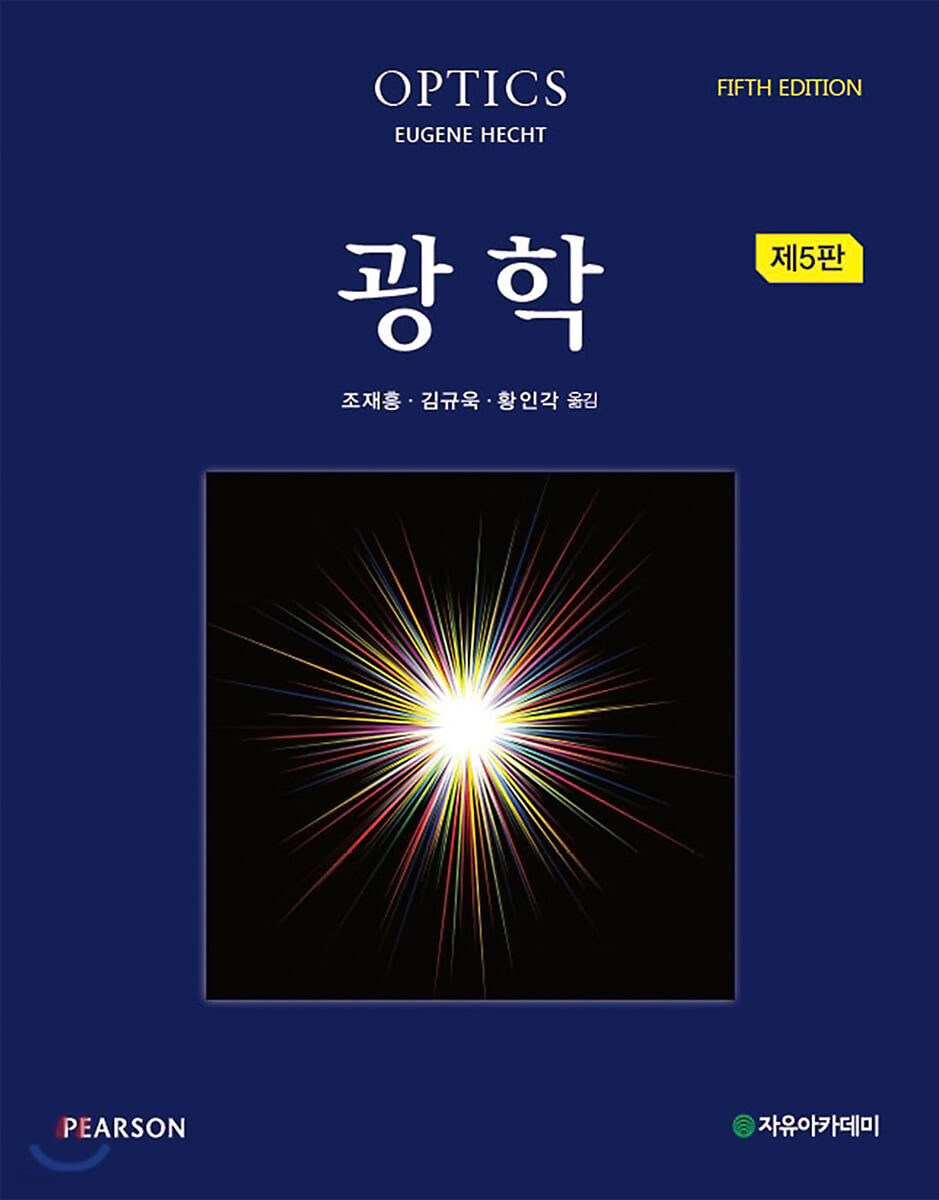
This fifth edition explains the latest theories in optics with minimal use of calculus, while providing easy-to-understand explanations of the latest optical technologies and existing fundamentals related to optics. Numerous examples and problems are included to help confirm the content.
Above all, I believe that the greatest strength of this textbook is its quantitative and qualitative explanations based on precise electromagnetic theory and the concepts of atomic scattering and quantum mechanics.
Although it demands great patience and a significant investment of time from readers due to its thick volume and lengthy explanations, I believe it will provide a very accurate and solid guide to optical concepts, providing greater satisfaction than any other textbook.
I believe that no further introduction is necessary, as this is a famous book that has been read and referenced in the fields of optics and optical engineering in Korea from the 2nd to the 4th editions.
This 5th edition of 『Optics』 was translated and proofread by Professor Jae-Heung Cho of Hannam University, Professor In-Gak Hwang of Chonnam National University, and Professor Gyu-Wook Kim of Kumoh National Institute of Technology.
I believe that the translators, who are already experts in the fields of research and education both domestically and internationally, have each done their best in their translation.
The editorial department of Jayu Academy also put a lot of effort into proofreading and editing.
I would like to express my deepest gratitude for your excellent work.
The following three translators are E.
This is a translation of the original text of Hecht's 『OPTICS 5th ed.』.
This fifth edition explains the latest theories in optics with minimal use of calculus, while providing easy-to-understand explanations of the latest optical technologies and existing fundamentals related to optics. Numerous examples and problems are included to help confirm the content.
Above all, I believe that the greatest strength of this textbook is its quantitative and qualitative explanations based on precise electromagnetic theory and the concepts of atomic scattering and quantum mechanics.
Although it demands great patience and a significant investment of time from readers due to its thick volume and lengthy explanations, I believe it will provide a very accurate and solid guide to optical concepts, providing greater satisfaction than any other textbook.
I believe that no further introduction is necessary, as this is a famous book that has been read and referenced in the fields of optics and optical engineering in Korea from the 2nd to the 4th editions.
This 5th edition of 『Optics』 was translated and proofread by Professor Jae-Heung Cho of Hannam University, Professor In-Gak Hwang of Chonnam National University, and Professor Gyu-Wook Kim of Kumoh National Institute of Technology.
I believe that the translators, who are already experts in the fields of research and education both domestically and internationally, have each done their best in their translation.
The editorial department of Jayu Academy also put a lot of effort into proofreading and editing.
I would like to express my deepest gratitude for your excellent work.
The following three translators are E.
This is a translation of the original text of Hecht's 『OPTICS 5th ed.』.
index
Chapter 1: A Brief History
1.1 Introduction
1.2 Early History
1.3 From the 17th century
1.4 19th century
1.5 20th century
Chapter 2 Wave Motion
2.1 One-dimensional waves
2.2 Harmonic waves
2.3 Phase and phase velocity
2.4 Superposition Principle
2.5 Complex representation
2.6 The sum of phase and wave
2.7 Plane waves
2.8 Three-dimensional differential wave equation
2.9 Spherical wave
2.10 Cylindrical wave
2.11 Spiral Light
Chapter 3: Electromagnetic Theory, Photons, and Light
3.1 Basic laws of electromagnetic theory
3.2 Electromagnetic waves
3.3 Energy and momentum
3.4 Copy
3.5 Light in a lump of matter
3.6 Electromagnetic Waves - Photon Spectrum
3.7 Quantum field theory
Chapter 4: The Propagation of Light
4.1 Introduction
4.2 Rayleigh scattering
4.3 Reflection
4.4 Refraction
4.5 Fermat's Principle
4.6 Electromagnetic Approach
4.7 Total internal reflection
4.8 Optical properties of metals
4.9 Interaction between light and matter
4.10 Stokes' treatment of reflection and refraction
4.11 Photons, Waves, and Probability
Chapter 5 Geometrical Optics
5.1 Introduction
5.2 lens
5.3 aperture
5.4 Mirror
5.5 prism
5.6 Fiber Optics
5.7 Optical System
5.8 Deformation of the wave front
5.9 Gravitational Lensing
Chapter 6 In addition to geometric optics
6.1 Thick lenses and lens systems
6.2 Analytical methods for ray tracing
6.3 Aberration
6.4 Gradient refractive index optical system
6.5 Conclusion
Chapter 7: Superposition of Waves
7.1 Synthesis of waves of the same frequency
7.2 Synthesis of waves of different frequencies
7.3 Nonharmonic periodic waves
7.4 Non-periodic waves
Chapter 8 Polarization
8.1 Properties of polarized light
8.2 Polarizer
8.3 Dichroism
8.4 Double refraction
8.5 Scattering and Polarization
8.6 Polarization by reflection
8.7 Phase delay
8.8 Circular Polarizer
8.9 Polarization of natural color light
8.10 Photoactivity
8.11 Induced optical effects - optical modulators
8.12 LCD
8.13 Mathematical representation of polarization
Chapter 9 Interference
9.1 General Considerations
9.2 Interference conditions
9.3 Wavefront-separating interferometer
9.4 Amplitude-separated interferometer
9.5 Types and localization of interference patterns
9.6 Multi-beam interference
9.7 Applications of single-layer and multilayer thin films
9.8 Applications of Interferometry
Chapter 10 Diffraction
10.1 Preliminary Considerations
10.2 Fraunhofer diffraction
10.3 Fresnel diffraction
10.4 Kirchhoff's scalar diffraction theory
10.5 Edge diffraction waves
Chapter 11 Fourier Optics
11.1 Introduction
11.2 Fourier Transform
11.3 Optical Applications
Chapter 12: Foundations of Coherence Theory
12.1 Introduction
12.2 Interference patterns and coherence
12.3 Visibility
12.4 Coherence functions and coherence diagrams
12.5 Coherence and Stellar Interference
Chapter 13 Modern Optics: Lasers and Other Topics
13.1 Lasers and Laser Light
13.2 Spatial distribution of phase-light information
13.3 Holography
13.4 Nonlinear Optics
Appendix 1 Electromagnetic Theory
Appendix 2 Kirchhoff Diffraction Theory
1.1 Introduction
1.2 Early History
1.3 From the 17th century
1.4 19th century
1.5 20th century
Chapter 2 Wave Motion
2.1 One-dimensional waves
2.2 Harmonic waves
2.3 Phase and phase velocity
2.4 Superposition Principle
2.5 Complex representation
2.6 The sum of phase and wave
2.7 Plane waves
2.8 Three-dimensional differential wave equation
2.9 Spherical wave
2.10 Cylindrical wave
2.11 Spiral Light
Chapter 3: Electromagnetic Theory, Photons, and Light
3.1 Basic laws of electromagnetic theory
3.2 Electromagnetic waves
3.3 Energy and momentum
3.4 Copy
3.5 Light in a lump of matter
3.6 Electromagnetic Waves - Photon Spectrum
3.7 Quantum field theory
Chapter 4: The Propagation of Light
4.1 Introduction
4.2 Rayleigh scattering
4.3 Reflection
4.4 Refraction
4.5 Fermat's Principle
4.6 Electromagnetic Approach
4.7 Total internal reflection
4.8 Optical properties of metals
4.9 Interaction between light and matter
4.10 Stokes' treatment of reflection and refraction
4.11 Photons, Waves, and Probability
Chapter 5 Geometrical Optics
5.1 Introduction
5.2 lens
5.3 aperture
5.4 Mirror
5.5 prism
5.6 Fiber Optics
5.7 Optical System
5.8 Deformation of the wave front
5.9 Gravitational Lensing
Chapter 6 In addition to geometric optics
6.1 Thick lenses and lens systems
6.2 Analytical methods for ray tracing
6.3 Aberration
6.4 Gradient refractive index optical system
6.5 Conclusion
Chapter 7: Superposition of Waves
7.1 Synthesis of waves of the same frequency
7.2 Synthesis of waves of different frequencies
7.3 Nonharmonic periodic waves
7.4 Non-periodic waves
Chapter 8 Polarization
8.1 Properties of polarized light
8.2 Polarizer
8.3 Dichroism
8.4 Double refraction
8.5 Scattering and Polarization
8.6 Polarization by reflection
8.7 Phase delay
8.8 Circular Polarizer
8.9 Polarization of natural color light
8.10 Photoactivity
8.11 Induced optical effects - optical modulators
8.12 LCD
8.13 Mathematical representation of polarization
Chapter 9 Interference
9.1 General Considerations
9.2 Interference conditions
9.3 Wavefront-separating interferometer
9.4 Amplitude-separated interferometer
9.5 Types and localization of interference patterns
9.6 Multi-beam interference
9.7 Applications of single-layer and multilayer thin films
9.8 Applications of Interferometry
Chapter 10 Diffraction
10.1 Preliminary Considerations
10.2 Fraunhofer diffraction
10.3 Fresnel diffraction
10.4 Kirchhoff's scalar diffraction theory
10.5 Edge diffraction waves
Chapter 11 Fourier Optics
11.1 Introduction
11.2 Fourier Transform
11.3 Optical Applications
Chapter 12: Foundations of Coherence Theory
12.1 Introduction
12.2 Interference patterns and coherence
12.3 Visibility
12.4 Coherence functions and coherence diagrams
12.5 Coherence and Stellar Interference
Chapter 13 Modern Optics: Lasers and Other Topics
13.1 Lasers and Laser Light
13.2 Spatial distribution of phase-light information
13.3 Holography
13.4 Nonlinear Optics
Appendix 1 Electromagnetic Theory
Appendix 2 Kirchhoff Diffraction Theory
GOODS SPECIFICS
- Date of issue: February 1, 2018
- Page count, weight, size: 736 pages | 188*254*40mm
- ISBN13: 9791158081621
- ISBN10: 1158081626
You may also like
카테고리
korean


korean

![GQ KOREA Mark (Monthly): December [2025]](http://librairie.coreenne.fr/cdn/shop/files/8ef265dbbfbf186523ed75ba7319009d.jpg?v=1765340328&width=3840)


