

Five Practices Teachers Need to Know for Effective Mathematical Discussion
 |
Description
Book Introduction
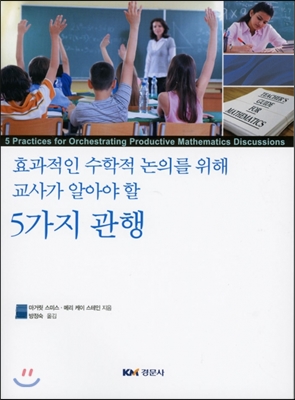
A teaching guide for mathematics teachers.
We introduce five specific practices for mathematical communication.
Detailed practical methods were presented based on class examples.
We introduce five specific practices for mathematical communication.
Detailed practical methods were presented based on class examples.
index
Translator's Note · v
Preface viii
Introduction 1
Successful or Superficial? A Debate in the Maniman Classroom · 5
The Leaf and the Caterpillar: The Case of Teacher Maniman · 6
Case Study of Teacher Maniman · 8
Conclusion · 10
Chapter 1: Introducing the Five Practices · 11
Five Practices · 13
Anticipate · 14
Check · 15
Select · 17
Series Building · 18
Connect · 20
Conclusion · 21
Chapter 2: Setting the Groundwork: Setting Goals and Selecting Tasks · 23
Setting Class Goals · 25
Selecting an Appropriate Task · 28
Conclusion · 35
Chapter 3: Exploring Five Practices in Action · 37
Five Practices from the Case of Teacher Choi Yu-yeon· 39
Teacher Choi Yu-yeon's Case Study · 46
Evidence of Five Practices · 46
Anticipate · 46
Check · 47
Select · 48
Series Building · 48
Connect · 49
The Relationship Between Five Practices and Learning Opportunities· 50
Conclusion · 51
Chapter 4 Getting Started: Anticipating Student Responses and Monitoring Activities · 53
Anticipate · 55
Analysis of the Predictions Based on the Case of Teacher Shin Jung-nam · 60
Anticipating What Students Will Do · 60
Planning How to Respond to Students' Approaches · 61
Checking the response to the mathematical goal · 62
Check · 62
Analysis of the case of teacher Shin Jung-nam · 67
Conclusion · 69
Chapter 5: Setting the Discussion Direction: Selecting, Sequencing, and Connecting Student Responses · 71
Selection and Series · 73
Analysis of Selection and Seriesization in the Case of Teacher Shin Jung-nam · 80
Connect · 82
Analysis of the connection in the case of teacher Shin Jung-nam · 91
Mathematical Ideas: The Meaning of Intersection · 92
Mathematical Idea: Functions Change Location at Intersections · 92
Mathematical Ideas: Connecting Expressions · 93
Conclusion · 95
Chapter 6 Ensuring Active Thinking and Participation: Asking Good Questions and Holding Students Responsible · 97
Asking Good Questions · 100
Exploring Questions in Teacher Yoon's Class · 102
Analyzing Questions in Teacher Yoon's Class · 107
Actions that guide discussion and assign responsibility · 110
Jaeseong (Speaking Again) · 111
Asking Others to Rephrase Their Reasoning · 113
Applying Your Reasoning to Others' Reasoning · 113
Encouraging students to follow up · 115
Making the Most of Your Waiting Time · 116
Conclusion · 117
Chapter 7: Integrating the Five Practices into a Broader Lesson Planning Context · 119
Lesson Plan · 122
Planning Thoughtful and Comprehensive Lessons · 125
The Relationship Between TTLP and the Five Practices · 126
Overcoming the Five Practices · 128
Creating a Permanent Record of Your Classes · 131
Conclusion · 135
Chapter 8: Working in School Settings to Enhance Classroom Discussion · 137
Case Study of a Teacher Who Did It · 144
Overcoming Obstacles · 145
Collaborating with Others · 147
Conclusion · 149
References · 151
Five Practices for Professional Development · 155
Search · 167
Preface viii
Introduction 1
Successful or Superficial? A Debate in the Maniman Classroom · 5
The Leaf and the Caterpillar: The Case of Teacher Maniman · 6
Case Study of Teacher Maniman · 8
Conclusion · 10
Chapter 1: Introducing the Five Practices · 11
Five Practices · 13
Anticipate · 14
Check · 15
Select · 17
Series Building · 18
Connect · 20
Conclusion · 21
Chapter 2: Setting the Groundwork: Setting Goals and Selecting Tasks · 23
Setting Class Goals · 25
Selecting an Appropriate Task · 28
Conclusion · 35
Chapter 3: Exploring Five Practices in Action · 37
Five Practices from the Case of Teacher Choi Yu-yeon· 39
Teacher Choi Yu-yeon's Case Study · 46
Evidence of Five Practices · 46
Anticipate · 46
Check · 47
Select · 48
Series Building · 48
Connect · 49
The Relationship Between Five Practices and Learning Opportunities· 50
Conclusion · 51
Chapter 4 Getting Started: Anticipating Student Responses and Monitoring Activities · 53
Anticipate · 55
Analysis of the Predictions Based on the Case of Teacher Shin Jung-nam · 60
Anticipating What Students Will Do · 60
Planning How to Respond to Students' Approaches · 61
Checking the response to the mathematical goal · 62
Check · 62
Analysis of the case of teacher Shin Jung-nam · 67
Conclusion · 69
Chapter 5: Setting the Discussion Direction: Selecting, Sequencing, and Connecting Student Responses · 71
Selection and Series · 73
Analysis of Selection and Seriesization in the Case of Teacher Shin Jung-nam · 80
Connect · 82
Analysis of the connection in the case of teacher Shin Jung-nam · 91
Mathematical Ideas: The Meaning of Intersection · 92
Mathematical Idea: Functions Change Location at Intersections · 92
Mathematical Ideas: Connecting Expressions · 93
Conclusion · 95
Chapter 6 Ensuring Active Thinking and Participation: Asking Good Questions and Holding Students Responsible · 97
Asking Good Questions · 100
Exploring Questions in Teacher Yoon's Class · 102
Analyzing Questions in Teacher Yoon's Class · 107
Actions that guide discussion and assign responsibility · 110
Jaeseong (Speaking Again) · 111
Asking Others to Rephrase Their Reasoning · 113
Applying Your Reasoning to Others' Reasoning · 113
Encouraging students to follow up · 115
Making the Most of Your Waiting Time · 116
Conclusion · 117
Chapter 7: Integrating the Five Practices into a Broader Lesson Planning Context · 119
Lesson Plan · 122
Planning Thoughtful and Comprehensive Lessons · 125
The Relationship Between TTLP and the Five Practices · 126
Overcoming the Five Practices · 128
Creating a Permanent Record of Your Classes · 131
Conclusion · 135
Chapter 8: Working in School Settings to Enhance Classroom Discussion · 137
Case Study of a Teacher Who Did It · 144
Overcoming Obstacles · 145
Collaborating with Others · 147
Conclusion · 149
References · 151
Five Practices for Professional Development · 155
Search · 167
Publisher's Review
This book systematically guides teachers who recognize the importance of mathematical communication but struggle to engage in meaningful discussions, on what to do and how to do it.
The authors argue that teachers must adhere to five practices to facilitate effective mathematical discussions.
The five practices discussed here are anticipating students' diverse responses to cognitively challenging mathematical tasks, monitoring students' actual responses while they are working on the task, selecting students to present in the plenary discussion, sequencing students to present based on learning objectives and students' overall responses, and connecting diverse solutions to core mathematical ideas.
The strengths of this book include at least the following three:
First, it provides detailed guidance on what teachers should do and how to effectively lead mathematical discussions, based on specific classroom examples. Beyond concisely presenting the necessary theoretical foundations, most of the content is structured around analyzing specific classroom examples, allowing readers to naturally become familiar with the five practices.
Lesson examples range from immature lesson planning and execution to more complete lesson planning and execution, and from individual lesson execution to collaborative execution with fellow teachers.
Through these case studies, readers can learn about what teachers 'should do' in the process of lesson planning and implementation.
Second, this book is not simply about mathematical discussions in the classroom.
While the focus is clearly on the five practices, one of these five practices, 'anticipating', is a practice that occurs before class, and its importance is highlighted throughout the lesson plan in that how well teachers 'anticipate' when planning lessons is the foundation for good mathematical discussion.
As the authors note, for the five practices to be implemented successfully, it is necessary to first select lesson objectives well and prepare cognitively challenging tasks.
It's also important to ask good questions during class and hold students accountable for their own learning.
Ultimately, although this book focuses on mathematical discussions, it can be seen as focusing on what teachers must know and do throughout the planning and implementation of lessons.
Third, this book provides 'Professional Development Guidelines' to improve the teaching expertise of prospective and in-service teachers.
Rather than passively reading this book and uncritically following the author's perspective, three activities encourage readers to actively reflect on the book's various arguments and their theoretical and practical foundations.
First, before presenting the author's analysis of each class case, there is a corner called "Active Participation," which encourages readers to analyze the cases themselves, and a corner called "Let's Try It!" that encourages readers to apply the various suggestions introduced in this book to their own class situations.
It also presents questions that require deep thought regarding the content of each chapter.
This provides readers with the opportunity to delve deeper into the core content of each chapter and reflect on their own teaching and learning beliefs and practices by experiencing the five practices and related activities firsthand.
Given these strengths, this book is suitable for individual study by prospective and in-service teachers, but it would also be appropriate for groups of teachers working collaboratively to study teaching practices with the goal of improving teaching expertise.
I also believe it will provide practical assistance to teacher educators who can help prospective teachers build a foundation for teaching mathematics effectively, and to help in-service teachers improve their mathematics teaching.
It is generally accepted that the specialized knowledge teachers need today is inherent in actual classroom situations.
However, not all of a teacher's expertise needs to depend entirely on his or her momentary judgments or decisions during class.
As the authors argue, thoughtful and thorough lesson planning can essentially alleviate the burden of complex and overwhelming teaching.
I also believe that with proper guidance and continuous effort from teachers, a teacher's teaching expertise can be learned and improved.
I sincerely hope that many teachers who encounter this book will recognize the importance of lesson planning and, based on the book's detailed guidance, actively and reflectively implement the five practices, thereby enhancing their teaching expertise.
The authors argue that teachers must adhere to five practices to facilitate effective mathematical discussions.
The five practices discussed here are anticipating students' diverse responses to cognitively challenging mathematical tasks, monitoring students' actual responses while they are working on the task, selecting students to present in the plenary discussion, sequencing students to present based on learning objectives and students' overall responses, and connecting diverse solutions to core mathematical ideas.
The strengths of this book include at least the following three:
First, it provides detailed guidance on what teachers should do and how to effectively lead mathematical discussions, based on specific classroom examples. Beyond concisely presenting the necessary theoretical foundations, most of the content is structured around analyzing specific classroom examples, allowing readers to naturally become familiar with the five practices.
Lesson examples range from immature lesson planning and execution to more complete lesson planning and execution, and from individual lesson execution to collaborative execution with fellow teachers.
Through these case studies, readers can learn about what teachers 'should do' in the process of lesson planning and implementation.
Second, this book is not simply about mathematical discussions in the classroom.
While the focus is clearly on the five practices, one of these five practices, 'anticipating', is a practice that occurs before class, and its importance is highlighted throughout the lesson plan in that how well teachers 'anticipate' when planning lessons is the foundation for good mathematical discussion.
As the authors note, for the five practices to be implemented successfully, it is necessary to first select lesson objectives well and prepare cognitively challenging tasks.
It's also important to ask good questions during class and hold students accountable for their own learning.
Ultimately, although this book focuses on mathematical discussions, it can be seen as focusing on what teachers must know and do throughout the planning and implementation of lessons.
Third, this book provides 'Professional Development Guidelines' to improve the teaching expertise of prospective and in-service teachers.
Rather than passively reading this book and uncritically following the author's perspective, three activities encourage readers to actively reflect on the book's various arguments and their theoretical and practical foundations.
First, before presenting the author's analysis of each class case, there is a corner called "Active Participation," which encourages readers to analyze the cases themselves, and a corner called "Let's Try It!" that encourages readers to apply the various suggestions introduced in this book to their own class situations.
It also presents questions that require deep thought regarding the content of each chapter.
This provides readers with the opportunity to delve deeper into the core content of each chapter and reflect on their own teaching and learning beliefs and practices by experiencing the five practices and related activities firsthand.
Given these strengths, this book is suitable for individual study by prospective and in-service teachers, but it would also be appropriate for groups of teachers working collaboratively to study teaching practices with the goal of improving teaching expertise.
I also believe it will provide practical assistance to teacher educators who can help prospective teachers build a foundation for teaching mathematics effectively, and to help in-service teachers improve their mathematics teaching.
It is generally accepted that the specialized knowledge teachers need today is inherent in actual classroom situations.
However, not all of a teacher's expertise needs to depend entirely on his or her momentary judgments or decisions during class.
As the authors argue, thoughtful and thorough lesson planning can essentially alleviate the burden of complex and overwhelming teaching.
I also believe that with proper guidance and continuous effort from teachers, a teacher's teaching expertise can be learned and improved.
I sincerely hope that many teachers who encounter this book will recognize the importance of lesson planning and, based on the book's detailed guidance, actively and reflectively implement the five practices, thereby enhancing their teaching expertise.
GOODS SPECIFICS
- Date of issue: February 25, 2013
- Page count, weight, size: 169 pages | 188*254*20mm
- ISBN13: 9788961056656
- ISBN10: 8961056654
You may also like
카테고리
korean


korean

![GQ KOREA Mark (Monthly): December [2025]](http://librairie.coreenne.fr/cdn/shop/files/8ef265dbbfbf186523ed75ba7319009d.jpg?v=1765340328&width=3840)


